PeakMetrics / Fact Checks
Health & medicine fact checks
Explore claims publishers have checked about health & medicine. Read their original ratings and follow the evidence.
Search fact checks
Search by text or image13,675 published reviews in this topic

« Pas de 2ème vague, ni en Asie, ni en Afrique, ni en Scandinavie, ni en Russie. Curieux, non ? », s’interroge un utilisateur de Facebook, en Suisse.
Publisher’s rating: La publication est mensongère. Le rebond de la pandémie de Covid-19 touche, à des degrés divers, tous les continents. Et à l’échelle régionale ou nationale, la Scandinavie et la Russie ne sont pas épargnées, tant s’en faut.
The review examined a Facebook post by a user in Switzerland claiming there was no second Covid-19 wave in Asia, Africa, Scandinavia, or Russia. To assess that assertion, it compared contemporaneous statistics published by the WHO, the European Centre for Disease Prevention and Control (ECDC), and Johns Hopkins University. The review reports that these sources’ continuously updated figures all showed Covid-19 affecting every continent. It also cautions that lower case levels in parts of Asia and Africa did not mean those continents were free of a second wave. The country examples in the review show why a continent-wide generalization was misleading. It says India had recorded about 644,000 new cases since the end of October, bringing its total since January 2020 to approximately 8.7 million, with about 128,000 deaths. For Africa, it describes a varied situation and cites Morocco, where roughly 63,000 new cases were recorded over two weeks, out of about 270,000 since January; it reports 4,500 deaths there in total. The review also specifically challenges the claim about Scandinavia and Russia. It identifies Denmark, Sweden, and Norway as affected, noting that Denmark and Sweden were both in Europe’s “red zone.” For Sweden, it reports an average of 456 new cases per day per 100,000 residents over the two-week period ending November 11. For Russia, it cites 277,000 new cases in the preceding two weeks and approximately 1.858 million cases and 32,000 deaths during 2020. These figures, as presented in the review, contradict the post’s assertion that those regions had no second wave.

දෑත් සනීපාරක්ෂක (හෑන්ඩ් සැනිටයිසර්) ප්රමිතිය පිළිබඳව ඉදිරිපත්වු නොමග යවන සුළු සටහනක් | Misleading facts about Sri Lankan hand sanitizer standards
Publisher’s rating: Missing Context

Voluntário morto que recebeu a vacina chinesa, Coronavac, pode ter sofrido alterações neurológicas que levaram ao suicídio
Publisher’s rating: ENGANOSO: A publicação cita estudos feitos com poucos casos e que não são conclusivos. Especialistas dizem que não há comprovação na literatura médica de que uma vacina possa causar danos neurológicos
Jerry John Rawlings Died Of COVID-19
Publisher’s rating: Jerry John Rawlings Died Of COVID-19
Research from related reporting directly addresses the claim but does not settle the medical cause of Rawlings’ death. A January 2026 article says he died on November 12, 2020, “after reportedly suffering complications from COVID-19.” That wording reports the commonly stated cause; the excerpt does not provide medical records or identify the source for the reported complications. Later reporting presents a contrary account from Dr Nyaho Nyaho-Tamakloe, an NPP founding member. In an interview described by GhanaWeb, he said information available to him contradicted the belief that Rawlings died of COVID-19. He said checks involving a relative indicated Rawlings had two negative tests. These are attributed claims, not test documents independently shown in the supplied excerpts. Nyaho-Tamakloe also argued that an autopsy should establish the cause of death and questioned why a report had not been made public. The excerpts do not establish whether an autopsy was performed, provide its findings, or independently verify his account. They therefore document a dispute about the reported cause, rather than evidence sufficient here to confirm or disprove that COVID-19 caused Rawlings’ death.
Zur Eindämmung der Corona-Pandemie gibt es teils auch in Schulen eine Maskenpflicht. Im Internet warnen Maskengegner nun vor drohenden Gesundheitsschäden. So kursiert die Behauptung, die Deutsche Gesetzliche Unfallversicherung (DGUV) habe Masken für Kinder verboten (hier archiviert). Erwachsene dürfen demnach nur zwei Stunden lang eine Mund-Nasen-Bedeckung tragen. Als Beleg wird ein Dokument verbreitet, das unter anderem von einer Arbeitsmedizinerin verfasst wurde
Publisher’s rating: Falsch. Aus den Empfehlungen der DGUV ergibt sich kein Masken-Verbot für Kinder. Die Angaben zu Orientierungswerten für Arbeitnehmer sind verkürzt wiedergegeben.

Instituto Butantan e governo de São Paulo encobrem morte de voluntário da vacina chinesa CoronaVac
Publisher’s rating: ENGANOSO: Ao contrário do que sugere a postagem, o Instituto Butantan comunicou a Anvisa sobre o chamado “evento adverso grave” envolvendo um dos voluntários. A notificação foi enviada no dia 6 de novembro, dentro do prazo de uma semana estabelecido pela agência

Cenę szczepionki na COVID-19 produkowanej przez Pfizer nie jest jeszcze znana.
Publisher’s rating: Nieweryfikowalne
In der Schule, im Nahverkehr oder in Geschäften - zur Eindämmung der Corona-Pandemie gilt mittlerweile in diversen Bereichen eine Maskenpflicht. Im Internet warnen Maskengegner nun vor drohenden Gesundheitsschäden und behaupten, die derzeitigen Regeln seien unzulässig. «Es wird seit Wochen gegen Arbeitsschutzvorschriften verstoßen», heißt es in einem Video (hier archiviert). Das habe die Deutsche Gesetzliche Unfallversicherung (DGUV) bestätigt. Damit stütze sie die Ergebnisse einer Studie, die im Video präsentiert wird.
Publisher’s rating: Falsch. Die DGUV hat mitgeteilt, dass ihr in dem Video Aussagen zugeschrieben wurden, die sie nicht getroffen hat. Ihre Empfehlungen sind außerdem verkürzt und teilweise falsch wiedergegeben.
The review addresses a video claiming that the German Statutory Accident Insurance (DGUV) confirmed a study warning of health risks from mask requirements, and that workplace safety rules were being violated. The review reports that the DGUV had publicly rejected statements attributed to it in the video and said it had no evidence that wearing face coverings posed a health risk. It also says the DGUV had requested that those responsible stop spreading the false claims and had taken legal steps. The video’s displayed document, attributed in part to occupational physician Beatrice Vöhringer, warned of health risks to students. But the review distinguishes that document’s claims from the DGUV’s own position: the DGUV had issued recommendations about how long face coverings should be worn, not an endorsement of the document’s conclusions. Those recommendations were published in May and updated in October without substantive changes, according to the review. The review explains that the recommendations were guidance for employers, not binding rules. For moderately strenuous work, they suggested two hours of wear followed by a 30-minute recovery period, during which a worker could remove the mask; for light work, wear could be extended to three hours. The review says the guidance did not establish that masks could never be worn for more than two hours, nor that workplace mask rules were invalid. It also reports that the video’s claims about mandatory medical examinations and mask breathing resistance were incorrect.
Foto yang diklaim sebagai foto Menkes Terawan yang mendapat penghargaan WHO atas keberhasilannya menangani Covid-19
Publisher’s rating: Keliru

許多人看到筊白筍上的黑點會挑過不吃,以為是壞了,其實這些小黑點正是茭白筍可以抗骨鬆的重點,這些黑點是一種名為「菰黑穗菌」的真菌類,對於一些代謝有正面的效果,可以延緩骨質的老化。
Publisher’s rating: 不實
Alles nur Panikmache? In den sozialen Medien kursiert erneut die Behauptung, in Deutschland gebe es keine Corona-Pandemie. Als Grundlage dienen Daten der Helios-Kliniken, wonach hierzulande angeblich nur wenige Intensivbetten mit Covid-19-Patienten belegt seien. Spöttisch heißt es darum im Posting (hier archiviert): «Corona ist eine Plandemie.»
Publisher’s rating: Die Helios-Daten sind aus ihrem Kontext gerissen und spiegeln nicht die Gesamtsituation in Deutschland wider. Angesichts steigender Infektionszahlen geraten immer mehr Kliniken an ihre Belastungsgrenzen.
The post argued that there was no coronavirus pandemic in Germany, pointing to Helios figures that allegedly showed few intensive-care beds occupied by Covid-19 patients. The review explains that those figures covered the beds in Helios’s own hospitals, not the whole country: the company reported data for each of its 86 clinics, which were spread across Germany. The figures therefore could not, by themselves, establish the nationwide situation. [S1: “Helios ermittelt für jede seiner 86 Kliniken, die quer über Deutschland verteilt sind, eigens aufgeschlüsselte Daten.”] The review describes substantial regional variation in those hospital figures. Covid-19 intensive-care patients had been rising for weeks at the Berlin-Buch clinic, while their numbers could fall at clinics in rural areas such as the Sauerland. It says critics used such locally accurate but context-stripped figures to claim there was no pandemic of national significance. [S1: “Während in der Klinik Berlin-Buch etwa die Zahl der Covid-19-Intensivpatienten seit Wochen kontinuierlich steigt, ist sie Kliniken ländlicher Regionen wie dem Sauerland bisweilen sogar rückläufig.”] National figures cited in the review also contradicted the inference that the pandemic did not affect Germany: it reported more than 3,100 intensive-care beds occupied by Covid-19 patients, with more than half of those patients needing artificial ventilation. The review noted that, in many places, the constraint was not yet a shortage of beds but a lack of staff trained in intensive care. It also reported that intensive-care units had filled less quickly than feared over the previous two weeks, while warning that rising infections and a growing proportion of older patients could increase the number of severe cases. [S1: “Nach Angaben der deutschen Interdisziplinären Vereinigung für Intensiv- und Notfallmedizin (DIVI) sind mittlerweile mehr als 3 100 Betten durch Covid-19-Patienten belegt. Mehr als die Hälfte davon müsse künstlich beatmet werden.”] [S1: “Vielerorts mangele es zwar noch nicht an freien Betten, wohl aber an intensivmedizinisch geschultem Personal.”]
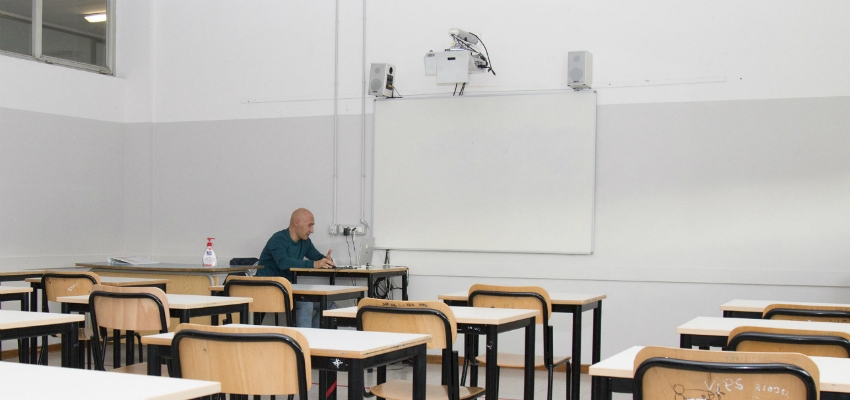
«Sono 150 mila i contagi che partono dalle scuole»
Publisher’s rating: Nì
The claim concerns a Facebook post by Fabio Rampelli, vice-president of Italy’s Chamber of Deputies, saying that 150,000 coronavirus infections “start from schools.” The review reports that he had used the figure of 105,000 in a note the previous day, with otherwise similar wording, and judges that “150 mila” was most likely a typo. The 105,000 figure was not an official statistic: it came from an estimate by Unsic, a trade union whose communications office told the review it had no reliable comprehensive data on school infections and could not provide a publicly available document showing the calculation. Unsic’s estimate covered cases it considered connected with the school world, not only infections occurring inside school buildings. Its sources included Ministry of Education figures that were no longer updated after 10 October, data from some local health authorities, and information collected by the union’s provincial offices. The estimate said that from schools reopening on 14 September through early November there had been 105,000 infections among people who had attended classrooms, with 80 per cent attributed to students. Unsic itself acknowledged that the estimate had little scientific reliability. The review compared that estimate with age-group figures from Italy’s National Institute of Health (ISS): cases among people aged 0–20 rose from nearly 13,800 on 15 September to more than 102,500 by 7 November. That increase was broadly similar in scale, but it did not establish that those infections were caused by school attendance. The age bands included children under six, and the review says the available data could not identify where infections occurred or measure the causal effect of reopening schools. Its conclusion was that the precise number of school-related cases, and the contribution of in-person schooling to the wider increase, could not then be established.
Seit Monaten wird die Aussagekraft von sogenannten PCR-Tests in der Corona-Pandemie angezweifelt. Aktuell wird ein Schreiben der Berliner Senatsverwaltung für Gesundheit vielfach als Kronzeuge herangezogen, dass mit den Tests angeblich keine Corona-Infektion nachgewiesen werden könne. «Der staatliche Corona-Betrug ist endgültig aufgedeckt», heißt es zum einen (hier archiviert). Die ganze bisherige Corona-Politik sei mit dem Senatsschreiben in Frage gestellt, zum anderen (hier archiviert).
Publisher’s rating: Falsch. PCR-Tests stellen Infektionen im Sinne des Infektionsschutzgesetzes fest. Das schreibt auch die Berliner Senatsverwaltung.
The claims concern a response letter from Berlin’s Senate Department for Health dated 30 October 2020. The review says that critics of PCR testing focused especially on a question from parliamentarian Marcel Luthe: whether a PCR test can distinguish a virus capable of replication from one that is not. The authority answered “No.” But that answer addressed whether the test can establish if someone is infectious at the time of sampling—not whether the person is infected. The review explains that a person who tests positive may become infectious later, and that the test detects infection rather than immediate contagiousness. [S1: “Grundsätzlich beziehen sich aktuell diejenigen, die den PCR-Test anzweifeln, auf ein Dokument der Berliner Senatsverwaltung für Gesundheit, Pflege und Gleichstellung vom 30. Oktober 2020. Darin werden Fragen des parteilosen Parlamentariers Marcel Luthe beantwortet.”] [S1: “Denn der PCR-Test weist nicht nach, ob eine Testperson zum Zeitpunkt des Abstriches möglicherweise weitere Menschen anstecken kann oder nicht. Es kann aber durchaus sein, dass der Infizierte später noch infektiös wird. Der Test weist vielmehr nach, ob jemand infiziert ist oder nicht.”] That distinction is central to the claim that the letter proves PCR tests cannot establish infection under the Infection Protection Act. The review says the Act defines infection as the uptake of a pathogen and its subsequent development or multiplication in the human body, and notes that a positive test indicates that the pathogen has multiplied in the body. It also points to the Senate department’s answer to Luthe’s fifth question: SARS-CoV-2 is detected by PCR, and the presence of the virus correlates with infection relevant to infection control. Thus, the letter’s answer about detecting infectiousness at the sampling moment does not support the broader claim that PCR cannot detect infection. [S1: “Dem Gesetz zufolge gilt als Infektion «die Aufnahme eines Krankheitserregers und seine nachfolgende Entwicklung oder Vermehrung im menschlichen Organismus».”] [S1: “Das Vorhandensein dieser Viren korreliert mit einer Infektion mit diesen Viren. Diese Infektion ist relevant für die Überlegungen zum Infektionsschutz”] The review also describes PCR testing as analysis of viral genetic material from a throat and/or nose swab, while acknowledging that tests can rarely produce false-positive results. That qualification concerns occasional errors, not the letter’s distinction between infection and whether a person can transmit the virus at the moment of sampling. [S1: “Bei PCR-Tests wird, wie etwa die Bundeszentrale für gesundheitliche Aufklärung erläutert, aus dem Rachen und/oder der Nase ein Abstrich genommen, der im Labor auf Genmaterial der Coronaviren untersucht wird.”] [S1: “Solche Tests sind ziemlich genau, können aber in sehr seltenen Fällen - das ist unter Experten ziemlich unstrittig - auch daneben liegen.”]
«Maske tragen ist dumm! Ihr werdet davon krank und ihr werdet letztendlich daran sterben!» lautet der Titel eines im Netz verbreiteten Videos (hier archiviert; archiviertes Video). Der Sprecher behauptet darin unter anderem, dass es «weit und breit kein Virus» gebe, dass das Gewebe einer Maske zu grob sei, um ein Virus aufzuhalten, und dass Masken auch «gutartige Viren» abhalten würden.
Publisher’s rating: Abgesehen davon, dass die Aussagen in sich widersprüchlich sind, sind sie auch falsch. Die Existenz von Sars-CoV-2 ist wissenschaftlich belegt. Und Masken können die Ausbreitung von Viren verringern.
The review concerns a video titled “Wearing a mask is stupid! You’ll get sick from it and eventually die!” Its speaker says there is no virus “far and wide,” argues that mask fabric is too coarse to stop a virus, and also claims masks block “good” viruses. The review points out that these assertions conflict with one another, then addresses the claims about the virus’s existence and mask effectiveness. For the claim that SARS-CoV-2 does not exist, the review cites evidence that researchers in the United States and China had isolated the virus early in 2020, and that Chinese researchers had also sequenced its genome and published their results in January. It reports that Ralf Bartenschlager, president of the German Society for Virology, said the virus had since been “isolated, sequenced and characterized” thousands of times, with results available in GISAID and scientific studies. The review explains that the virus is generally carried in droplets rather than travelling as isolated virus particles. It gives the virus’s size as about 60–100 nanometres and says droplets range from 1,000 to more than 100,000 nanometres; droplets can be released when people speak, cough or sneeze. On masks, it notes that no mask can prevent infection completely, and distinguishes protection for others from protection for the wearer: simple masks can reduce the risk of infecting someone else, but do not themselves protect the wearer from infection. The review says studies from several countries found that face coverings reduce infection risk.

Hallazgos positivos de vacuna contra el coronavirus se retuvieron hasta después de las elecciones
Publisher’s rating: No hay evidencias
Mehr als 1,2 Millionen Menschen sind bis Anfang November 2020 weltweit in Zusammenhang mit dem Coronavirus gestorben. Den Verlauf der Pandemie in Deutschland schätzen viele Wissenschaftler bis zum Herbst als vergleichsweise glimpflich ein. Heißt das, es gab in Deutschland keine Corona-Toten? In einem Facebookpost wird behauptet: «Weder im März, noch im April hatten wir eine Notlage, noch eine Übersterblichkeit.» (hier archiviert) Stimmt das?
Publisher’s rating: Ende März und in mehreren Wochen im April 2020 sind in Deutschland mehr Menschen gestorben als im Vergleichszeitraum in den Jahren zuvor. Später hat unter anderem die Begrenzung von Kontakten dazu geführt, dass die Übersterblichkeit abnahm.

Em vídeo, enfermeiro afirma que o médico voluntários dos testes da vacina de Oxford morreu devido a vacina
Publisher’s rating: FALSO: De acordo com o atestado de óbito do jovem, que era voluntário no ensaio clínico da vacina de Oxford, ele faleceu em decorrência de uma pneumonia viral causada pela covid-19 e não pela vacina, como afirma um vídeo publicado no Facebook e YouTube
« Voilà pourquoi le monde s’est arrêté », lit-on sur une image. Au-dessus de la phrase, on retrouve des données sur la « population mondiale : 7.782.797.552 » et un prétendu nombre de décès du coronavirus : « 485.904 ». D’après l’image, ce chiffre représente « 0,006% » de la population mondiale. Cette publication comprenant des données soi-disant relatives au coronavirus circule sur Facebook en Suisse.
Publisher’s rating: Les données reprises dans l’illustration sont erronées. Le nombre de décès attribués au COVID-19 n’est pas de 485.904. Au 9 novembre 2020, il y avait 1.255.831 décès rapportés selon l’European Centre for Disease Prevention and Control.
The claim concerns a Facebook image circulating in Switzerland that says the world stopped because of the pandemic and gives a world population of 7,782,797,552, 485,904 coronavirus deaths, and a death share of 0.006%. The DPA review checked the population and death-count figures against United Nations population data, Worldometer estimates, and COVID-19 figures reported by the European Centre for Disease Prevention and Control (ECDC) and the World Health Organization (WHO). The review identifies the image’s death figure as inconsistent with those reported totals. For 9 November 2020, the review gives an ECDC total of 1,255,831 COVID-19 deaths. It also reports that WHO listed 1,257,523 deaths as of 10 November. Against the UN’s 2020 world-population figure of 7,794,799,000, the review calculates that the ECDC death count represents 0.016%, rather than the image’s 0.006%. It separately notes that Worldometer estimated 7.825 billion people on 10 November, underscoring that the image’s population figure also differs from the cited estimates. The review says the image’s calculation focuses on deaths and leaves out worldwide infections. It reports 50,459,886 total infections, including deaths, according to WHO on 10 November, equivalent to 0.65% of the population figure used in its comparison. This is the review’s stated contextual comparison; the image’s claimed death percentage is not a measure of all infections or of the share of people who recovered.