PeakMetrics / Fact Checks
Health & medicine fact checks
Explore claims publishers have checked about health & medicine. Read their original ratings and follow the evidence.
Search fact checks
Search by text or image13,675 published reviews in this topic
Ein Kommentar sorgt für Aufregung: Unter einem Facebook-Posting der Tageszeitung «Heute» über einen 38-Jährigen, der an Covid-19 verstorben sei, behauptete ein User, dass es sich dabei um einen Bekannten gehandelt habe. Dieser habe kein Corona gehabt. Ein Screenshot des Ganzen wird oft geteilt, etwa in einem Posting (hier archiviert) mit dem Text «Glaubt ihnen kein Wort...».
Publisher’s rating: Der 38-jährige Mann ist laut Informationen des Krankenhauses an Covid-19 gestorben. Eine andere Todesursache sei auszuschließen.
The claim arose from a comment beneath a Facebook post by the Austrian newspaper «Heute». A user said the 38-year-old who had died had been an acquaintance and had not had Covid-19; a screenshot of the comment was shared with the caption «Glaubt ihnen kein Wort...». The review examined that specific death and the assertion made in the comment, rather than treating the screenshot itself as proof of the cause of death. The newspaper had reported the death on 4 November. (S1: “Unter einem Facebook-Posting der Tageszeitung «Heute» über einen 38-Jährigen, der an Covid-19 verstorben sei, behauptete ein User, dass es sich dabei um einen Bekannten gehandelt habe. Dieser habe kein Corona gehabt.”; “Die Gratiszeitung «Heute» berichtete am 4. November über den 38-jährigen Verstorbenen.”) To identify the hospital involved, the review says it matched information about daily Covid-19 deaths from the Upper Austria state media service to a hospital. It identified the Konventhospital Barmherzige Brüder in Linz. The hospital’s public-relations director confirmed the previously stated information about the case: the man had died of Covid-19 and had tested positive. (S1: “Der entsprechende Todesfall lässt sich über die Informationen zu den täglichen Corona-Toten des Medienservices des Land Oberösterreichs einem Krankenhaus zuordnen: Es handelt sich um das Konventhospital Barmherzige Brüder in Linz.”; “Dort bestätigte die Leiterin der Öffentlichkeitsarbeit des Krankenhauses bereits zuvor geäußerte Angaben zum Fall: Der Mann sei an Covid-19 verstorben; ein Corona-Test sei positiv ausgefallen.”) The review also reports that the hospital attributed the death to Covid-19, not merely a positive test, and that the treating physician ruled out another cause of death. It notes that the hospital referred to a «Krone» article, which reported that the deceased was obese. That detail is reported as context; the evidence described for the cause of death is the hospital’s information and the physician’s statement. (S1: “Nach Informationen des Krankenhauses ist der Mann auch ursächlich an Covid-19 gestorben.”; “Die Sprecherin verwies auf ein Statement des behandelnden Arztes, der eine andere Todesursache als Covid-19 ausschließt.”; “Demnach war der Verstorbene adipös.”)
In sozialen Medien wird angezweifelt, dass Bayerns Ministerpräsident Markus Söder (CSU) die Wahrheit über den Anstieg Covid-19-Patienten auf Intensivstationen gesagt hat. In Bayern habe sich binnen neun Tagen die Belegung der Intensivbetten verdoppelt, soll Söder am 29. Oktober gesagt haben. Diesem Statement werden in einem Facebook-Beitrag Zahlen aus dem Intensivregister entgegengestellt: Demnach seien am 20. Oktober 3 012 Betten belegt gewesen, neun Tage später dann 3 083 Betten. «STATT +100% NUR +2%», heißt es dazu auf einer kursierenden Bildmontage (hier archiviert), «WER KANN NOCH BEI SOLCH LÜGEN WEGSCHAUEN,...?»
Publisher’s rating: Markus Söder hat sich korrekt über die Verdopplung von Covid-Patienten auf bayerischen Intensivstationen geäußert. Die Zahlen, die in dem Facebook-Beitrag gezeigt werden, sind irreführend. Sie stehen für die Belegung von Intensivbetten mit jeglichen Patienten, nicht nur mit Corona-Infizierten.
The claim concerns a Facebook post that challenged Markus Söder’s statement about the rising number of Covid-19 patients in intensive care in Bavaria. Söder made the statement at a press conference after a Bavarian cabinet meeting in Munich on October 29, 2020. The post contrasted figures of 3,012 beds occupied on October 20 and 3,083 on October 29 with the assertion that occupancy had doubled. The investigation distinguishes the measure Söder was discussing from the total-bed figures used in the post. [S1: “Am 29. Oktober 2020 tagte das bayerische Kabinett in München” and “Die im Facebook-Beitrag dargestellten Angaben zeigen stattdessen die Auslastung der bayerischen Intensivstationen mit jeglicher Art von Patienten”] According to the review, Söder said that intensive-care occupancy had doubled in the previous nine days. It reports that the Divi intensive-care register recorded 167 Covid-infected patients receiving intensive care in Bavaria on October 29, compared with 87 on October 20—nearly twice as many. Those figures address Covid patients specifically, unlike the Facebook post’s overall occupancy counts. [S1: “die Belegung der Intensivbetten hat sich in den letzten neun Tagen verdoppelt” and “am 29. Oktober 167 Corona-Infizierte auf bayerischen Intensivstationen behandelt wurden. Neun Tage davor, am 20. Oktober, waren es nur 87”] The two total-bed figures in the post were also reported as accurate, but they counted patients with any condition, not just Covid-19. The article gives examples including accident victims and stroke patients. Thus, comparing the change in total occupied beds with Söder’s statement about Covid patients conflates different measures; the overall figures do not contradict the reported near-doubling of Covid patients. [S1: “Am 20. Oktober waren tatsächlich laut Divi-Register insgesamt 3 012 Intensivbetten belegt und am 29. Oktober 3 083” and “neben Covid-Erkrankten sind darunter etwa Unfallopfer oder Schlaganfallpatienten.”]

Laudos periciais do IML e do IC apontam que o voluntário da CoronaVac morreu de intoxicação por agentes químicos e não por suicídio.
Publisher’s rating: ENGANOSO: A hipótese de suicídio foi levantada pela Polícia Civil desde o início do caso, por conta de indícios coletados no local onde o corpo foi encontrado. O exame do IML detectou a presença de opióides, sedativos e álcool no sangue da vítima
Gegner der Corona-Maßnahmen argumentieren häufig, dass Covid-19 angeblich nur so gefährlich sei wie eine Grippe. Das soll nun sogar die Weltgesundheitsorganisation (WHO) bekanntgegeben haben. Sie habe «endlich bestätigt, was wir (und viele Experten und Studien) seit Monaten sagen - das Coronavirus ist nicht tödlicher oder gefährlicher als die saisonale Grippe», heißt es in einem Facebook-Beitrag (hier archiviert). Demnach ergebe sich im Verhältnis von Todesopfern und Infizierten weltweit eine Sterblichkeitsrate ähnlich wie bei der saisonalen Grippe.
Publisher’s rating: Die WHO hat nicht bestätigt, dass das Coronavirus nicht gefährlicher sei als die Grippe. Sie hat eine Schätzung veröffentlicht, wie viele Menschen sich weltweit mit Corona angesteckt haben könnten. Kritiker der Corona-Maßnahmen haben damit eine irreführende Rechnung zur Todesrate aufgestellt. Seriöse Studien weisen auf eine deutlich höhere Sterblichkeit bei Covid-19 hin.
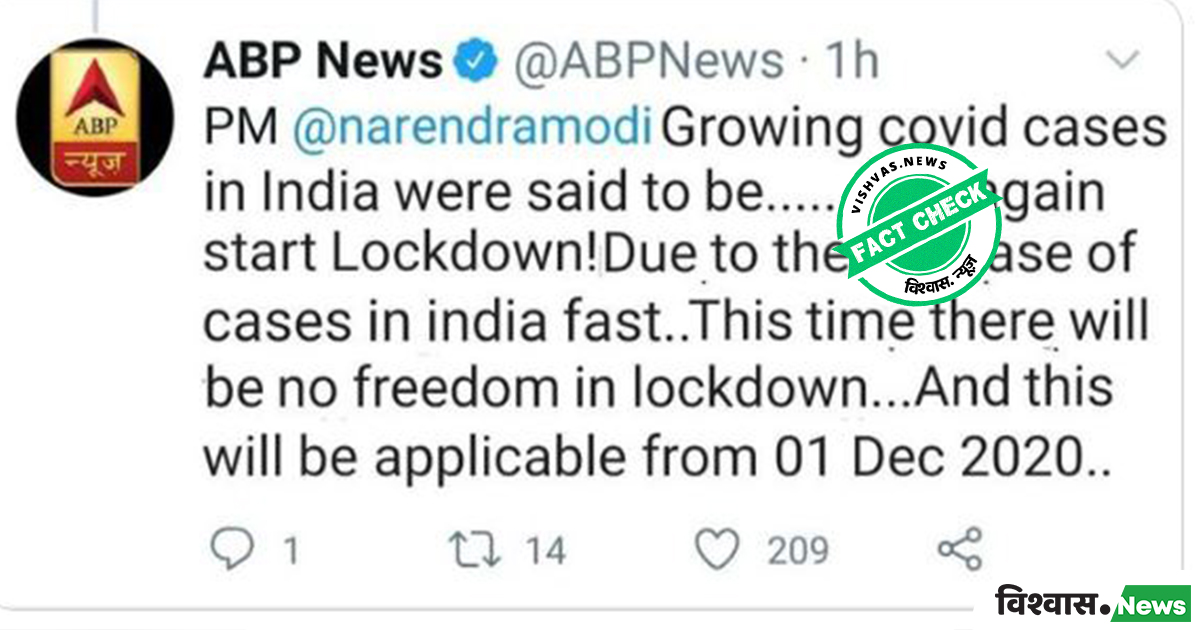
देश में एक बार फिर से लॉकडाउन लगाए जाने का दावा
Publisher’s rating: FALSE

WHO డైరెక్టర్ జనరల్ COVID-19 పాజిటివ్గా గుర్తించబడ్డారు.
Publisher’s rating: FALSE
The claim concerns a viral social-media post saying that WHO Director-General Tedros Adhanom Ghebreyesus had tested positive for COVID-19. The review examined the post and the linked article. It reports that the linked article said Tedros had gone into self-isolation after meeting someone who tested positive—not that Tedros himself had tested positive. The review describes the viral post’s headline as saying, “BREAKING: WHO DGకి COVID-19 సోకింది,” and says that headline misrepresented the linked article. To check what Tedros had said, the publisher reports using Twitter Advanced Search and finding his tweet. In it, he said he had been identified as a contact of someone who tested positive, that he was well and without symptoms, and that he would self-quarantine and work from home in line with WHO protocols. The review also notes that neither this tweet nor a subsequent tweet said he had tested positive. The review further reports that WHO rejected the claim in a tweet, saying Tedros had not tested positive and was self-quarantining as a precaution. It also cites a conversation with a WHO technical officer, who said Tedros had met someone who tested positive but had not himself tested positive. Taken together, the evidence described in the review distinguishes being a contact of a person who tested positive from testing positive oneself; the post’s headline turned the former into the latter.

Leicht auf das Coronavirus positiv Getestete dürfen arbeiten gehen, müssen aber zuhause die Quarantäne einhalten.
Publisher’s rating: Gesundheits- und Pflegepersonal darf bei einem positiven PCR-Test auf das Coronavirus dann arbeiten gehen, wenn der Ct-Wert über 30 ist. Das bedeutet, dass Personen mit einem solchen CT-Wert in der Regel nicht mehr ansteckend sind. In Quarantäne müssen sie dann nicht mehr.
The claim concerned a widely shared Facebook post that attributed to Health Minister Rudolf Anschober the idea that people who tested “leicht positiv” could go to work but had to quarantine at home afterward. The review found an important distinction: the work exception described in the evidence applied to health and care personnel, not to all people with a positive test. For those workers, a positive PCR result alone did not settle whether they could return; the stated condition was a Ct value above 30 or a negative PCR test. To check the rule, the review cited a Health Ministry press release dated 2 November 2020 and reported a telephone conversation with a ministry spokesperson on 16 November. The release said that positive cases could generally leave quarantine no earlier than 10 days after symptoms began and after 48 hours without symptoms, and could then return to work. The spokesperson explained that some recovered people could continue to test positive for weeks; the Ct value was used to assess whether they were likely still infectious. The review reports that a value above 30 generally indicated no remaining risk of transmission. The post’s claim about home quarantine after work was not what the review said the rule required. The relevant quarantine period ended under the same release criteria; workers meeting the return-to-work exception were not required to quarantine at home after their shift. The review also noted that the rule was not new, although it was made explicit in the regulation that took effect on 17 November 2020. The exception therefore did not mean that infectious workers could return: the regulation required that medical laboratory findings, particularly a Ct value above 30, indicate no remaining risk of infection.
Angesichts hoher Infektionszahlen rückt die Versorgung von Corona-Patienten auf Intensivstationen stärker in den Fokus. In sozialen Medien verbreitet sich dazu eine Grafik, die offenbar belegen soll, dass die Zahl von Intensivbetten in Deutschland künstlich reduziert worden sei. «Angeblich haben wir eine Pandemie und ein Killer Virus bedroht unser aller Leben !!!!!!», heißt es in einem Beitrag dazu auf Facebook (hier archiviert). «Und genau in dieser schlimmen Zeit, werden bei uns massiv Intensiv Betten abgebaut.» Die dazugehörige Grafik zeigt in grünen Balken die «gemeldete Kapazität der verfügbaren Intensivbetten» - zwischen dem 31. Juli und dem 14. November wird diese immer kleiner.
Publisher’s rating: Die Grafik ist irreführend. Kapazitäten auf Intensivstationen wurden nicht bewusst abgebaut. Im August gab es zwei Änderungen in der Zählweise. Zusätzlich lässt die Grafik vorhandene Notfallreserven weg, die im offiziellen Divi-Register jedoch angezeigt werden.
The Facebook post used a chart of reported available intensive-care beds in Germany, with green bars falling from July 31 to November 14, to suggest beds were being deliberately removed during the pandemic. The review examined that chart against information in the German DIVI intensive-care register and explanations from a DIVI spokesperson. The register’s figures reflect not simply physical beds but places that can be staffed: a spokesperson described a bed as a treatment place and said patient-care staff are needed to operate it. The review reports two changes that help explain the decline. Until the end of July, minimum nursing-staffing requirements on intensive-care wards had been suspended. Under the rule described in the review, one nurse could care for at most 2.5 patients; beds without enough staff were taken out of operation. The spokesperson identified staffing shortages as the main reason for falling capacity and said that, as infections rose again in September and October, sick nursing staff also reduced the number of beds that could be reported as operational. A second change began in August, when the register started showing an emergency reserve: intensive-care places that could be ready for use within seven days. The review says some beds previously reported as free were shifted into this reserve category, which the Facebook graphic omitted. It also notes that the graphic omitted the zero line and parts of the time and bed-count scales, distorting the visual comparison. Thus, the chart’s decline alone does not establish that beds were intentionally dismantled.
The 17, 727 COVID recoveries reported on Nov. 1 alone was "national record-shattering."
Publisher’s rating: Needs context
Hasil tes positif Covid-19 pada pepaya dan kambing di Tanzania menunjukkan penyakit tersebut hanyalah konspirasi
Publisher’s rating: Tidak terbukti
Kontakte, Gastronomie, Sport, Reisen und Arbeit: Einschränkungen in diesen Bereichen sollen Deutschland helfen, das Infektionsgeschehen bei der Corona-Pandemie in den Griff zu bekommen. Die angebliche Unrechtmäßigkeit eines Teil-Lockdowns wird in sozialen Netzwerken thematisiert. Zu den von Bundeskanzlerin Angela Merkel und den Länder-Chefs beschlossenen Corona-Maßnahmen heißt es in einem über Soziale Medien verbreiteten Beitrag (hier archiviert): «Es ist vollkommen unstrittig, dass diese demokratisch in keinster Weise dazu legitimiert sind und die vorsätzliche Umgehung des gewählten Parlamentes verfassungswidrig ist.»
Publisher’s rating: Als rechtliche Grundlage für die derzeit gültigen Corona-Maßnahmen dient das Infektionsschutzgesetz. Für die Umsetzung sind die Länder zuständig.
The post challenged the legitimacy of restrictions agreed by Chancellor Angela Merkel and the state leaders, asserting that they were not democratically authorized and that parliament had been deliberately bypassed. The review examined the legal basis for those measures and who was responsible for putting them into effect. It identified the Infection Protection Act as the relevant federal law and the Länder as responsible for implementation. [S1: “Zu den von Bundeskanzlerin Angela Merkel und den Länder-Chefs beschlossenen Corona-Maßnahmen heißt es in einem über Soziale Medien verbreiteten Beitrag (hier archiviert): «Es ist vollkommen unstrittig, dass diese demokratisch in keinster Weise dazu legitimiert sind und die vorsätzliche Umgehung des gewählten Parlamentes verfassungswidrig ist.»”] [S1: “Das Infektionsschutzgesetz löste vor fast 20 Jahren das Bundes-Seuchengesetz ab.”] [S1: “Der Vollzug bzw. die Umsetzung des Infektionsschutzgesetzes erfolgt nach Paragraf 54 durch die Länder.”] The review describes the Act as allowing government intervention in fundamental rights for infection control, subject to proportionality. It cites section 28, which authorizes necessary protective measures where and for as long as required to prevent infectious disease from spreading, and notes that the law includes examples such as restrictions on movement. This legal framework is relevant to the post’s broad claim that the measures lacked lawful authority; the review does not present the claim’s assertion of unconstitutional circumvention as an established fact. [S1: “Der Staat darf demnach zum Infektionsschutz in die Grundrechte eingreifen. Dabei müssen die Maßnahmen jedoch verhältnismäßig sein.”] [S1: “In Paragraf 28 des Infektionsschutzgesetzes heißt es, «die zuständige Behörde» könne «die notwendigen Schutzmaßnahmen» ergreifen, «soweit und solange es zur Verhinderung der Verbreitung übertragbarer Krankheiten erforderlich ist».”] The review also distinguishes the federal law from its administration: it reports that the Länder execute the Act, and quotes the federal government saying they are mainly responsible for the direct control of infectious diseases under the constitutional division of responsibilities. It notes that proposed amendments would specify measures such as contact restrictions, distancing rules, mask requirements, and closures, with the planned legislative decision scheduled for the parliamentary sitting week beginning 16 November. These details describe the legal and legislative setting; the excerpt does not provide a separate court ruling on the constitutionality of each restriction. [S1: “Das bestätigt auch die Bundesregierung in einer Antwort auf eine Kleine Anfrage: «Für den Vollzug des Infektionsschutzgesetzes (IfSG) und damit für die unmittelbare Bekämpfung von Infektionskrankheiten sind in Deutschland hauptsächlich die Länder zuständig, da sie gem. Artikel 83 Grundgesetz Bundesgesetze grundsätzlich als eigene Angelegenheit ausführen.»”] [S1: “Nach Plänen von Union und SPD sollen bisherige allgemeine Formulierungen präzisiert werden.”] [S1: “Der Beschluss ist in der Sitzungswoche ab 16. November geplant.”]

A CDC study found most people who test positive for COVID-19 wear masks
Publisher’s rating: Needs Context
The claim concerns a CDC study that was cited to suggest mask use was common among people with COVID-19. MediaWise describes the claim as coming from a popular Instagram account, which said the study found many COVID-19 patients had worn masks. The review’s account supports the narrower point that some patients reported wearing masks; it does not establish that most people who test positive wear them.
Ein früherer Professor stellt angeblich die Gefährlichkeit des neuen Coronavirus in Frage. «85 Prozent sind immun gegen das Virus», soll der Mikrobiologe Sucharit Bhakdi einem Zitat-Bild zufolge gesagt haben. Dies wird im Netz verbreitet (hier archiviert). Bhakdi habe ausserdem dafür plädiert, die Zahl der Toten und schwer Erkrankten in den Blick zu nehmen - und nicht die Infektionszahlen. «Die Sterberate beträgt so lediglich 0,1 bis 0,2 Prozent der Erkrankten», heisst es.
Publisher’s rating: Bhakdis Zitat zum Thema Immunität wird hier verkürzt und damit verfälscht wiedergegeben. Die Rede war von 85 Prozent der Infizierten, nicht von 85 Prozent aller Menschen, die immun seien. Zur Immunität gibt es überdies noch keine gesicherten Erkenntnisse. Die von Bhakdi angegebene Sterberate deckt sich nicht mit bisherigen internationalen Studien, die von höheren Werten ausgehen.
The claim concerns a quotation image attributing two points to microbiologist Sucharit Bhakdi: that 85 percent of people are immune to coronavirus, and that the death rate among those infected is only 0.1 to 0.2 percent. The review traces the quotations to a newspaper interview and compares the immunity wording in the image with Bhakdi’s statement in that interview. The review reports that he said 85 percent of infected people were not seriously ill and then described those people as immune—not that 85 percent of everyone was immune. That distinction changes the scope of the 85-percent claim: Bhakdi was referring to people who had already been infected. The review also cautions that immunity after infection, including how well it protects against reinfection and how long it lasts, had not been established. It cites a virologist describing the state of knowledge as contested, and notes that evidence about antibodies should not automatically be treated as proof of immunity. On the death-rate claim, the review explains that estimates depend on what is counted and on factors such as testing, population age and the state of an outbreak. It distinguishes deaths among reported cases from deaths among all infected people, and says that estimates for the latter varied across studies. The cited estimates include 0.6 percent for Stockholm, 0.37 percent in the Gangelt study, and global-study averages of 0.23 and 0.68 percent. Thus, the review says Bhakdi’s figure did not match the international studies it examined; it does not present one universal rate, but emphasizes that estimates varied substantially.

Vacina chinesa mata voluntário depois de Dória já ter investido mais de meio milhão na compra de doses
Publisher’s rating: FALSO: Morte não teve relação com a vacina e o que o governador de São Paulo anunciou foi a chegada de um lote de vacinas em 20 de novembro, não o início da vacinação

New Zealand contact traced COVID back to a trash can lid and an elevator button
Publisher’s rating: Legit
The review examines social-media claims about the precision of New Zealand’s COVID-19 contact tracing, including that investigators traced infection sites to “single elevator buttons and specific trash bins.” It reports that trusted local reporting and public health authorities confirmed those claims, supporting the claim’s central point that contact tracing identified particular possible infection sites. The excerpt does not provide the underlying local reports, name a specific bin or elevator, or explain how investigators established the links. Its conclusion is therefore limited to the review’s account that local reporting and public-health authorities corroborated the claims; the supplied text does not provide further case details to independently assess those investigations.


The Pfizer/BioNTech vaccine "tampers with your DNA."
Publisher’s rating: The BBC asked three independent scientists about this. They said that the coronavirus vaccine would not alter human DNA.
"75% of [Pfizer/BioNTech] vaccine trial volunteers had experienced side-effects."
Publisher’s rating: It's unclear where Ms Robinson gets the 75% figure from, but it may have selectively been chosen from the rate of mild side-effects reported in one age group in an earlier phase of the trial. Full data about side-effects has not yet been published for the most recent phase of the trial, but Pfizer has confirmed they observed no serious side-effects.