PeakMetrics / Fact Checks
Health & medicine fact checks
Explore claims publishers have checked about health & medicine. Read their original ratings and follow the evidence.
Search fact checks
Search by text or image13,677 published reviews in this topic

Diabetes can be cured in two days with homeopathic treatment.
Publisher’s rating: FALSE

Slaked lime or lime stone (chuna) could cure over 70 diseases, from infertility to jaundice and anemia.
Publisher’s rating: FALSE

Claim: US woman gives birth to 17 babies at one time
Publisher’s rating: FALSE

This is a claim newborn babies were made to sleep on plastic chairs due to insufficient beds at a Nigerian hospital.
Publisher’s rating: False
The review examined a viral post claiming that newborn babies were laid on plastic chairs because a Nigerian hospital had too few beds. The posts placed the alleged incident in Nigeria’s South-South region: one said there were “no more beds” for newborns, and another described chairs being used instead of baby cots. The review reports that the claim circulated on Facebook and that the same image and allegation appeared on Nairaland and Nigerian blogs. [S1]
Amoeba found in warm freshwater can be deadly if it enters the body through the nose.
Publisher’s rating: True
Related reporting supports the claim’s central point: Naegleria fowleri occurs in warm freshwater, and infection can happen when contaminated water enters the nose. One report names lakes, ponds and rivers as environments where the amoeba is naturally found and says infection typically occurs when contaminated water enters the nose, often during swimming, diving or water-skiing. Another describes the same route, saying people can become infected when contaminated freshwater enters the nose, most often while swimming or diving. The reporting also supports the warning that infection can be deadly, while showing that it is rare. The North Carolina report says the infection can cause primary amebic meningoencephalitis (PAM), progresses rapidly, and is usually fatal within about five days after symptoms begin. It reports fewer than 10 U.S. cases annually and a mortality rate above 95 percent. Separately, USA TODAY’s case-map report says the disease is almost always fatal and records 180 U.S. cases from 1937 through 2025. These sources support the claim as a general description of the risk, not as a suggestion that exposure or infection is common.


美國已正式規定:65歲以上標準血壓150/90...70歲以上的人高血壓不能低於130,否則極易產生體位低血壓暈倒?
Publisher’s rating: 錯誤
The claim combines two assertions: that the United States officially sets a standard blood pressure of 150/90 for people aged 65 and older, and that people over 70 must not have systolic pressure below 130 because they could readily faint from postural hypotension. The review says the first figure reflects an older treatment recommendation, not the later guidance it describes: it attributes a 150/90 treatment threshold for patients aged 60 and older to the 2014 U.S. standard, then reports that the 2017 guidance changed treatment targets for older patients. It also distinguishes treatment targets from the review’s account of normal-pressure and hypertension thresholds.
Israel menyebarkan pembalut yang mengandung virus AIDS
Publisher’s rating: Keliru
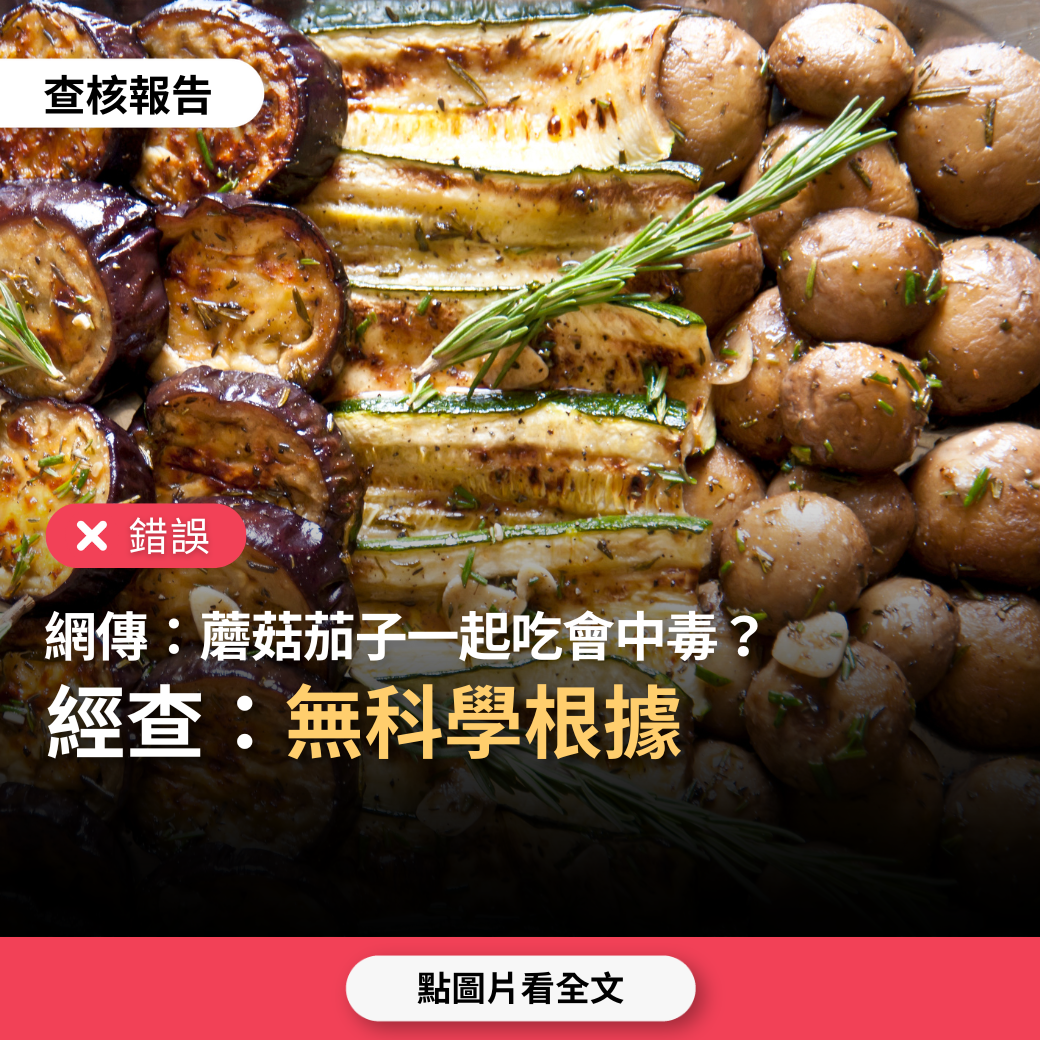
網傳「蘑菇茄子一起吃會中毒」?
Publisher’s rating: 錯誤
The review addresses a circulating message that claimed eating mushrooms with eggplant, millet or a type of yellow rice would create a poison, and also alleged that mushroom poisoning had killed 17 people. It notes that versions of the message circulated in 2019 and that details such as the hospital named in the death allegation varied. The report says Taiwan’s Food and Drug Administration had already publicly rebutted the 17-death story in 2015, noting that it lacked source information and scientific support. To assess the food-combination claim, the review reports interviews with food-science professor Hsieh Chang-Wei of National Chung Hsing University and nutritionist Lin Shih-Hang. Hsieh explained that some wild mushrooms are poisonous and described green-spored parasol mushrooms as a species that can be mistaken for edible mushrooms; he advised against eating mushrooms picked in the wild and recommended mushrooms from qualified commercial suppliers. He said there was no scientific basis for claiming mushrooms eaten with other foods cause poisoning, and that Taiwan had no comparable poisoning reports. Lin likewise said there was no evidence that eating mushrooms and eggplant together causes food poisoning or another adverse reaction, or that their nutrients combine to produce a toxin. The report also notes that mushrooms are cooked with other foods in vegetarian dishes without reported poisoning cases. Its conclusion is specifically about the alleged interaction between foods; it does not suggest that all mushrooms are safe, and it distinguishes the risk of eating poisonous wild mushrooms from the unsupported claim about combining ordinary foods.

A drug called Caripill can cure dengue in 48 hours.
Publisher’s rating: FALSE

Poner el aire acondicionado de un coche sin abrir antes las ventanas es peligroso para la salud porque emite benceno
Publisher’s rating: Falso
The claim concerns cars, especially after being parked in the sun: it says that switching on the air conditioning without first opening the windows exposes occupants to cancer-causing benzene emitted by heated plastic. Newtral’s review addresses that specific scenario and says the alleged danger does not follow from the car’s interior materials. It reports that benzene may have been used in manufacturing some materials, but cites the OCU’s explanation that it would have evaporated long before the car was used. The review also quotes Joaquín Martínez Triguero, an industrial chemist and CSIC scientist, as saying that benzene arising inside a car is “very improbable.” It describes a remote possibility of benzene forming in the fuel tank, but says the vehicle’s system is designed to guard against leaks and that any such substance would not enter through the ventilation channel. The review therefore concludes that the claimed pathway—from heated interior materials, through the vents, into the cabin—is not supported. The review distinguishes this claim from evidence that people in cars can be exposed to benzene. It cites a 2001 study in Korea comparing exposure among people travelling by car and public transport: car travellers had greater exposure, but the review says the benzene came from their vehicles’ fuel, not from interior components. Thus, evidence of exposure in cars does not establish that turning on the air conditioning releases benzene from hot plastic.

Claim: Don’t touch this virus spreading killer bug
Publisher’s rating: FALSE

網傳吃冷的米飯能抗腸癌?
Publisher’s rating: 部分錯誤
The review examined a circulating message claiming that cooling cooked rice increases resistant starch, which is less readily converted to sugar and is beneficial for preventing colorectal cancer. It consulted nutrition experts, including Cheng-Tzu Liu of Chung Shan Medical University and dietitian Shih-Hang Lin, about the rice’s digestion, blood-sugar effects and proposed link to cancer. The review’s conclusion was qualified: cooled rice can have a lower glycemic index than freshly cooked rice, but that does not establish that eating it prevents cancer. (The claim in circulation was that “將熱米飯放涼以後再吃,冷飯會產生較多的抗性澱粉,抗性澱粉不易轉換為醣類,有易控制血糖,對預防腸癌也非常好”; the review says, “若比較等量剛煮熟的熱飯和放冷的米飯,吃冷飯會讓升糖指數(GI值),也就是進食後血糖上升了多少的數值比熱飯低”.) Liu explained that some starch in cooled rice is harder for small-intestinal enzymes to break down, so it can reach the large intestine and be fermented by gut bacteria into short-chain fatty acids. The review describes possible benefits to intestinal cells and the gut environment, but distinguishes those effects from proof of cancer prevention: Liu said colorectal cancer has multiple causes and that there is not sufficient medical evidence to show that eating cooled rice prevents it. Thus, the biological mechanism discussed in the review does not establish the stronger claim. (The review says cooled rice’s “抗性澱粉則會殘留到大腸,在大腸停留期間,受到腸道菌發酵而產生短鏈脂肪酸”; it also reports Liu’s qualification: “目前醫學上尚無充分的證據顯示此效果”.) The review also cautions that eating large quantities of cooled rice does not offer a substantial blood-sugar-control advantage, and that reheating reduces its resistant-starch content. Lin suggested choosing brown rice instead if seeking resistant starch, and warned that storage conditions matter: contamination while rice cools or is stored may harm intestinal health. These qualifications mean that the review supports some limited properties of cooled rice, not the claim that it is a proven way to prevent colorectal cancer. (It states, “要留意吃過多冷飯仍會造成總糖量及總熱量之吸收增加,對血糖控制並無太大幫助”; it also warns, “若放涼及儲放過程受到微生物污染,反而有礙腸道健康”.)


「泰國水果罐頭被愛滋病患者血液汙染」謠言再起
Publisher’s rating: 錯誤
The rumor described in the report alleges that people with HIV, acting under a leader’s direction, entered Thai canned-food factories and put their blood into cans. It further claims the Thai government confirmed that several canned products had been removed from supermarkets. The review says this was an old rumor that had begun circulating again, and investigates both whether the alleged contamination occurred and whether eating food containing HIV could transmit the virus. For the contamination allegation, the review says it sought confirmation from Taiwan’s Food and Drug Administration and Centers for Disease Control. Both agencies said the claim was false. The review also reports that Taiwan’s Food and Drug Administration had previously said it found no evidence of the alleged incident, and that Thailand’s Food and Drug Administration had issued a clarification calling the contamination story a rumor. The review describes consulting Thailand’s Sure And Share Center for assistance; its head, Peerapon Anutarasoat, said the rumor had circulated in Thailand for three to four years. On transmission, the review cites National Taiwan University Hospital infectious-disease physician Hsieh Ssu-min. He said that blood containing HIV loses activity shortly after leaving the body, and that processing and transport of canned food would further mean any virus in it would not retain infectious activity. The review’s conclusion is that the rumor is false and that HIV is not transmitted through food.
網傳若心臟病發作,可以用深吸呼和用力咳嗽來自救?
Publisher’s rating: 錯誤
The review addresses the specific online advice that someone alone who suspects a heart attack should repeatedly take a deep breath and cough forcefully until help arrives or they feel better. It reports that two cardiology specialists did not recommend using this “cough CPR” as a self-rescue method: it is not part of recommended emergency procedures, and the review says its effectiveness has not been established in clinical research. The review distinguishes this viral instruction from a limited, medically supervised use of coughing. One specialist said a cough might temporarily help in some cases involving a conscious patient with low blood pressure or a slow heart rate, but whether it helps depends on the individual situation. The other explained that coughing is not the same as the Valsalva maneuver, which may ease some abnormal heart rhythms, and that neither point establishes a general benefit from forceful coughing during a suspected heart attack. The central finding is therefore not that coughing can never have a clinical use; it is that people should not rely on the circulating self-rescue routine as a proven or recommended emergency response. The review says that if symptoms persist, the person should seek medical care, and that if someone has lost consciousness, another person should arrange prompt transport to medical care or perform CPR. Its conclusion characterizes the viral advice as false information.


研究證實吃辣可能導致失智症...研究結果顯示,每天吃超過50g辣椒的人,記憶力衰退和認知能力變差的風險為一般人的2倍
Publisher’s rating: 部分錯誤
The review examined reports claiming that eating more than 50 g of chili daily could double the risk of memory decline and dementia. It traced those reports to a study published in *Nutrients* that followed Chinese adults between 1991 and 2006, recording chili consumption and assessing cognitive function. The review notes a discrepancy in the study’s title and participant count: the title says 4,582, while its abstract and main text say 4,852, which the review says is the correct number after comparing the paper’s text. The study grouped participants by daily chili intake, from none to more than 50 g, and found an association between greater intake and lower cognitive-function measures. (S1: “研究團隊自1991到2006年,在十五年間,共調查4852名55到71歲的受測者” and “研究標題為「4582人」,但論文摘要及內文皆為「4852人」”) The reported “twice the risk” refers specifically to participants’ self-reports of poor memory, not a diagnosis of dementia. Compared with non-consumers, those eating more than 50 g daily had an odds ratio of 2.12 for reporting poor memory; their odds of reporting memory decline were 56% higher. The review explains that an odds ratio should not simply be presented as a relative risk. It also reports that the high-intake group scored lowest on a cognitive test at the first assessment in 1997, and its 2006 score was nearly half those of the other groups, but the study did not explain the baseline difference or establish that chili caused it. (S1: “Overall, compared with non-consumers, a chili intake higher than 50 g/day was associated with more than twice the risk of having self-reported poor memory (OR, 2.12 (1.63–2.77)), and 56% increased risk of having self-reported memory decline (OR, 1.56(1.23–1.97)).” and “研究並未解釋為何這組的基礎分數(1997年)最低”) Experts quoted in the review cautioned that the study supports an association, not proof that high chili intake causes cognitive decline. They pointed to differences between the high-intake group and other participants, including education, alcohol consumption, urbanization, and socioeconomic factors, as potential confounders. The review also stresses that memory complaints or lower cognitive-test scores are not equivalent to dementia: the study did not assess dementia diagnoses, which require more extensive clinical evaluation. (S1: “這個研究僅能提供相關性的結論-辣椒攝取量大與認知分數低有相關,而無法直接推論「辣椒高攝取量導致認知功能下降」的因果關係。” and “研究沒有直接去討論「失智症」的診斷。” )

Al zumo no se le van las vitaminas porque no te lo tomes al minuto
Publisher’s rating: Falso
The claim is that freshly squeezed juice must be drunk immediately or it will lose its vitamins. Newtral examines that idea by discussing vitamin C in juice and reporting an interview with Susana Gastón, technical secretary of the Spanish Association for Juice and Nectar Self-Control. Gastón explains that the vitamin does not simply disappear over time: ascorbic acid oxidizes into dehydroascorbic acid, a change the article says can make the juice more bitter but does not change its nutritional value. The article also addresses other alleged causes of a dramatic loss of vitamin C, including the type of juicer, storage at room temperature rather than in a refrigerator, and exposure to light. It cites a 2014 study in the Spanish Journal of Human Nutrition and Dietetics, reporting that vitamin C degradation occurs from 120°C and that even at that temperature only half the vitamin disappears. The article therefore distinguishes ordinary changes over time from loss under extreme heating. The account is qualified: it notes that juice processing can involve some reduction in nutritional properties compared with the fruit’s initial state, and that packaged juice is perishable. It says the vitamin variation after opening packaged juice is similar to that in fresh juice. The evidence presented does not support the idea that juice must be consumed immediately to retain its nutritional value.