PeakMetrics / Fact Checks
Health & medicine fact checks
Explore claims publishers have checked about health & medicine. Read their original ratings and follow the evidence.
Search fact checks
Search by text or image13,669 published reviews in this topic
Covid vaccine causes Stiff Person Syndrome
Publisher’s rating: Mostly False
Sri Lanka made condoms free for people aged 18 to 25?
Publisher’s rating: False

you can whiten your teeth with coconut oil and turmeric
Publisher’s rating: Mostly False
heart diseases can be caused by root-canaled teeth
Publisher’s rating: False

El Foro Económico Mundial ha pedido a los dueños de mascotas de todo el mundo que practiquen la eutanasia a sus perros y gatos.
Publisher’s rating: Falso
The claim is that the World Economic Forum asked pet owners worldwide to euthanize their dogs and cats to combat climate change. The review says the allegation circulated in social-media posts and directly addresses whether the organization had made that request. Its conclusion is that the claim is false. The review reports that elDetector contacted Yann Zopf, the Forum’s head of press and an executive committee member. In an email responding on December 14, 2022, Zopf said the organization had never made such statements. The review also says it checked the Forum’s press releases and official Twitter posts from January 1 through December 15, 2022, and found no announcement supporting the allegation. The review distinguishes the claim from real discussions of pets’ environmental impact. It describes two Forum articles about pet food and emissions: one considered diet changes, including alternative ingredients and reducing animal protein; the other suggested insect protein. According to the review, neither article recommended eliminating pets. Thus, discussion of the environmental footprint of pet food does not establish that the Forum called for euthanasia.
Shiliwangxiongdanye is an FDA-registered eye drop that can help treat cataracts and nearsightedness
Publisher’s rating: Fake

Variko stop’ cream can cure varicose veins
Publisher’s rating: FALSE
FACTLY examined a social-media advertisement for ‘Variko stop’ cream that claimed the product cures varicose veins. The review reports that it checked the websites of the Food and Drug Administration, the Central Drugs Standard Control Organisation, and the Ministry of AYUSH, and found no product by that name in their lists of approved drugs or medicines. This addresses the product’s approval status; it does not by itself establish whether a cream works.

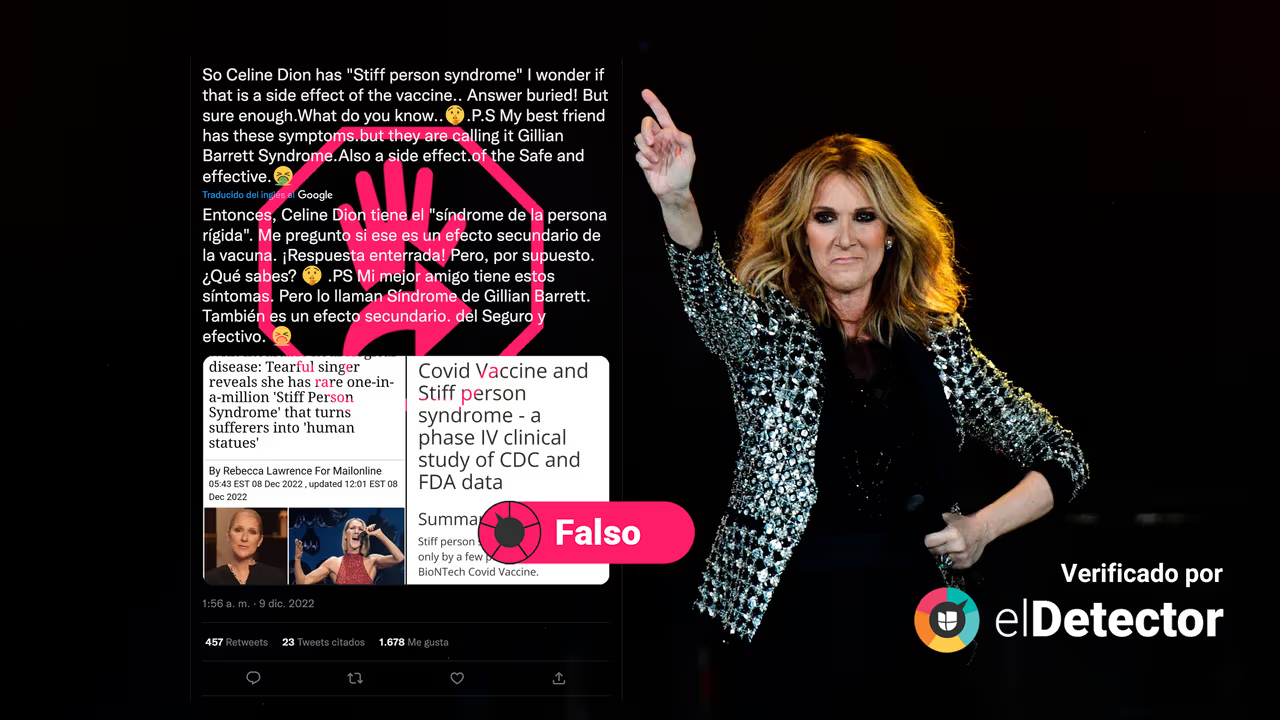
El síndrome de la persona rígida, que padece Celine Dion, es igual al síndrome de Guillain-Barré y lo causó la vacuna contra el covid-19.
Publisher’s rating: Falso

「加藤勝信・厚生労働相はコロナワクチン未接種」と医師を名乗るアカウントが拡散した情報
Publisher’s rating: 誤り
The claim concerned Katsuhiro Kato, then Japan’s health minister: a Twitter account whose user claimed to be a doctor posted on December 13 that Kato had not received a COVID-19 vaccine. The review reports that the post attracted substantial engagement, but found the claim false. Its evidence addresses Kato’s vaccination directly, rather than relying only on general information about vaccination or politicians. The review points to reporting that Kato received his first dose at a Self-Defense Forces mass-vaccination site on June 14, 2021, and to a vaccination certificate he shared after installing the vaccine-certificate app. The certificate showed that he completed two doses on July 14, 2021. It also reports that Kato himself rejected the claim on Twitter on December 15, saying he had already received four doses. The account’s allegation was also contradicted by Kato’s office: a communications representative said Kato had been vaccinated and described the circulating information as baseless. Separately, the review notes Kato’s August 16 report that he had received a fourth dose. Taken together, the described vaccination record, Kato’s direct denial, and his office’s response conflict with the claim that he was unvaccinated.
Dr. Josephine Rojo is endorsing a granola mixed nuts product
Publisher’s rating: Fake


Daten der Kassenärztlichen Bundesvereinigung (KBV) belegen einen massiven Anstieg plötzlicher Todesfälle seit Start der Corona-Impfungen in Deutschland.
Publisher’s rating: Falsch, die KBV-Daten belegen keine Zunahme von Todesfällen. Sie wurden irrführend ausgewertet. Die Daten stammen von Versicherten, die noch im Jahr 2021 in ärztlicher Behandlung waren - und daher nicht in den Vorjahren gestorben sein konnten.
The claim was that KBV data showed a massive increase in sudden deaths after COVID-19 vaccination began in Germany. The review explains that the data at issue were physician billing records requested for groups of people selected because they had visited a doctor in 2021. They were not a count of all deaths in the population, nor a dataset that could support the claimed year-to-year comparison. The review says the selected people could not have generated death-diagnosis billing codes in earlier years because they were still alive before their 2021 doctor visits. The review attributes the apparent increase to this selection method, describing it as a cohort effect. The Central Research Institute of Ambulatory Health Care (ZI), which studies the physicians’ data, said that the apparent rise resulted from the way the records were selected; it also said that pre-2021 death codes appearing for some selected people could reflect data-entry or transmission errors. The review notes that a meaningful comparison would need to use the population of all people with statutory health insurance, rather than only those who visited a doctor in 2021. The review reports that the ZI published such a comparison for 2012–2022 and found no anomalies in the diagnostic codes highlighted in the claim. It also says that neither the KBV records nor the cited findings establish that increased excess mortality was caused by vaccination. The review distinguishes that separate question from its assessment of the billing-data claim: the Federal Statistical Office was observing elevated excess mortality, but had not yet determined its other causes and awaited future cause-of-death statistics.

Anitta está com câncer e pede por um milagre em vídeo de dezembro de 2022
Publisher’s rating: Falso

Photo of a US soldier who received a new ear on his arm
Publisher’s rating: MISLEADING
The post presented a photo as showing a US soldier who lost an ear in a car crash and received an ear reconstruction on her arm. The review says the photo and the account of the soldier’s surgery are unrelated: the image shows Australian artist Stelarc, not the soldier. It concludes that the photo does not show the soldier who underwent reconstruction. [Evidence: the review describes the post as claiming a “picture of a US soldier who lost an ear in a car crash” and states that “the photo shared in the post shows Stelarc, an Australian artist.”] To check the image’s identity, the review reports conducting a reverse image search. That search located the same photo in an Independent article, which identified Stelarc as an Australian artist and Curtin University professor in Perth. The review says Stelarc intentionally grew an extra ear on his arm as a project to enable a wireless internet connection and make the ear a remote listening device. [Evidence: “On reverse image search of the photo shared in the post, the same photo is found” in an Independent article; it describes Stelarc as someone who “intentionally implanted an extra third ear on his arm.”] The review separately examined reporting about the soldier’s surgery and identifies her as Shamika Burrage. It says Burrage lost her left ear in a 2016 car accident in Texas, and that Army medical-centre surgeons reconstructed an ear on her forearm. Thus, the review distinguishes a real soldier’s reconstruction from Stelarc’s unrelated arm-ear project: the existence of the surgery does not establish that the circulated photo depicts the soldier. [Evidence: “US Army soldier Shamika Burrage lost her left ear in 2016, during a car accident in Texas”; the review says the photo and story “are unrelated.”]

هل أُجريت فحوصات أظهرت وجود الكوليرا في حوض نهر الليطاني؟
Publisher’s rating: صحيح
The claim concerns whether testing found cholera in the Litani River basin. The article reports that on 7 December 2022 the National Litani River Authority said it had collected 10 samples from different points along the Litani and its tributaries in the upper basin and analyzed them at the Authority’s Khirbet Qanafar laboratory. According to the reported results, four of the 10 sampling points were contaminated with cholera. The article names those locations as the Litani at Dalhamiyah Bridge, the course of the Shtoura spring, the Berdawni at Marj Bridge, and the Litani at Marj. It says the Authority attributed the contamination to direct discharge of untreated sewage and reported that cholera bacteria were found at points preceded by refugee camps or sewage and hospital تجمعات. The report therefore supports the central claim that tests found cholera at several points in the basin; it does not say that all sampled locations tested positive. The article also reports that the Authority notified government bodies and that its director, Sami Alawieh, said the sewage problem remained unresolved. These details describe the reported response and the Authority’s account; the excerpt does not provide independent laboratory records or additional test results beyond the Authority’s statement.

El cantante de música country Jake Flint murió a causa de la vacuna contra el covid-19.
Publisher’s rating: Falso