PeakMetrics / Fact Checks
Health & medicine fact checks
Explore claims publishers have checked about health & medicine. Read their original ratings and follow the evidence.
Search fact checks
Search by text or image13,669 published reviews in this topic

mRNA-Impfstoffe konnten innerhalb von Tagen hergestellt und auf den Markt gebracht werden.
Publisher’s rating: mRNA-Impfstoffe wurde nicht innerhalb weniger Tage hergestellt, es dauerte Monate, bis sie auf den Markt kommen konnten.
The claim concerns whether mRNA Covid-19 vaccines were made and brought to market within days. The review distinguishes that claim from the fact that vaccine development and authorization proceeded unusually quickly. It reports that the virus’s genetic sequence was published in January 2020 and that the first vaccine authorization discussed, the US emergency authorization for the BioNTech-developed and Pfizer-produced vaccine, came on December 11, 2020. The EU authorized it conditionally on December 21, and the EMA authorized Moderna’s vaccine on January 6, 2021. On that chronology, the review says nearly a year passed between the virus becoming known and the first vaccine authorizations. The review’s explanation for the speed is not that a finished vaccine was produced and released within days. It says BioNTech began development on January 27, 2020, and describes two ways the process was accelerated: regulators received clinical-trial data as it became available through a rolling review, rather than waiting for data to be bundled in stages; and manufacturers began production while authorization was still underway, taking a production risk once they expected approval. Those details support a distinction between accelerated development and authorization, and a claim of completion and market release within days. The review also notes that the claim appeared in social-media posts alongside a separate claim about children’s fever medicine. It reports that a shortage of fever medicines was confirmed in Luxembourg, but that the situation there was less severe than in Germany and equivalent medicines from other brands remained available. This is separate from the vaccine timeline and does not change the dates the review gives for vaccine authorization.
Eating aspirin daily can help you survive a heart attack
Publisher’s rating: Mostly False
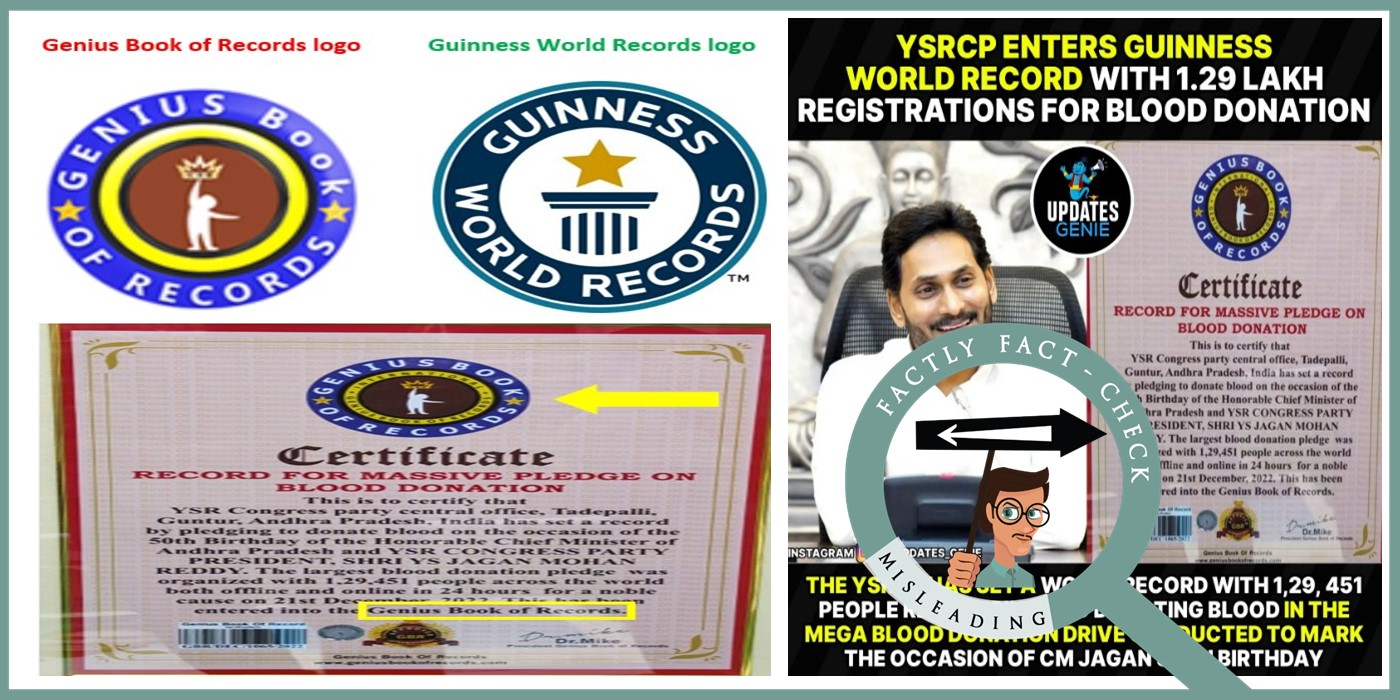
YSRCP set a Guinness World Record with 1.29 lakh registrations (both online & offline) for blood donation on Y.S Jagan’s 50th Birthday
Publisher’s rating: MISLEADING
The claim concerned 1.29 lakh blood-donation registrations attributed to YSRCP on the occasion of Andhra Pradesh Chief Minister Y.S. Jagan’s 50th birthday, and said the achievement was a Guinness World Record. The review’s central distinction is that the certificate identified in the viral post was from a different record organisation: it says the certificate showed “Genius Book of Records,” not “Guinness book of World Records.” The review describes checking the certificate image against one uploaded to the YSR Congress Party’s official website. It reports that the latter also displayed the Genius Book of Records logo and approval. It further says that, during the record announcement, a representative identified the organisation as Genius Book of Records. The review therefore supports that the event was recognised by that organisation, not by Guinness World Records. For comparison, the review cites Guinness World Records’ website as listing the record for the most people signing up as blood donors online in 24 hours: 71,121 registrations by Shincheonji Youth Volunteers in South Korea on 2 October 2022. It also states that Guinness had made no announcement acknowledging the mass blood-donation pledge associated with Jagan’s birthday. The 1.29 lakh figure and the Guinness attribution are thus not equivalent: the cited certificate and announcement identify a different record body.

ファイザーCEOが辞任し、mRNAテクノロジーの安全性は確保されていないと発言
Publisher’s rating: 誤り
The review says the circulated video was taken from a March 11, 2022 POSTLIVE interview in which Bourla described initially finding mRNA counterintuitive, then trusting his employees’ judgment about the technology. It also reports that there was no information that Bourla had resigned. The review concludes that the claim that he resigned and said mRNA technology was unsafe is false.
वीडियो में हथेलियां रगड़ने के फायदे गिनाता शख्स बतरा अस्पताल के ह्रदय रोग विशेषज्ञ डॉ बजाज हैं
Publisher’s rating: FALSE

हाल ही में बढ़ते कोरोना संक्रमण को ध्यान में रखते हुये प्रधानमंत्री ने अभी जनता कर्फ्यू का ऐलान किया है।
Publisher’s rating: Missing Context
Philippines has found a cure for stomach diseases
Publisher’s rating: Mostly false
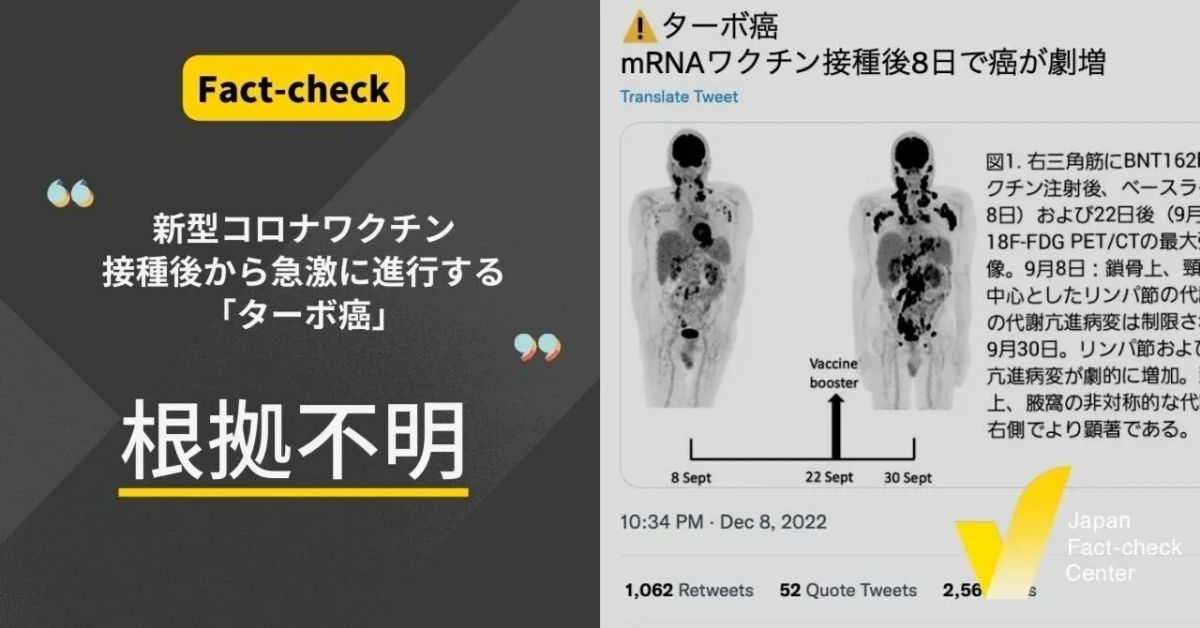
コロナワクチン接種後から急激に進行する「ターボ癌」
Publisher’s rating: 根拠不明
The review reports that an interviewed cancer physician said “ターボ癌” is not a medical term and that reliable data establishing such a condition are lacking. It also says there were no reports of increased cancer growth after vaccination, while noting that long-term observational research would be needed to determine the full effects.
कोरोना का नया वैरिएंट पुराने वैरिएंट से कई गुना ज्यादा खतरनाक. नहीं दिखते बीमारी के लक्षण
Publisher’s rating: FALSE

Une couverture de journal datant de 2011 montre que Bill Gates prévoyait de réduire la population mondiale à travers la vaccination forcée.
Publisher’s rating: Le Sovereign Independent était un journal irlandais connu pour relayer des théories conspirationnistes. L’article déforme des propos tenus par Bill Gates en 2010. Il avait estimé que la vaccination ainsi qu’une amélioration des soins de santé pourrait aider à endiguer la croissance démographique mondiale. Il n’a pas appelé à réduire la population.


Paylaşılan tavsiyelerin fotoğraftaki Japon doktora ait olduğu iddiası
Publisher’s rating: Yanlış
home remedies can replace angioplasty or bypass surgery
Publisher’s rating: Half true
Research from related reporting offers limited support for rejecting the idea that home remedies can substitute for treatment of heart disease. One article says there are “no effective home remedies for chest pain that can replace medical treatment” and advises people with chest pain to seek medical attention. It also describes angioplasty as a procedure for significant blockages and bypass surgery as an option for severe blockages or when angioplasty is not feasible. This supports the narrower point that home remedies should not be treated as a replacement for medical care, but the excerpt does not specifically compare remedies with either procedure. The supplied material does not identify the home remedies at issue, report a clinical study testing them against angioplasty or bypass surgery, or establish that the fact-check publisher conducted particular checks. A separate article discusses angioplasty and bypass surgery among treatments for heart-related problems, but does not evaluate home remedies as substitutes. Thus, these excerpts provide relevant general guidance rather than direct evidence about the effectiveness of any particular remedy or patient’s treatment choice.
a natural remedy can save a heart attack patient
Publisher’s rating: False
Pfizer CEO has quit because mRNA vaccines are proven unsafe
Publisher’s rating: False

Novo dipirona importado da Venezuela para o Brasil contêm vírus!
Publisher’s rating: Falso

Menschliche Körperteile und Produkte von menschlichen Föten werden bestimmten Lebensmitteln und Getränken als Geschmacksverstärker zugesetzt.
Publisher’s rating: Lebensmittel, alkoholfreie Getränke und Kosmetika enthalten keine Zellen von menschlichen Föten. Es gibt jedoch eine andere Verbindung zwischen ihnen.
The review investigates recurring claims that aborted human fetal material is added to foods or drinks to improve their taste. It traces the claim to a 2017 article shared in a Facebook post in Luxembourg, which alleged that human body parts were used as a food additive and mentioned PepsiCo. The review says the claim likely arose from a 2002 scientific paper about research on taste receptors, rather than evidence that fetal cells were ingredients in consumer products. That paper’s six authors worked for biotechnology company Senomyx and described experiments involving HEK-293T cells. The review explains that HEK-293 is a cell line derived from cells taken in 1973 from the kidney of an aborted embryo, and that the line is used in various kinds of research. Senomyx also researched taste enhancers and used HEK-293 cells in research involving taste modulators. These facts establish a connection between fetal-origin cells and laboratory research into taste, but do not establish that the cells were put into foods or drinks. The distinction is central to the review’s conclusion: the cells were used to investigate chemical processes in taste receptors, not to enhance the taste of finished foods or soft drinks. It also reports that PepsiCo told a US organization in an April 2012 letter that it did not conduct or fund research using human tissue or fetal cell lines, and that Senomyx did not use HEK cell lines for research on Pepsi’s behalf. The review further cites a University of North Florida nutrition and dietetics article stating there was no evidence that the embryonic kidney cells were part of taste-enhancement products. The excerpts describe research and a company statement; they do not provide a detailed independent audit of product manufacturing.