PeakMetrics / Fact Checks
Education fact checks
Explore claims publishers have checked about education. Read their original ratings and follow the evidence.
Search fact checks
Search by text or image1,862 published reviews in this topic
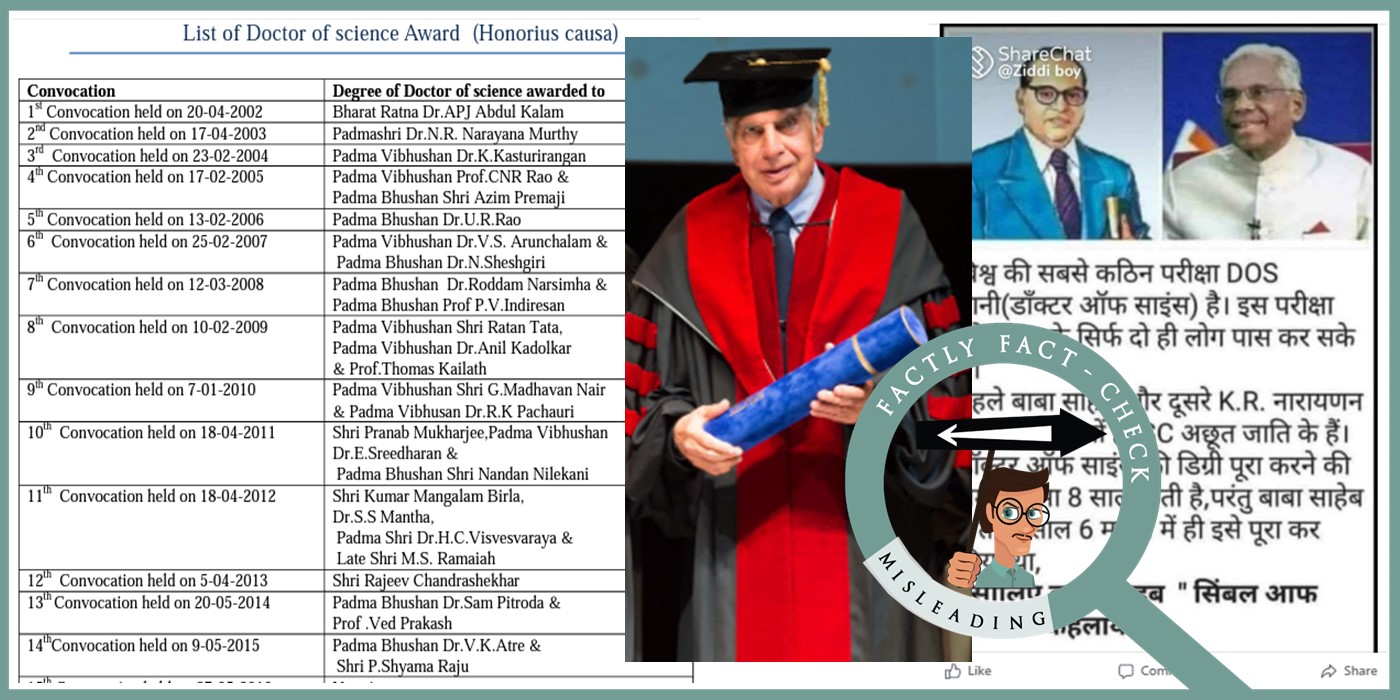
B.R. Ambedkar and K.R. Narayanan are the sole individuals from India who have successfully passed the world’s toughest exam known as Doctor of Science
Publisher’s rating: MISLEADING
The review investigates a social-media post depicting B.R. Ambedkar and K.R. Narayanan and claiming they were the only people from India to pass the “world’s toughest exam” called Doctor of Science. It finds that the claim misrepresents the degree: “there is no specific exam associated with this degree.” The review also notes that there is no definitive authority ranking exam difficulty, so describing this degree as the world’s toughest exam is not supported by the evidence it presents. The review distinguishes the two men’s awards. It says Ambedkar received a Doctor of Science from the University of London in 1923 for his thesis, *The Problem of Rupee*, citing an NCERT report on his life and works. Narayanan, by contrast, received an honorary Doctor of Science from the University of Toledo in 1987. The review explains that honorary degrees recognize achievement and do not require recipients to meet the degree’s standard requirements. The exclusivity claim is also contradicted by other Indian recipients named in the review: former President A.P.J. Abdul Kalam, chemist C.N.R. Rao, and agricultural scientist M.S. Swaminathan. It concludes that the degree is awarded for research contributions or, in some cases, on an honorary basis—not by passing a single exam—and that many people beyond Ambedkar and Narayanan have received it.
Görüntülerin İstanbul Üniversitesi Hukuk Fakültesi mezuniyet törenini gösterdiği iddiası
Publisher’s rating: Yanlış

Abdüllatif Şener’in doçent unvanıyla rektör olabileceği iddiası
Publisher’s rating: Yanlış

Cette image montre une bibliothèque mobile en Italie.
Publisher’s rating: En effet, l'image a été générée à l'aide d'une intelligence artificielle (IA), et n'est donc pas réelle.
All students studying Business Management at Seton Hall University in the USA are obligated to study Bhagavad Gita
Publisher’s rating: MISLEADING
FACTLY examined a social-media post claiming that all Business Management students at Seton Hall University must study the Bhagavad Gita. The review describes the relevant course as “The Journey of Transformation,” the first course in the university’s core curriculum. It says that the course includes the Bhagavad Gita alongside texts from multiple religious traditions, rather than treating the Gita as its sole subject. The review reports that media accounts said Seton Hall made study of the Bhagavad Gita compulsory for all students starting in 2008. It also describes how the curriculum was developed: Professor A. D. Amar advocated including ancient philosophies alongside biblical teachings, and the university ultimately incorporated study of the Gospels, the Bhagavad Gita, and Dante’s *The Divine Comedy* into the core course. This account supports the existence of required study in a broad core-curriculum course, but the supplied review does not establish a separate requirement specific to Business Management students. The review’s conclusion also addresses the post’s suggestion that the Gita is absent from Indian education. It states that Indian universities offer courses involving the Bhagavad Gita and that NCERT school textbooks include references or content from it. The excerpt does not name those universities or textbooks, so it does not provide further detail about their coverage.
వీడియోలో కనిపిస్తున్న దృశ్యాలు, కేరళలోని ఒక స్కూల్లో నిర్వహించిన పోటీకి సంబంధించినవి
Publisher’s rating: MISLEADING
Fotoğrafın bir okuldaki ‘cinsiyet seçme etkinliğini’ gösterdiği iddiası
Publisher’s rating: Yanlış
“Quase 3 mil creches que estavam paralisadas [quando assumimos o mandato atual]”
Publisher’s rating: Falso
মৌমিতা মৌ নামে কুড়িগ্রামের এক শিক্ষার্থী ঢাবি ভর্তি পরীক্ষায় উত্তীর্ণ না হওয়ায় চিঠি লিখে আত্মহত্যা করেছে
Publisher’s rating: মিথ্যা
Lawyer Shola Mos-Shogbamimu wrote an opinion article in the Guardian that claims the UK education system is "supremacist whitesplaining"
Publisher’s rating: False
That a video shows "banned books" being removed from a school.
Publisher’s rating: The claim is false. The video shows the routine removal of old books during a library renovation project and has nothing to do with any new laws passed in Florida.
10/12 ఉత్తీర్ణులైన విద్యార్థుల కోసం ప్రధాని మోదీ అబ్దుల్ కలాం, వాజ్పేయీ పేర్లపై స్కాలర్షిప్లను ప్రకటించారు
Publisher’s rating: FALSE

Escola Leonardo Da Vinci da Asa Norte de Brasília levou adolescentes para prestigiar o ditador Nicolás Maduro
Publisher’s rating: Falso
“Durante nuestro primer año avanzamos en reducir la inasistencia grave en un 13%”
Publisher’s rating: Real
“As crianças devem ter parceiros sexuais”, diz a ONU” Evidências chocantes mostram como as Nações Unidas e a Organização Mundial de Saúde estão instruindo as escolas primárias de todo o mundo a ensinar as crianças a se masturbarem, usarem pornografia, aprenderem a fazer sexo oral e a terem relações homossexuais. A ONU instrui os professores a se certificarem de que as crianças tenham parceiros sexuais e comecem a fazer sexo o mais cedo possível. Convidamos você a dar uma olhada nesse relatório e a se posicionar para proteger as crianças.
Publisher’s rating: Falso