PeakMetrics / Fact Checks
Education fact checks
Explore claims publishers have checked about education. Read their original ratings and follow the evidence.
Search fact checks
Search by text or image1,862 published reviews in this topic
העברנו חוק חינוך חינם אפס עד שלוש
Publisher’s rating: לא נכון ברובו
Benjamin Netanyahu said that during the Knesset’s summer session, his government had passed a law providing free education for children from birth to age three. The review distinguishes that claim from what the government actually did: it announced a program, rather than passing such a law. It notes that free education for this age group had featured in Netanyahu’s election campaign, but says he did not pursue the policy through legislation after the government was formed. The program was announced at the end of April by Netanyahu, Education Minister Yoav Kisch, and Finance Minister Bezalel Smotrich. The review describes two main financial components. One offered tax-credit points worth up to NIS 940 a month for a family with two working parents, with smaller benefits for some other eligible families. Citing early-childhood researcher Dr. Carmel Blank, the review explains why that was not equivalent to free care: the tax benefit was unavailable to people who did not pay income tax, and its maximum amount was far below the stated cost of private daycare, NIS 3,000–4,000 a month and sometimes more than NIS 5,000. The review also describes an additional work grant for some low-wage workers and says people who did not work were not eligible for that benefit. The other component increased state support for eligible families using subsidized “symbol” daycare centers, including WIZO and Na’amat. The review reports an additional NIS 500 in subsidy, bringing average monthly support to NIS 1,700, but notes that a fee increase announced in May reduced the practical effect of the added subsidy. It also says about 120,000 children in these centers—22% of children in the relevant age group—received partial or full subsidies. Blank’s assessment, as reported in the review, was that only a small share of families could combine the full daycare subsidy with the maximum tax benefit. The evidence therefore supports a distinction between targeted, indirect assistance and a law establishing free education for all children aged zero to three.
కర్ణాటక ప్రభుత్వం, ప్రభుత్వ పాఠశాల విద్యార్థులకు ఖురాన్ను సరఫరా చేసి వారికి ఖురాన్ బోధించాలని నిర్ణయం తీసుకుంది
Publisher’s rating: MISLEADING
2022 උසස් පෙළ විභාගයේ ප්රතිඵල මෙතෙක් නිකුත් වී නැහැ!
Publisher’s rating: False
52 Philippine universities are on World University Rankings lists
Publisher’s rating: Misleading
ಕರ್ನಾಟಕದ ಮದರ್ಸಾ ವಿದ್ಯಾರ್ಥಿಗಳು ಮೊಹಮ್ಮದ್ ಅಸ್ಲಾಂ ಹುಸೇನ್ ಅವರನ್ನು ಭಾರತದ ಪ್ರಧಾನಿ ಎಂದು ಉಲ್ಲೇಖಿಸುತ್ತಿರುವ ವೀಡಿಯೊ.
Publisher’s rating: FALSE
52 Philippine universities are included in the World University Rankings
Publisher’s rating: Misleading
S.M.S English Medium School in Karnataka designed a Social Studies question paper for 7th standard students, which exclusively asked questions related to Muslim and other communities, indicating bias against Hinduism
Publisher’s rating: MISLEADING
The claim concerns a June 2023 Social Studies question paper attributed to S.M.S English Medium School in Brahmavar, Karnataka. The allegation was that the paper asked exclusively about Muslims and other communities and thereby showed bias against Hinduism. The review reports the school management’s response: the questions reflected the topics taught in the first month, rather than evidence of the alleged prejudice. The school’s principal, Abhilasha Hande, said the first-month lessons covered “Major Developments in the World” and “Beginning of the Modern Age-Renaissance.” The review says those lessons included Christianity, Islam, the Crusades, the Mongols, and the Renaissance, and that related topics were put in the unit test according to the prescribed syllabus. This provides an explanation for the paper’s subject matter, but the excerpt does not reproduce the question paper or independently compare all its questions against the syllabus. The review also reports that school management held a press meeting on 13 July 2023 after the paper’s image circulated with allegations. It says the textbook content for class seven matched the topics described by management. The review notes that it had requested final question papers from the previous academic year and would update its post if it received them. Thus, the evidence presented supports the school’s syllabus-based explanation, while the excerpt does not show that the requested papers were obtained.
Karnataka Education Dept. has issued a controversial new order banning bangles from women who are preparing mid day meal for children in schools. Is this an attempt to ban Hindu religious practice? Why is there no ban on the act of spitting on the bread of other community ?
Publisher’s rating: False
Resmi Gazete’de yayımlanan karar ile üniversite harçlarının geri getirildiği iddiası
Publisher’s rating: Yanlış
Video showing Madarsa students in Karnataka referring to Mohammed Aslam Hussain as their Prime Minister of India
Publisher’s rating: FALSE
The claim concerns a video said to show Madarsa students in Karnataka naming Mohammed Aslam Hussain as India’s Prime Minister. The review identifies the footage instead as an interview with students at a government school in Rajouri district, Jammu and Kashmir. It says the video was filmed by Jammu journalist Amit Sharma in August 2022, so the asserted Karnataka setting—and its connection to the Siddaramaiah government’s education policy—does not fit the footage’s reported origin. To investigate, the review says it reverse-searched screenshots from the video and searched the internet using relevant keywords. Those searches led it to a Facebook post by Sharma sharing the same video. The review reports that Sharma published it on 12 August 2022 and described the children as seventh-standard students at a government school in Rajouri. According to the review’s account of his report, the children referred to an anonymous person, Mohammed Aslam Hussain, as the country’s Prime Minister. The key distinction is therefore not whether the name is heard in the footage, but where and when the footage was made. The review traces the video to a 2022 report from Jammu and Kashmir, rather than to a Madarsa in Karnataka. Its conclusion addresses the claim’s central attribution of the video to Karnataka; the supplied excerpt does not provide further details about the school or independently identify the person named by the students.
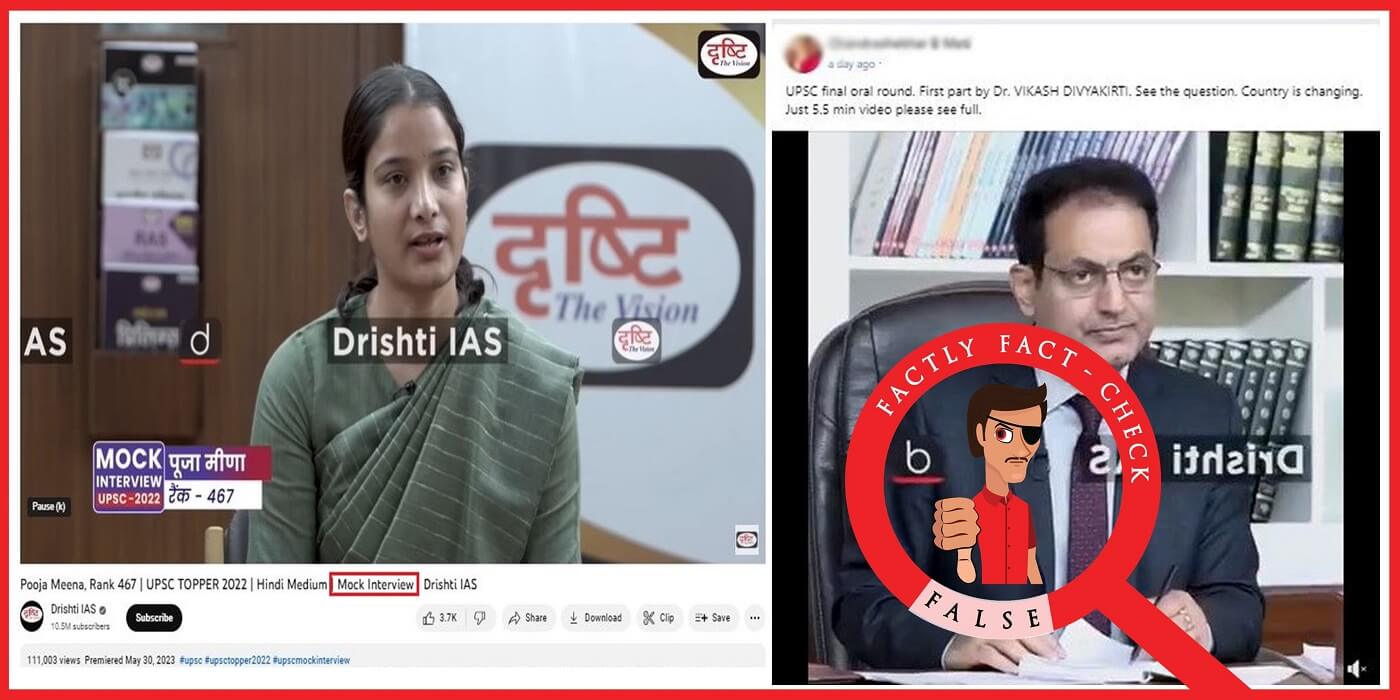
Video showing real footage of the UPSC final oral interview
Publisher’s rating: FALSE
The claim concerns a video presented as real footage of the UPSC final oral interview, in which a panellist asks an aspirant about Shankaracharya’s Advaita Vedanta philosophy. FACTLY identifies the footage instead as a mock interview conducted by Drishti IAS Academy before the UPSC 2022 examination. It says the interview features academy founder Vikas Divyakrithi questioning Pooja Meena, who achieved rank 467 in that exam. The review’s finding is that the video is not footage of the UPSC’s actual final oral interview. To check the video’s provenance, the review says it searched the internet using relevant keywords and found a video with similar visuals on the Drishti IAS Academy YouTube channel. The channel’s description identified it as a mock interview Meena had given at the academy before the examination. That provenance, together with the review’s identification of the people in the footage, supports the conclusion that the circulated clip was an academy practice interview, not an actual UPSC interview. The review also points to a disclaimer at the start of the video describing Drishti IAS mock interviews as training intended to give candidates a real-interview-like experience. It further states that actual UPSC interview footage is not published and is not available in the public domain. These details help explain why the clip could resemble an official interview while still being a mock exercise.
පේරාදෙණිය සරසවිය මහජනතාවට විවෘත කළ දිනයේ ඡායාරූප පෙළක් ද?
Publisher’s rating: Partly False
The photos were shared as showing the University of Peradeniya after the public was invited onto its grounds. The review says the university opened the campus, including all nine faculties, to the public to mark its 80th anniversary. It also reports that the vice-chancellor said nearly 200,000 people had visited, and that while most behaved responsibly, a small number did not. The question, then, was whether the circulating collection really showed damage at the university during that public day. (The article dates the public opening to July 1 but does not specify the year in this excerpt.) To check the collection, the publisher says it used reverse-image searches. It found that two pictures—one of a swimming pool and one taken inside a building—were actually from the presidential palace during its occupation by protesters in July 2022, not from Peradeniya. The other two pictures described in the review do show the university: one depicts a crowd on Akbar Bridge during the public day, and another shows a road on the campus. The article says these latter images were shared alongside posts about littering and irresponsible conduct by some visitors. Thus, the collection was mixed: the two palace images were misattributed, but the review identifies the other two as Peradeniya campus scenes. Its findings do not support treating every image in the collection as either an authentic public-day photograph or a false image; the origin depends on the individual photograph.
Congress party government in the Indian state of Karnataka has introduced eggs and bananas to the midday meal in schools, unlike BJP-ruled states.
Publisher’s rating: Misleading