PeakMetrics / Fact Checks
Economy & business fact checks
Explore claims publishers have checked about economy & business. Read their original ratings and follow the evidence.
Search fact checks
Search by text or image7,104 published reviews in this topic

एटीएम से ४ बार से अधिक पैसे निकालने पर १५० रुपये टैक्स और २३ रुपये सर्विस चार्जेस कटेंगे
Publisher’s rating: FALSE


Opened the commercial coal mining sector to private players.
Publisher’s rating: TRUE
Disinvestment crossed target of 72,500 crore rupees.
Publisher’s rating: TRUE
The claim concerns whether disinvestment in 2017–18 exceeded the government’s ₹72,500 crore target. The review identifies that figure as the budget estimate and says it comprised ₹46,500 crore from disinvestment of Central Public Sector Enterprises, ₹15,000 crore from strategic disinvestment, and ₹11,000 crore from listing insurance companies. Together, those components add up to the stated target of ₹72,500 crore. For the comparison, the review cites a December 2018 Lok Sabha response reporting net proceeds from disinvestment in 2017–18 of ₹1,00,057 crore. That is ₹27,557 crore more than the target, so the cited figures support the claim that proceeds crossed it. The review’s conclusion rests on comparing the reported proceeds with the budget estimate; the excerpt does not provide a separate breakdown of the proceeds or further detail about how they were calculated.
Transparent resource allocation with 89 coal mines allocated
Publisher’s rating: PARTLY TRUE

Desde Madrid Central, los comerciantes venden un 15% menos
Publisher’s rating: Engañoso
Home-buyers’ dreams and rights protected with Real Estate Regulation Act (RERA).
Publisher’s rating: MISLEADING

Payment of wages to workers within 15 days in 85% of the cases as compared to long delays in the past.
Publisher’s rating: PARTLY TRUE
The claim concerns MGNREGA wages: that workers received payment within 15 days in 85% of cases, an improvement over long delays in the past. The review reports that government data showed timely payment in 84.52% of cases in 2017–18. But that figure did not establish that workers had actually received their wages within the deadline. The government clarified in 2017 that delays were counted only until a Funds Transfer Order (FTO) was generated at block or panchayat level, not until the worker received the money. That distinction materially changes the result. The review cites an Azim Premji University research paper analysing a large sample of the government data, which found that only 32% of wage payments reached workers on time. Thus, the government’s figure was close to 85% for an administrative processing step, while the cited analysis found a substantially lower rate for timely receipt by wage seekers. The review also gives evidence of earlier delays: government MIS data recorded Rs. 12,673.14 crore in payments delayed beyond 15 days in 2013–14. It notes that, as of March 10, 2019, Rs. 40.1 crore in delay compensation was payable for 2018–19, but Rs. 3.9 crore had been approved and Rs. 1.88 crore paid. These figures provide context for the comparison with past delays, but do not resolve the central measurement problem: an FTO being generated on time is not the same as a worker receiving wages on time.

भारत के बैंकों को बर्बाद करने और घोटालों में सोनिया-मनमोहन का हाथ : रघुराम राजन, पूर्व गवर्नर रिज़र्व बैंक’
Publisher’s rating: FALSE

I salari bassi [in Italia] sono cresciuti gli unici due anni nel 2014 e nel 2015 per i tanto vituperati 80 euro, li hanno fatti crescere del 10 per cento gli 80 euro
Publisher’s rating: C'eri quasi
The review examines Carlo Calenda’s statement on Di Martedì on 5 March 2019 that the €80 bonus introduced by the Renzi government caused low salaries to rise by 10 percent in 2014–2015, and that this was the only period of growth. It compares Eurostat figures for the net annual pay of a single, childless Italian worker earning less than half the average wage. The review reports that this measure rose from €8,710 in 2001 to €12,888 in 2016. It says the increase was not confined to 2014 and 2015: pay had also risen before then, including a 32.5 percent increase from 2001 to 2013. The largest year-on-year rise in the series was in 2014, at 8 percent; the increase from 2013 to 2015 was 11.7 percent. The review distinguishes those wage figures from the effect of the bonus on disposable income. It describes the measure as a tax credit of up to €640 for May–December 2014, continued from January 2015 at up to €960 a year for eligible workers. Citing an Istat study of 2016, it reports an estimated 4.4 percent increase in disposable income for the poorest fifth of households and 3.6 percent for the next fifth. These findings support a positive effect on low-income workers’ disposable income, but do not establish that the bonus caused the full rise in the wage series. The review cautions that estimating the bonus’s standalone effect would require assessing what would have happened without it and without other interventions, and says there were no conclusive studies on that question. Its conclusion is therefore qualified: the data show substantial rises in the relevant wage measure around 2014–2015 and a positive effect on disposable income, but they do not support the claim that those were the only years of growth or that the bonus alone caused a 10 percent wage increase.
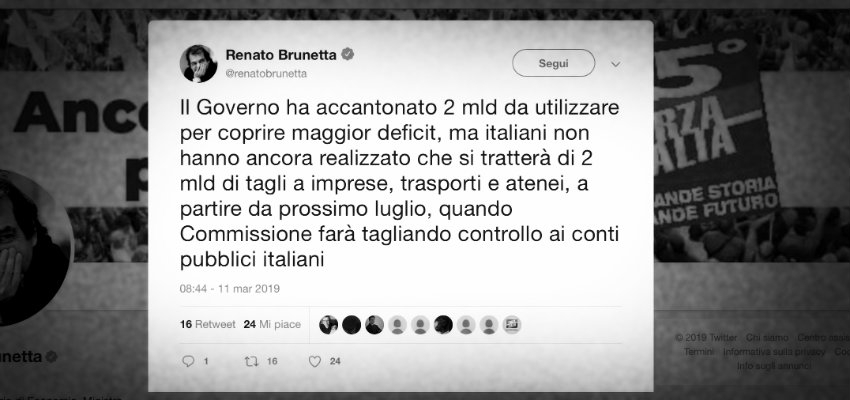
Il governo ha accantonato 2 mld da utilizzare per coprire maggior deficit, ma italiani non hanno ancora realizzato che si tratterà di 2 mld di tagli a imprese, trasporti e atenei, a partire da prossimo luglio, quando Commissione farà tagliando controllo ai conti pubblici italiani
Publisher’s rating: C'eri quasi
The review says the government had set aside two billion euros as a contingency, to be used if public-finance trends made an adjustment necessary. The funds had been allocated among ministries in theory but were not available for them to spend. The review treats whether using them would count as a cut as open to reasonable disagreement: the money could instead be described as becoming unavailable for other planned uses. It says businesses, transport and universities would lose resources if the funds were used, but notes that defence, development cooperation and social policies would also give up significant resources. The supplied excerpt does not establish that cuts would begin the following July or that a Commission review would trigger them.

Government moves to pay cane farmers following president Kenyatta's directive
Publisher’s rating: TRUE
در بنزین و گازوئیل خودکفا شدهایم و حتی صادر هم میکنیم
Publisher’s rating: درست

Seventh pay commission benefitted 50 lakh employees and 35 lakh pensioners.
Publisher’s rating: TRUE
Minimum wage increased by 42%, directly benefiting 55 lakh workers.
Publisher’s rating: MISLEADING

A claim that Nigeria’s economic growth rate at 1.2%.
Publisher’s rating: This claim is false.

Noi paghiamo 65 miliardi più o meno di interessi sul debito che è l'intero bilancio del ministero dell'Istruzione
Publisher’s rating: C'eri quasi
The claim concerned Emma Bonino’s comparison, made on 1 March 2019 during a television appearance, between Italy’s public-debt interest costs and the entire Ministry of Education budget. Pagella Politica examined whether those figures were comparable, drawing on government forecasts, an institutional parliamentary research dossier, and budget documents. The review reported interest costs of about €65.5 billion in 2017 and €64.4 billion in 2018; the 2019 estimate was about €66 billion. [S1: “Il 1° marzo 2019, ospite a L’Aria che tira su La 7, Emma Bonino ha dichiarato che in Italia gli interessi pagati sul debito pubblico equivalgono all’intero bilancio del Ministero dell’Istruzione.”; “In valore assoluto, la spesa è stata di 65,5 miliardi di euro circa nel 2017”; “nel 2018 la cifra era leggermente scesa, a 64,4 miliardi di euro”; “Per il 2019 si stima una spesa pari a circa 66 miliardi di euro”] For the education-budget side, the review noted that the Ministry’s latest available budget-section update dated from November 2018 and gave roughly €56 billion for each of 2017–2019. It also consulted a more recent technical attachment to the 2019 Budget Law, which put the Ministry’s total budget at about €60 billion for 2019 and €58 billion for 2020. Thus, the two amounts were in the same broad range, but the education budget was somewhat lower than the approximately €65 billion interest figure. [S1: “L’ultimo aggiornamento della sezione dedicata al bilancio sul sito del Miur è di novembre 2018”; “sono stanziati circa 56 miliardi di euro per ciascuno dei tre anni”; “un allegato tecnico alla legge di Bilancio per il 2019, a cura della Ragioneria dello Stato, pone il bilancio totale del Miur a circa 60 miliardi per il 2019 e 58 miliardi nel 2020.”] The comparison therefore broadly held, but should not be read as an exact equality: the review described the Ministry’s budget as between about €55 billion and €60 billion, below the roughly €65 billion interest cost. It also cautioned that the older Ministry budget figures were not fully up to date, while presenting the newer technical estimates as an alternative comparison. [S1: “Le cifre sono sicuramente comparabili, anche se il bilancio del Miur è un po’ inferiore (tra i 55 e i 60 miliardi).”; “Dunque cifre non aggiornatissime, visto che sono comunque responsabilità del precedente governo.”]