PeakMetrics / Fact Checks
Economy & business fact checks
Explore claims publishers have checked about economy & business. Read their original ratings and follow the evidence.
Search fact checks
Search by text or image7,103 published reviews in this topic

Claim nine banks to be closed permanently by RBI
Publisher’s rating: FALSE

Nine banks will be closed permanently by Reserve Bank of India
Publisher’s rating: FALSE

కాంగ్రెస్ బీజేపీ హయాంలలో జీడీపీ మరియు ఎగుమతుల వృద్ధి రెట్లు
Publisher’s rating: MISLEADING

Madrid es la comunidad con menos deuda de España
Publisher’s rating: Falso
Newtral checked Isabel Díaz Ayuso’s assertion that Madrid was Spain’s least-indebted autonomous community. The review says she made it in an interview on Espejo Público on September 18, while discussing uncertainty following the call for a new election and its implications for regional budgets. Her statement relied on Madrid being a compliant region, but the review tested the specific comparison of regional debt rather than that broader characterization. [S1: “La presidenta de la Comunidad de Madrid ha defendido la buena marcha de la región con este dato durante una entrevista en Espejo Público el 18 de septiembre.”; “La presidenta se quejaba del efecto que provoca la situación nacional en el funcionamiento de las autonomías.”] The review identifies the Banco de España’s quarterly report on autonomous-community debt, measured as a percentage of GDP, as its evidence. It says that in the third quarter of 2018 Madrid had recorded the lowest figure, at 14.5%, but that this was no longer the latest available comparison. The review also reports asking the Madrid presidency’s press office what source Ayuso had used; the office pointed to the Banco de España report as of the end of 2018. [S1: “Así lo comprobamos en el informe que hace de manera trimestral el Banco de España sobre este dato especifico.”; “en el tercer trimestre, la Comunidad de Madrid sí fue la que registró una deuda menor (14,5%), pero ya hay datos actualizados de dos trimestres más, así que, esa referencia es antigua.”; “Según nos han explicado es también el informe del Banco de España, pero a cierre de 2018.”] Newtral’s decisive comparison was with newer figures: it says that even in the fourth quarter of 2018 the Basque Country recorded less debt than Madrid, and that the first-quarter 2019 figures were already published when Ayuso spoke. In that latest comparison Madrid ranked third, behind the Basque Country and the Canary Islands; the review names the Basque Country as the community with the least debt. Thus, the older quarter in which Madrid led did not support the claim about the current ranking. [S1: “Sin embargo, en el cuarto trimestre, País Vasco también registró menor deuda que la Comunidad de Madrid.”; “cuando Ayuso hizo esta declaración ya estaban publicadas las cifras del primer trimestre de 2019 donde la Com. de Madrid aparece en tercer lugar.”; “La comunidad con menos deuda en la actualidad es el País Vasco, no Madrid.”]
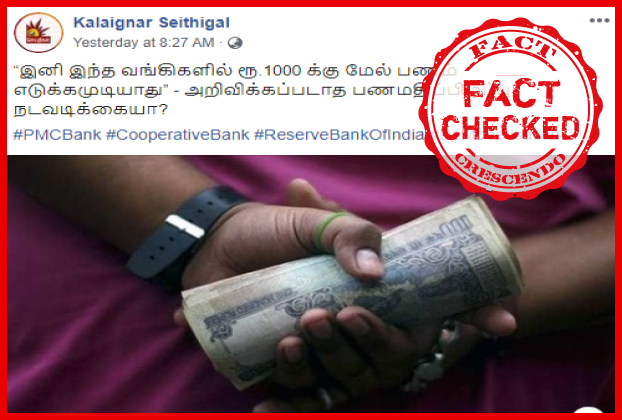
Claim: customers cannot take more than 1000 rs from banks
Publisher’s rating: FALSE
The review checked a circulating Kalaignar Seithigal headline saying customers could no longer withdraw more than ₹1,000 from “these banks,” and questioning whether this was an undeclared demonetisation measure. It says the Facebook page posted the item on September 25, 2019. The fact-check’s central distinction is that the withdrawal restriction described in the article applied to one bank, Punjab and Maharashtra Cooperative Bank (PMC), rather than to banks generally. To check the restriction, the review says it examined a statement published on the Reserve Bank of India’s website. It reports that the RBI had imposed restrictions on PMC under Section 35A of the Banking Regulation Act, 1949, following alleged irregularities. The review says depositors could withdraw only ₹1,000 and that the restrictions also prevented the bank from issuing new loans or renewing existing ones without RBI permission. It found no evidence that the same restriction had been imposed on other banks under that order. The review also compared the headline with the article’s contents. It says the article’s lead correctly identified PMC, while the plural wording in the headline could make readers think multiple banks were affected. The article’s demonetisation comparison was attributed in its body to a customer’s reaction, not presented as an RBI measure. The review therefore found the headline misleading: its broad wording and framing obscured the limited scope of the restriction, even though the article itself contained more specific information.

Claim all the banks be closed from 26th september to 2nd october and there will be no money in the ATM after 27th
Publisher’s rating: FALSE
RBI will soon permanently close 9 nationalized banks
Publisher’s rating: FALSE

Reserve Bank of India is closing down nine commercial banks.
Publisher’s rating: FALSE
The claim was that the Reserve Bank of India (RBI) was closing down nine commercial banks. FACTLY’s review reports that the RBI explicitly rejected the circulating reports. It says the review checked the RBI’s Twitter account and found a post stating: “Reports appearing in some sections of social media about RBI closing down certain commercial banks are false”. The post was dated September 25, 2019, according to the review. The review also cites a separate public response from Finance Secretary Rajeev Kumar. He called the circulating claims “mischievous rumours” and said there was “No question of closing any #PSB”; he added that the government was strengthening public-sector banks through reforms and capital infusion. These statements address the specific allegation that banks were to be shut, rather than simply discussing changes to the banking sector. The review distinguishes the shutdown rumour from a separate banking-reform development: it notes that the government had merged 10 public-sector banks into four. A merger is not evidence that the RBI was closing nine commercial banks. On the evidence it presents—the RBI’s denial and Kumar’s response—FACTLY concluded that the shutdown reports were false.

Poverty in all its manifestations remains one of the greatest challenges facing our world…In this regard, Nigeria has developed a National Social Investment Programme – a pro-poor scheme that targets the poorest and most vulnerable households in the country
Publisher’s rating: Misleading
The claim combines two points: that poverty remains a major global challenge and that Nigeria’s National Social Investment Programme (NSIP) is designed to target the poorest and most vulnerable households. DUBAWA assessed this as a statement by President Buhari. Its review did not conclude that the programme had no achievements; it acknowledged that the government records several. Its central concern was whether the programme’s reach and results could be verified from available information. [S1: “While the government records several achievements under the National Social Investment Policy (NSIP), it is very hard to verify claims about the NSIP”] The review said it could not verify the programme’s activities because there was no credible database containing full details. That limitation matters to the claim: without such records, the excerpt does not establish how many households were reached or whether assistance was concentrated among the poorest and most vulnerable. The review therefore treats the targeting assertion as difficult to substantiate, rather than demonstrating that the programme did not exist or did nothing. [S1: “there is no credible database that houses full details of the activities of the programme.”] As additional context for its assessment, DUBAWA cited the World Poverty Clock, which it described as a platform providing real-time poverty estimates. The review reported that the clock showed 94 million of 197 million Nigerians living in extreme poverty. It also referred to a prior fact-check that had characterized Nigeria as the world’s poverty capital. These figures indicate the scale of poverty cited by the reviewer, but do not by themselves measure NSIP performance or prove who received assistance. [S1: “the World Poverty Clock, a web platform designed to provide real-time poverty estimates, shows that 94 million out of 197 million Nigerians are still living in extreme poverty.”]
رشد تولید ناخالص ملی ایران بدون احتساب نفت در ماههای اخیر مثبت شده است.
Publisher’s rating: غیرقابلاثبات
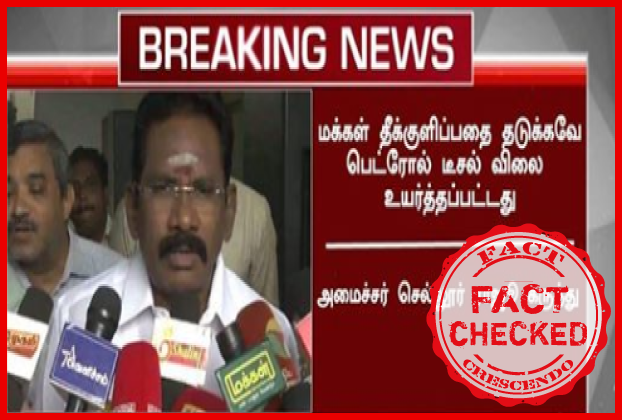
Claim: TN Minister Sellur Raju says fuel price hike prevents suicide attempts
Publisher’s rating: FALSE
The viral post attributed to Tamil Nadu minister Sellur Raju the statement that petrol and diesel prices had been raised to prevent self-immolation incidents. The review says a Facebook post making that claim was shared on September 23, 2019, and presented in the style of a News 7 news card. The investigation identifies the relevant setting: Raju had spoken to reporters on September 22 after actor Vijay’s remarks at a film audio launch drew controversy. In the account of that interview, Raju discussed Vijay’s comments and political seating arrangements—not fuel prices. To check the attribution, the review searched for supporting news coverage and found none. It also checked News 7’s official Facebook page and found no such report. Most directly, it compared the viral claim with the available video of Raju’s interview, stating that he did not discuss petrol or diesel prices there. The review additionally reports that an examination of the circulated image using FotoForensics indicated it had been manipulated. Taken together, the review’s evidence challenges the claim on both attribution and provenance: the cited interview does not contain the alleged statement, the outlet did not have the claimed item on its official page, and the purported news-card image showed signs of alteration. The review concludes that the post was fabricated and that Raju did not make the attributed remark.

Claim people protesting against economic slowdown
Publisher’s rating: FALSE

भारतीय रिजर्व बैंक 9 सरकारी बैंकों को बंद करने जा रहा है।
Publisher’s rating: FALSE
اقتصاد ایران در سال ۲۰۱۷ بالاترین نرخ رشد اقتصادی جهان را داشت.
Publisher’s rating: نادرست

Currency notes of denomination Rs. 5000, Rs. 350, Rs. 5 and Rs. 2 launched by the Reserve Bank of India.
Publisher’s rating: FALSE
The review examines a Facebook post that presented images of Rs. 5,000, Rs. 350, Rs. 5 and Rs. 2 notes as newly launched by the Reserve Bank of India (RBI). It distinguishes between whether the RBI had issued those denominations and whether the pictured Rs. 5 and Rs. 2 notes were genuine: “The Reserve Bank of India hasn’t launched currency notes of denomination Rs. 5000 and Rs. 350. It has also not released new notes of denomination Rupees 5 and 2. And, the images of Rs. 5 and Rs. 2 notes in the post are photoshopped ones.” To check the higher denominations, the review says it looked to RBI announcements and the bank’s published list of notes in circulation. It explains that RBI notifies the public of new notes through circulars on its website, and publishes details and security features for circulating notes on its ‘Paisa Bolta Hai’ website. Its stated finding was that Rs. 5,000 and Rs. 350 notes did not appear on that list: “Rs. 5000, Rs. 350 currency notes are not part of this list.” For the pictured Rs. 5 and Rs. 2 notes, the review points to two specific inconsistencies in the images: the supposed Rs. 5 note bears the words “pachaas rupaiye,” and the Rs. 5 and Rs. 2 notes share the same serial number. It also clarifies that the post’s pictured high-value coins were commemorative coins, which SPMCIL mints and auctions, and that some may not be legal tender. The article’s conclusion is that the RBI had not released the claimed notes, and that the smaller-denomination images were manipulated.
“Azərbaycanda işsizlik səviyyəsi 40-45%-dən 5-6 %-dək azalıb”
Publisher’s rating: yalan

Common man is paying 30% tax, Mukesh Ambani is paying only 22% tax.
Publisher’s rating: FALSE