PeakMetrics / Fact Checks
Economy & business fact checks
Explore claims publishers have checked about economy & business. Read their original ratings and follow the evidence.
Search fact checks
Search by text or image7,100 published reviews in this topic

Correos regala teléfonos móviles como parte de su programa de fidelización
Publisher’s rating: Falso
The claim concerns an email that purported to offer a mobile phone to people selected as Correos customers. The email invited recipients to click a link and complete a survey to qualify for the gift. The review says the message presented this as part of a Correos customer loyalty program, rather than as an offer from an unrelated sender. (S1: “un correo electrónico en el que Correos te invita a recibir un teléfono de regalo al pinchar un enlace y rellenar una encuesta. Supuestamente has sido seleccionado, como cliente de Correos y parte de su programa de fidelización, para responder unas preguntas y optar a un regalo.”) To check the offer, Newtral says it contacted Correos. The postal service confirmed that the message was not one of its promotions and that its IT Security area was working against the scam. That directly contradicts the email’s presentation of the phone as an official Correos loyalty-program reward. (S1: “Desde Newtral.es nos hemos puesto en contacto con Correos que nos ha confirmado que no se trata de ninguna de sus promociones y que su área de Seguridad Informática ya está trabajando contra esta estafa.”) The review describes the purpose of the fake promotion as collecting personal information through a form, and identifies it as phishing. Its evidence therefore addresses the specific phone-and-survey email, not a general claim about Correos rewards: Correos disavowed the promotion, while the email used the promise of a gift to direct recipients to a data-collection process. (S1: “El organismo nos ha confirmado que se trata de una promoción falsa que persigue robar tus datos personales.”)
Massive Recruitment at Kenya Red Cross Society
Publisher’s rating: False.
"지난해 취업자, 고용률, 실업 등 3대 고용지표가 개선됐다"며 "양적 측면에서 V자형 반등에 성공했다"
Publisher’s rating: 절반의 사실
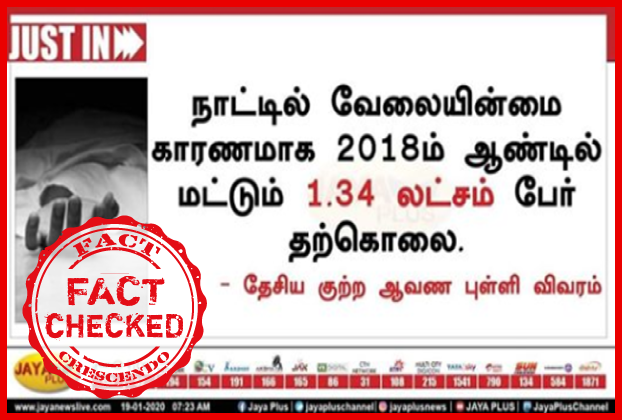
Claim: 134516 unemployed Indians committed suicide during 2018
Publisher’s rating: Fact Crescendo Rating: False
The claim conflates the total number of suicides in India in 2018 with the smaller number attributed to unemployment. The review says that 134,516 was the total number of people who died by suicide that year, while 12,936 deaths were attributed to unemployment. It also gives 13,149 as the number attributed to losses from self-employment. Thus the figure in the claim is not the unemployment-related count.
ファイナンシャルプランナー、証券外務員、生命保険、損害保険、変額保険、少額短期保険募集人、宅地建物取引士
Publisher’s rating: https://kyoko-yamaguchi.com/

NPR పత్రం సమర్పించకుంటే బ్యాంకు ఖాతా నుండి డబ్బులు తీసుకోలేరు.
Publisher’s rating: MISLEADING

NPR document needs to be submitted to withdraw money from the bank accounts.
Publisher’s rating: MISLEADING
The claim concerned a social-media post asserting that the Central Bank of India had added a National Population Register (NPR) document to its KYC requirements and that people could withdraw money from their accounts only if they submitted it. FACTLY examined the bank advertisement cited in the post and the bank’s subsequent clarification. Its account says the advertisement, published in Eenadu in Telangana on 11 January 2019, listed a letter from NPR authorities among documents valid for KYC; it did not say that every listed document had to be submitted. (S1: “In the advertisement, it can be seen that the ‘letter issued by the NPR authorities’ has been included in the list of documents valid for the KYC verification. But, in the advertisement, it is not mentioned that all the documents in the list need to be submitted for the KYC verification.”) The decisive evidence described in the review is a later Central Bank of India clarification, published in Eenadu on 17 January 2020. FACTLY reports that the clarification said “any 1 document” from the list of Officially Valid Documents could be submitted for KYC. It also says the bank clarified the point on Twitter. Thus, the NPR letter was an acceptable option, not a requirement to submit that particular document if another listed document could be provided. (S1: “In the clarification, published in Eenadu on 17th January 2020, it can be read that ‘any 1 document’ from the list of Officially Valid Documents need to be submitted for the KYC verification. Also, the same has been clarified by the Central Bank of India on Twitter.”) The review also checks the broader KYC rules against the Reserve Bank of India’s Master Direction and a government information site. It says the NPR letter appears on the list of valid documents in the RBI direction, including its update dated 9 January 2020, but that the direction does not make it mandatory. The review’s conclusion therefore concerns the post’s specific claim of a compulsory NPR document: the sources it describes distinguish between accepting NPR as one valid document and requiring it in every case. (S1: “Even in the updated direction, there is no mention of mandatory submission of the NPR document for the KYC verification.”)

ఒకప్పుడు అప్పులు తీసుకనే భారత్ ఇప్పుడు అప్పులు ఇస్తుంది.
Publisher’s rating: MISLEADING
“You know, I was a single parent, too. When my wife and daughter were killed, my two boys I had to raise. ... I was making $42,000 a year. I commuted every single solitary day to Wilmington, Delaware — over 500 miles a day, excuse me, 250 miles a day — because I could not afford ... child care. It was beyond my reach.”
Publisher’s rating: Not the Whole Story

“Workers” are “paying on average 20% of their incomes for health care."
Publisher’s rating: Exaggerates
"[T]he American public is getting clobbered. The wealthy are the only ones doing well, period."
Publisher’s rating: False
The preliminary trade deal between the United States and China "is the biggest deal anybody has ever seen."
Publisher’s rating: False

"연간 노동시간이 2000시간 아래로 낮아졌고, 저임금근로자 비중도 20% 미만으로 줄었습니다."
Publisher’s rating: 판단 보류
"2016년에 13만 원 수준이던 쌀값이 19만 원으로 회복되어, 농가소득 4천만 원, 어가소득 5천만 원을 돌파했습니다."
Publisher’s rating: 절반의 사실
"지난해 혁신성장 관련 법안 통과가 지연되는 상황 속에서도, 신규 벤처투자가 4조 원을 돌파했고 다섯 개의 유니콘 기업이 새로 탄생했습니다."
Publisher’s rating: 절반의 사실