PeakMetrics / Fact Checks
Economy & business fact checks
Explore claims publishers have checked about economy & business. Read their original ratings and follow the evidence.
Search fact checks
Search by text or image7,103 published reviews in this topic
"지난해 혁신성장 관련 법안 통과가 지연되는 상황 속에서도, 신규 벤처투자가 4조 원을 돌파했고 다섯 개의 유니콘 기업이 새로 탄생했습니다."
Publisher’s rating: 절반의 사실

Massive recruitment in Kenya for jobs in Canada
Publisher’s rating: False.
KRA Demanded Tax in order to Clear ARVs Shipment to Kenya
Publisher’s rating: False.

"We are now the No. 1 producer of oil and natural gas anywhere in the world."
Publisher’s rating: Not a new feat

Honda is giving away 372 free Activa 5G Scooters on the eve of the company’s 72nd Anniversary.
Publisher’s rating: FALSE
The claim concerns a message offering 372 Honda Activa 5G scooters on the eve of the company’s 72nd anniversary, with recipients directed to a link to avail themselves of the offer. FACTLY reports that the message circulated through WhatsApp and Facebook and concludes that Honda was not giving away scooters; it describes the offer as a scam.
“We are now the No. 1 producer of oil and natural gas anywhere in the world. We are independent, and we do not need Middle East oil.”
Publisher’s rating: This is misleading.
« L'Éthiopie est l'économie à la croissance la plus rapide au monde »
Publisher’s rating: Globalement correct

Bom dia, só hoje a Nike está dando 3 MIL pares de calçados e 2 MIL camisetas totalmente grátis, pelo 55º aniversário
Publisher’s rating: Falso

El empleo está en su peor cifra de los últimos seis años
Publisher’s rating: Engañoso


Los productos catalanes tienen un código de barras propio
Publisher’s rating: Falso
The claim circulated in a WhatsApp message urging a boycott of Catalan products. The message said consumers could identify those products because their barcodes began with 15. Newtral’s review rejects that claim: it says there are no Catalan barcodes and that the Spanish prefix range, 840–849, does not vary by autonomous community. The review describes the barcode system as the international GS1 standard and reports that Spain’s GS1 administration is handled by the Association of Manufacturers and Distributors (AECOC). AECOC told Newtral that a company can obtain a Spanish barcode by selling in Spain and joining the standard, even if its products are not Spanish. The first part of a GTIN barcode is the company’s GS1 prefix; for Spain, it begins with 84 and is unique to each company. Thus, the prefix indicates the company’s GS1 registration, not that a product is specifically Catalan. The review also says that no organization internationally has been assigned prefix 15, and that products beginning with 015 are associated with the United States or with a distributing company registered there. It traces the Catalan-prefix idea to a 2010 initiative that sought an exclusive code beginning with 15, but says it could not meet GS1’s membership requirements: GS1 recognizes one member per country, representing the state. The review separately addresses the viral message’s claim about VAT; it says the applicable Catalan Statute provides for a 50% share, not 100%.
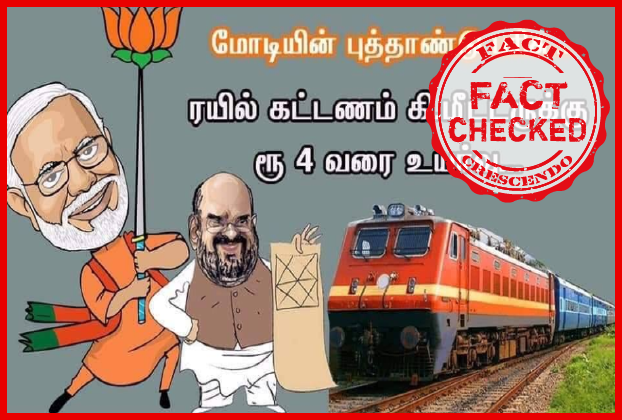
Claim: Train fare raised to Rs 4 per Kilo Meter
Publisher’s rating: Fact Crescendo Rating: False
The review investigates a social-media post claiming that train fares had increased by as much as Rs 4 per kilometre. It says the post, shared on Facebook on January 1, 2020, used images of Narendra Modi and Amit Shah and described the increase as a New Year’s gift. The review focuses specifically on whether the per-kilometre increase was Rs 4—not on whether any fare increase occurred. The review says fares did rise from January 1, but the amounts it reports are in paise: one paisa per kilometre for ordinary trains’ second-class fares, two paise for non-AC mail and express classes, and four paise for AC classes. It describes searching for the Railway Ministry’s announcement and finding it on the ministry’s official Twitter account; the excerpt identifies that announcement as dated December 31, 2019. The review quotes the announcement as saying the increases were one paisa for ordinary non-AC classes, two paise for non-AC mail and express classes, and four paise for AC classes, with no increase for suburban or season tickets. To illustrate the difference between paise per kilometre and rupees per kilometre, the review gives a Chennai–Kanyakumari journey of 727 km: it calculates increases of Rs 7.27 for ordinary travel, Rs 14.54 for non-AC mail or express travel, and Rs 29.08 for AC travel. It concludes that the maximum stated increase was four paise per kilometre, not Rs 4, and says it found no media report stating a Rs 4-per-kilometre increase. Thus, the evidence in the review supports the distinction at the heart of the claim: a fare increase was announced, but the quoted maximum was four paise—not four rupees—per kilometre.


En menos de un año del gobierno del cambio de Juanma Moreno, después de décadas a la cola, Andalucía ya es la tercera potencia económica de España
Publisher’s rating: Falso
The claim linked Andalucía’s position as Spain’s third-largest regional economy to the first year of Juanma Moreno’s government, while also saying the region had spent decades “at the bottom.” The review explains that Moreno was invested as president of the Junta on January 16, 2019, and that this was the first non-socialist Andalusian government since 1982. But the economic figures published in 2019 referred to 2018, so they could not show an improvement produced by Moreno’s administration: they were a statistical revision of the previous year’s data. To assess the ranking, the review consulted the INE’s Regional Accounts of Spain, using GDP at market prices. It reports that Andalucía ranked third, behind Cataluña and the Community of Madrid, throughout the 2000–2018 series, and also held third place in the 1980–1996 and 1995–2000 series. Thus, third place was not a new achievement made in less than a year; and the claim that Andalucía had been at the bottom for decades did not fit the historical ranking by total GDP. The review distinguishes total GDP from GDP per capita, which gives a different picture: in the 2000–2018 series, Andalucía was among the lowest-ranking communities, above only Extremadura until 2017, when Melilla also ranked below it. The review says Andalucía’s 2018 per-capita position did not differ from its historical pattern. That qualification helps explain how the statement could invoke a real low ranking on one measure while misrepresenting the history and timing of the third-place ranking on another.

Los funcionarios de la UE van a subirse la pensión y a jubilarse a los 50
Publisher’s rating: Falso