PeakMetrics / Fact Checks
Economy & business fact checks
Explore claims publishers have checked about economy & business. Read their original ratings and follow the evidence.
Search fact checks
Search by text or image7,100 published reviews in this topic
بین سه تا هفت میلیون کودک کار ایرانی وجود دارند.
Publisher’s rating: شاخدار
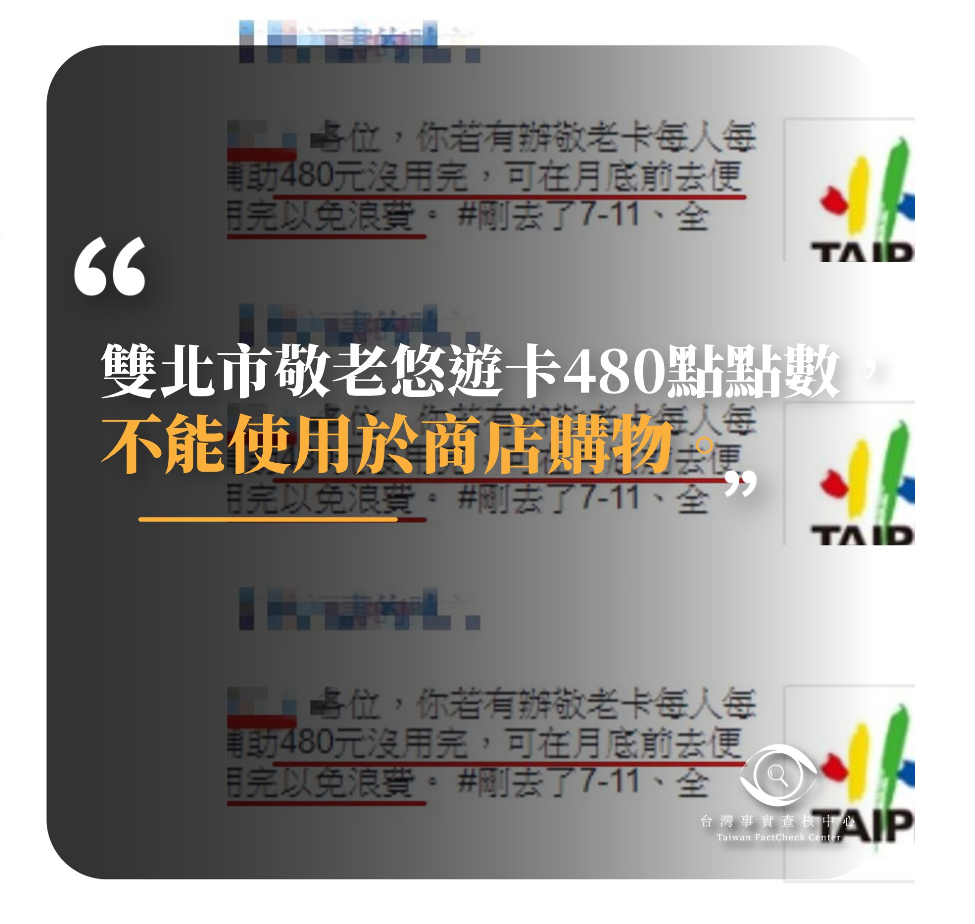
【錯誤】網傳「通告各位好友確定:你若有辦敬老卡每人每個月乘坐交通工具補助480元沒用完,可在月底前去便利商店買東西把他用完以免浪費。」?
Publisher’s rating: 錯誤
The message under review said that holders of senior cards who had not used their monthly 480-point transport allowance could spend the remainder at a convenience store before the month ended. The investigation identified this amount as the allowance on senior EasyCards provided by Taipei and New Taipei City, rather than a general rule for every senior card in Taiwan. It examined the two cities’ card information and interviewed officials and a convenience-store representative. The review states that the points are intended for specified transport and, in Taipei, certain facilities and taxi services—not convenience-store purchases. Supporting source text: “符合傳言指稱的「480點優惠」,為新北、台北二市的「敬老悠遊卡」” and “雙北主要是使用在搭乘指定大眾運輸,其中,台北市還可以在部分場館設施與敬老愛心車隊計程車使用。” A New Taipei City social-welfare official told the investigators that unused monthly points expire automatically and cannot be used directly for shopping. The official distinguished the card’s points from money the holder has loaded: transport fares first draw on the points, but a convenience-store purchase reads only the card’s separately stored cash balance. The review also reports that Taipei City’s social-welfare office confirmed its 480 points could not be used for convenience-store purchases. Supporting source text: “每月未使用完的點數,會在限期內自動歸零,不能直接使用於便利商店或其他商家購物。” and “當長輩使用敬老悠遊卡在便利商店購物,只會讀取自行儲值額。” The review further describes a direct check with FamilyMart: its representative said unused senior-card points could not pay for store purchases, and advised that cardholders could use a separately cash-loaded balance instead. Thus, the message conflates a restricted monthly benefit with the card’s cash-stored balance. The cited investigation supports neither spending the unused points in stores nor the suggestion that doing so is necessary to avoid losing them; it says unused points expire. Supporting source text: “敬老卡限期內沒用完的點數,不能使用在便利商店購物。” and “若長輩需要以卡消費,建議可另外現金儲值再使用。”

Leroy Merlín regala vales de 1.000 euros por la reapertura de sus tiendas
Publisher’s rating: Falso
The claim concerned a supposed Leroy Merlin offer circulating on Facebook: €1,000 vouchers for people who responded to a post. Newtral’s review describes the offer as a phishing scam, not a genuine reopening promotion. The posts impersonated the company and promised vouchers to the first 50,000 people who wrote “VALE” or “LEROY.” The reported sequence explains how the scheme sought personal data. After someone responded, the scammers sent a Facebook message saying the person had won and directing them to click a button to claim the voucher. The review says the fraud consisted of collecting users’ data when they tried to claim the supposed prize. It also reports that Leroy Merlin had issued a warning about the fraud on its official social media account. The excerpt does not provide further details of the review’s verification process or reproduce the company’s warning.
Carrefour ofrece cupones gratuitos de 180€
Publisher’s rating: Falso
Newtral examined messages circulating online and on social media that promised free Carrefour coupons worth €180. The article says the offer used Carrefour’s name and claimed the company was showing solidarity with the country. Newtral reports that recipients were asked to answer questions and then provide personal details to receive a supposed prize; according to the article, the coupon never arrived and the process was intended to collect users’ information. The article says Newtral contacted Carrefour, whose communications department confirmed that the company had no similar promotion. On that basis, Newtral identifies the offer as a phishing scam rather than a genuine Carrefour coupon campaign. The excerpt does not identify a specific message, website, or recipient, so it does not establish the provenance of any particular version beyond the described circulating offer.
El Gobierno acuerda, a 20 de mayo una subida del IRPF y la supresión de extras a funcionarios y pensionistas
Publisher’s rating: Falso

«[Il Recovery Fund] è un prestito, non sono soldi a fondo perduto [...]. È un prestito, come il Mes, è un prestito»
Publisher’s rating: Nì

【錯誤】網傳「台電回饋金採登錄制 6/30前要登入,7/1就截止申請!撥打1911...504元不拿白不拿...按5進入台電紓困登錄,按照指示步驟操作就可以了」?
Publisher’s rating: 錯誤
The message combines claims about a Taiwan Power Company (Taipower) electricity-saving reward with instructions to call 1911, enter a purported relief registration option, and receive NT$504. The review checked the alleged July 1 deadline and fixed payment, and whether the reward and pandemic relief measures were the same program. It reports that Taipower told the Taiwan FactCheck Center the reward activity ran from 2018 through December 13, 2021, inclusive—not until July 1. People who had registered in 2018, 2019 or 2020 retained their registration and did not need to register again. The review also says it checked Taipower’s electricity-saving reward webpage, which identified the circulating message as false. (S1) The reward was not a guaranteed monthly payment. According to the account of Taipower’s explanation, savings were calculated against the same period in the previous year, with NT$0.6 awarded for each kilowatt-hour saved after successful registration; rewards were settled every two months and applied to the electricity bill. The review therefore distinguishes an incentive conditional on actual electricity savings from the message’s claim that people could simply collect NT$504. (S1) The call-in instructions also conflated that reward with a separate electricity-fee relief and deferral program. Taipower told the review that the programs were different: relief measures were directed at industry, not ordinary households or individuals, and did not require users to register with Taipower. The review says it checked Taipower’s relief-program information and called customer service at 1911; the recorded message stated that the relief program did not apply to ordinary homes or individuals and that users who had already registered for the electricity-saving reward did not need to register again. The evidence thus addresses the message’s central instructions as well as its deadline and promised payment. (S1)

ప్రజలకు పెద్ద ఎత్తున ఉద్యోగావకాశాల కల్పించేందుకు దేశంలో 3376 ఇండస్ట్రియల్ పార్కుల ఏర్పాటు
Publisher’s rating: FALSE

«Il blocco dei licenziamenti oggi non c’è più a causa dei ritardi del governo»
Publisher’s rating: Vero
The claim concerned a brief legal gap in Italy’s COVID-era dismissal restrictions on May 18, 2020. Pagella Politica explains that the Cura Italia decree barred collective dismissals and suspended certain individual dismissals for 60 days from March 17. It calculates that the restriction therefore lasted through May 16, inclusive; its conversion into law on April 24 did not restart the 60-day period. Carfagna made her statement two days after that deadline. [S1]


Govt Giving Rs 1.2 L to Workers Employed From 1990-2020
Publisher’s rating: FALSE

லலிதா ஜூவல்லரி உரிமையாளர் கிரண்குமார் ரெட்டி பிறந்து வளர்ந்தது நெல்லூர். பிழைக்க வந்தது சென்னை. சாதாரண நடுத்தர குடும்பம் இன்று தென்னிந்தியாவில் 15 கடைகள் பல ஆயிரம் கோடி சொத்துக்கள். கொரானா நிவாரண நிதியாக தலா ஒருகோடி ஆந்திரா, தெலுங்கானா மாநிலங்களுக்கு. ஆனால் தமிழகத்திற்கு ஒன்றுமில்லை. இதுதான் தமிழ்நாட்டு நிதர்சனம்.
Publisher’s rating: FAKE
Australia "[has] the most secure food security in the world".
Publisher’s rating: In the ballpark
The claim arose during COVID-19 restrictions, when panic buying had caused shortages of some groceries. Agriculture Minister David Littleproud said Australia had the world’s most secure food security, and cited the country’s population and food production. The investigation assessed whether that superlative was warranted, distinguishing a country’s capacity to supply food from people’s reliable access to food that is safe, nutritious and affordable. (S1: “Rice, pasta and some canned foods sold out in the weeks after state and federal governments imposed restrictions”; “We're a nation of 25 million people,” Mr Littleproud told ABC Radio National's Afternoon Briefing program on May 11. “We produce enough food for 75 million.”) The review concluded that Australia had very strong food security, but that the evidence did not establish it was the world’s most secure. It cited the Economist Intelligence Unit’s Global Food Security Index, which placed Australia 12th out of 113 countries in December 2019, with an overall score of 81.4. Australia ranked seventh for affordability and 10th for availability, but 20th for food quality and safety. (S1: “The EIU's Global Food Security Index ranked Australia 12th out of 113 countries in December 2019, based on an overall score of 81.4 out of 100.”; “The EIU ranked Australia seventh for affordability of food and 10th in terms of availability of food.”) The review also described reasons for confidence in Australia’s capacity to withstand supply pressures: it produces abundant food, exports more than it needs, and can draw on alternative sources or change production priorities. But the picture was not that food insecurity was absent. The review reported that the FAO found a rising number of Australians struggling to obtain reliable access to safe, nutritious and affordable food. Thus, strong national production and supply resilience supported a high level of security, while international rankings and domestic access problems qualified the claim that Australia was uniquely the most secure. (S1: “The nation produces an abundance of food, exports far more than it needs, and has ample alternative sources of certain foods should they become scarce.”; “the FAO found that an increasing number of people in Australia struggled to obtain reliable, safe, nutritious and affordable food.”)



പ്രധാനമന്ത്രിയുടെ സാമ്പത്തിക പാക്കേജിനെ അപലപിച്ചു കൊണ്ട് 24 ന്യൂസ് ചാനൽ വാർത്ത പ്രസിദ്ധീകരിച്ചു
Publisher’s rating: FALSE

«Portogallo, Spagna e Grecia hanno detto NO al MES»
Publisher’s rating: C'eri quasi
The claim concerned whether Portugal, Spain and Greece had rejected the European Stability Mechanism’s Pandemic Crisis Support, a lending instrument for euro-area states’ health spending related to Covid-19. The review explains that Borghi’s statement was about not using this new instrument, rather than a general rejection of the mechanism. It says the potential loans could amount to up to 2 per cent of each country’s 2019 GDP. The publisher reports that it checked the claim and consulted foreign fact-checking colleagues. For Portugal, the review reports that the government welcomed the instrument but was not planning to use it at that time. It cites Finance Secretary Ricardo Mourinho Félix, who said on 8 May that Portugal had regular, favourable access to markets and that using the credit line did not then seem sensible. The review notes that Portugal had not ruled out using it later. For Spain, it cites Finance Minister María Jesús Montero’s 8 May statement that the instrument was positive while the government was receiving a good response in debt markets. The review says Spain had not adopted an official, explicit refusal, according to its colleagues at Maldita and Newtral. For Greece, the review reports that Finance Minister Christos Staikouras said on 9 May that, based on current data, the country did not need to borrow through the instrument. It says there had been no official refusal, and relays a reported explanation that Athens preferred to avoid being the first to apply, while possibly waiting for Italy to move first. The review’s conclusion is therefore narrower than a categorical, permanent rejection: all three countries were not seeking the loans at that point, but the evidence did not establish definitive refusals in every case.

500 TKA Cina bakal mengerjakan proyek PLTU di Morowali seperti yang terlihat dalam sebuah video
Publisher’s rating: Sesat