PeakMetrics / Fact Checks
Economy & business fact checks
Explore claims publishers have checked about economy & business. Read their original ratings and follow the evidence.
Search fact checks
Search by text or image7,095 published reviews in this topic

安倍晋三元首相が「ドルで給料をもらっている人はいない!円安は国民生活に影響はありません!」と発言した
Publisher’s rating: ミスリード

Der Staat verdiene an den teuren Spritpreisen
Publisher’s rating: Falsch. Hohe Energiepreise führen zu weniger Steuereinnahmen an anderer Stelle, etwa bei Einkommenssteuern und Sozialbeiträgen.


Haldiram’s group is currently under the ownership of a Muslim; Yogesh & Naresh, grandsons of Haldiram sold the company to a Muslim
Publisher’s rating: FALSE
The claim under review says Haldiram’s group is owned by a Muslim and that two grandsons, Yogesh and Naresh, sold the company. The review examined both parts: whether those named individuals were grandsons of founder Ganga Bhishen Agarwal, and whether Haldiram business units had been sold or were owned by people outside the family.
اتفاق خبراء صندوق النقد على قرض للبنان... غير ملزم وشبيه بـ"سيدر"؟
Publisher’s rating: صحيح جزئياً

सोशल मीडिया वर एक चित्र व्हायरल होत आहे, ज्यात दावा करण्यात येत आहे कि काँग्रेस ची सरकार असताना पेट्रोल ६० रुपये होते, डिझेल ४० आणि गॅस सिलेंडर ४५० तेव्हा भाजप च्या कार्यकर्त्यांनी कपडे काढून प्रदर्शन केले होते.
Publisher’s rating: MISLEADING
The claim attached to the viral image was that BJP workers had stripped during a protest against the prices of petrol at ₹60, diesel at ₹40 and a gas cylinder at ₹450, when Congress was in government. Vishvas News says its investigation found the image was from a 2013 demonstration in Ambala, Haryana, and that the claim connecting the protest to those prices was false. To trace the image, the review reports searching Google using keywords. It found an India.com report published on 7 August 2015 that discussed the image in the context of a political exchange: after Smriti Irani criticised Congress’s performance, Congress leader Raja Amarinder showed the image and said the BJP should not forget its own record. The review also found a Daily Tribune report dated 22 September 2013. According to Vishvas News’s account of that report, BJP workers led by Anil Vij marched in a semi-nude state through markets in Ambala Cantonment. The review says the 2013 demonstration concerned alleged bias in development work in Ambala Cantonment, not inflation. It also reports that Vishvas News shared the viral claim with Deepak Bahl, identified as Ambala’s chief reporter, who said the protest was about bias among constituencies rather than rising prices. Thus, the image depicts a real protest, but the price-related explanation attached to it misstates the protest’s stated purpose.
പണം മരത്തില് ഉണ്ടാവുന്നതല്ല; വാങ്ങിയ കടം വീട്ടാന് പെട്രോള് വില കൂട്ടും’ ഡോ. മന്മോഹന് സിംഗ്
Publisher’s rating: MISSING CONTEXT

In a span of two months, 317 foreign companies have moved out of Karnataka
Publisher’s rating: FALSE
The review assessed a social-media post alleging that 317 foreign companies had moved out of Karnataka in a two-month period. It placed the post amid communal tensions in the state, including disputes over hijab in educational institutions, Muslim traders at temple fairs, and calls to boycott halal meat. It also noted that business-community leaders had voiced concern about the tensions; those concerns, however, are not evidence that companies had actually left. [S1: “A social media post claiming that in a span of two months, 317 foreign companies have moved out of Karnataka is being widely circulated across all platforms.”; “Lately, Karnataka has been witnessing communal tensions, starting with tensions over a government order banning Muslim women from wearing hijab to educational institutions, followed by Muslim traders being barred at temples during religious fairs, and the latest one calling for a boycott of halal meat.”] For the central claim, the review said it found no official or unofficial reports of companies moving out in numbers remotely as large as alleged. It explained that a departure on that scale would have been reported by the media, but said it found no such reports. This is the review’s stated check; the excerpt does not identify a company-by-company database or name specific outlets searched. [S1: “However, there are no official or unofficial reports of such a large number of companies moving out of the state lately as claimed in the viral post.”; “If companies in such large numbers have indeed moved out of the state, the media would have reported it. However, there are no such reports.”] The review also cited investment data as context against the post’s portrayal of a mass business exodus: it said Karnataka had the country’s highest foreign direct investment inflows in the latest available information and cited the Maharashtra Economic Survey’s figure of Rs 1,02,866 crore in FDI inflow for Karnataka in 2021–22. That measure concerns investment inflows, not a direct count of company relocations, so it is supporting context rather than a standalone test of whether any particular company moved. The review’s decisive point was the lack of reports supporting the specific claim of 317 departures. [S1: “Further, as per the latest available information, Karnataka has witnessed the highest inflows of foreign direct investment (FDI) in the country.”; “Moreover, according to the Maharashtra Economic survey report, Karnataka leads with Rs 1,02,866 crore FDI inflow in 2021-22.”]

هل الاتفاق مع صندوق النقد الدولي سيوحِد سعر الصرف؟
Publisher’s rating: غير صحيح

భారతదేశ జీడీపీలో అప్పుల వాటా శ్రీలంకలో లాగా ఎక్కువగా ఉంది
Publisher’s rating: MISLEADING

60% من الذهب في المصرف المركزي لم يتمّ جرده
Publisher’s rating: صحيح
The claim concerned whether auditors could physically inventory about 60% of the gold held by Lebanon’s central bank. The review says Reuters examined the central bank’s 2018 financial statements, prepared by Deloitte and Ernst & Young, and reports that the auditors could not conduct a physical inventory because access was reserved for senior bank executives. It also says L’Orient-Le Jour reviewed the report and described more than 60% of the gold as not physically inventoried because auditors could not access it under the restrictions. The review places the finding in the context of a longer-running limitation, rather than presenting it as evidence that the gold was missing. It reports that lawmakers told L’Orient-Le Jour a substantial part of the reserve had not been accounted for since 1996, and quotes former official Alain Bifani saying that, to his knowledge, auditors had not been allowed to inventory the reserves in the preceding 30 years. The review’s conclusion is specifically about inability to access the gold for physical inventory; it does not establish that the gold was absent or quantify any loss.

IOCL warning informing people not to fill petrol or diesel in vehicles to the maximum limit
Publisher’s rating: FALSE
The claim concerned a social-media post asserting that Indian Oil Corporation Limited (IOCL) had warned people against filling petrol or diesel tanks to their maximum limit. The post attributed the warning to rising atmospheric temperatures and a risk of explosions from overfilling, and said IOCL recommended filling only halfway. FACTLY’s review examined whether IOCL had issued such a warning. The review reports that IOCL addressed the circulating message in a Facebook post on 09 April 2022. According to the review, IOCL called the message fake and said fuel can safely be filled to the maximum limit specified by the vehicle manufacturer, in winter or summer. This directly contradicts the post’s attribution of a half-tank recommendation and an overfilling warning to IOCL. The review also describes IOCL’s earlier statements when similar messages circulated in 2018 and 2019. Those statements said vehicle manufacturers design fuel tanks with safety factors and that filling to the specified maximum is safe regardless of season. The review further notes that posts resurfaced alongside reports about a bike petrol-tank explosion in Andhra Pradesh, but says there was no evidence that overfilling caused that explosion. Its reported evidence therefore disputes both the alleged IOCL warning and the suggested link between overfilling and that incident.

Video shows Haldiram’s company being caught red-handed while mixing meat in its products
Publisher’s rating: FALSE
The claim concerns a video circulated as showing Haldiram’s caught mixing meat into its products. FACTLY identifies the footage as a Sudarshan News broadcast and says the anchor’s actual concern was the Arabic-language text on a packet of Haldiram’s Falahari Mixture. The review reports that the broadcast did not show or state that the company had been found mixing meat; the anchors instead speculated about what the packet’s language might mean. To check that interpretation, FACTLY says it examined an extended version of the broadcast and translated the disputed text on the packet. It found that the text was Arabic, not Urdu, and was a translation of the English product information printed above it. The review says that information did not state that the product contained meat. It also notes that the packet displayed the prescribed vegetarian-food symbol. The review further reports statements from Haldiram representatives explaining the Arabic text as product information for consumers and saying Arabic is used because products are sold in markets where local-language labelling is required. On the evidence described, the video’s language-label discussion and the packet’s product information do not establish that meat was being mixed into the product or that the company was caught doing so.
USA steigerten ihre Erdöl-Importe aus Russland um 43 Prozent
Publisher’s rating: Die Behauptung beruht auf tatsächlichen Zahlen, ist aber völlig aus dem Kontext gerissen. Die 43 Prozent ergeben sich aus einem wöchentlichen Vergleich. Zwischen 18. März und 25. März stieg die Erdölabnahmemenge der USA aus Russland tatsächlich um 43 Prozent. Allerdings unterliegen die US-Erdölimporte – nicht nur aus Russland – starken Schwankungen. Zudem sind die USA noch bis 22. April berechtigt, Altverträge zum Erdölimport aus Russland einzuhalten. Erst danach gilt der generelle Importstopp.

Cesta de chocolate de Páscoa Lacta GRÁTIS 5.000 presentes grátis para você
Publisher’s rating: Falso

Increase in petrol prices is because of debts incurred by the previous UPA government led by Congress in the form of oil bonds
Publisher’s rating: MISLEADING
The claim under review was that petrol prices were rising because the Modi government was repaying oil-bond debts incurred by the previous Congress-led UPA government. The review examined the outstanding bond obligations, repayments by the later government, and central-government revenue from taxes on petroleum products; it did not present evidence establishing that oil-bond repayments set or directly caused petrol prices. The review says that when the BJP-led NDA first took office in 2014, outstanding oil-bond dues were Rs. 1,34,423 crore. It reports that from fiscal years 2014–15 through 2020–21, the government paid Rs. 73,695.72 crore in principal and interest on the bonds, while collecting more than Rs. 25 lakh crore in petroleum-product taxes over the same period. The review’s comparison is that repayments were only a fraction of those tax receipts, so the outstanding bond burden did not justify the price increases. The review also notes that the government still had Rs. 92,200.17 crore in bonds due over the four years from 2023 to 2026. It describes the original UPA-era bonds as one way of covering oil companies’ losses from selling fuel at subsidised rates, alongside budget allocations and contributions from oil companies. These figures provide context for the debt, but the review’s conclusion rests on comparing bond payments with petroleum-tax revenue—not on a detailed calculation of how each component determined retail petrol prices.
P20 peso coins can be exchanged for cash or sacks of rice
Publisher’s rating: Fake
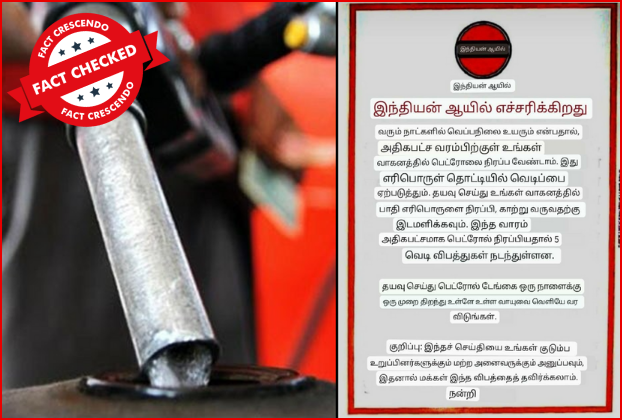
Claim: Indian oil not issued this warning on fuel tank fill
Publisher’s rating: FALSE
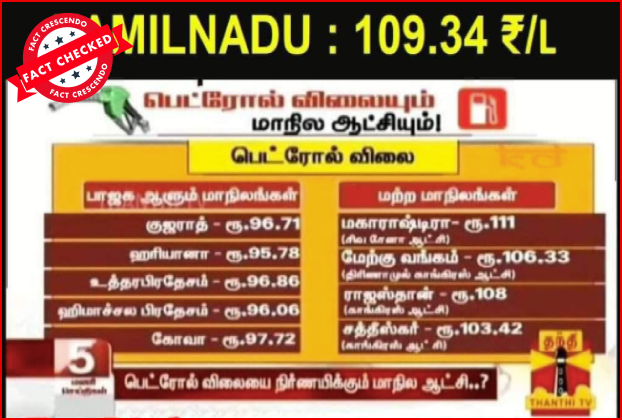
Claim: misinformation spreading that petrol price is low in bjp ruling states
Publisher’s rating: FALSE
The post compared petrol prices in states governed by different parties, presenting Tamil Nadu at ₹109.34 per litre and Gujarat, Haryana, Uttar Pradesh, Himachal Pradesh and Goa at less than ₹100. It was shared on Facebook on April 5, 2022. Fact Crescendo checked whether the figures represented prices at that time, rather than relying on the graphic’s comparison alone. The review says the graphic came from a Thanthi TV news card uploaded to YouTube on March 24. It compared the listed petrol prices in five BJP-governed states with Tamil Nadu, but was shared nearly two weeks later as if it reflected current prices. Checking prices in the named cities for April 5 and 6, the article reports that all were above ₹100 per litre: Ahmedabad was ₹104.28 on April 5 and ₹105.43 on April 6; Gurugram was ₹104.76 and ₹105.77; Lucknow was ₹105.25 on both days; Shimla was ₹104.91 and ₹106.54; and Goa was ₹105.07 and ₹106.51. The review also gives counterexamples to the claim that prices were low specifically in BJP-ruled states. It reports petrol at ₹111.16 per litre in Bengaluru, ₹118.25 in Bhopal, ₹116.29 in Patna and ₹104.65 in Puducherry on April 6. Its explanation is that prices had begun rising again from March 22, after a 137-day period without increases during the five-state election period. The investigation concludes that the old card did not establish current prices: at the time covered by the review, prices in the listed locations—and, it says, across all Indian states—were above ₹100 per litre.