PeakMetrics / Fact Checks
Economy & business fact checks
Explore claims publishers have checked about economy & business. Read their original ratings and follow the evidence.
Search fact checks
Search by text or image7,096 published reviews in this topic
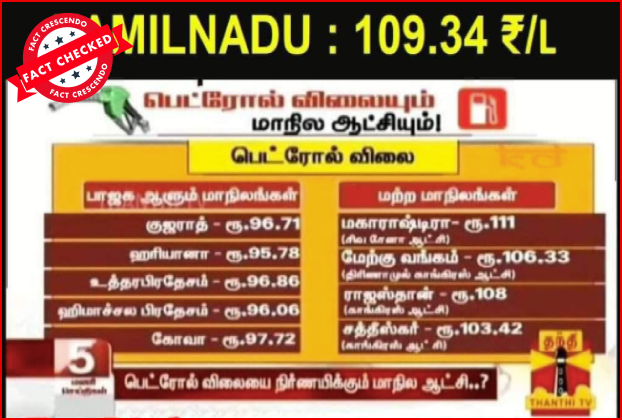
Claim: misinformation spreading that petrol price is low in bjp ruling states
Publisher’s rating: FALSE
The post compared petrol prices in states governed by different parties, presenting Tamil Nadu at ₹109.34 per litre and Gujarat, Haryana, Uttar Pradesh, Himachal Pradesh and Goa at less than ₹100. It was shared on Facebook on April 5, 2022. Fact Crescendo checked whether the figures represented prices at that time, rather than relying on the graphic’s comparison alone. The review says the graphic came from a Thanthi TV news card uploaded to YouTube on March 24. It compared the listed petrol prices in five BJP-governed states with Tamil Nadu, but was shared nearly two weeks later as if it reflected current prices. Checking prices in the named cities for April 5 and 6, the article reports that all were above ₹100 per litre: Ahmedabad was ₹104.28 on April 5 and ₹105.43 on April 6; Gurugram was ₹104.76 and ₹105.77; Lucknow was ₹105.25 on both days; Shimla was ₹104.91 and ₹106.54; and Goa was ₹105.07 and ₹106.51. The review also gives counterexamples to the claim that prices were low specifically in BJP-ruled states. It reports petrol at ₹111.16 per litre in Bengaluru, ₹118.25 in Bhopal, ₹116.29 in Patna and ₹104.65 in Puducherry on April 6. Its explanation is that prices had begun rising again from March 22, after a 137-day period without increases during the five-state election period. The investigation concludes that the old card did not establish current prices: at the time covered by the review, prices in the listed locations—and, it says, across all Indian states—were above ₹100 per litre.

India’s debt to GDP ratio figures is in line with that of Sri Lanka.
Publisher’s rating: MISLEADING
FACTLY examined a social-media post circulating amid Sri Lanka’s economic crisis. It claimed India’s debt-to-GDP figures were in line with Sri Lanka’s and suggested India faced a similar crisis. The review distinguishes India’s national debt from the combined debt of the central and state governments—a distinction that changes the comparison. For India’s national debt, the review says it used debt-position information on the Reserve Bank of India website. It reports that from 2016–17 through 2020–21, national debt was around 50% of GDP, substantially below the post’s figures. It also notes that India’s external liabilities were just under 3% of GDP, unlike Sri Lanka, where external and domestic debt were nearly equal. The comparison looks different when states’ outstanding debt is added: the review says the combined central-and-state figure was in line with the post’s figures for every year except 2020–21. Thus, the post’s comparison was not an accurate description of India’s national debt alone, though including state debt brought the figures closer to its claim.
Claim: sbi not writes off adani groups 12770 crore worthy loan
Publisher’s rating: FALSE

Der Rubel ist an Gold gebunden worden.
Publisher’s rating: Falsch. Zwar kauft die Notenbank Russlands derzeit Gold zu einem Festpreis ein, die Einführung eines «Goldstandards» ist damit jedoch nicht gegeben.
The claim arose from online posts asserting that Russia’s central bank had tied the ruble to gold, and that this would sharply reduce the value of the dollar and euro. The review traces the claim to a blog article published on March 28, 2022, and explains that it relied on reports of a fixed price for gold purchases by the central bank. The measure described was a commitment to buy gold from Russian banks—not an announcement that rubles could be exchanged for gold. [S1: “Auf Facebook (archiviert) und Telegram (archiviert) kursiert zusätzlich die Behauptung, die russische Zentralbank habe den Rubel nun an Gold gebunden” / “Am 28. März veröffentlichte ein Blog einen Artikel, in dem es heißt, dass die Währung Rubel vorerst an Gold gebunden sei.”] The review says that the central bank would buy one gram of gold for 5,000 rubles through the end of June. It compares that price with an international-market figure: on March 28, one gram was about US$68, or approximately 6,655 rubles. This comparison shows that the announced purchase price was lower than the cited price outside Russia; it does not establish a gold-convertibility commitment. [S1: “Die russische Zentralbank wird bis Ende Juni Gold zu einem Festpreis von ihren Banken kaufen, nämlich 1 Gramm Gold für 5000 Rubel.” / “Am 28. März musste für 1 Gramm Gold etwa 68 US-Dollar gezahlt werden. Das entsprach umgerechnet circa 6.655 Rubel.”] The key distinction is that buying gold at a set price is not, by itself, the same as guaranteeing that holders can redeem currency for gold. The review states that a gold standard would require the central bank both to buy and sell gold at a fixed price, and cites an expert definition that also entails an obligation to purchase gold and redeem money. It reports that Russia was buying gold voluntarily and quotes the central bank’s stated purpose as balancing domestic supply and demand. The review also notes that, in the days after the fixed-price measure was introduced, the predicted rush from dollars and euros into rubles was not visible on international financial markets. [S1: “Damit dies zutrifft, müsste die russische Zentralbank das Gold nicht nur zu einem Festpreis einkaufen, sondern auch verkaufen.” / “Laut der russischen Zentralbank selbst dient die Wiederaufnahme des Goldankaufs dem Ausgleich von «Angebot und Nachfrage auf dem inländischen Edelmetallmarkt».” / “Eine solche Entwicklung lässt sich auf den internationalen Finanzmärkten wenige Tage nach der Einführung des Festpreises nicht feststellen.”]

బీజేపీ పాలిత రాష్ట్రాలతో పోల్చుకుంటే తెలంగాణలోనే పెట్రోల్ ధరలు అధికంగా ఉన్నాయి
Publisher’s rating: MISLEADING

الدولة اللبنانية تعلن إفلاسها وتقول إنها ستوزع الخسائر على المصارف والمودعين
Publisher’s rating: تضليل
Sandro Marcos proposed to impose taxes on seafarers, nurses and other high-income Filipino earners based abroad
Publisher’s rating: Fake

महिला दिवस के मौके पर अमेजन कंपनी मुफ्त गिफ्ट दे रही है। इ
Publisher’s rating: FALSE


Claim: nirmala sitharaman not made this announcement on gst
Publisher’s rating: FALSE
The claim concerns a social-media news card, made to look as if it came from Thanthi TV, saying that 12% GST on house and shop rents would be introduced at the next GST Council meeting and attributing that announcement to Finance Minister Nirmala Sitharaman. The review says the card circulated on Facebook and notes that one user posted it on April 2, 2022. Its subject is the alleged announcement in that card, not whether GST rules already applied to some rentals. Fact Crescendo describes checking whether Sitharaman had made such an announcement by searching Google for reports and says it found no media outlet reporting it. It also checked whether Thanthi TV had published the card. The review found a similar-looking card from the broadcaster, but its actual text concerned March GST collections of ₹1.42 lakh crore, not a new tax on rent. The review says the circulating version had been altered with false information. The review further reports that Fact Crescendo sent the card to the person responsible for Thanthi TV’s digital division, who said it was fake, and that the broadcaster also posted on its social-media accounts identifying the card as fake. Together, the mismatch with the broadcaster’s genuine card and the broadcaster representative’s confirmation support the review’s conclusion that the attributed announcement was fabricated. The review separately notes that GST rules already provided for GST on certain rental arrangements, subject to limits; that existing tax treatment does not establish that Sitharaman made the announcement shown in the card.

التسجيل على البطاقة الذكية في ألمانيا لمواجهة ارتفاع الأسعار
Publisher’s rating: سخرية
Kijk nou, ze hebben gewoon zonnebloemolie in Spanje en trouwens het komt helemaal niet uit Oekraïne.
Publisher’s rating: Het kan best zijn dat de vriendin toevallig een supermarkt heeft gevonden waar nog wél zonnebloemolie aanwezig was, maar Spanje kampt met vergelijkbare voorraadproblemen als Nederland. Oekraïne is bovendien ’s werelds grootste producent van zonnebloemolie.
The review examines a Facebook post said to show a friend’s photograph from Spain, accompanied by the assertions that Spain was “swimming in sunflower oil” and that most sunflower oil came from France rather than Ukraine. The fact-check looked closely at the image: the visible Vita d’Or brand is Lidl’s house brand, while Spanish wording on the bottles and nearby packaging points to a Lidl in Spain. But one photograph of stocked shelves does not establish that supplies were plentiful across the country. The review describes evidence of restrictions and shortages as well as the possibility that some oil remained available. Lidl had limited purchases to five litres per customer on 5 March. The company later said the limit was precautionary, intended to prevent a shortage prompted by panic buying, rather than proof that a shortage had already occurred. The review also cites an El País report describing consumers emptying shelves of milk and oil amid fears of shortages, with the disruption linked to the war in Ukraine and a transport-sector strike. Its conclusion is that the photographed stock could have been real, but did not support the broader claim that Spain was awash in oil. On origin, the review says Ukraine led sunflower-oil production, followed by Russia, and that the two countries together accounted for about 80% of global trade in sunflower oil and meal in an average year. It further reports that Spain obtained 62% of its sunflower oil from Ukraine, citing El País. However, the review explicitly says it could not establish whether the specific Vita d’Or oil in the Facebook photo came from Ukraine: dpa had asked the brand’s producer and had not received a response. Thus the country-level claim about Spain’s supply is addressed, but the origin of the pictured product remains unverified.

Unemployment data for Jan-Mar 2020 is compared with the unemployment rates of July-Sept 2021
Publisher’s rating: MISLEADING
The post compared unemployment figures for Jan–Mar 2020 with those for July–Sept 2021 to argue that the Narendra Modi government had performed poorly. The review says the figures were “true to an extent,” but that the comparison was not appropriate: the first quarter was before the COVID-19 lockdown, while the second was after the initial lockdown. Comparing those endpoints without accounting for the intervening pandemic disruption obscures how unemployment changed across the period. [S1: “A post claiming to show the unemployment rates for Jan-Mar 2020 and July-Sept 2021 and comparing them to show the dismal performance of the Narendra Modi government, is being widely shared on social media.”; “The data for the quarter Jan-Mar 2020 (the quarter before the COVID-19 lockdown) is compared to the July-Sept 2021 quarter, which is after the initial lockdown.”] As a point of comparison within the pandemic period, the review reports that the unemployment rate fell from 13.2% in July–Sept 2020 to 9.8% in July–Sept 2021. It also gives declines for men, from 12.6% to 9.3%, and women, from 15.8% to 11.6%. These figures show why selecting the July–Sept 2021 endpoint alone does not convey the trajectory during the pandemic. [S1: “According to Periodic Labour Force Surveys, the unemployment rate registered a decline from 13.2% in July-Sept 2020 quarter to 9.8% in July-Sept 2021. The male unemployment rate declined from 12.6% to 9.3% and the female unemployment rate declined from 15.8% to 11.6%.”] The review also presents annual figures: the overall rate declined from 6.1% in 2017–18 to 4.8% in 2019–20, with declines for men and women as well. It distinguishes those annual figures from the quarterly comparison and notes that lockdowns and the second COVID-19 wave affected quarterly unemployment numbers. Its conclusion therefore concerns the suitability of comparing the selected pre-lockdown and post-initial-lockdown quarters, not whether every number in the post was false. [S1: “The unemployment rate registered a decline from 6.1% in 2017-18 to 4.8% in 2019-20. The male unemployment rate declined from 6.2% to 5.1% and the female unemployment rate declined from 5.7% to 4.2% in the last few years.”; “The initial lockdown in 2020 and the second wave of COVID-19 have impacted the quarterly numbers i.e., unemployment rates. The unemployment rates were high during these periods.”]
Das ist ein Gewinnspiel von Edeka.
Publisher’s rating: Die angeblichen Gewinnspiele haben nichts mit Edeka zu tun und sind nicht glaubwürdig. Polizei und Verbraucherschützer warnen vor solchen dubiosen Angeboten.
The review examined Facebook posts from pages presenting themselves as Edeka pages. They advertised shopping vouchers and cash prizes for simple tasks, such as counting three-legged cats in an image or finding a number. The investigation therefore addresses the claim that the pictured offer is an Edeka giveaway, rather than giveaways in general. The posts did not establish that Edeka was running the promotions. The review says the pages did not make clear who was organizing the offers and lacked the required business-site imprint identifying the page’s operator. It also notes that the posts lacked Facebook’s verification badge. In contrast, the review describes Edeka’s official Facebook page as having a complete imprint and more than 1.2 million followers, while the pages carrying the false giveaways had few subscribers and posted little beyond the giveaway and a cover photo. These details support the finding that the offers were not official Edeka promotions. The review also describes what happened after users participated: they were directed to another website to confirm entry and prompted to provide personal data. It warns that such data could be sold and reports that consumer-protection organizations and police cautioned against giving personal information to dubious giveaway offers. The excerpt does not identify the specific Facebook page or prize in the claim, so its findings apply to the described Edeka-branded posts, not necessarily to every offer using Edeka’s name.


Promoção Páscoa Cacau Lovers 2022 2.975 Ovos de Chocolate, com 7kg cada!
Publisher’s rating: Falso

Claim: nirmala sitharaman not commented this on fuel price hike
Publisher’s rating: FALSE


Claim: misinformation spreading that ladli foundation helpline for marriage donations
Publisher’s rating: FALSE