PeakMetrics / Fact Checks
Disasters & emergencies fact checks
Explore claims publishers have checked about disasters & emergencies. Read their original ratings and follow the evidence.
Search fact checks
Search by text or image3,259 published reviews in this topic

Syrië krijgt na de aardbeving geen hulp van de Westerse landen vanwege de sancties.
Publisher’s rating: Nee, de sancties zijn niet de reden waarom westerse hulp niet in de getroffen gebieden geraakt. Het westen stuurt al jaren ondanks de sancties humanitaire hulp naar Syrië. Het regime van President Bashar al-Assad in Damascus verhindert dat humanitaire hulp de door de aardbeving getroffen regio bereikt. Die regio is grotendeels in handen van rebellengroepen die zich verzetten tegen het bewind van Assad.
The claim under review was that Syria received no Western assistance after the earthquakes because sanctions blocked it. The review focuses on the badly affected northwest, where aid was slow to reach people after the 6 February 2023 earthquakes. It distinguishes Western efforts to provide aid from the separate question of whether supplies could reach that opposition-controlled region: the review says the EU was sending items including tents, blankets, medicines, generators and food, while little aid had yet reached the hardest-hit northwest. The investigation identifies the Syrian government’s insistence that foreign aid pass through Damascus, rather than cross into the region from Turkey, as the main obstacle described by its sources. It reports that many Western countries did not accept that route because they doubted aid would reach its intended recipients. ECFR expert Kelly Petillo told dpa that the demand to route aid through Damascus was the main reason aid was not reaching people in the northwest, both before and after the earthquake. On 13 February, UN Secretary-General António Guterres announced that Bashar al-Assad had agreed to open two additional crossings from Turkey; the review said whether this would speed deliveries remained to be seen. The review also gives evidence against sanctions being a blanket bar to Western humanitarian aid. It states that the EU and its member states had made more than €27.4 billion available for Syrians since 2011, in both government- and opposition-controlled areas, despite EU sanctions on the Syrian regime. It says US and EU sanctions included humanitarian exceptions. The review does acknowledge that some aid organizations reported sanctions could hinder certain assistance, and that the US introduced a 180-day exception for earthquake-related transactions. But it quotes Petillo as emphasizing that sanctions were not the main problem preventing aid from reaching northwest Syria.

Videonun 6 Şubat depremi öncesindeki gökyüzünü gösterdiği iddiası
Publisher’s rating: Yanlış

Fotoğrafın Kahramanmaraş’ta depremzede bir aileyi gösterdiği iddiası
Publisher’s rating: Yanlış

టర్కీ అధ్యక్ష్యుడు ఎర్డోగాన్, భారత్ అందించిన భూకంప సహాయానికి మీడియా ముందు ఏడ్చాడు
Publisher’s rating: FALSE
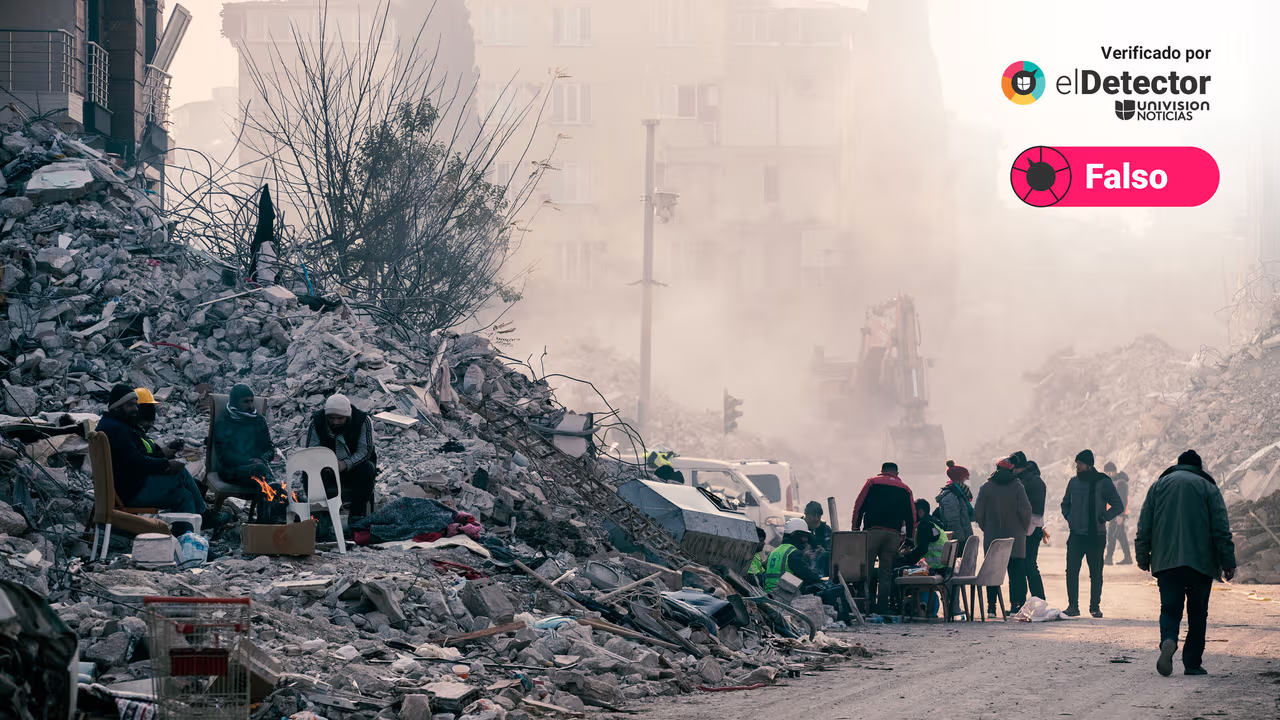
Los terremotos se pueden predecir.
Publisher’s rating: Falso

Une vidéo de phénomènes précédant les tremblements de terre en Turquie prouve qu'ils ont été déclenchés par des moyens artificiels.
Publisher’s rating: Les tremblements de terre survenus en Turquie et en Syrie sont le résultat naturel du mouvement des plaques tectoniques. Les vidéos des caméras de surveillance présentées comme une preuve de l'artificialité des séismes sont celles d'un autre tremblement de terre. De plus, le projet HAARP n'a pas la capacité de provoquer des séismes ou toute autre catastrophe naturelle.
The claim focuses on surveillance footage circulated as evidence that the February 2023 earthquakes in Turkey were artificially triggered. The investigation reports that the footage itself identifies a different event: a year visible in the video’s upper-left corner is 2022, and the images show the earthquake that struck Düzce province on November 23 that year—not the February 2023 disaster. [S1]

Ces photos montrent la ville turque de Kahramanmaras avant et après le tremblement de terre.
Publisher’s rating: Les dégâts constatés à Kahramanmaras sont certes énormes, mais le photomontage relayé sur les réseaux sociaux ne représente pas exactement la situation avant et après la catastrophe. Les deux photos montrent en fait deux endroits différents de la ville. En outre, il n'existe aucune preuve que la première photo ait été prise avant les séismes.
Video shows a building scaffolding collapse in Turkey after the 7.8 magnitude quake struck on Feb. 6, 2023
Publisher’s rating: False

De aardbevingen in Turkije en Syrië waren een HAARP-aanval.
Publisher’s rating: Het onderzoeksproject HAARP kan geen aardbeving veroorzaken. Het project werkt met hoge frequentie-radiogolven en die kunnen geen steenverschuiving in de aardkorst veroorzaken. Het gebied in Turkije waar het epicentrum van de aardbevingen was, ligt op de grens tussen verschillende tektonische platen. Lichtfenomenen tijdens aardbevingen zijn vaak te verklaren door de beschadiging van stroomvoorzieningen.
The claim concerns the devastating earthquakes that struck Turkey and Syria on February 6, 2023, and the allegation that they were caused by a HAARP attack. The review also addresses a video of flashes circulated as evidence of an attack. It reports that the footage seemed recent and first appeared on websites on the day of the earthquake, but that dpa could not establish its exact location. The review’s conclusion is that HAARP could not have caused the earthquakes: its radio waves cannot trigger movement in the Earth’s crust, and the affected area lies at the boundary of tectonic plates. The review describes HAARP as a research facility that studies the ionosphere using radio waves. University of Alaska Geophysical Institute director Robert McCoy said the facility investigates a limited area above the institute, not a region extending to Turkey and Syria. Geophysicist Oliver Heidbach of the German Research Centre for Geosciences explained that radio waves cannot cause rock movement or pressure changes in the crust. The review also notes that HAARP’s power is negligible compared with the force needed to cause an earthquake. The video’s flashes do not establish that an attack took place. In the footage, the review says, no lightning bolts are visible; as the shaking intensifies, nearby light sources go out and the neighborhood becomes darker. The German Federal Institute for Geosciences and Natural Resources told dpa that power outages are the most common explanation for lights seen during earthquakes. The review notes that scientific explanations for purported “earthquake lights” remain disputed, but says the footage is more consistent with disruption and failure of the power network than lightning. It also reports that the earthquake area is prone to earthquakes because it lies on a boundary between tectonic plates.
कुत्ते का बच्चा तुर्की सीरिया भूकंप के बाद खंडहरों के नीचे दब गया था
Publisher’s rating: False

वीडियो में तुर्की और सीरिया में भूकंप आने से पहले आसमान में देखी जा सकती है अजीब लाइट
Publisher’s rating: FALSE

এই ভিডিঅ'টো ভূমিকম্পৰ সময়ত তুৰস্কৰ পাৰমাণৱিক কেন্দ্ৰত হোৱা বিস্ফোৰণৰ হয়।
Publisher’s rating: Misleading

Photos showing the scene of Turkey and Syria after the recent earthquake
Publisher’s rating: MISLEADING
The post paired a condolence message for people affected by the earthquake in Turkey and Syria with four photos said to show its aftermath. FACTLY’s review found that only two of the four photos were taken after that earthquake; the other two came from different events or places. This means the collection did not consistently depict the recent disaster as presented. For the photo of a child crouching amid building debris, the review reports that reverse image searches led to stock-image listings and an earlier article. It identifies the photographer as Zapylaieva Hanna and says she clarified on Facebook that she took the image in Ukraine in 2018. A separate photo showing a man holding bread and wiping tears was from the 1999 Turkey earthquake, not the recent one. The review says the other two images did relate to the 2023 earthquake: one showed rescue operations in Baghlar city of Diyarbakir, and the other was an aerial view of damaged buildings in Hatay, Turkey. The post’s presentation was therefore misleading because it grouped images from multiple events and locations as though they all showed the same recent earthquake.

තුර්කියේ භූ කම්පනයෙන් මිය ගිය ප්රේමවන්තයින් යුවලක්!
Publisher’s rating: False
तुर्की-सीरिया में आए भूकंप के बाद मलबे में फंसे पिल्लों को बचाने का वीडियो
Publisher’s rating: FALSE
তুরস্কের ভূমিকম্পের জন্য হার্পের জাহাজ দায়ী
Publisher’s rating: মিথ্যা

Fotoğrafın Suriye’ye deprem yardımı götüren Lübnan konvoyunu gösterdiği iddiası
Publisher’s rating: Yanlış
The review examines a photograph said to show a Lebanese convoy carrying earthquake aid to Syria. It reports that the image was posted by photographer Maher Barake on Facebook on February 10, with a caption identifying the scene as traffic at Daher El Baydar and mentioning snow and ice on the road. The review identifies Daher El Baydar as being in Lebanon and says the caption described traffic, not an aid convoy. The review also says Barake later shared a fact-checking team’s post identifying the claim as false and told that team the photograph showed traffic after work. According to the article, he also posted a collage of examples of the photograph being recirculated with its logo removed and its context changed. The investigation’s central evidence, as described in the excerpt, is therefore the photograph’s original caption and the photographer’s account of what it depicts. The article distinguishes the miscaptioned photograph from separate Lebanese earthquake-relief efforts: it notes that Lebanon sent a search-and-rescue team to Syria and that Lebanese civil-society organizations organized campaigns to collect food and aid for earthquake victims in Turkey and Syria. Those activities do not establish that this particular photograph shows a relief convoy.

Videoda Avusturyalı arama kurtarma ekiplerinin Türk ekipler bahsettiği iddiası
Publisher’s rating: Yanlış

トルコ地震は人工地震
Publisher’s rating: 誤り
The review says the waveform circulated as evidence was recorded for a magnitude 4.6 earthquake in Kazakhstan, not the Turkey earthquake. It reports that Turkey’s recorded P and S waves and the shaking along the East Anatolian Fault are consistent with a natural earthquake.