PeakMetrics / Fact Checks
Disasters & emergencies fact checks
Explore claims publishers have checked about disasters & emergencies. Read their original ratings and follow the evidence.
Search fact checks
Search by text or image3,259 published reviews in this topic

عودة شاب للحياة بعد وفاته بالزلزال في مدينة الأتارب
Publisher’s rating: كذب

Videonun cebinde bisküvi taşıyan depremzede Şerif Ölmez’in oğluna sarıldığı anı gösterdiği iddiası
Publisher’s rating: Yanlış

شاب ينقذ حبيبته من تحت الأنقاض في مدينة مرعش المنكوبة بالزلزال ويتزوجها بعد ذلك
Publisher’s rating: تضليل

De última hora: Terremoto de 8.2 deja a México en pedazos.
Publisher’s rating: Falso
The review investigated a Facebook post published on February 14, 2023, claiming that an 8.2-magnitude earthquake had left Mexico “in pieces” and promoting a video supposedly transmitted live. It reports that the same account posted the claim four times in less than an hour. The post included images of a purported epicenter near Crucecita, Oaxaca, rescue work at a collapsed structure, and people standing in a street. The investigators followed the post’s link and found that it led not to a video or earthquake report but to a blog entry about what happens to the body when someone stops having sex, followed by unrelated advertisements. They describe the post as clickbait and say the account repeatedly used alarming posts to direct users to the same external link. To check the earthquake claim, the review says it searched Mexico’s National Seismological Service earthquake catalog. The catalog showed no 8.2-magnitude earthquake in Mexico in February 2023; the largest listed for that month was magnitude 5.5, on February 8. The review also distinguishes the post’s claim from an actual 8.2-magnitude earthquake on September 7, 2017, whose epicenter was offshore from Chiapas—not near Crucecita—and which the Mexican government said killed 99 people. The images also did not establish that the claimed February event happened. The review reports that reverse-image searches linked one image to coverage of a different, magnitude 7.1 earthquake on September 19, 2017, and another to a Marca video published in 2020 about a magnitude 7.5 earthquake near Crucecita. That 2020 earthquake killed 10 people. These findings identify older, different events and a misleading link rather than evidence of the claimed February 2023 disaster.

Bei einem Erdbeben der Stärke 9,5 ist in Japan nur ein Mensch ums Leben gekommen.
Publisher’s rating: Das in den Beiträgen genannte Erdbeben in Japan ist nicht dokumentiert. Das schwerste Beben in Japan nach 1900 wurde laut Angaben der United States Geological Survey (USGS) im Jahr 2011 mit einer Stärke von 9,1 aufgezeichnet. Tausende Menschen kamen dabei ums Leben. Das Seebeben hatte einen Tsunami und die nukleare Katastrophe von Fukushima zur Folge.
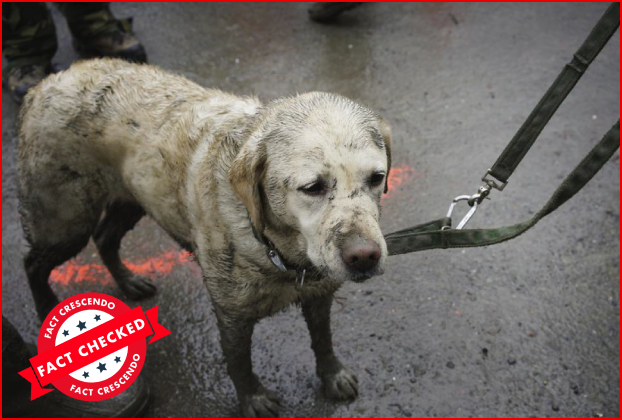
สุนัขพันธุ์ลาบราดอร์ในภาพเป็นหนึ่งในสุนัขกู้ภัยในเหตุการณ์แผ่นดินไหวในตุรกีและซีเรีย
Publisher’s rating: False
The claim concerned a photograph of a mud-streaked Labrador on a leash, shared with a caption saying the dog had searched earthquake rubble in Turkey, found ten people and helped save them. The review investigated whether this specific image showed a dog involved in the Turkey–Syria earthquake response. It reports using reverse-image search to trace the photograph’s earlier appearance. That search found the image had been published in 2014, years before the earthquake. The review identifies its actual setting as a rescue mission in Oso, Washington, on March 30, 2014, following a mudslide. It credits the photograph to Reuters photographer Rick Wilking and describes the pictured dog as part of a trained search-and-rescue team looking for people caught in the disaster. The review distinguishes the false identification of this photograph from the separate fact that rescue teams and dogs were sent to Turkey. The image’s documented 2014 origin in Washington means it does not depict a dog participating in the later Turkey–Syria earthquake response.
ये वीडियो न्यूज़ीलैण्ड के चक्रवात गेब्रियल का है।
Publisher’s rating: False


A dog in the picture is a rescue worker in the recent Turkey-Syria earthquake
Publisher’s rating: False
The claim concerned a widely shared photograph of a muddy dog, described in a social-media caption as having searched earthquake rubble in Turkey and saved ten people. Factcrescendo Thailand investigated whether that image showed a dog working in the recent Turkey-Syria earthquake. Its review says the image was not from that earthquake and identifies it instead with an earlier rescue operation in Oso, Washington. [S1: “Recently, there is a picture depicting a dog as a rescue worker in the recent Turkey-Syria earthquake” … “However, we found that this image is not from the recent earthquake in Turkey and Syria.”] The review describes its method as tracing the photograph’s origin and using reverse image search, which led to websites carrying the picture. It reports that the photo had been published in 2014 and attributes it to Reuters photographer Rick Wilking, documenting a rescue mission in Oso on March 30, 2014. The article says a mudslide struck the area and killed 43 people; the pictured dog was a trained search-and-rescue dog deployed to look for survivors. This earlier provenance contradicts the caption’s claim that the photograph shows the dog at work in the Turkey-Syria earthquake. [S1: “We began investigating by finding the origin of this photo. We then used the reverse image search feature, and it led us to various websites containing this dog’s picture. We found out that this photo was primarily published in 2014.”; “In fact, the photo is from a rescue mission that took place in Oso, Washington, on March 30, 2014, by a Reuter’s photographer, Rick Wilking. During that incident, a massive mudslide hit the area, causing the deaths of 43 people. The dog in the photo was one of the rescue workers who searched for victims in the aftermath of the disaster.”] The review distinguishes the photo’s provenance from the broader fact that rescue dogs were sent to assist after the Turkey-Syria earthquake. It says the pictured dog had no connection to that incident; the existence of other rescue teams and dogs does not establish that this particular image came from the earthquake. [S1: “Although the dog in the above picture has no connection to this Turkey-Syria incident, many countries have sent rescue dogs and staff to help find the victim under the ruins in Turkey and Syria.”]
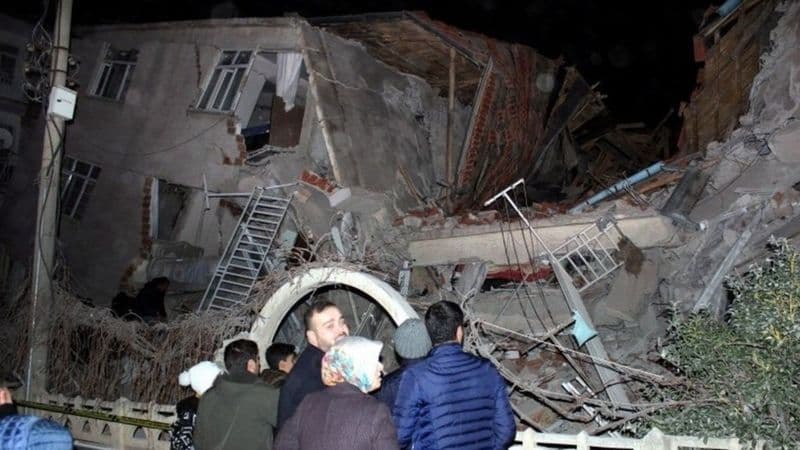
انهيار مبنى في ريف حلب جراء الهزة الارتدادية مع وجود عالقين تحت الأنقاض
Publisher’s rating: كذب

Das Erdbeben in der Türkei hat die Gaspipeline aus Aserbaidschan zerstört, die die Hauptquelle der EU für Erdgas darstellt.
Publisher’s rating: Die transanatolische Gaspipeline (TANAP) ist nach den Erdbeben in der türkisch-syrischen Grenzregion weiter intakt. Sie ist auch nicht die wichtigste Gasquelle für die EU.
The claim concerned the February 2023 earthquakes in southeastern Turkey and alleged that they had destroyed TANAP, a pipeline carrying gas from Azerbaijan toward Europe, leaving the EU without what the post called its most important gas source. The review addresses both parts of that claim: whether the pipeline was damaged and whether Azerbaijani gas was the EU’s leading source. For the damage question, the review reports that pipeline shareholder BP told dpa there was no damage and that gas continued to flow. It also cites Fluxys, which said it had observed no interruption. The review compared the pipeline’s route, as shown on an operator map, with the locations of the two February 6 earthquakes in Kahramanmaras province. TANAP runs through northern Turkey, while the earthquakes occurred in the southeast, near Pazarcik and Ekinozu; the review says shaking was weaker elsewhere and concludes that the pipeline was not damaged. The review also tests the claim about the EU’s gas supply against import information. It notes that the EU’s 2022 agreement with Azerbaijan aimed to double imports to 20 billion cubic metres per year, but says that even this increase would not make Azerbaijan the EU’s largest gas source. For January through November 2022, the review reports that the largest share of imports was liquefied natural gas, mainly from the United States, Qatar and Nigeria; the United States alone supplied more than 50 billion cubic metres. It also names Norway as a major supplier. Thus, the evidence in the review contradicts both the alleged pipeline destruction and the description of TANAP as the EU’s principal gas source.

Cette vidéo montre un objet dans le ciel juste avant les tremblements de terre en Turquie.
Publisher’s rating: Cette vidéo n’a rien à voir avec la récente catastrophe en Turquie. Elle a initialement été publiée en septembre 2022, et se déroule au Kazakhstan. Tout porte à croire que l’appareil visible sur les images est une fusée à destination de la Station spatiale internationale.
The video was shared with a caption claiming it showed an unusual object in the sky shortly before the earthquakes that struck Turkey and Syria on February 6. The review says the footage shows a shape moving through the air and leaving silvery trails, but concludes that the scene was not in Turkey and did not occur just before those earthquakes: the video had already appeared online months earlier and was filmed in Kazakhstan.

Terremoto na Turquia e Síria foi provocado pelos EUA com armas Haarp?
Publisher’s rating: Falso

Videonun deprem bölgesine giden konteyner evleri gösterdiği iddiası
Publisher’s rating: Yanlış

After losing their mother in the Turkey earthquake, a little girl pretended to breastfeed her crying brother to comfort him
Publisher’s rating: FALSE
The claim concerns a video said to show a girl pretending to breastfeed her crying brother after the children lost their mother in the February 2023 Turkey earthquake. FACTLY reports that it investigated the video’s origin rather than relying on the caption accompanying its later circulation. The review describes two steps in its check: a reverse image search of keyframes led to Facebook posts carrying the same video, and a watermark in one post identified a TikTok account, “anelya.495.” The investigators then searched TikTok for that account and found the same video there. FACTLY reports that the account uploaded it on 26 November 2022—before the earthquake struck Turkey on 6 February 2023. That earlier upload establishes that the video could not depict the children as survivors of the later earthquake. The review also says the video’s Russian description translates to “#children laughing.” Its finding challenges the claim’s identification of the footage and its earthquake-related context; the supplied excerpt does not establish the children’s identities or family circumstances beyond the account and video history it describes.

Image of a dog, after a shift, searching for the ruins in Turkey, found 10 people and saved their lives.
Publisher’s rating: False

İzmir Marşı çalan aracın deprem bölgesinde görüntülendiği iddiası
Publisher’s rating: Yanlış

Fotoğraf, Depremden Etkilenen Bir Aileyi mi Gösteriyor?
Publisher’s rating: Yanlış
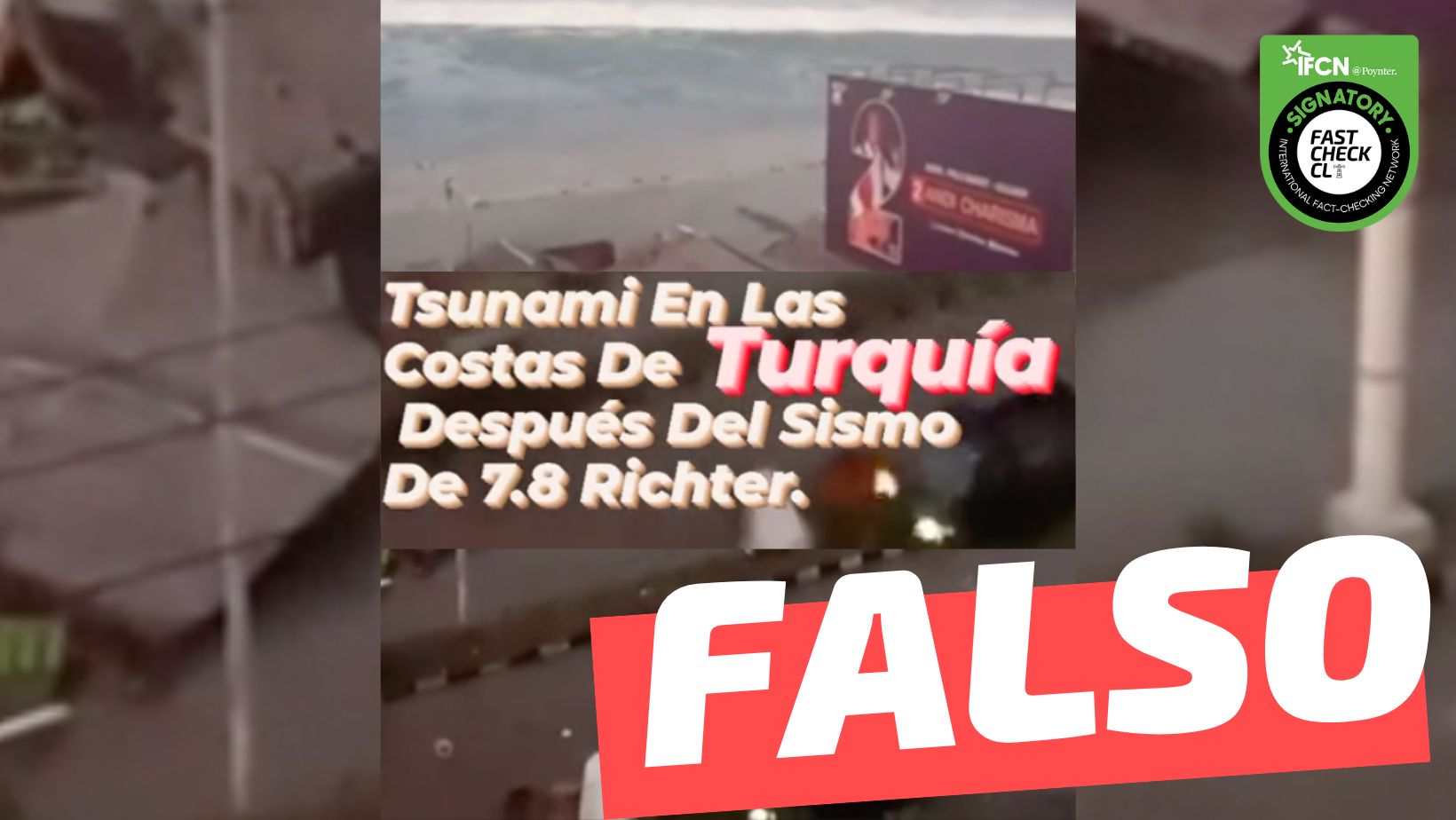
“Tsunami en las costas de Turquía después del sismo de 7.8 Richter”
Publisher’s rating: Falso

De aardbevingen in Turkije vernielden de gasleiding vanuit Azerbeidzjan. Hij was de belangrijkste bron van de EU na de Nord Stream-sabotage.
Publisher’s rating: De TANAP-gaspijpleiding is niet vernietigd na de aardbevingen in Turkije en functioneert nog steeds. Het is ook niet de belangrijkste gasbron voor de EU.