PeakMetrics / Fact Checks
War & conflict fact checks
Explore claims publishers have checked about war & conflict. Read their original ratings and follow the evidence.
Search fact checks
Search by text or image5,848 published reviews in this topic

Soldiers of Indian army doing their duty sitting on a branch of a tree in Kashmir valley
Publisher’s rating: FALSE
The claim concerns an image presented as showing Indian army soldiers doing their duty while sitting on a branch of a tree in Kashmir valley. FACTLY reports that its investigation found the image was assembled from separate photographs, rather than documenting soldiers sitting in a tree. It says the tree and the soldiers were individually present in source images, but not together in the way shown in the circulated image. To investigate the image’s origins, FACTLY cropped the post image to isolate the tree and used Yandex reverse image search. The search led to an original tree image with no soldiers visible. FACTLY then separately cropped the soldiers and reverse-searched that portion, finding a similar image of soldiers sitting on the ground. The review says these separate images had been edited together, creating the misleading appearance that the soldiers were perched on the branch. That reported comparison addresses the central visual claim: the image does not show the soldiers sitting on the tree as presented. The conclusion is about the image’s authenticity and what it depicts; the supplied review does not provide further details about the soldiers’ identities or the location of either source photograph.

Photo of Indian Army soldiers in camouflage suits.
Publisher’s rating: FALSE
The claim concerned an image shared as showing Indian Army soldiers in camouflage attire. FACTLY reports that its investigation identified the pictured clothing as Gulch Gear’s Cross Cover Brown Camouflage pattern and located the image in Northwest Oregon, USA—not as a photograph of Indian Army soldiers. To check the image, the review says it used reverse image search and found the same photo on Pinterest, uploaded by Gulch Gear. The Pinterest listing identified the gear as the company’s Cross Cover Brown Camouflage Pattern; a Vimeo video on the account using the same image gave the location as Northwest Oregon. FACTLY says it also found the image on Gulch’s Facebook and Instagram accounts. The review further cites Gulch’s website, which describes the company as a US-based camouflage-apparel manufacturer founded in 2014. Taken together, the reported matches link the image to Gulch’s product and to a location in the United States, rather than supporting the post’s identification of the people as Indian Army soldiers.

ಭಾರತಕ್ಕೆ ಹೋಗುವಾಗ ಹಾರಾಟದ ಮಧ್ಯದಲ್ಲೇ ರಫೇಲ್ ಫೈಟರ್ ಜೆಟ್ಗಳಿಗೆ ಇಂಧನ ತುಂಬುವ ವಿಡಿಯೋ.
Publisher’s rating: FALSE

LOC సరిహద్దుల్లో ముసుగు డ్రెస్ ధరించి పహారా కాస్తున్న భారత సిపాయి ఫోటో
Publisher’s rating: FALSE
दिल्ली के करोल बाग की गफ्फार मार्केट में एक आतंकी पकड़ा गया है
Publisher’s rating: False
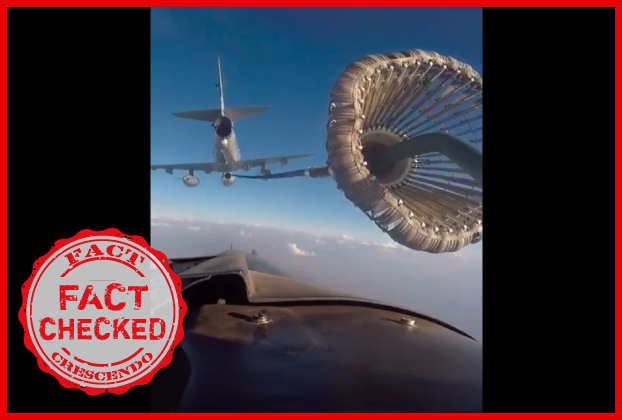
Claim: Fuel filling video of Rafale jet in mid-air
Publisher’s rating: False
The claim concerned a circulating video presented as showing a Rafale fighter being refuelled in the air, reportedly at 30,000 feet. The review distinguishes that clip from the arrival of the first five Rafale aircraft from France: it says the French side handled their refuelling en route, and that the Indian Air Force released photographs relating to it, not a video. The fact-check describes its investigation as checking whether the circulating video was really of a Rafale. The review says a reverse-image search found the clip had circulated on social media for years, so it was not footage of a Rafale during its recent arrival in India. To identify the aircraft, the investigators traced the video to an official Brazilian Air Force Twitter post. According to the review, that post identified the scene as a Brazilian Navy A-4 refuelling a Brazilian Air Force F-5 fighter, and said the video was posted in September 2018. The review further says it found that the F-5 was American-made, not French-made. On that basis, it concluded that the video did not show a Rafale and that the Facebook post was misleading. Its conclusion addresses the identity and provenance of the video; it does not dispute that Rafale aircraft were refuelled during their journey to India.

এইটো ভাৰতলৈ শেহতীয়াকৈ অনা ৰাফেল বিমান কেইখনত আকাশ মাৰ্গতে ইন্ধন ভৰাই থকা সময়ৰ ভিডিঅ' হয়
Publisher’s rating: মিছা


When our soldiers showed the Raphael fighter plane a small test drive game…
Publisher’s rating: Fake

భారత ప్రభుత్వం కొనుగోలు చేసిన రఫేల్ యుద్ద విమానం గాల్లోనే ఇంధనం నింపుకుంటున్న వీడియో
Publisher’s rating: MISLEADING

Photos of an Indian Air Force (IAF) jet shot down by Nepal
Publisher’s rating: FALSE
FACTLY investigated social-media posts claiming that Nepal had shot down an Indian Air Force jet and killed two Indian pilots. Its review says the photos accompanying the claim did not show such an incident: one was linked to a 2011 photograph from Libya, while the other showed an IAF Mirage-2000 that crashed in Bengaluru in 2019. The review also reports that India’s Press Information Bureau called the post fake and said no such action had been conducted by the Indian Air Force against a neighbouring country. The evidence therefore addresses the specific claim by tracing the images to earlier, unrelated events and reporting an official denial of the alleged action. For the first image, FACTLY describes using Google reverse image search to find the same photo in a 2011 article. It then checked AP Images, where the photo description identified a pilot ejecting from a warplane shot down near Benghazi, Libya, on March 19, 2011. That provenance places the image in a different country and event, rather than in a Nepal-related incident. For the second image, the review points to its appearance in a February 2019 Statesman article and says its caption identifies the crash site of an IAF Mirage-2000 at a military airport in Bengaluru. FACTLY says the same photo also appeared in Deccan Herald. These accounts identify the pictured aircraft as one involved in an earlier crash, not as a jet shot down by Nepal.
Wanita bercadar yang membawa senjata dalam sebuah foto yang diklaim sebagai wanita Palestina yang ikut perang
Publisher’s rating: Keliru
In einem Park im britischen Reading hat ein Mann am 20. Juni 2020 wahllos auf Menschen eingestochen. Bei dem Terrorangriff starben drei Menschen, drei weitere erlitten schwere Verletzungen. Bei dem 25-jährigen Tatverdächtigen handelt es sich um einen Flüchtling aus Libyen. In einem Artikel auf dem Blog «achgut.com» vom 30. Juni wird behauptet, «kaum ein Medium in Deutschland» hätte über den Fall berichtet. Von den Namen der Opfer, mutmaßt der Autor, dürfte außerhalb der «britischen Medien kaum jemand gehört haben»
Publisher’s rating: Viele deutsche Medien haben Artikel und Beiträge über die Tat veröffentlicht. Auch die Namen der Opfer waren Teil der Berichterstattung deutschsprachiger Medien.
The achgut.com article made two related assertions about the Reading attack: that hardly any German media had reported it and that the victims’ names were probably known mainly in British media. The DPA review checked both the extent of German coverage and whether German-language reports named the victims. Its account documents coverage beginning on the night of the attack and continuing in the following days, rather than relying on a general impression of how widely the story circulated. The review says Associated Press published an account shortly after Thames Valley Police’s first tweet about an incident in Forbury Gardens. German reporting followed that same evening. DPA’s own report, carried by Welt, mentioned that the suspect was reported to be Libyan. On 21 June, the review identifies reports on the attack and the suspect’s reported Libyan origin from the Frankfurter Allgemeine Zeitung, Bild, ZDF’s heute, ARD’s Tagesschau, Stuttgarter Zeitung and taz. This list provides concrete examples across German newspapers and broadcasters, directly bearing on the claim that hardly any German outlet covered the event. The review also addresses the names claim with specific examples. It says Bild’s 23 June report named the three people killed as well as the suspect, and that later reports by ZDF and Salzburger Nachrichten also named the victims. The evidence therefore concerns not just initial reports of the attack but subsequent German-language coverage that included identifying details. The review’s account supports rejecting both assertions in the achgut.com article; it does not establish that every German outlet reported the incident or named the victims.

Indian missile test is failed. Can this type of Army fight against Nepal
Publisher’s rating: FALSE

ویدیوی شلیک کشتی چینی به لنج ایرانی و قتل ماهیگیران ایرانی
Publisher’s rating: نادرست

గల్వాన్ ఘటనలో 100 మందికి పైగా చైనా సైనికులు చనిపోయారని తెలిపిన చైనా మాజీ సైనిక అధికారి జియాన్లీ యాంగ్
Publisher’s rating: FALSE
Former Chinese military official, Jianli Yang claimed that more than 100 Chinese soldiers were killed in a faceoff with India on ‘15 June 2020’ at Galwan valley
Publisher’s rating: FALSE
The claim concerned a purported tweet attributed to Tsai Ing-Wen, Taiwan’s president, which said that former Chinese military official Jianli Yang had claimed more than 100 Chinese soldiers were killed in the 15 June 2020 Galwan Valley clash with India. FACTLY’s review concluded that the tweet was not from Tsai Ing-Wen’s official account and that Yang had not made the alleged claim; it also found that Yang was not a former Chinese military official. The review therefore rejected both the attribution and the description of Yang in the post. To check the tweet’s provenance, the review searched Twitter using the name and handle visible in the screenshot. It found an account with the same tweet, but compared its handle, ‘@tsaiing_wen’, with the official account, ‘@iingwen’, which the review says was verified. That comparison led the review to conclude that the screenshot did not show a tweet from the official account. To assess whether Yang had made the statement about casualties, FACTLY says it searched for news reports corroborating it and found none. It also examined an article Yang wrote for The Washington Times and his Twitter account. The review reports that the article said Chinese authorities had not provided details of soldiers killed in the Galwan incident, but did not claim that more than 100 Chinese soldiers had died; it likewise says Yang had not posted the alleged claim on Twitter. These checks address the specific attribution in the post, rather than establishing a casualty count for the clash.