PeakMetrics / Fact Checks
War & conflict fact checks
Explore claims publishers have checked about war & conflict. Read their original ratings and follow the evidence.
Search fact checks
Search by text or image5,848 published reviews in this topic

"On the military, I’ve accomplished, first of all I’m bringing many of the troops home and most of the troops home."
Publisher’s rating: Exaggerates

Photos of ‘Special Frontier Force (SFF)
Publisher’s rating: FALSE
FACTLY examined a social-media post presenting two images as related to the Special Frontier Force (SFF). Its conclusion was that neither image showed the SFF: one depicted National Security Guard (NSG) commandos, while the other showed Indo-Tibetan Border Police (ITBP) personnel. The review therefore found the photos falsely attributed to the SFF. For the first image, FACTLY says a reverse-image search located the same photograph in a Hindustan Times article. That article’s caption identified the people as NSG commandos marching in New Delhi’s 2017 Republic Day parade. FACTLY also found other photographs by the same photographer on Getty Images and reports that one showed “NSG” written on a uniform, providing additional support for identifying the unit. For the second image, FACTLY reports that a reverse-image search found the same photograph on the official ITBP Twitter account. The review says it was taken in Ladakh on Independence Day in 2020 and identifies the personnel as ITBP. These distinct image histories support the finding that neither photograph is evidence of the SFF, despite the post’s attribution.

Videos related to the recent Indian and Chinese troops standoff near Ladakh on the intervening night of 29/30 August 2020
Publisher’s rating: FALSE
The review examines social-media videos presented as footage of the Indian and Chinese troops’ standoff near Ladakh on the intervening night of 29/30 August 2020. It reports that the Indian government described a fresh standoff on that night, then checks whether the circulated videos could be from that event. Its conclusion rests on finding the same footage in earlier uploads or reports, not on denying that the standoff occurred. For the first video, the review describes reverse-image searches that led to the same video on a YouTube channel in January 2020 and to a news report using the visuals in May 2020. For the second, it identifies matching visuals in a June 2020 report about ceasefire violations on the India–Pakistan border, as well as an April 2020 Facebook upload. These earlier appearances mean the footage predates the August standoff and cannot document that later event. The review’s evidence is more qualified for the third video: it says the footage appeared on Tumblr in January 2020 but that it found no credible source confirming the soldiers’ identity or the video’s location. Thus, the evidence supports the conclusion that the shared videos were old or unverified as footage of the claimed standoff; it does not establish that every soldier or location shown was definitively identified.


Video of Special Frontier Force personnel dancing after reclaiming the land under Chinese occupation in the Eastern Ladakh
Publisher’s rating: FALSE
The post presented a video of army personnel dancing as showing Special Frontier Force personnel celebrating after reclaiming land under Chinese occupation in Eastern Ladakh. The review assessed whether the video could depict the reported events of 29/30 August 2020, when Indian forces thwarted a People’s Liberation Army intrusion in Eastern Ladakh, according to the Ministry of Defence update cited in the article. Its central test was chronology: the same video was found online before those events. The review says reverse-image searches of screenshots produced no specific results. Investigators then noticed a flag resembling the Tibetan flag and used keyword searches to find an extended version of the video on YouTube. That upload was dated 27 August 2020; the review also reports finding Facebook posts of the same video dated 27 August. Because the footage was already circulating before the 29/30 August incident, it could not show personnel dancing after that incident. The article separately notes reporting that a Special Frontier Force unit captured key heights along the Line of Actual Control. But that reported military development does not establish that the circulating dance video depicts it. The timing of the video, rather than the existence of the reported operation, is the evidence the review uses to reject the claimed connection.
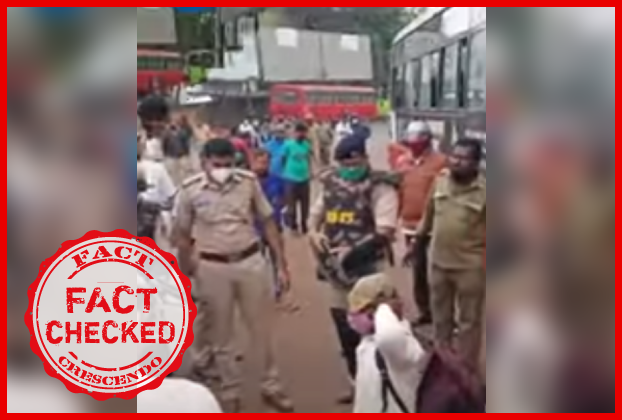
कर्नाटक में हुबली बस स्टेशन में एक आतंकवादी पकड़ा गया
Publisher’s rating: False
The Makabayan bloc is calling for the resumption of peace talks between the government and communist rebels
Publisher’s rating: Needs Context


Photo collage of women whose faces are severely injured in an alleged attack by jihadists in recent Swedish riots
Publisher’s rating: FALSE
The claim concerns a collage of women with serious facial injuries, circulated as showing victims of jihadist attacks during recent riots in Sweden. FACTLY reports that a reverse-image search led to an earlier fact-check of the same images, which had circulated in Germany in 2017 under a different claim. That earlier investigation traced the collage to photographs of victims of separate attacks in different countries; FACTLY says its examination of the original sources found that none of the women shown was from Sweden. The review gives examples of the images’ documented origins: Christina West was injured during a 2013 police encounter in Florida; Rebecca Beattie was abused by a former friend in England in 2012; and Mary Brandon was hit by a man in England in 2014. These cases are not evidence of injuries in the Swedish riots. The review separately describes unrest in Malmö after a video of far-right Danish politician Rasmus Paludan burning a Quran circulated, with protests involving tyre burning and stones thrown at police. Its conclusion is that the old, unrelated images were falsely presented as showing women injured in those events.

Video of Rafale fighter jets refuelling in mid-flight on its way to India
Publisher’s rating: FALSE
The claim concerns a video presented as showing Rafale fighter jets refuelling in mid-flight while travelling to India. FACTLY’s review investigated that specific footage, rather than whether Rafale aircraft can refuel in flight. It reports that five Rafales arrived at Ambala Airbase on 29 July 2020, but identifies the video as footage of different aircraft. To check the clip, the review says it performed reverse image searches on screenshots from the posted video. Those searches led to a tweet by the Brazilian Air Force, which shared similar footage and identified the aircraft as a Brazilian Air Force F-5 refuelling Brazilian Navy A-4 fighter jets. That identification is the central evidence against the video’s claimed identity and setting. The review also notes two relevant qualifications: the Rafales acquired by India have the facility for mid-flight refuelling, and the Indian Air Force had shared images of Rafales refuelling en route to India. Those facts do not establish that the circulated video shows Rafales. The review’s conclusion rests on the clip’s identification with Brazilian aircraft, not on a claim that Indian Rafales cannot refuel.

Joe Biden “even opposed the operation that took down Osama bin Laden.”
Publisher’s rating: Misleading
The review examined Mike Pence’s assertion that Joe Biden opposed the operation that killed Osama bin Laden. It reports that Biden’s stated position concerned the timing: he wanted Obama to wait for further checks on whether bin Laden was at the compound in Pakistan. The review distinguishes that advice from opposing the operation outright. The excerpt describes several accounts Biden gave of his advice. In a reported late-May 2011 statement, he said he had urged Obama to “wait another seven days for information.” At a January 2012 retreat, Biden said he had advised, “don’t go” until “two more things” were done to check bin Laden’s presence. In 2012 and 2015, he also described privately telling Obama to follow his instincts. The review says it could not confirm what Biden told Obama privately, but notes that others at the security-team meeting corroborated the account that Biden recommended waiting. It concludes that recommending delay was not the same as opposing the raid outright.

"La historia registra que Joe Biden incluso se opuso a la operación que derribó a Osama Bin Laden".
Publisher’s rating: Engañoso
“[Joe Biden] believes in war without winning, war without end. President Trump doesn’t want us in distant deserts. He wants to fight to save America here and now.”
Publisher’s rating: Not the whole story


ముష్కర మూకలతో జరిగిన పోరాటంలో క్షతగాత్రుడైన భారత సైనికుడి ఫోటోలు
Publisher’s rating: FALSE
In einem Beitrag wird der Eindruck erweckt, Israel habe eine Atomrakete auf das Hafengelände in Beirut geschossen. Das hätten die libanesische Regierung und der US-amerikanische Präsident Donald Trump bestätigt.
Publisher’s rating: Nach allen bisherigen Erkenntnissen ist die Explosion in Beirut wegen der unsachgemäßen Lagerung von hochexplosiven Chemikalien verursacht worden. Es gibt keine Belege für einen Raketenbeschuss. Die libanesische Regierung und Trump haben eine solche Behauptung nicht bestätigt.
The review examines a post suggesting that Israel fired an atomic missile at Beirut’s port and that both Lebanon’s government and Donald Trump confirmed the attack. It concerns the explosion at the port on August 4, 2020, which the review says killed at least 171 people and injured more than 6,000 as of August 11. It reports that ammonium nitrate exploded, while the cause that first ignited the chemicals remained unclear. The distinction matters: uncertainty about the initial trigger did not establish that a missile or an Israeli attack caused the blast. To assess the missile claim, the review points to videos recorded close to the explosion site, in which it says no missile or comparable impact is visible. It also describes examinations of purported missile footage: comparison with original recordings showed one edited video contained a retouched missile that disappeared before the supposed impact when viewed frame by frame; another video used a negative effect to make an object appear that was absent from the original and had been added. The review says these checks found the submitted missile videos manipulated, not corroboration of a strike. The review also distinguishes what officials said from what the post implied. Lebanon’s government was investigating whether the explosion was an accident or an outside attack, but the review says the government considered ammonium nitrate the cause; Prime Minister Hassan Diab had criticized storing an estimated 2,750 tonnes at the port. Trump initially speculated, citing US generals, that a bomb attack might have occurred, but the review says he did not identify a missile as the cause and later acknowledged the possibility of an accident. It reports that Defense Secretary Mark Esper said most sources considered the explosion an accident. Thus, neither the government’s investigation nor Trump’s remarks amounted to confirmation of the alleged Israeli missile strike.
Video yang diklaim sebagai video hantaman rudal Israel dalam ledakan di Beirut, Lebanon, pada 4 Agustus 2020
Publisher’s rating: Keliru