PeakMetrics / Fact Checks
War & conflict fact checks
Explore claims publishers have checked about war & conflict. Read their original ratings and follow the evidence.
Search fact checks
Search by text or image5,828 published reviews in this topic
Video shows Israeli troops arresting a two-year-old boy during the recent conflict.
Publisher’s rating: Misleading
The video shows Yemen fighters capturing an Israeli Submarine.
Publisher’s rating: False
A sniper was placed at the León Cathedral to protect against radical Islamists in Spain.
Publisher’s rating: False
حسابات إسرائيلية تعقيباً على فيديو لمصابين في غزة.. "هذا فيلم آخر ما زلت أحاول معرفة ما يحدث بالفعل هناك، بعض الغبار على النساء والفتيات ، لمسة من الدم، الجميع يدورن أمام الكاميرات، ألا يحتاج أي شخص إلى رعاية طبية هناك".
Publisher’s rating: مضلل، الفيديو حقيقي لكن السياق مضلل، إذ يوثق لحظة وصول عائلة فلسطينة إلى مستشفى شهداء الأقصى بعد أن سقط عليها جدار منزلها إثر قصف استهدف دير البلح جنوبي مدينة غزة ، وفق ما أكده لـ"تحقق" موثق الفيديو عمر الديراوي.
جميع موظفي الصليب الأحمر الدولي يغادرون قطاع غزة.
Publisher’s rating: خاطئ، لم يغادر جميع موظفي الصليب الأحمر قطاع غزة، بل ستغادر مجموعة منهم في إطار تبديل "شفت" المناوبة وفق ما أكده لـ"تحقق" الناطق الإعلامي باسم الصليب الأحمر في غزة، ومسؤول الإعلام في معبر رفح، وقد حصل المرصد على صورة لجدول المناوبة تثبت صحة ذلك.

Ces deux photos montrent un âne peint aux couleurs d'Israël être lapidé à mort puis incendié (par des Palestiniens).
Publisher’s rating: Les deux images ne montrent pas le même âne. L'une a été photographiée en 2011 en Cisjordanie, et l'autre en 2014 dans la bande de Gaza. Selon les informations disponibles, l'âne mort a été tué dans une frappe israélienne.
The claim links two photos to one episode: an Israeli-flag-painted donkey is allegedly stoned to death and then set on fire by Palestinians. The investigation found that the images show different animals, photographed years apart and in different places, rather than a sequence documenting one event. It also found no support for the suggestion that the burning was retaliation against Israel. The review traced the images through reverse image searches and identified versions of both on Getty Images. It located the painted-donkey photo to Kafr Qaddum in the West Bank on September 23, 2011. Getty’s caption described the donkey as painted in the colors of the Israeli flag during a demonstration supporting the Palestinian Authority’s bid for UN membership. The second image was dated August 6, 2014, in Rafah, Gaza, more than 130 kilometers from Kafr Qaddum. According to the caption for the Rafah image, Palestinians burned the donkey after it had been killed in an Israeli strike a few days earlier. The review says it could not find other photos of that animal, but notes that Israel had heavily bombarded Rafah in early August 2014 and that other Getty images placed the photographer in Rafah on the day the donkey photo was taken. This evidence supports separate origins for the photos and contradicts the claim that they show the same donkey being killed and burned by Palestinians.

Deze foto's tonen hoe Palestijnen een ezel beschilderen met de Israëlische vlag, stenigen en in brand steken.
Publisher’s rating: De foto's tonen twee verschillende ezels. De ene ezel is op de Westelijke Jordaanoever gefotografeerd in 2011, de andere in de Gazastrook in 2014. De dode ezel zou zijn omgekomen bij een Israëlische luchtaanval.
The viral collage is presented as evidence that Palestinians painted an Israeli flag on a donkey and then stoned and burned the animal. The investigation finds that the two photographs show different donkeys, photographed in different places and years; they are not images of one animal undergoing the sequence implied by the collage. For the painted donkey, the review traced the image to Getty Images and reports that it was taken on 23 September 2011 in Kafr Qaddum, a village in the West Bank. It describes the caption as showing a demonstration on the day of the Palestinian application for UN membership. The review says that reverse image searching led to the image, and that several photo agencies also dated it to that same day. The other image was traced to Getty Images and dated 6 August 2014 in Rafah, Gaza. Its caption describes a donkey that was set on fire after it had died in an Israeli bombardment a number of days earlier. Thus, the collage combines separate images from separate events; the evidence does not support its portrayal of Palestinians burning the flag-painted donkey.
“مؤيدون فلسطينيون لحماس يحملون دمية أطفال بلاستيكية يدعون أنها “قتلت” في غارة جوية! إذا كان في الواقع 6000 طفل قد قتلوا في غزة، فلماذا يحتاجون إلى عرض دمى ألعاب واضحة كأطفال رضع ؟”.
Publisher’s rating: الادعاء مضلل والطفل حقيقي وليس دمية وهو محمد هاني محمد الزهار، استشهد جراء القصف الذي استهدف قرية المغراقة جنوبي مدينة غزة ظهر اليوم الجمعة، وفق ما أكده لـ”تحقق” موثق الفيديو عطية درويش.
Ein Zeitungsartikel hat aufgedeckt, dass die israelischen Verteidigungsstreitkräfte (IDF) die Zivilisten beim Musikfestival bzw. in den Grenzorten getötet und die Hamas gar nichts von dem Festival gewusst haben.
Publisher’s rating: Der zitierte „Haaretz“-Artikel wird verfälscht und unvollständig wiedergegeben. Die Hamas sind für die Attacken am 7. Oktober verantwortlich. Das Musikfestival könnten sie spontan als Ziel ausgewählt haben.
The claim attributes two conclusions to a Haaretz report: that the Israeli military killed civilians at the festival or in border communities, and that Hamas did not know about the festival. The review says the viral posts distort and truncate the article. It distinguishes not knowing about the festival in advance from not being present at or attacking it: the report’s account was that Hamas may have selected the festival spontaneously during the assault. According to the review, a police investigation described Hamas attackers initially targeting kibbutzim and learning of the festival while en route. The Haaretz article also briefly mentioned that an IDF helicopter apparently hit some festivalgoers while firing at attackers. The review says the posts omitted the qualification that only a small number of people were likely hit in that incident; it does not say that this account establishes that the IDF caused the festival deaths or that Hamas was unaware of the festival throughout the attack. The review also points to Hamas body-camera footage and other published video as evidence against the broader suggestion that Hamas was not responsible for the attacks. It says that a separate video alleged to show an Israeli helicopter shooting festivalgoers was geolocated by experts far from the festival site. The excerpt therefore presents the viral account as misleading: it turns a limited, qualified mention of possible helicopter fire into a claim that Israel was responsible for the attacks, while omitting the account of Hamas’s actions and the reported sequence of events.

Video Filistinli hamile kadının İsrailli biri tarafından saldırıya uğradığını mı gösteriyor
Publisher’s rating: Yanlış
مصادر عبرية “(ح.م) أحد الأسرى الذين أفرجت عنهم إسرائيل، والذي أُعدم على يد حماس بتهمة العمالة، قُتل -في الواقع- لأنه أسود اللون”.
Publisher’s rating: (ح.م) تم إعدامه من قبل المقاومة في طولكرم بعد اعترافه بالتعاون والتخابر مع الاحتلال، ومساعدته في إغتيال أربعة من المقاومين في طولكرم في 6/11/2023.
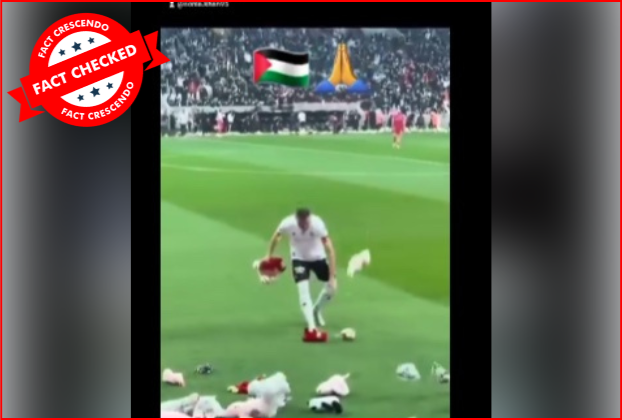
Claim: Turkey video being shared on israel palestine conflict
Publisher’s rating: ஃபேக்ட் கிரஸண்டோ ரேட்டிங்: FALSE
The claim concerned a video presented as showing toys thrown onto a football field for Palestinian children. The review says readers sent the video to Fact Crescendo for verification and describes the captions accompanying it, which referred to Palestine and included “#FreePalestine” and “#Gaza.” The review’s finding is that the footage was not connected to Palestine: it says it was recorded in Turkey. The review identifies the setting as an Istanbul football match and gives the event’s purpose and context: fans threw toys onto the field to benefit children who had survived the earthquake in Turkey on February 6, 2023. That attribution directly contradicts the accompanying claim that the toys were for Palestinian children. The review concludes that a video from a different event was being circulated with a Palestine-related description. The excerpt mentions an Al Jazeera link as additional reporting, but does not provide its contents or describe independent media-analysis methods. Accordingly, the explanation here is limited to the original review’s stated attribution and the evidence visible in the supplied excerpt.
Германия проводит учения по захвату Польши
Publisher’s rating: Фейк. Цель учений — отработать задачи по защите страны входящей в Североатлантический альянс, а не нападение на одного из его членов

यमन आतंकी इजराइली के लिए कहर बना हुआ है । यमन ने इजराइली जहाज के बाद एक इजराइली पनडुब्बी पे भी कब्ज़ा कर लिया है
Publisher’s rating: False


गाजा में चल रहे युद्ध में इजरायल ने एक मस्जिद पर बमबारी की।
Publisher’s rating: False
Video shows a Palestinian mother meeting her son, who was released under the recent prisoner exchange agreement.
Publisher’s rating: Misleading
एक ईरानियन ड्रोन ने एक इजरायली जहाज़ पर पानी के बीचों बीच हमला किया। पानी के बीच जहाज़ जल रहा है।
Publisher’s rating: False