PeakMetrics / Fact Checks
Has this been
fact-checked?
Paste a claim or upload an image to find existing fact checks. See what fact-checkers found and read the evidence before you share.
Search fact checks ↓API & integrations ↗Browse by topic
Explore fact checks by subject.
Search fact checks
Search by text or imageLatest fact checks
98,314 published reviews
త్రిపుర కార్పొరేషన్ ఎన్నికలలో సీపీఎం 49 సీట్లలో 45 గెలుచుకుంది
Publisher’s rating: MISLEADING

Deze beelden tonen undercoveragenten bij de boerenprotesten.
Publisher’s rating: De beelden van politieagenten in burger zijn zo'n twee jaar oud en hebben niets met de huidige boerenprotesten te maken.
The claim concerns photos and video shared as evidence that undercover police officers were present at the farmers’ protests in the Netherlands. The review distinguishes the possibility that undercover officers may have attended those protests from what the circulated images establish: it says the images themselves do not show the claimed connection. It notes that the protests had been taking place since late June 2022 and that social-media posts speculated about police using undercover officers to inflame tensions. (The review describes that speculation as a claim, not as an established fact.) For the photo, the review traces it to a video of a demonstration against coronavirus measures in The Hague on 21 June 2020. It reports that the video was uploaded to YouTube the following day and that the photo is a screenshot from that video. The location and event therefore differ from the 2022 farmers’ protests, despite the image appearing to show people in civilian clothes by a police vehicle. The review traces the separately shared video to another demonstration against coronavirus measures in The Hague, this one in August 2020. It says the video was posted on Twitter on 20 August with a caption claiming that the police arrest unit was being attacked. These identified origins place both pieces of media about two years before the farmers’ protests at issue; they do not establish that the depicted people were undercover officers at those protests.
A cold-water bath improves blood circulation and reduce muscle soreness
Publisher’s rating: Mostly True

Scenes Of A Recent Robbery In Wellawatte !! (VIDEO)
Publisher’s rating: Misleading

For months, a father gave oxygen to his son from his lungs through a hole ripped in his chest
Publisher’s rating: MISLEADING
The post described in the review claimed that a hole had been ripped into a father’s chest so he could supply oxygen to his premature baby boy, and that this continued for months. The review identifies the people in the image as RaSean Dickey and his son Fontaine, and says the image actually shows the father giving the baby skin-to-skin therapy. The review’s account is that the chest-hole and oxygen-from-the-father story is false. Supporting text: “A post is being circulated on social media saying that, to save a premature baby boy, a hole was ripped into his father’s chest to supply oxygen to him.” Supporting text: “It shows her prematurely born son, Fontaine Dickey receiving skin-to-skin therapy from his father, RaSean Dickey.” To trace the image, the review says it used reverse image search, which led to a Facebook post and then to Jenny Sanchez’s Instagram account. It reports finding a similar image on her timeline and says the Instagram images show RaSean giving their baby skin-to-skin therapy. This establishes the family and the setting for the image rather than relying only on the viral post’s description. Supporting text: “After performing a reverse image search, we found a Facebook post leading us to an Instagram user account, jdazzle101, that belongs to Jenny Sanchez.” Supporting text: “The images on her Instagram account show her husband, RaSean Dickey, giving their baby skin-to-skin therapy.” The review also points to the image itself: it says there is no hole in the father’s chest and that an oxygen tube visible in the pictures does not come from his chest. On the claim that this continued for months, it reports that Sanchez posted an image of her son on a separate bed a few weeks later, and quotes her rejecting stories invented about her family. These observations support the review’s conclusion that the image depicts care for a premature infant, not the claimed procedure. Supporting text: “An oxygen pipe can be seen too, which is not coming from the father’s chest.” Supporting text: “she posted a picture of her son on a separate bed only a few weeks later.”
women bear 57 del (unit) pain at the time of delivery
Publisher’s rating: False
नूपुर शर्मा के आवेदन पर टिप्पणी करने वाले सुप्रीम कोर्ट के न्यायाधीश, भारत विरोधी धर्मयुद्ध के गणमान्य व्यक्तियों के साथ 7-सितारा होटल में दोपहर का भोजन कर रहे हैं
Publisher’s rating: Missing Context

Visuals of a journalist asking some blunt questions to Amit Shah for not allocating funds to the state at the time of floods
Publisher’s rating: MISLEADING
The claim concerns a video in which a journalist appears to challenge Amit Shah over the central government’s failure to provide funds during floods. FACTLY reports that the footage came from Amit Shah’s road show during the GHMC election campaign in November 2020, rather than from a recent event. The review says the video’s framing leaves out the context of the question. To check the clip, FACTLY says it searched the internet using relevant keywords and found the full interview on V6’s official YouTube channel. In that footage, the journalist’s question was not presented as his own accusation: he was paraphrasing allegations that the ruling TRS had made against the BJP, and seeking Shah’s response. The viral version cuts off that context, making the question appear to be the journalist’s personal challenge. The longer footage also includes Shah’s reply. According to FACTLY, he said the central government had provided Hyderabad with more financial assistance than other cities. Thus, the review’s conclusion rests on the difference between the clipped question and the fuller exchange: the video is from the 2020 campaign, and the question was a paraphrase of a political allegation, not the journalist independently accusing Shah of withholding funds.

El desmayo que sufrió el guitarrista Carlos Santana fue provocado por la vacuna contra el covid-19
Publisher’s rating: Falso
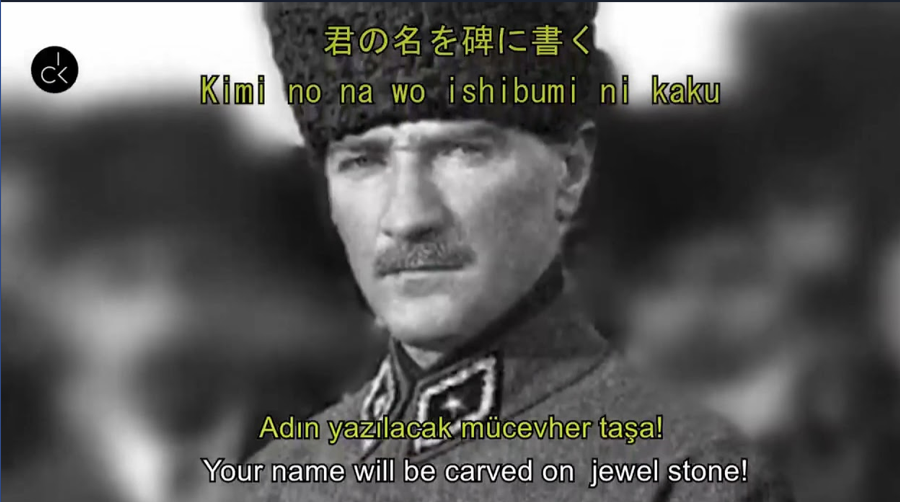
İzmir Marşı’nın Japonca versiyonunu Japonların hazırladığı iddiası
Publisher’s rating: Yanlış

The police of Stalin’s regime Dravidian model saluted Jeeyar for the first time in Tamil Nadu.
Publisher’s rating: Fake

ගෝඨාභය-රනිල් ප්රමුඛ ආණ්ඩුව පිළිබඳ නාමල් රාජපක්ෂ සිදු කළ විවේචනය?
Publisher’s rating: Misleading
The review examined a circulating video that appeared to show Namal Rajapaksa criticizing the government led by President Gotabaya Rajapaksa and Prime Minister Ranil Wickremesinghe. In the clip, he seemed to say that the public had rejected the government’s policies and to call for Parliament to be dissolved and for the prime minister to resign. The review’s central question was whether he had made those remarks recently, as the social-media post implied. The investigation found that the footage came from a 2018 video on Rajapaksa’s official Facebook account, not a recent statement about the government then in power. The original remarks followed the local government election and criticized the government of that time, calling for Parliament to be dissolved and an election held. The review identifies the event as Rajapaksa speaking to the media on 11 February 2018, addressing then-President Maithripala Sirisena and then-Prime Minister Ranil Wickremesinghe. The review says it compared the original footage with the circulating edit and found that portions had been cut and the video edited to make the old remarks appear to concern the current government. It also reports that Rajapaksa confirmed to the publisher that the video was an old one from 2018. Thus, the video’s words were presented with a misleading date and political context; the investigation does not establish that he made those statements recently.
आख़िर अमित शाह ने क्यों साधी चुप्पी ? पत्रकार ने पूछे कुछ ऐसे सवाल। पत्रकार – जब बारिश आया इधर बाढ़ आया तब मोदी सरकार तेलंगाना का कोई मदद नहीं किया अमित शाह – चुप्पी
Publisher’s rating: Missing Context
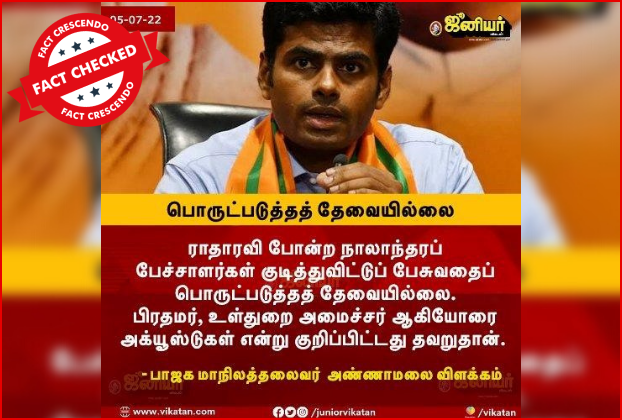
Claim: annamalai not made this statement on radha ravi
Publisher’s rating: FALSE
The review examined a social-media news card presented as if it had been published by Junior Vikatan. The card attributed to Annamalai a statement that remarks by “low-class speakers like Radha Ravi” should not be taken seriously, following controversy over Radha Ravi referring to Prime Minister Narendra Modi and Home Minister Amit Shah as “accused.” The review says the card was shared on Facebook on July 5, 2022, by an account named Stalin Venkatesh, and that others were sharing it too. Fact Crescendo reports that the card’s design and Tamil font did not resemble Junior Vikatan’s usual news cards. It checked the publication’s Facebook page for cards posted on July 5 and found no matching card. It then sent the disputed image to the person responsible for Junior Vikatan’s social-media and digital section, who confirmed that it was fake. The review also says it searched Annamalai’s social-media pages and found no such statement, and that no news report carrying it had appeared. On the evidence described, the review concluded that the purported Junior Vikatan card was fabricated and that the attribution to Annamalai was false. Its printed result is “False.”
“A reincidência desses criminosos está batendo 50%”
Publisher’s rating: Insustentável
মমতাজের গানের বিরুদ্ধে সংসদে কঠিন হুশিয়ার দিলেন জুনায়েদ আহমেদ পলক
Publisher’s rating: False

Newspaper clipping stating Nepal recently occupied 7100 acres of Indian territory
Publisher’s rating: MISLEADING
The clipping’s headline, “7100 acres of Indian territory occupied by Nepal,” was being shared as a report of a recent event. FACTLY traced the headline to a Dainik Bhaskar article and found that it was published in 2018, rather than being a new report in 2021. The review therefore challenges the clipping’s apparent recency, not the existence of the older article. According to FACTLY’s account of the article, it reported that Nepal had acquired about 7,100 acres in West Champaran district, Bihar, and described alleged illegal encroachment in areas including Susta in Valmiki Nagar, Valmiki Tiger Reserve forests, and Shivalik hills in Govardna. FACTLY says Janasatta also reported the issue. These details describe what the older reports said; the supplied review does not establish an official finding that the land had been occupied. FACTLY says it searched the internet using the subject mentioned in the post, found the Dainik Bhaskar article, and found no recent articles about Nepal occupying 7,100 acres. It also notes that it found no official Government of India response to that report at the time. The evidence supports calling the clipping misleading when presented as recent: the identified article dated to 2018, and the review reports finding no recent coverage of the specific 7,100-acre claim.
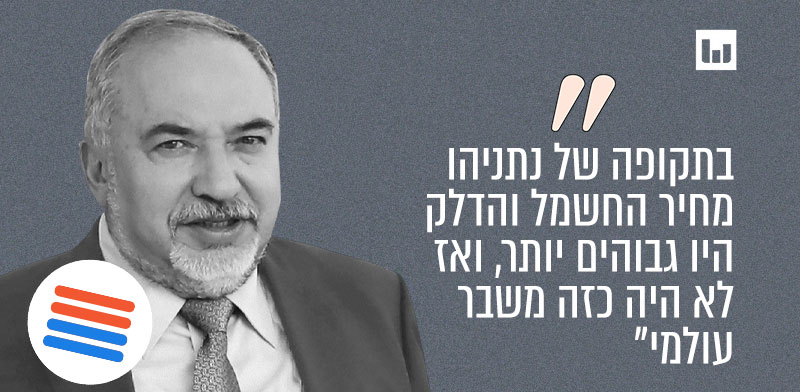
בתקופה של נתניהו מחיר חשמל ודלק היה יותר גבוה מאשר היום, ואז לא היה כזה משבר עולמי כמו שאנחנו חווים בימים האלה
Publisher’s rating: חצי נכון
"[São Paulo] É um estado onde o ICMS per capita subiu 26% de 2019 até aqui".
Publisher’s rating: Verdadeiro
Where the data comes from
Fact checks come from Data Commons and link to the organizations that published them.
What you’ll find
Each result links to the original fact check. Open it to read the publisher’s findings, with summaries and supporting sources where available.
Report an error
To report an error, send the page URL and supporting evidence.