PeakMetrics / Fact Checks
Has this been
fact-checked?
Paste a claim or upload an image to find existing fact checks. See what fact-checkers found and read the evidence before you share.
Search fact checks ↓API & integrations ↗Browse by topic
Explore fact checks by subject.
Search fact checks
Search by text or imageLatest fact checks
98,240 published reviews

Traficante que sentou na cadeira de Alexandre, têm fotos com LULA e JANJA, são amigos e parceiros do crime organizado.
Publisher’s rating: Falso

पूर्व अमेरिकी राष्ट्रपति डोनाल्ड ट्रंप की गिरफ्तारी
Publisher’s rating: FALSE

Der Moderna-CEO gibt zu, dass er bereits vor der Pandemie über die geplante Pandemie informiert wurde.
Publisher’s rating: Nein. Die von Bancel genannten 100 000 Impfdosen haben nichts mit Corona zu tun. Der Geschäftsführer spricht beim Weltwirtschaftsforum in Davos ganz allgemein über die Impfstoffproduktion seines Unternehmens im Jahr 2019. Moderna suchte zu dieser Zeit zum Beispiel nach neuen Krebstherapien.

A audiência tem que ser grande!!! RECORD. Mito Hoje, às 22h (horário de Brasília), a TV Record entrevistará Bolsonaro durante 25 minutos.
Publisher’s rating: Falso


In Nigeria is drinkwater alleen nog verkrijgbaar met je ID-kaart. Het is onderdeel van het systeem van digitale controle.
Publisher’s rating: De video is opgenomen in Malawi, niet Nigeria, en toont een waterautomaat van het eMadzi project. Bij de automaat kunnen bewoners de hele dag door water kopen met een prepaid kaart. Van digitale controle in Nigeria middels je ID-kaart is hier dus absoluut geen sprake.

Manifestações de auditores fiscais em protesto à uma decisão de Alexandre de Moraes. Notíicias 30/03/2023
Publisher’s rating: Falso
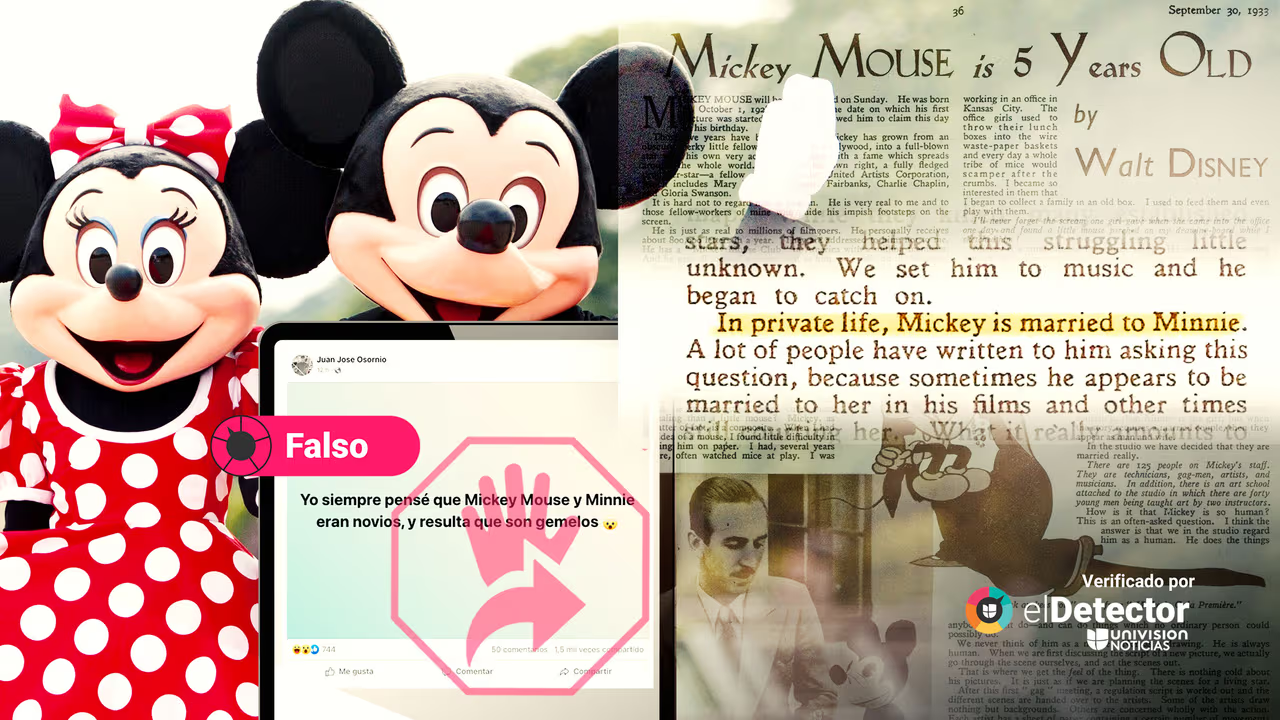
Mickey Mouse y Minnie Mouse “son gemelos”.
Publisher’s rating: Falso
The claim circulated in a Facebook post in late March 2023: Mickey Mouse and Minnie Mouse were said to be twins, not a couple. The review says the post had been shared more than 7,000 times between March 29 and March 31, 2023. Its central counterevidence is a statement attributed to Walt Disney in a 1933 Film Pictorial article: “in his private life Mickey is married to Minnie.” The investigation describes two keyword searches: one for material about whether Mickey and Minnie are a couple or twins, and another for the 1933 Film Pictorial interview. The second search led the reviewers to an image of the article. In the quoted passage, Disney explains that the characters’ roles could vary with the story: Minnie might be Mickey’s romantic interest in a courtship plot, but they would appear as husband and wife when a story called for a married couple. He adds that the studio had decided they were married. That qualification matters: the article acknowledges that some stories may depict the pair as courting, but it does not support the post’s claim that they are twins. The review also points to a 2013 Walt Disney Family Museum webpage that used the same Film Pictorial quotation when discussing their relationship. The evidence presented therefore supports the couple interpretation, while the claim that they are twins conflicts with the historical statement the review located.

Dit document toont de verwachte AOW-leeftijd voor mensen in Nederland.
Publisher’s rating: Nee, de werkelijke pensioengerechtigde leeftijd nu, net als de verwachte AOW-leeftijd in de toekomst, lig lager dan het document aangeeft. Het document is echt van vakbond FNV afkomstig, maar is oud campagnemateriaal dat gebruikt werd om te illustreren hoe hoog de AOW-leeftijd kon oplopen als er geen nieuwe pensioenafspraken werden gemaakt. Die nieuwe afspraken kwamen er met het pensioenakkoord van 2019.
The document in question was circulated on Facebook as a chart suggesting how long people born in the Netherlands would have to work before receiving AOW, the state basic pension. The review finds that the chart does not show expected eligibility ages under the rules currently in force. It says the document is genuine FNV material, but was made before 2019 as a campaign scenario illustrating how high the AOW age might rise if new pension agreements were not reached. To check the figures, the review compares the chart with the pension rules introduced in 2019 and 2020 and with the government’s published estimates based on the 2019 pension agreement. For example, the chart gives an AOW age of 67 for people born between 1 January and 30 June 1954; under the current rules cited in the review, people born before 1 September 1954 qualify at 66 years and four months. For someone born by 30 June 1991, the chart says 73 years and six months, while the government-based estimate is 69 years and six months. The review also checked the document’s provenance: an FNV spokesperson confirmed it was an authentic pre-2019 campaign scenario, not a depiction of current policy. A photograph of another copy had appeared on Twitter in March 2019, supporting the account that the document was already in circulation then. The key distinction is therefore between a genuine document illustrating a scenario that the union sought to avert and a current forecast of AOW eligibility.


राजस्थान बीजेपी के नए अध्यक्ष सीपी जोशी के डांस का है ये वीडियो
Publisher’s rating: FALSE

Duitsland wil BRICS vervoegen.
Publisher’s rating: Er is geen enkele aanwijzing dat Duitsland van plan is om lidmaatschap bij de BRICS-landen aan te vragen.
The review examines a social-media claim that Germany had applied to join BRICS, attributed to a table listing countries said to have sought membership. Its account says the table’s source was unclear and reports that the earliest version dpa found through reverse image search was posted on Twitter on March 16, 2023. The investigation therefore focused on whether the table was reliable evidence of a German application. The review describes several reasons to doubt the document’s authenticity: it appeared to be a photograph of a computer screen, the table was not aligned straight, and a Word interface bar showed the program set to English (United States). It also notes an apparent wording error (“gold back system” rather than “backed”), a population figure given only for India and incorrectly, and a parenthetical remark about Germany that the review considered unsuitable for an official document. The review further says the alleged news was not reported elsewhere. The article distinguishes Germany’s alleged application from genuine discussion about BRICS expansion. It says interest from multiple countries had been reported, but places Germany outside the countries identified as interested at that point. Its assessment of the German claim rests on the questionable provenance and features of the circulated table, together with the absence of other reporting—not on evidence that BRICS expansion itself was not being discussed.
Where the data comes from
Fact checks come from Data Commons and link to the organizations that published them.
What you’ll find
Each result links to the original fact check. Open it to read the publisher’s findings, with summaries and supporting sources where available.
Report an error
To report an error, send the page URL and supporting evidence.