PeakMetrics / Fact Checks
Science & space fact checks
Explore claims publishers have checked about science & space. Read their original ratings and follow the evidence.
Search fact checks
Search by text or image1,577 published reviews in this topic
One must turn off their mobile phone at night as a precaution against deadly cosmic ray radiation
Publisher’s rating: False
Esta foto muestra un "gato serpiente", la especie de gato más rara del mundo.
Publisher’s rating: Falso
تحذير من عاصفة مغناطيسية "قوية" تضرب الأرض
Publisher’s rating: خبر كاذب
André Kuipers deed alsof hij in de ruimte was en “het ruimtevaartscenario” is nep.
Publisher’s rating: Kuipers was wel degelijk in de ruimte. Het filmpje is zo geknipt dat de suggestie wordt gewekt dat er iets valt. In werkelijkheid maakt Kuipers een sluitinkje los om een paneel van de muur te halen. Dat sluitinkje blijft aan het paneel hangen. Er valt niets. Kuipers bukt om een volgend sluitinkje los te maken.
Het noorderlicht boven België op 5 november hing samen met HAARP.
Publisher’s rating: Nee, het poollicht boven België werd niet veroorzaakt door HAARP maar door sterke zonneactiviteit. HAARP is slechts krachtig genoeg om op een heel korte periode op één specifiek punt in de atmosfeer een artificieel poollicht te creëren.
The claim concerns the aurora seen in parts of Belgium on 5 November 2023, while HAARP was conducting ionosphere experiments in Alaska. The investigation confirms that the experiments took place from 4 to 7 November, but distinguishes HAARP’s deliberately induced, localized glow from the much larger natural aurora. It reports that HAARP’s announcement limited visibility of its artificial effect to within 500 kilometres of its Gakona, Alaska facility. The Belgian aurora, by contrast, was also seen in England and over the Alps, far beyond that stated range. The review says Belgian Institute for Space Aeronomy researcher Dr. Romain Maggiolo confirmed to dpa that HAARP’s artificial effect could not be seen as far as Belgium. The review attributes the Belgian display to a strong solar storm. It explains that charged particles from solar eruptions interact with atoms and molecules high in Earth’s atmosphere, producing light. The particles are usually diverted by Earth’s magnetic field, but the auroral oval can expand farther south when solar activity is strong. According to the investigation, observing the aurora in Belgium requires a Kp index of at least 7; on 5 November the index reached 7. Maggiolo linked that unusually far-south extent to the storm and noted that the solar cycle was nearing its maximum. The timing of the two events therefore does not establish a causal connection: the review describes HAARP’s effect as brief and confined to one atmospheric location, and says its energy falls far short of the scale associated with widespread natural aurora. The evidence presented supports a solar explanation for the Belgian display, rather than an effect transmitted from Alaska.
کاهش جرم جو زمین پدیدهای علمیست
Publisher’s rating: با وجود اینکه «زمین سالانه ۵۰هزار تن از جرمش را از دست میدهد» اما ادعای اینکه چنین چیزی دوبار در قرآن تکرار شدهاست، گمراهکننده است زیرا آیات ذکر شده درباره داستان دیگری است و هر چند روشهای متنوعی برای تفسیر قرآن وجود دارد ربط دادن پدیدههای علمی با آیات قرآن ایراد منطقی دارد. آیات قرآن را نمیتوان در چارچوب علم مدرن که ابطالپذیری، آزمون و تجربهگرایی از الزامات آن است، تفسیر و تعبیر کرد.
Este video muestra el río Nilo teñido de rojo.
Publisher’s rating: Falso / Fuera de contexto

Estas fotos muestran una misteriosa criatura que fue encontrada en la costa de Tailandia.
Publisher’s rating: Falso
The claim concerned Facebook images said to show a mysterious creature found on the coast of Thailand. The review identifies the post as circulating in November 2023 and describes two figures in its pictures: one on land and another partly submerged. Its investigation found that the images showed artworks by Italian artist Laira Maganuco, not a creature discovered on the coast. The article describes the pieces as hyperrealistic silicone sculptures with animal and human features. (S1: “Una publicación que está siendo compartida en Facebook en noviembre de 2023 asegura mostrar imágenes de una ‘misteriosa criatura’ que fue ‘encontrada en la costa de Tailandia’, aunque en realidad lo que se ve en las fotografías son esculturas de silicona hechas por la artista italiana Laira Maganuco.”) To check the images, elDetector says it ran a reverse-image search on the first photograph. The results led to Maganuco’s Etsy shop, where the same figure appeared as “Dog Man” and was described as a silicone sculpture made by hand. For the other figure, the reviewers found a similar image among Etsy customer-review photos and identified the associated work as another Maganuco sculpture, named “delfín alimentado.” (S1: “En elDetector realizamos una búsqueda inversa de imagen en Google con la primera de las fotografías y encontramos entre los resultados un enlace a la tienda de la artista italiana Laira Maganuco en la plataforma Etsy, en la que aparece la misma figura con el título ‘Viral Artwork: Dog Man’ (Trabajo artístico viral: Perro hombre).” S1: “Al revisar el producto asociado a esa reseña, encontramos que esa pieza es también una escultura de la misma artista, que lleva por nombre ‘delfín alimentado’.”) The review also points to Maganuco’s biography, which describes her practice as hyperrealist sculpture, and notes that her work had previously been misrepresented online as a real creature. These details support the identification of the pictured forms as artworks; the article does not report evidence that either sculpture was found in Thailand. (S1: “En la biografía de Maganuco en su página web se explica que la artista nacida en Milán se dedica a la ‘escultura hiperrealista’” S1: “en 2019, verificadores de Africa Check, miembro como elDetector del International Fact-Checking Network (IFCN), desmintieron que otra de sus creaciones fuera algún tipo de ser vivo encontrado en Kenia.”)
NASA has released the image of India during Diwali taken from its satellite yesterday.
Publisher’s rating: false
China has launched a rocket that will hit the Philippines
Publisher’s rating: Needs Context
Este video muestra imágenes de nubes en forma de manos que rezan que aparecieron en el cielo de Israel.
Publisher’s rating: Falso
The claim concerns a video said to show prayer-shaped clouds appearing in Israel. The Detector review examined the same 30-second video sent to its WhatsApp chatbot on November 9, 2023, accompanied by a message calling it a “marvel” in Israel. The review says the clip had circulated on Facebook and X with the same message; by November 14, those posts had more than 52,000 views. The review’s finding is that the images were digitally created, not footage of a sky phenomenon in Israel. To trace the video, the reviewers performed a reverse-image search on Google. They found its opening clip—the clouds appearing to form praying hands—on a TikTok account whose user described himself in Arabic as a content creator. The review reports that the account contained dozens of similar recordings, including images of a bird or Jesus-like silhouette matching or closely resembling scenes in the submitted video. It also describes repeated visual elements: in several clips the same people point toward the sky before different apparent figures or structures appear, and the same man shown in the account’s profile picture appears pointing or filming clouds. The review also gives a provenance lead for the praying-hands clip. It says La República fact-checkers contacted the TikTok account’s owner in February 2023, when the same clip had gone viral with a different false location-and-event claim: that it appeared after the Syria earthquake. According to the review, the owner told La República the footage was not real but a sample of his art. Together, the matching clips, recurring staged-looking elements, and reported creator explanation support the review’s conclusion that the Israel caption does not establish where the images were filmed; the review identifies them as digital creations.
Die Fotos zeigen eine vom Aussterben bedrohte, NORMALE Wolke und dieselbe Wolke, nachdem sie "GEHAARPT" wurde.
Publisher’s rating: Das Sharepic zeigt zwei Wolkengattungen, die in unterschiedlichen Wetterlagen entstehen. Es handelt sich also um zwei gewöhnliche Wolken. Es gibt keine Belege dafür, dass mit dem Forschungsprogramm HAARP Wolken manipuliert werden.
The Sharepic compares a cloud described as “normal” with one presented as the same kind of cloud after being “GEHAARPT,” and claims ordinary clouds are endangered as a result. The review identifies the images as two different cloud types, not before-and-after views of one cloud: it says MeteoSchweiz confirmed that both are ordinary clouds, belonging to the genera Cumulus and Altocumulus. It further identifies the pictured forms as Cumulus humilis and Altocumulus undulatus. The review reports that the two types form in different weather conditions and at different heights. A Cumulus humilis forms in the lower cloud layer as warm air rises in a high-pressure situation and condenses. An Altocumulus undulatus forms in the middle layer when moist air arrives in an approaching low-pressure situation and the airflow is wavelike. These differences explain why the clouds look different without requiring a claim that one was altered into the other. On the alleged HAARP connection, the review says there is no evidence that the US research program manipulates clouds. It describes HAARP’s purpose as studying the ionosphere, using an antenna array to send radio signals into that atmospheric region and investigate interactions between the layer and radio waves. The review contrasts that research focus with the lower atmospheric layers where most clouds form. Its account therefore does not support the Sharepic’s asserted cloud manipulation or endangered-cloud explanation.
පැයට කිලෝමීටර් 5000ක වේගයෙන් ගමන්ගන්නා දුම්රියක්?
Publisher’s rating: Misleading
The claim concerns a video shared as showing a train travelling at about 5,000 kilometres per hour. Fact Crescendo’s investigation examined the video itself and reported that the scenery beside the track did not appear to be real footage: it looked like a simulation, with settings similar to those found in train simulator video games. The review’s conclusion is that the clip is a simulation, not footage of a real train travelling at the claimed speed. The review also compared the claimed speed with train records it describes. It reports that Shanghai’s maglev train had reached a maximum of 431 kilometres per hour on its 30-kilometre route, and that a Japanese test train had recorded 603 kilometres per hour. It further mentions a report of China testing a train capable of reaching 600 kilometres per hour. These figures are far below 5,000 kilometres per hour, so the reported records do not support the video’s implied claim. Taken together, the review’s assessment rests on two points: the video’s surroundings resemble a simulated environment, and the train speeds cited in the article are nowhere near the speed claimed for the clip. The available excerpt does not identify the game or creator that produced the simulation, so it does not establish the video’s specific origin.
මේ දිනවල කතාබහට ලක්වන විසකුරු Stone Fish මත්ස්යයා පිලිබඳ ඔබ දැනුවත් ද?
Publisher’s rating: Explainer
కత్తితో కోసినప్పుడు రక్తం కార్చే చెట్టు యెమెన్ దేశంలో మాత్రమే ఉంటుంది
Publisher’s rating: MISLEADING
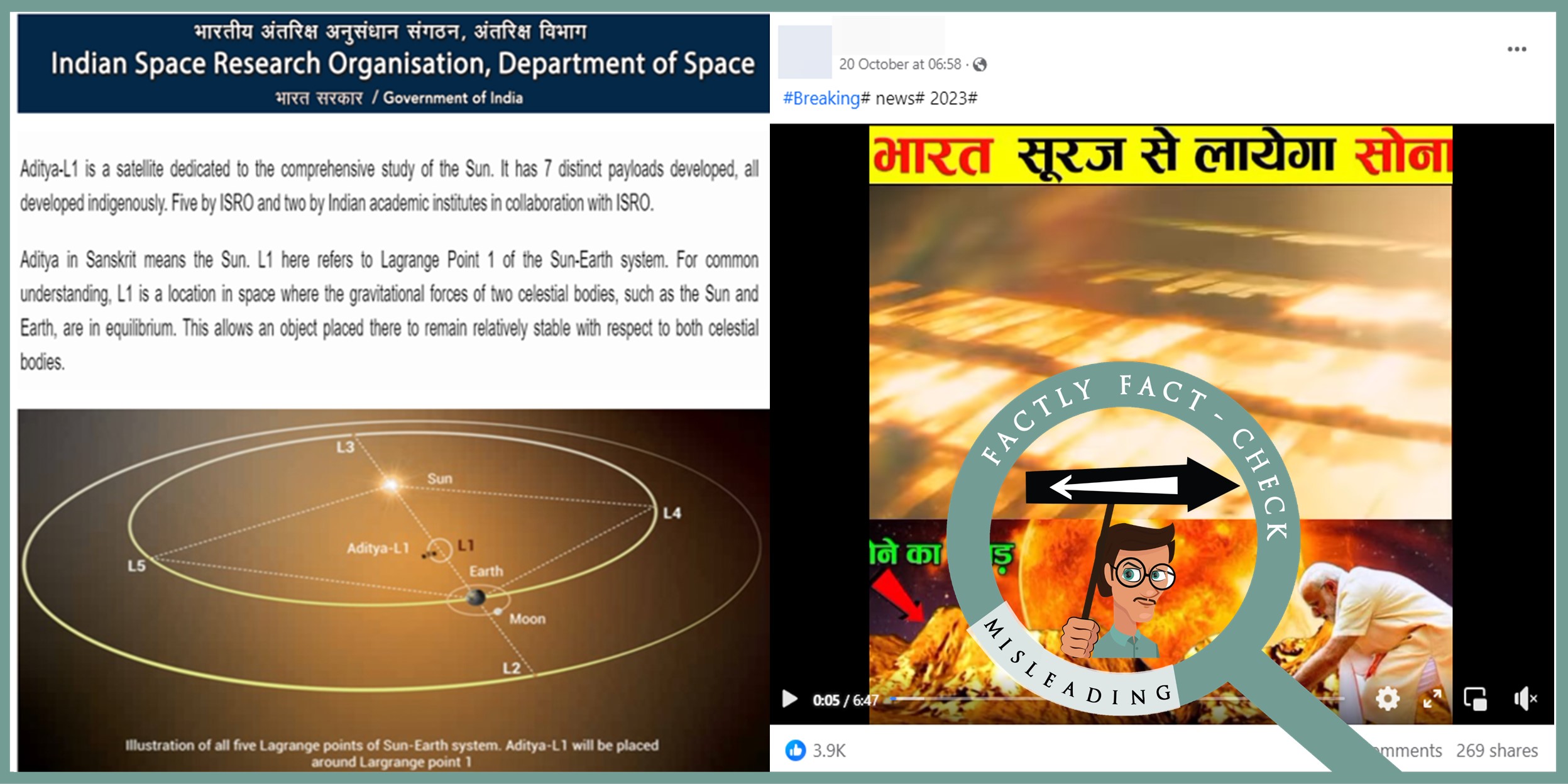
India is going to extract gold from the sun by sending Aditya-L1 mission spacecraft
Publisher’s rating: MISLEADING
The review examines a social-media video claiming that India will extract gold from the Sun by sending the Aditya-L1 spacecraft. It says the video also discusses how gold forms in cosmic events and estimates the Sun contains nearly 2.5 trillion tons of gold. The review distinguishes the presence of gold from the possibility of retrieving it: it reports that the Sun contains gold and other elements, but that the Sun’s extreme conditions make access and extraction impossible. To assess the mission-related part of the claim, the review says it conducted a keyword search about the formation of gold through cosmic events. It describes neutron-star collisions as producing heavy elements, including gold, and reports that Aditya-L1 is intended to study the Sun and its effects on the space environment—not to extract material. The mission’s stated focus is studying the Sun’s chromosphere and corona with seven instruments from the L1 point, about 1.5 million kilometers from Earth. Taken together, the review’s account separates a claim about what the Sun contains from what the spacecraft is designed to do. It says the mission is for solar observation, while the conditions within the Sun prevent the proposed extraction. The review therefore concludes that the video’s claim is misleading.

Astronaut Buzz Aldrin Said The Moon Landing Was Fake
Publisher’s rating: Misleading
The review examines viral videos presented as showing astronaut Buzz Aldrin admitting that the Moon landing was fake. It reports that one Facebook post described him as admitting the landing was “not real,” and that another video combined clips from three interviews while being shared with a similar claim. The review says its team used Google Reverse Image Search to investigate the clips’ origins and context. For one clip, the review found a matching-format video on theroarbots’s YouTube channel, posted on September 16, 2015. It describes an interview with a young girl in which Aldrin discussed money as a possible factor in pursuing new space equipment and resources—not an admission that the Moon landing was fabricated. The review states that the video did not show him making the claimed admission. The review also describes a separate excerpt from an Oxford Union Q&A. Aldrin’s words “it didn’t happen” were given in response to a question about the “scariest moment”; the review says he was not referring to the mission as a whole. When prompted further, he recounted finding a broken circuit breaker on the lunar module’s floor while on the Moon. These contexts support the review’s conclusion that the clips were misleadingly presented as evidence that Aldrin said the landing was fake.
Buzz Aldrin admits Moon Landing was fake
Publisher’s rating: Misleading