PeakMetrics / Fact Checks
Politics & government fact checks
Explore claims publishers have checked about politics & government. Read their original ratings and follow the evidence.
Search fact checks
Search by text or image12,754 published reviews in this topic
Atal Bihari Vajpayee ji’s niece finally broke her silence
Publisher’s rating: Misleading

కేరళలో NRC కి మద్దత్తుగా ర్యాలీ నిర్వహిస్తున్న వారిని ప్రజలు తరిమికొడుతున్న వీడియో.
Publisher’s rating: FALSE

మూడు రాజధానులకు సపోర్టుగా ర్యాలీకి రావటానికి వై.సీ.పీ. నాయకులు డబ్బులు పంచి పెడుతున్న వీడియో.
Publisher’s rating: FALSE

కేరళలో CAA ,NRC కి మద్దతుగా బీజేపీ నిర్వహించిన ర్యాలీ వీడియో.
Publisher’s rating: FALSE

అమరావతి నుంచి రాజధానిని తరలింపును వ్యతిరేకిస్తూ రైతులు చేస్తున్న నిరసన
Publisher’s rating: FALSE

Pablo Iglesias tiene RTVE «bajo su control»
Publisher’s rating: Falso
The review examines the claim that Pablo Iglesias controlled RTVE, including a circulating message that called him “the director de los telediarios e informativos de las cadenas estatales” and said the broadcaster’s board consisted of five Podemos members, four PSOE members and one PNV member. It rejects those assertions, explaining that at the time there was no RTVE board in place and that the members of a future board were not yet known. The review’s account of the news leadership also contradicts the claim that Iglesias directed the broadcaster’s information programmes. Rosa María Mateo appointed Begoña Alegría as director of TVE’s News Services; Alegría held the post until the end of 2019, when she chose to leave. From 1 January, Enric Hernández held the information and current-affairs director role provisionally. The article therefore describes named RTVE officials, rather than Iglesias, exercising these responsibilities. The review’s evidence concerns the institutional arrangements and officeholders it identifies. It does not establish that Iglesias had control through some other, undocumented channel; its stated basis for rejecting the claim is that the alleged board was not in place and the news leadership was held by other people.


Según el CIS, los españoles sitúan al PP en la escala ideológica más centrada desde 2012
Publisher’s rating: Verdadero
The claim concerned Pablo Casado’s January 2020 assertion that CIS data showed Spaniards locating the PP at its most centrist point since 2012. The review identifies the relevant comparison as survey respondents’ placements of the PP on a scale from 0 (far left) to 10 (far right), and reports the figures Casado cited: 7.6 in 2008, 8.35 in 2016, and 7.83 in the November 2019 survey. It says those figures are correct and that the November 2019 result was the party’s most centrist since 2012. [S1: “los españoles situaban al PP en el 7,6 en la escala ideológica, siendo cero la extrema izquierda y 10, la extrema derecha. En 2016, nos situaban en el 8,35. En el último, que es del pasado noviembre, nos sitúan en 7,83, que es el registro más centrado desde el año 2012”] The article places this change in the period after Casado became PP president on 21 July 2018. At that point the party’s score was 8.24; by November 2019 it had fallen to 7.83, with an intervening high of 8.31 in October 2018. The review also compares the PP’s result with other parties: the PSOE scored 4.18 in November 2019, while Vox scored 9.37. Those comparisons show the PP’s reported movement toward the centre, not that it was the party closest to the centre. [S1: “Pablo Casado se convirtió en el nuevo presidente del PP el 21 de julio de 2018, tras la moción de censura al expresidente Mariano Rajoy, cuando el PP tenía un registro de 8,24. Desde entonces, la posición del partido se ha ido ‘centrando’ hasta el 7,83 de noviembre de 2019, con un único pico de 8,31 en octubre de 2018.”] The review qualifies what the survey can establish: the figures reflect public perceptions of parties, not an independent assessment of their policies or ideology. It cites political science professor Antonio Robles Egea, who says the results depend on respondents’ own outlook and on how they perceive a party. Thus, the survey supports the specific historical comparison in Casado’s claim, but does not by itself prove that the PP’s policies moved toward the political centre. [S1: “esa medición se basa en las percepciones de la gente, no en un análisis real de las posturas de cada partido.”]
El currículum de la presidenta de la Diputación de Pontevedra
Publisher’s rating: Falso
The review investigates a viral screenshot that appeared to show Carmela Silva, president of the Provincial Council of Pontevedra, described on Wikipedia as an English teacher. The screenshot circulated alongside video of Silva speaking at the opening of the World Triathlon event in Pontevedra on April 26, 2019; her English pronunciation drew mockery online. Newtral concluded the claim that she was an English teacher was false. The article says it checked the Wikipedia page’s edit history. That history showed that someone had replaced a description of Silva as a special-education teacher with “English teacher”; the edit’s author had since been removed, and the article says the description had been restored. Newtral also reports that Silva’s curriculum on the provincial council’s website listed her qualification as a special-education teacher, but did not say she had taught English. The article says her profile on the Spanish Congress of Deputies’ website likewise made no mention of her being an English teacher. Thus, the screenshot reflected a change made to Wikipedia, not evidence establishing the qualification it attributed to Silva. The review’s account of the edit history and its comparison with the two institutional profiles support its conclusion that the viral claim was false.
Auf Facebook kursiert seit Anfang Januar ein Post, der die Beschlussfähigkeit des Deutschen Bundestages bei der Verabschiedung des Netzwerkdurchsetzungsgesetzes (NetzDG) in Frage stellt. In dem Post ist unter dem Paragrafen 45 der Geschäftsordnung des Deutschen Bundestages ein Foto vom Plenarsaal mit etwa 60 anwesenden Abgeordneten zu sehen. Nur etwa ein Zehntel statt - wie laut Paragraf 45 gefordert - mehr als die Hälfte der Abgeordneten sei bei der Abstimmung anwesend gewesen, heißt es unter dem Foto. Damit wird suggeriert, dass der Bundestag an besagtem Tag nicht beschlussfähig gewesen sei.
Publisher’s rating: Entgegen der Darstellung des Posts war der Bundestag am 30. Juni 2017 bei der Abstimmung zum NetzDG beschlussfähig. Als Grundlage dafür gilt Paragraf 45 Absatz 2. Eine Fraktion etwa hätte die Beschlussfähigkeit demnach bezweifeln müssen. Die Beschlussunfähigkeit hätte dann erst über eine Stimmenzählung festgestellt werden müssen.
The Trump administration "certified" that Iran was complying with the nuclear deal.
Publisher’s rating: True.

Assam FM's tweet showing the crowd at an AASU rally in Dhemaji vs crowd at BJP rally
Publisher’s rating: FALSE
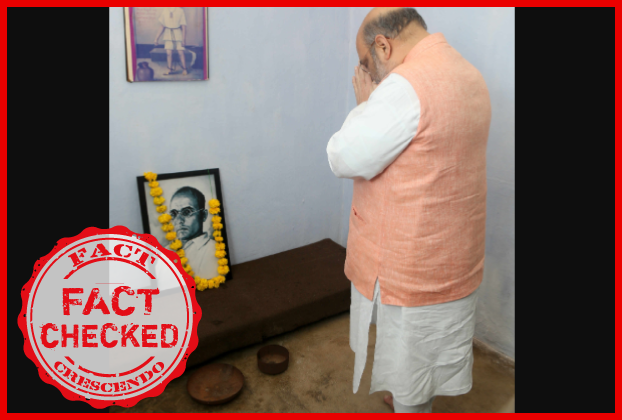
Claim: Amit Shah paid tribute to Godse portrait
Publisher’s rating: Fact Crescendo Rating: False
Fact Crescendo investigated a social-media post claiming that Amit Shah was paying tribute to Nathuram Godse, the assassin of Mahatma Gandhi. The review says the image appeared to show Shah honoring a portrait, and that the post identified the person in it as Godse. The investigation instead concluded that the portrait showed Vinayak Damodar Savarkar. To check the image’s provenance, the review reports using Google reverse-image search. It found the same photograph among images on Shah’s website, in a set described as showing him paying tribute to Savarkar at the Cellular Jail in the Andaman Islands on May 28, 2016. The review also notes that Shah was BJP national president at the time, not Union home minister. As further comparison, the investigators say they found images of other public figures paying tribute to Savarkar at the Cellular Jail and compared an image of Godse with the portrait in Shah’s photograph. They report that the pictures were different. On that basis, the review judged the post’s identification of the portrait as Godse—and thus its claim about Shah paying tribute to Godse—to be false.
Mitglieder des Bundestags stellen beinahe täglich Kleine Anfragen an die Bundesregierung. Wegen der hohen Anzahl sei sie nun nicht mehr bereit, alle derartigen Anfragen zu beantworten, heißt es in einem Blog-Beitrag auf "Journalistenwatch". Die Regierung beklage, ""Tausende Kleine Anfragen" würden die Ministerien [...] "überschwemmen"".
Publisher’s rating: Die Darstellung, dass die Bundesregierung "nicht mehr bereit" zur Beantwortung aller Kleinen Anfragen sei, ist falsch. Sie bittet allerdings die Bundestagsfraktionen darum, nach Möglichkeit weniger Anfragen zu stellen.
The claim concerns a Journalistenwatch post alleging that the government was no longer willing to answer all Kleine Anfragen, and attributing the phrase about thousands of inquiries “overwhelming” ministries to the government. The review distinguishes the government’s actual request to reduce the volume of questions from a refusal to answer them. It reports that a letter sent by the Federal Chancellery to the parliamentary groups’ first parliamentary secretaries in late November 2019 asked them to reduce the number of inquiries, while seeking an agreement that would allow answers to remain high quality. The review quotes the letter’s stated rationale: maintaining a “qualitativ hochwertigen Beantwortung” and reaching an agreement that “auch eine Reduzierung des Frageaufkommens einschließen sollte.” It reports no announcement that the government would stop answering Kleine Anfragen. Instead, the evidence presented is a request to reduce their number. The review also says the sentence about ministries being “überschwemmt” came from an n-tv.de article and was falsely attributed to the government by Journalistenwatch; it states that the Chancellery letter did not contain that sentence. The review supplies figures to explain the request’s context: 5,836 Kleine Anfragen had been submitted in the 19th legislative period by mid-November 2019, and 6,185 by January 3, 2020. It says the Chancellery calculated that the mid-November figure was 48 percent higher than in the preceding legislative period. These figures support the account of rising volume, but do not establish a decision to stop answering questions.
Nancy Pelosi und Chuck Schumer in muslimischer Bekleidung vor iranischer Flagge
Publisher’s rating: Falsch. Das Foto ist eine Montage und stammt von einem Twitter-Konto Trump-freundliche Inhalte und Posts über iranische Themen verbreitet.
Pablo Iglesias dijo que “disfrutaría viendo como matan a tiros a líderes del PP”
Publisher’s rating: Falso

Claim BJP MLA Anil Upadhyay speaking against BJP and Modi
Publisher’s rating: FALSE
Presiden Jokowi menyebut Cina bukan mencuri tapi hanya mengejar ikan yang lari ke perairan Natuna
Publisher’s rating: Keliru