PeakMetrics / Fact Checks
Health & medicine fact checks
Explore claims publishers have checked about health & medicine. Read their original ratings and follow the evidence.
Search fact checks
Search by text or image13,677 published reviews in this topic

If the virus is exposed to a temperatureof 26 - 27 degrees celcius it will be killed
Publisher’s rating: False
The claim appeared in a social-media post attributed to the Facebook page Clean and Green Services. It said that exposing the virus to temperatures above 26–27°C would kill it, and presented UNICEF as its source. The review reports checking that attribution directly: Vishvas News shared the viral image with UNICEF health specialist Dr. Kanupriya Singhal, who said UNICEF had not issued such a message. UNICEF communications specialist Christopher Tidey also replied by email that the post was not from UNICEF and was inaccurate. [S1]

Pigs being burnt alive in pit by China government over fear of coronavirus
Publisher’s rating: FALSE
The Quint investigated a video circulated with a claim that China’s government was destroying pigs because they might be infected with coronavirus or another sickness. The footage shows pigs in a pit being burned and then covered with earth. The review’s conclusion is that the video is from China but predates the coronavirus outbreak and depicts a different disease-related cull. To check its context, The Quint searched Google for material about pigs being killed in China, found the same video in a Kinder World article, and searched YouTube for the footage. It reports that the YouTube upload, posted by a user called Lightning TV, had been online since 21 January 2019 and was captioned as showing pigs being burned after contracting “the plague.” The review says the Kinder World account placed the burning in December 2018 and linked it to African swine fever. The review also describes a reverse search of video frames, which led to reporting by Russian outlet Ach 24. That account said the footage was from a Chinese village and had circulated online in January 2019, although it had been shared with a different location-based claim in Russia’s Amur region. Taken together, the reported footage history and the earlier event date contradict the coronavirus explanation: the video existed before the outbreak and was associated with fears of African swine fever, not coronavirus. The article does not identify the village or independently establish the farm’s identity.

A Tencent graphic shows that the death toll in China due to Coronavirus has crossed 24,000.
Publisher’s rating: FALSE
Evitar el contagio coronavirus con alimentos que sean fuentes de Vitamina C.
Publisher’s rating: Engañoso

"Anybody that wants a test [for COVID-19] can get a test. That’s what the bottom line is. ... Anybody right now and yesterday — anybody that needs a test gets a test. We — they’re there. They have the tests. And the tests are beautiful. Anybody that needs a test gets a test."
Publisher’s rating: Exaggerates
"[T]hey don't even have a test kit [for COVID-19]. A test kit to determine whether or not someone has the disease."
Publisher’s rating: False
3. Myth: Goods manufactured in affected countries like China could spread the disease
Publisher’s rating: when goods travel, exposing the surfaces to different conditions and temperatures, it is highly unlikely that the virus would survive.
2. Myth: Taking antibiotics could prevent and treat the coronavirus
Publisher’s rating: Not true. Antibiotics work only against bacteria, and not against viruses.

La ex alcaldesa de Madrid, Manuela Carmena, da positivo en Coronavirus
Publisher’s rating: Falso
The claim was that Manuela Carmena, Madrid’s former mayor, had tested positive for coronavirus. The review says the claim circulated in a Twitter post using an “última hora” graphic styled to resemble El País. It reports that the post came from an account named @GjisPoric, which identified itself as a parody account, rather than the newspaper’s account, @el_pais. (S1: “La ex alcaldesa de Madrid, Manuela Carmena, da positivo en Coronavirus”; “La cuenta que publica el tuit indica que es «parodia» y se llama @GjisPoric. La cuenta correcta de El País es @el_pais.”) For its check of the health claim, the review says Newtral sought confirmation from Más País’s communications office, which told it the claim was false. The excerpt does not describe independent medical-record checks or identify another evidentiary method, so the support it gives for rejecting the reported positive test is that confirmation. (S1: “Es falso, según nos confirma el gabinete de comunicación de Más País.”) The review also says the claim spread beyond Twitter: at least four websites published the false content after the tweet was shared. This distinguishes repetition of the claim from confirmation of Carmena’s health status; the excerpt presents those websites as further circulation, not as independent evidence that she had tested positive. (S1: “Al menos cuatro páginas webs han publicado este contenido falso después de que se compartiera el tuit.”)
Seit Wochen werden Falschnachrichten über das Coronavirus Sars-CoV-2 in sozialen Netzwerken verbreitet. Unter anderem wird in einem Facebook-Post behauptet, dass das Virus "bei einer Temperatur von 26 bis 27 Grad stirbt". Daher sei es ratsam, viel heißes Wasser zu trinken. Außerdem sei das Virus so groß, dass "jede normale Maske (...) es filtern kann"
Publisher’s rating: Coronaviren halten höhere Temperaturen aus als 27 Grad Celsius, zum Beispiel die menschliche Körpertemperatur. Händehygiene und Abstandhalten sind ein deutlich effektiverer Schutz vor Ansteckung als das Tragen eines Mund-Nasen-Schutzes.
The dpa review examined a Facebook post claiming that SARS-CoV-2 dies at 26–27°C, so people should drink hot water, and that the virus is large enough to be filtered by any ordinary mask. The review’s temperature check compared the claim with human body temperature: it notes that almost everyone’s core temperature is above 35°C. If the virus could not survive above the claimed threshold, the review reasons, it could not be viable in the human body. It also points to more than 100,000 confirmed infections worldwide as evidence inconsistent with that premise. The review does not report a specific test of drinking hot water; its reasoning addresses why the claimed temperature threshold would make infection in people impossible. On masks, the review reports the RKI’s position that there was insufficient evidence that healthy people wearing a mask substantially reduce their risk of infection. It distinguishes that from a possible benefit: a mask may reduce touching the mouth or nose with potentially contaminated fingers, which could help prevent smear infection. The review identifies good hand hygiene and keeping distance from sick people as key protective measures. It does not substantiate the post’s claim that every ordinary mask filters the virus; rather, it explains that the post’s mask-related advice does not establish a meaningful reduction in infection risk for healthy wearers.

Unicef O Corona vírus é maior do que o normal; o diâmetro da célula é de 400 a 500 mícrons e, por esse motivo, qualquer máscara impede a sua entrada no organismo.
Publisher’s rating: Falso
The claim was part of a message circulating online that purported to offer UNICEF’s coronavirus-prevention advice. It said the virus was unusually large—400 to 500 microns—and that this meant any mask would prevent it from entering the body. The review also describes other claims in the same message, about how long the virus survived on surfaces and whether heat, hot food or gargling could stop it. The review reports that UNICEF directly denied producing the message. It quotes the organization’s statement that the circulating guidance was attributed to UNICEF falsely, and that the text contained misinformation. UNICEF’s response specifically marks the size-and-mask assertion as false, alongside the message’s other listed claims. This directly addresses both the attribution to UNICEF and the central claim about masks. The review also gives context from its own examination of the message: it says a similar text had previously circulated under another attribution, to a doctor in Wuhan. It notes that the message’s claims about temperatures and virus survival were not substantiated in the material it discusses. For the mask claim, the excerpt’s decisive evidence is UNICEF’s explicit denial and its direct rejection of that specific assertion; the review does not describe an independent laboratory test of mask performance.

Tomar agua cada 15 minutos acaba con el coronavirus
Publisher’s rating: Falso
5. Myth: Taking a hot bath could prevent the virus
Publisher’s rating: Your body temperature is in the range of 36.5°C to 37°C, and it will remain so even if you take a bath or shower in cold or hot water. If you take a bath in extremely hot water, it could burn you and can be harmful.

El audio con recomendaciones sobre el coronavirus de un jefe médico del Gregorio Marañón
Publisher’s rating: Falso

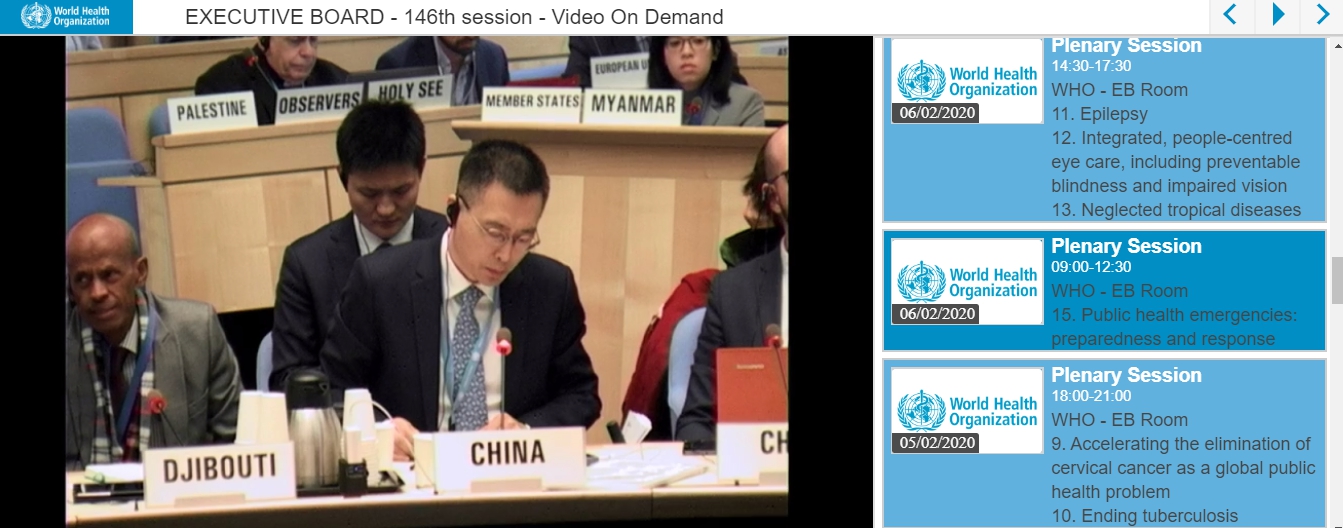
【錯誤】網傳WHO中國代表發言片段宣稱「台灣研發成功快篩,中國在WHO搶收割~ 」?
Publisher’s rating: 錯誤
The claim attached to the circulating video was that China’s representative had used a WHO speech to take credit for Taiwan’s rapid COVID-19 test development. The Taiwan FactCheck Center traced the clip to the representative’s remarks at the WHO Executive Board meeting on February 6, 2020, and compared the speech with the video and its subtitles. The review says the text matched, but the representative did not mention rapid tests during the speech. His remarks concerned Taiwan’s relationship with China and WHO, including claims about cross-strait communications and access to public-health information. The timing also contradicts the claim that the speech took credit for an already announced Taiwanese test. The review reports that Academia Sinica announced its rapid-test development on March 8, after the February 6 speech. Its Facebook announcement described a team led by researcher Yang An-sui and said the test reduced detection time from four hours to 15 minutes. Thus, the cited speech predates the announcement by about a month and, according to the transcript summarized in the review, contains no reference to the test. The review also checked whether the claim could refer to a more recent WHO appearance: it reports that no WHO meeting had taken place around March 8 and that searches of Chinese media found no public statement by representative Li Song about Taiwan’s rapid-test development. Its conclusion is specific to the claim and evidence examined: the video is a real excerpt from the February 6 meeting, but its accompanying rapid-test allegation is not supported by the speech or the chronology.
1. Myth: Garlic can help prevent the disease
Publisher’s rating: There is no proof that garlic could help prevent the infection.
4. Myth: Frequent drinking of water helps
Publisher’s rating: While drinking water and staying hydrated is a healthy practice, it won’t help to kill the virus.
Contener la respiración permite saber si uno está infectado por coronavirus
Publisher’s rating: Falso

Laila Ahmadi confirma que la vitamina C y el limón previenen el coronavirus
Publisher’s rating: Falso
Newtral examines an audio and text message circulating on social media and WhatsApp that urges people to take lemon and vitamin C to prevent coronavirus. The message is attributed to a purported Chinese expert, Laila Ahmadi, and also invokes a supposed doctor from a Beijing military university. The review says Ahmadi describes herself as a student at Zanjan University’s Faculty of Medical Sciences, then checks where that institution is located: it is in Iran, not China. It also cautions that the message’s purported expertise does not establish the advice as reliable. The review addresses the two suggested preventive measures separately. It reports that vitamin C acts as an antioxidant and supports immune defenses, but cites Joan Carles March of the Andalusian School of Public Health, who says research has not shown vitamin C supplements to reduce most people’s risk of catching even the common cold. The article therefore does not treat the vitamin’s role in the body as evidence that it prevents coronavirus. It also says health organizations do not include any specific food among their recommendations for preventing or combating the disease. The lemon advice is presented in the message through purported professor Chen Horin, described as CEO of a Beijing military hospital. Newtral says it found no hospital with that name in Beijing and notes that Chen Horin’s name had appeared in earlier false claims about lemon as a cancer cure. The review distinguishes limited claims about citrus and tumor cells from the unsupported leap that lemon can prevent or cure disease. Overall, the evidence described undermines the message’s attribution and its health claims; it does not substantiate lemon or vitamin C as coronavirus prevention.