PeakMetrics / Fact Checks
Health & medicine fact checks
Explore claims publishers have checked about health & medicine. Read their original ratings and follow the evidence.
Search fact checks
Search by text or image13,677 published reviews in this topic
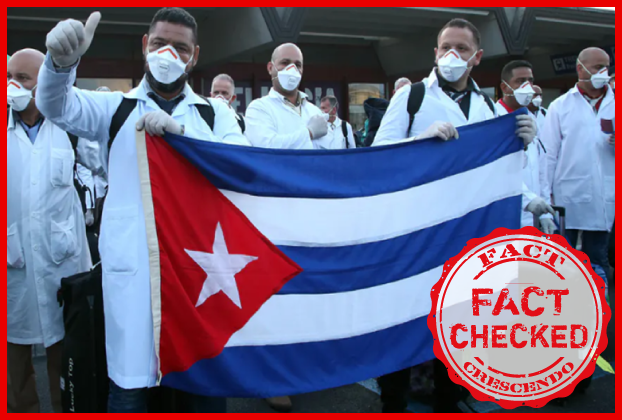
Claim: Has Cuba sent 2 lakh doctors to 95 countries
Publisher’s rating: Partly False
Fact Crescendo investigated the specific claim that Cuba had sent 200,000 doctors to 95 countries. The review questioned the figure by comparing it with estimates of Cuba’s own medical workforce, then examined how many Cuban doctors were working abroad. It reports that Cuba had about 95,000 doctors domestically and that roughly 50,000 Cuban doctors served in 67 countries—figures that do not support the claim as stated. The review also checked a report from Granma, which it describes as an official Cuban Communist Party media outlet. According to the review, Granma reported that Cuba had sent 400,000 healthcare workers to 164 countries. The review distinguishes that broader category from doctors: it says the total includes nurses, medical technicians and pharmacists, and that doctors made up about 50,000 of the personnel. Thus, the much larger figure refers to healthcare workers, not 200,000 doctors. The review’s conclusion is that the circulating claim combines inaccurate figures and categories. Its evidence supports a substantial Cuban international medical presence, but not the assertion that 200,000 Cuban doctors were serving in 95 countries. It also notes that Cuba’s overseas medical work developed gradually over roughly 50 years, rather than being a one-year deployment.

Das Tragen eines Mund- und Nasen-Schutzes (MNS) in Supermärkten ist im Kampf gegen das Coronavirus sinnvoll.
Publisher’s rating: Die Behauptung ist umstritten. Zum einen gibt es keine wissenschaftliche Evidenz, dass das Tragen einer Maske das Ansteckungsrisiko der Person, die sie trägt, verringert. Allerdings sollten am Coronavirus Erkrankte oder möglicherweise Erkrankte laut Experten eine Maske tragen, um die Ansteckungsgefahr zu minimieren.


Italians bidding goodbye to the world after being unable to control outbreak of coronavirus in Italy.
Publisher’s rating: FALSE

Indian Army to be deployed in Telangana to fight coronavirus pandemic
Publisher’s rating: FALSE

கோவாவில் காவல்துறையினரின் வித்தியாசமான அணுகுமுறை !! covid19.
Publisher’s rating: Fake

अजमेर में एक बालिका ने जन्म लेते ही यह कहा कि दाएं पैर के अंगूठे के नाखून पर हल्दी का लेप लगाने से कोरोनावायरस का संक्रमण रोका जा सकता है।
Publisher’s rating: False

為什麼外面沒有人,也要你戴口罩,因為噴嚏液體速度是每秒35公尺,空氣中擴散8米,可懸浮24小時
Publisher’s rating: 部分錯誤
The review examined a circulating social-media message that used figures of 35 metres per second for sneeze droplets, spread of about eight metres, and virus suspension for 24 hours to argue that people should wear a mask outdoors even when nobody is nearby. It says a reader identified the figures as coming from the study “Turbulent Gas Clouds and Respiratory Pathogen Emissions,” which discusses droplet spread. The review cautions that those figures do not by themselves establish how long infectious virus remains airborne or the risk of transmission: particle size and the virus’s ability to infect also matter.

昏倒在浴室...洗澡時不要先洗頭,理應先清洗身體其他部位..淋濕先從腳底開始..錯誤的沐浴方式,我們可能會中風或者偏頭痛
Publisher’s rating: 部分錯誤
The review investigated a circulating message that advised people not to wash their hair first, but instead to wet and wash their bodies progressively from the feet upward. The message claimed that cold or wetting the head could draw blood there, narrow or rupture blood vessels, and lead to a stroke or migraine. The review assessed those proposed mechanisms and the claimed importance of washing order, rather than reporting a particular bathroom incident. To examine the medical claims, the review quoted explanations from Lin Jun-ren, a neurologist at Taipei Veterans General Hospital, and Yeh Rui-ru, a family-medicine physician at Shuang Ho Hospital. They described stroke as brain damage resulting from a blood-vessel problem, and discussed the role of conditions such as high blood pressure, high blood sugar, and high blood lipids. On cold exposure, Yeh said that blood-vessel constriction and changes in blood pressure and heart rate are whole-body responses, not effects confined to the head. The doctors distinguished the possible effects of abrupt temperature changes from the message’s recommended washing sequence. Lin said a sudden temperature change can be hazardous in particular circumstances: abrupt hot-water exposure in cold weather may cause fainting and a fall, while sudden cold-water exposure in hot weather can sharply raise blood pressure and, although unlikely, may contribute to brain bleeding. He said this is related to water temperature, not which body part is washed first. The review concluded that the sequence advice has no direct relationship to stroke risk; it also noted that vascular risks and underlying chronic conditions matter, and that cold-water exposure may act as a trigger for people whose vessels are already unhealthy.

Carmena ha recibido un respirador en su casa por no acudir a un hospital público
Publisher’s rating: Falso
The claim concerned former Madrid mayor Manuela Carmena: viral posts said she had received a personal respirator at home from VitalAire, supposedly so she would not have to go to a public hospital. The posts circulated alongside a photograph of a VitalAire van parked on a street described as Carmena’s, and amid claims that she had contracted coronavirus. Newtral checked the allegation by asking Carmena and VitalAire about it. Carmena said it was false, added that she was well and at home, and described the story in comments to Cadena SER as a slander. VitalAire also told Newtral that the information was false. These direct responses address both the alleged recipient and the company said to have supplied the equipment. The van photograph did not establish that Carmena had received a respirator. She confirmed the vehicle was photographed on her street but said it had nothing to do with her. VitalAire explained that the vehicle was prepared to deliver oxygen to patients receiving chronic respiratory therapies and that its vans did not deliver respirators to homes. The review therefore distinguishes the real image and its location from the unsupported claim about Carmena.


意大利把65歲以上的老年人都關了起來」、「西班牙封城,老人家不准上街一發現就被警察抓走送到集中營?
Publisher’s rating: 錯誤
The claims attached to the video were that Italy had confined all people over 65, and that, during Spain’s lockdown, elderly people caught outside were arrested and sent to a concentration camp. The review traces the footage to an event in Baku, Azerbaijan, rather than to either country or to the COVID-19 pandemic. It says the original video documents police detaining protesters on October 19, 2019. To identify the footage, the fact-checkers searched YouTube and found an identical video uploaded on October 21, 2019, with an Azerbaijani-language title and description. They compared the logo in the circulating clip with the YouTube video and account, finding the same Meydan TV logo. The review also checked reporting about the Baku protest, including Reuters coverage, and cites reports that police detained protesters there, among them opposition leader Ali Kerimli. The central mismatch is therefore in the video’s identity and setting: footage from a 2019 protest in Azerbaijan was recirculated with captions about Italy and Spain during the pandemic. The review concludes that the video does not show the events described in those captions.
Berendam di laut bisa mengobati infeksi virus Corona Covid-19
Publisher’s rating: Keliru

Die Stadt Bergamo im Norden Italiens ist eine der am stärksten von der Corona-Pandemie betroffenen Kommunen. In einem Kettenbrief, der auf WhatsApp und Facebook geteilt wird, heißt es, an nur einem Tag seien dort 800 Menschen an Covid-19 gestorben. Über das italienische Lied "Rinascerò, Rinascerai" des Sängers Roby Facchinetti steht dort, dessen Urheberrechte seien an das Krankenhaus in Bergamo überschrieben worden. Und weiter: "Jeder Klick auf das Video ist damit quasi eine Spende, da YouTube dem Inhaber Geld pro Klick bezahlt."
Publisher’s rating: Der Sänger widerspricht dieser Behauptung. Mit dem Lied werde zwar Geld für das Krankenhaus gesammelt, aber nur wer es kaufe, spende auch.
59 jemaat gereja di Afrika Selatan tewas usai minum Dettol untuk mencegah penularan virus Corona Covid-19
Publisher’s rating: Keliru


Family of people who died due to coronavirus in Italy are throwing money on the streets
Publisher’s rating: FALSE
The claim was that relatives of people who died from COVID-19 in Italy were throwing money onto the streets. The Quint says the pictures showed currency scattered on the ground, but its investigation found they were old images and unrelated to the pandemic. Its review describes two images and reports checking each one separately. For the first image, the review says a reverse-image search led to a tweet posted in March 2019. The tweet identified the scene as a bank looting in Mérida, Venezuela. The Quint then searched Spanish-language terms about a bank being looted in Mérida and found a report by Venezuelan outlet Maduradas.com. According to The Quint’s account of that report, the image dated to 11 March 2019 and showed old currency scattered after a bank was looted, with some of the money set on fire. For the second image, The Quint says a reverse-image search found the same picture in an April 2019 post by Johns Hopkins applied economist Professor Steve Hanke, which also identified it as being from Venezuela. The review adds an important qualification: although it established that the image was old and not related to the pandemic, it could not independently verify the image. The evidence described therefore contradicts the post’s presentation of the pictures as scenes involving bereaved Italian families during the coronavirus outbreak.