PeakMetrics / Fact Checks
Health & medicine fact checks
Explore claims publishers have checked about health & medicine. Read their original ratings and follow the evidence.
Search fact checks
Search by text or image13,676 published reviews in this topic

Drinking alcohol can protect you from Covid-19
Publisher’s rating: This is misleading. Drinking alcohol does not protect you against the coronavirus
A recent study says coconut oil removes 93% of colon cancer cells in 2 days
Publisher’s rating: Misleading

網傳「台大醫師團契訊息...重症新冠肺像 “SARS+AIDS”...免疫系統也幾乎全被摧毀...多器官衰竭是新冠病毒重要死亡原因...出院的病人可能會像B型肝炎病人一樣,長期帶病毒生存」?
Publisher’s rating: 部分錯誤
The review examined a social-media message attributed to an “NTU doctors’ fellowship” that urged people to avoid close contact with recovered COVID-19 patients and made several claims about severe disease, immune damage, multi-organ failure, and possible long-term viral carriage. NTU Hospital said on April 16 that the message was not issued by its doctors and that it had no “NTU doctors’ fellowship.” The review also traced some versions of the message to a March 10 Tencent article and noted that the People’s Daily’s March 14 post quoted Wuhan physician Peng Zhiyong with an important qualification: the proposed link between immune-system weakness and testing positive again was speculation, not established by scientific evidence. The scientific claims were not all supported to the same degree. Virologist Shih Hsin-ju said severe COVID-19 outcomes can involve patients’ existing illnesses and COVID-related pneumonia; impaired lung function can affect the heart and kidneys, and multi-organ failure can occur. But she emphasized that this is not unique to COVID-19: other illnesses, including bacterial infection and sepsis, can also cause it. Researcher Ho Mei-hsiang explained that lymphocyte counts can fall in COVID-19, but lymphocytes participate in immune responses and decreases also occur with many other viruses, including SARS. The review reported that available evidence did not establish the viral effects as equivalent to HIV’s effects on immune cells. The review found no adequate basis for the message’s prediction that recovered patients would carry the coronavirus long-term like hepatitis B patients. Shih said that coronavirus and hepatitis B have different mechanisms, and that persistent carriage after recovery had not been observed for human coronaviruses; whether SARS-CoV-2 could persist in that way required more research. Ho likewise said there was insufficient research to support the claim of long-term carriers. Thus, the review distinguished observed findings—such as reduced lymphocyte counts and occasional detection of virus after recovery—from the message’s stronger claims about immune destruction, infectiousness, and lifelong carriage.
Inhale steam to kill coronavirus
Publisher’s rating: This is misleading advice and inhaling steam is potentially very dangerous. Water vapour rising from a boiling pan would be quickly cooled as it enters the body and not be hot enough to have an effect against the virus.

Após anúncio do Ministro Sérgio Moro que a PF irá investigar as mortes por Covid 19, cai o número de mortos em todo País.
Publisher’s rating: Falso
A World Health Organization advisory lays out a four-step protocol and procedure of lockdown periods
Publisher’s rating: Fake
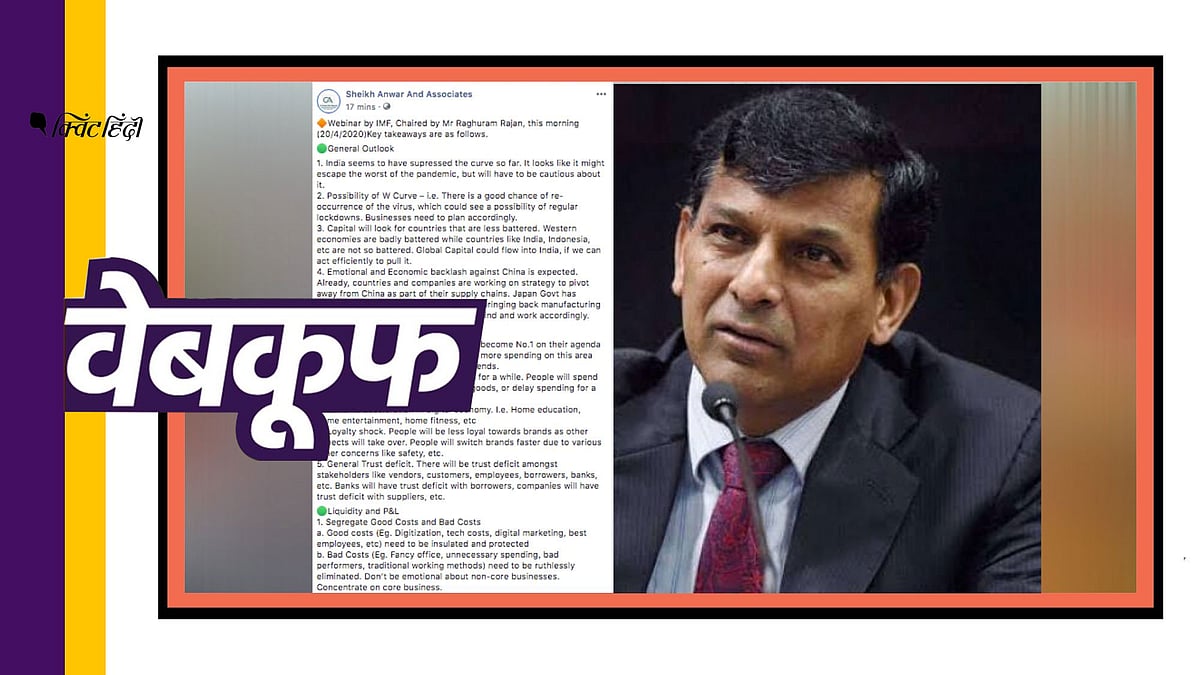
रघुराम राजन ने कोरोना वायरस पर IMF के वेबिनार को संबोधित किया
Publisher’s rating: FALSE

ATENÇAO ; SEGUNDO INFORMAÇOES PLAUSÍVEIS, EM MANAUS, ESTAO ENTERRANDO CAIXOES VAZIOS, SEM MORTES DE COVID19..; QUE INDIGN
Publisher’s rating: Falso


網傳文章「聯合國:人類『大限將至』!世衛組織:40年內全球吃素!必須馬上吃素...」?
Publisher’s rating: 部分錯誤
The reviewed article combines claims about climate change and diet: it presents the IPCC’s 1.5°C report as a warning that a crisis would arrive by 2040, urges people to eat less meat, and attributes a call for the whole world to become vegetarian within 40 years to the WHO. The review distinguishes what the climate report discusses from what the WHO actually recommends. The IPCC report was commissioned after the 2015 Paris Agreement and published in 2018 to assess the effects of warming of 1.5°C and 2°C. The review describes its focus as evaluating routes toward climate and sustainable-development goals, not issuing a universal order to become vegetarian. (S1: “2015年聯合國氣候峰會通過《巴黎協定》後,聯合國跨政府的專家小組IPCC接受特別任務委託,研究全球升溫攝氏1.5度和攝氏2度的環境衝擊,在2018年發布的特別報告。”; “該報告著重以各方整體性的衡量,來達到永續發展目標。”) The review reports that the IPCC assessment says warming would reach 1.5°C between 2030 and 2052 if it continued increasing at the then-current rate; its chart’s average trajectory indicated around 2040. But the report’s assessment target was 2100, and it also evaluated carbon-dioxide-removal options for limiting warming by that date. Thus, the 2040 figure is not presented as a date when humanity would be destroyed. (S1: “全球暖化將在2030年到2052年間升溫1.5度。”; “按照目前的增溫趨勢,以平均區間來看,全球會在2040年升溫至攝氏1.5度。”; “但是,此份報告是以2100年為目標,因此報告也評估了升溫超過1.5度後、以二氧化碳移除技術吸附大氣層中的二氧化碳的方案,以達到2100年時全球升溫在1.5度以下的目標。”) On diet, the review says the IPCC report discusses reducing meat and other livestock products as one way to lower food-system emissions, especially where consumption exceeds health-guideline recommendations. It says the report does not call for immediate, universal vegetarianism. Separately, the review searched the WHO website and reports finding no vegetarianism-related content in the press releases it examined. It also cites WHO guidance recommending varied foods, including meat, fish, eggs, and milk. The evidence therefore does not support attributing a 40-year global vegetarian mandate to WHO. (S1: “越來越多人同意,可透過減少肉類和其他畜產品,來降低食品系統的溫室氣體排放量,特別是在肉食的消費量高於人類健康準則建議的情況下。”; “但報告沒有呼籲「立即全面吃素」。”; “查核中心檢索世界衛生組織(WHO)官網,發布的新聞稿沒有「素食」相關的內容。”; “WHO於2019年12月26日公布的〈新年健康飲食的五個忠告〉中,建議攝取多樣化的食物來源,包括肉類、魚、蛋和牛奶。”)


«Ci sono due Italie: c’è la Lombardia, che è diventato l’epicentro mondiale dell’epidemia da Covid-19, e c’è il resto del Paese, che ha cifre tedesche o danesi»
Publisher’s rating: C'eri quasi
Beber ajo, cebolla, limón y jengibre cura el COVID-19
Publisher’s rating: Falso
The review addresses recipes circulated while people were waiting for a COVID-19 vaccine. It describes a video in which a woman who says she is a Spanish doctor claims that consuming garlic, onion, lemon and “kion” (ginger) together had produced positive effects in patients. The review rejects the causal claim: it says the reported effects were not due to consuming those foods. As supporting evidence, the review reports that the World Health Organization rebutted the idea that kion makes the virus remit in a post on its Peruvian Twitter account. The excerpt does not provide the post’s wording or date, describe any clinical study, or give details that would independently establish the video speaker’s identity or the patients’ outcomes. Its stated basis is therefore the WHO rebuttal, alongside the distinction between the video’s claimed observation and proof that the ingredients cure COVID-19.

Hand sanitizer destroys the novel coronavirus that causes COVID-19.
Publisher’s rating: Likely true
The National Academies review directly assesses whether hand sanitizer can destroy the novel coronavirus that causes COVID-19. Its stated conclusion is that hand sanitizer can do so, while qualifying that soap and water are the better choice for washing hands. The supplied excerpt gives that conclusion but does not describe testing methods, particular sanitizer formulations, or conditions of use; it therefore does not establish that every product or use is equally effective.
In diverse posts op Facebook wordt beweerd dat het nieuwe coronavirus, dat COVID-19 veroorzaakt, door mensen is gemaakt om als biologisch wapen te worden gebruikt. Dat zou in een laboratorium vlakbij het Chinese Wuhan kunnen zijn gebeurd, waar de epidemie begon. Dit soort samenzweringstheorieën wordt snel populair. Volgens een op 8 april gepubliceerde opiniepeiling gelooft bijna een derde van de volwassen Amerikanen dat de ziekteverwekker opzettelijk in een laboratorium is gekweekt
Publisher’s rating: Fout. Gerenommeerde wetenschappers vinden deze verklaring volstrekt niet plausibel.
The claim combines two assertions: that the virus causing COVID-19 was made in a laboratory near Wuhan for use as a biological weapon, and that nearly a third of American adults believed it had been deliberately grown in a lab. The review says the latter figure came from a Pew Research poll published on April 8. It distinguishes the still-unresolved question of how the first person was infected from the separate question of whether the virus was engineered: “Inderdaad is nog niet definitief vastgesteld hoe precies de eerste mens met het nieuwe coronavirus is besmet.” To assess engineering, the review describes research by Kristian Andersen and other researchers examining the virus’s spike proteins, which help it attach to and enter human cells. The researchers compared SARS-CoV-2 with other coronaviruses and found differences in the spike protein’s structure and amino-acid composition. Their analysis argued that the virus’s ability to enter human cells did not look like an optimally designed weapon, and concluded: “Dit is sterk bewijs dat SARS-CoV-2 niet het product van een manipulatie is.” The review also reports the researchers’ reasoning that it was not plausible to turn a virus previously harmless to humans into a weapon rather than start with known dangerous coronaviruses such as MERS or SARS. It therefore says a laboratory origin was not the most plausible explanation, while describing natural animal-to-human transmission—directly from bats or via an intermediate species—as the explanation the researchers considered plausible. It does not present the initial infection route as definitively settled. On Wuhan, the review notes that Chinese authorities pointed to the city’s wildlife market and that many early infections were traced there. It also includes a qualification: a study by Chinese scientists said the market might not have been the original source and that the virus could have arrived there from elsewhere. Thus, the reported evidence addresses the engineered-bioweapon allegation, but does not establish exactly where or how the first human infection occurred.

Die Ausgangsbeschränkungen haben nicht geholfen, die Reproduktionszahl der Coronafälle in Deutschland zu senken – und auch generell "nichts gebracht".
Publisher’s rating: Falsch. Die Maßnahmen und die Verhaltensänderungen haben etwas bewirkt, und zwar nicht nur bis zum Beginn der Ausgangsbeschränkungen. Denn die Reproduktionszahl ist auch danach weiter gesunken. Ende März war sie etwa bei 1, nun (Stand Ende April) ist sie bei 0,7.

కరోనావైరస్ వ్యాధి సోకి చనిపోయిన వారిని కొన్ని దేశాలు సముద్రాల్లో పడేస్తే, ఆ మృత దేహాలు ఒడ్డులో తేలిన వీడియో
Publisher’s rating: FALSE
Todeszahlen zeigen: Eine Covid-19-Erkrankung ist harmloser als die Grippe
Publisher’s rating: Irreführend. Die angegebene Zahl von Grippetoten basiert auf einer statistischen Schätzung und kann daher nicht mit den Corona-Todesfällen verglichen werden.
Bleach and other disinfectants destroy the novel coronavirus that causes COVID-19.
Publisher’s rating: True. Many chemical disinfectants work against the novel coronavirus, but it is important to use them properly and never ingest them or apply them to your skin.