PeakMetrics / Fact Checks
Health & medicine fact checks
Explore claims publishers have checked about health & medicine. Read their original ratings and follow the evidence.
Search fact checks
Search by text or image13,676 published reviews in this topic

Medidas de bloqueio matam mais que o próprio coronavírus, diz epidemiologista alemão
Publisher’s rating: Enganoso: Frase atribuída a médico alemão em site brasileiro não foi dita de forma literal pelo pesquisador. Ele fala, na verdade, sobre como as medidas mais rígidas de contenção à doença afetam outros setores da vida da sociedade, mas também não diz ser contra a quarentena

Ein Arzt warnt auf seiner Facebook-Seite vor den Gefahren einer möglichen Impfung mit einem mRNA-Impfstoff gegen das neuartige Coronavirus Sars-CoV-2 (http://dpaq.de/hhBpK). In dem Beitrag heißt es unter anderem, dass mRNA-Impfstoffe die Erbinformation in jeder Zelle veränderten, wodurch der Geimpfte etwaige «Fehler» an alle folgenden Generationen weitergebe. Personen, an denen der Impfstoff gerade getestet werde, müssten sich darum verpflichten, keinen Geschlechtsverkehr ohne Verhütung zu haben.
Publisher’s rating: Es ist extrem unwahrscheinlich, dass eine genetische Information der RNA (Ribonukleinsäure) in DNA (Desoxyribonukleinsäure) umgeschrieben wird. Noch weniger wahrscheinlich ist es, dass die entsprechende Informationen auf die Keimdrüsen übertragen und an die nächsten Generationen vererbt werden könnten. Personen, die derzeit an einer Studie zur Untersuchung der Sicherheit und Wirkung von mRNA-Impfstoffen gegen Covid-19 teilnehmen, müssen verhüten. Das gilt aber auch für Probanden, die an anderen Studien im Rahmen von Covid-19 teilnehmen.
The post warned that an mRNA vaccine would change genetic information in a person’s cells and pass resulting errors to descendants. It also pointed to contraception requirements for people in a Covid-19 vaccine trial as if those rules demonstrated a hereditary risk. The review distinguishes the biological claim from the trial precaution: the requirement to avoid pregnancy was intended to exclude pregnancy during early safety testing, not to prevent alleged inherited damage. (S1: “In dem Beitrag heißt es unter anderem, dass mRNA-Impfstoffe die Erbinformation in jeder Zelle veränderten, wodurch der Geimpfte etwaige «Fehler» an alle folgenden Generationen weitergebe.”; “Dies hat also nichts damit zu tun, dass durch die Impfung angebliche Erbgutschäden an nachfolgende Generationen weitergegeben würden, wie es der Autor des Postings behauptet.”) The review describes mRNA as carrying information used to make viral proteins in some body cells, after which the mRNA breaks down. It reports that molecular geneticist Tugce Aktas said RNA information entering DNA was theoretically possible but had a probability “quasi gegen Null”; transfer to reproductive glands and inheritance were still less likely. The source therefore does not support the post’s assertion that the vaccine changes hereditary information in every cell or passes errors to later generations. (S1: “Wenn diese genetische Information in einige wenige Körperzellen des Geimpften gelangt, werden im Körper entsprechende Proteinstrukturen des Virus hergestellt.”; “Danach stirbt die mRNA wieder ab.”; “Die Wahrscheinlichkeit für diesen Vorgang - reverse Transkription genannt - gehe hier jedoch quasi gegen Null.”; “Es sei zudem noch unwahrscheinlicher, dass diese Information auf die Keimdrüsen übertragen und so an die nächsten Generationen vererbt werde.”) For the trial point, the review cites the EU clinical-trial register: women who could become pregnant had to agree to use two highly effective forms of contraception during the study and for 60 days after the final vaccination; male participants also had a contraception requirement with a partner of childbearing potential. The review says the precaution was to exclude pregnancy while safety experience was being gathered in an early trial phase. It also notes that pregnancy restrictions appeared in other Covid-19 studies, including studies that did not test vaccines, so the requirement alone does not establish the post’s proposed explanation. (S1: “Gebärfähige Frauen müssen sich deshalb bereit erklären, während der Studie und bis 60 Tage nach Erhalt der letzten Impfung «zwei hochwirksame Formen der Empfängnisverhütung zu praktizieren»”; “Nach Angaben der Sprecherin des PEI dient diese Vorsichtsmaßnahme dazu, dass in frühen Phasen einer klinischen Prüfung eine Schwangerschaft ausgeschlossen wird, da erst Erfahrungen zur Verträglichkeit gesammelt werden.”; “In einigen davon wird kein Impfstoff getestet, sondern beispielsweise eine bestimmte medizinische Vorgehensweise oder Behandlung”)

क्या टमाटर वायरस कोरोना वायरस से ज्यादा खतरनाक है
Publisher’s rating: FALSE
Menhub Budi Karya kembali dinyatakan positif Covid-19 setelah 15 hari sembuh
Publisher’s rating: Sesat
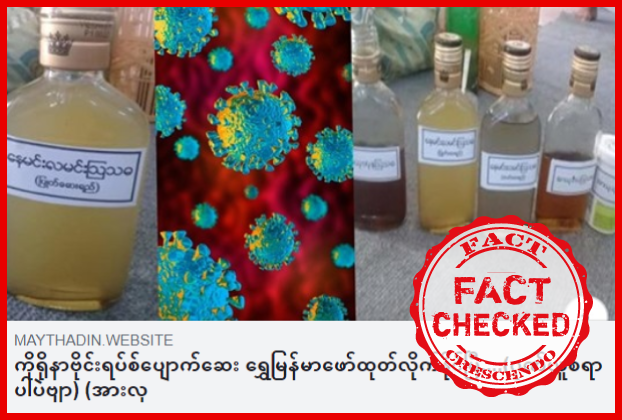
မြန်မာတိုင်းရင်းဆေးတစ်မျိုးက COVID-19 ရောဂါအမြစ်ပြတ်ကုသနိုင်တယ်
Publisher’s rating: False
Humans are getting sick because the “bioengineered” coronavirus in one’s body is reacting to 5G
Publisher’s rating: False
A COVID-19 vaccine “with an RFID chip” will be introduced as the cure for the disease, referred to as “mark of the beast.”
Publisher’s rating: False

ಮಾರುಕಟ್ಟೆಯಲ್ಲಿ ಸಾಮಾಜಿಕ ಅಂತರದ ಫೋಟೋವನ್ನು ಮಣಿಪುರದಲ್ಲಿ (ಭಾರತ) ತೆಗೆದುಕೊಳ್ಳಲಾಗಿದೆ.
Publisher’s rating: FALSE
【錯誤】網傳「英國最新研究證實新冠病毒是美國來的,並非武漢本地發生」?
Publisher’s rating: 錯誤
The claim concerns a paper that was presented online as proof that the virus originated in the United States, rather than Wuhan. The review identifies the paper as “Phylogenetic network analysis of SARS-CoV-2 genomes,” published in PNAS on April 9, 2020, with Peter Forster of the University of Cambridge as first author. It describes the study as comparing viral sequences from 160 cases and grouping them into A, B and C types; the review says the paper did not identify a definite place of origin. (The review reports that the sequences were from patients sampled between December 24, 2019, and March 4, 2020.) The key point is that where a type was common does not establish where the virus originated. According to the review’s account of the study, A-type viruses became widespread in the United States after transmission from China and a founder effect; B was mainly found in China and East Asia, while C was mainly found in Europe and East Asia. The review also reports that the earliest A-type cases discussed in the paper included people in Guangdong, Japan and the United States, and that the U.S. patients had China-related exposure, including travel to Wuhan. Thus, the finding of many A-type viruses in the United States was not evidence that the virus came from there. The review says both the paper’s author and experts consulted for the fact-check rejected that inference. It quotes Forster as saying that early spread was in China and that a greater number of A-type viruses in the United States did not mean the virus originated there. The review further reports that the paper did not state an origin location and that its authors’ analysis could not establish one. The evidence described therefore contradicts the post’s claim that the paper proved a U.S. origin; the review’s conclusion is about what that paper showed, not a definitive determination of the virus’s ultimate origin.

Para cada óbito no hospital pela Covid-19 o estado recebe R$ 16.450,00 Entenderam porque os números só crescem!
Publisher’s rating: Falso


Tiranga virus, a new version of Coronavirus found in tomatoes, is harmful to humans.
Publisher’s rating: FALSE

Ein Arzt warnt auf seiner Facebook-Seite vor den Gefahren einer möglichen Impfung mit einem mRNA-Impfstoff gegen das neuartige Coronavirus Sars-CoV-2 (http://dpaq.de/hhBpK). In dem Beitrag heißt es unter anderem, dass mRNA-Impfstoffe die Erbinformation in jeder Zelle veränderten, wodurch der Geimpfte etwaige "Fehler" an alle folgenden Generationen weitergebe. Personen, an denen der Impfstoff gerade getestet werde, müssten sich darum verpflichten, keinen Geschlechtsverkehr ohne Verhütung zu haben.
Publisher’s rating: Es ist extrem unwahrscheinlich, dass eine genetische Information der RNA (Ribonukleinsäure) in DNA (Desoxyribonukleinsäure) umgeschrieben wird. Noch weniger wahrscheinlich ist es, dass die entsprechende Informationen auf die Keimdrüsen übertragen und an die nächsten Generationen vererbt werden könnten. Personen, die derzeit an einer Studie zur Untersuchung der Sicherheit und Wirkung von mRNA-Impfstoffen gegen Covid-19 teilnehmen, müssen verhüten. Das gilt aber auch für Probanden, die an anderen Studien im Rahmen von Covid-19 teilnehmen.
The claim combines two assertions from a doctor’s Facebook post: that an mRNA vaccine would alter genetic information in every cell and pass resulting “errors” to future generations, and that vaccine-study participants must avoid unprotected sex for that reason. The dpa review examined both the biological claim and the contraception requirements in the BioNTech study. It reports that mRNA carries information used to make proteins and is subsequently broken down; a researcher told dpa that transfer of RNA information into DNA is possible in principle, but its likelihood here is close to zero, with transfer to reproductive cells and inheritance still less likely. The evidence therefore does not support the post’s asserted mechanism of inherited vaccine-caused genetic damage. (S1) The review confirms that participants in the BioNTech study had to take precautions against pregnancy: women of childbearing potential had to agree to use two highly effective contraceptive methods during the study and for 60 days after their last vaccination, and male participants also had contraception requirements with partners of childbearing age. But the review says the purpose was to exclude pregnancy during early clinical testing while experience with tolerability was gathered—not to prevent alleged genetic damage from being passed on. It also notes that pregnancy restrictions applied in some other Covid-19 studies, including studies not testing a vaccine. Thus the post describes a real precaution but gives a misleading explanation for it. (S1)

Weltweit suchen Forscher nach einem Impfstoff gegen das Coronavirus. Zugleich streuen Nutzer von sozialen Netzwerken Falschbehauptungen über eine angebliche Impfpflicht gegen die Seuche: "Impfpflicht in Deutschland beschlossen" (https://perma.cc/64HL-9DQ4), heißt es zum Beispiel im Begleittext zu einem auf Facebook vielfach geteilten Video zu Corona-Maßnahmen.
Publisher’s rating: Eine Pflicht zur Impfung gegen das Coronavirus ist bisher nicht beschlossen worden. Der vom Gesundheitsministerium vorgelegte Gesetzentwurf sieht keine solche Regelung vor.


Existe una vacuna para el nuevo coronavirus y fue creada en 2001
Publisher’s rating: Falso
The claim came with a viral Facebook image of a small vaccine vial and a message saying that a vaccine existed in 2001, so it was wrong to say there was no vaccine for COVID-19. Newtral identifies the product shown as Nobivac Canine 1-Cv, made by Merck Animal Health, and explains that it is a real vaccine for dogs—not a vaccine for the SARS-CoV-2 virus that causes COVID-19. The key evidence is the product’s stated target and intended use. Newtral says the vial’s English label identifies a canine-coronavirus vaccine, and reports that the full medicine label on the manufacturer’s website specifies that it is for animal use only. The review distinguishes canine coronavirus from SARS-CoV-2: although both belong to the coronavirus family, they are not the same virus. The existence of a vaccine for canine coronavirus therefore does not establish that a vaccine for the new coronavirus existed in 2001. The review also gives relevant context for the canine vaccine: it says canine coronavirus causes gastroenteritis in dogs and cites veterinarian María del Mar Martín Calvo’s doctoral thesis for that description. Its conclusion addresses the mismatch between the image’s canine product and the post’s implication about COVID-19; it does not treat the vial as evidence of a human SARS-CoV-2 vaccine.