PeakMetrics / Fact Checks
Health & medicine fact checks
Explore claims publishers have checked about health & medicine. Read their original ratings and follow the evidence.
Search fact checks
Search by text or image13,676 published reviews in this topic
Op Facebook staat een posting met een plaatje met allerlei giftige, schadelijke of onsmakelijke stoffen die in vaccins zouden zitten, zoals kwik, formaldehyde, aluminium, stukken van geaborteerde foetussen en dierlijk bloed.
Publisher’s rating: De stelling is vrijwel compleet fout. De meeste van de stoffen op het plaatje komen niet of alleen in verwaarloosbare en onschuldige hoeveelheden in vaccins voor.
The review examines a Facebook image alleging that vaccines contain a range of toxic or unpleasant substances, including mercury, formaldehyde, aluminium, pieces of aborted foetuses and animal blood. It explains that vaccines can contain active ingredients, additives and residual traces from production, but that production aids are generally removed and that ingredients vary by vaccine. The post’s list therefore conflates substances used at some stage in making certain vaccines with ingredients present in the finished product. [S1: “Naast hulpstoffen bij de productie, die er in principe weer uit worden gehaald, zijn er stoffen zoals conserveringsmiddelen en stoffen die worden toegevoegd om de werking van een vaccin te verbeteren. Die stoffen kunnen er wel of niet in zitten, afhankelijk van het type vaccin.”] The review gives specific examples from information attributed to the Dutch National Institute for Public Health and the Environment (RIVM). Formaldehyde may be used to kill viruses during production, but the vaccine liquid is purified before filling, leaving at most very small residues; the review says the amount in a flu-vaccine dose is far below what the body produces daily. Chicken-embryo cells may be used to grow flu viruses, and tiny amounts of egg protein may remain, which is why it can be listed as a residue and allergy warning. Antibiotics, too, are used during production or storage of intermediate products, but are not a fixed vaccine ingredient; only very small traces may remain after cleaning. [S1: “Vóórdat de vaccinvloeistof in de spuit gaat wordt dit gezuiverd, maar toch kunnen zeer kleine hoeveelheden formaldehyde als reststof achterblijven.”] [S1: “Na virusgroei wordt het tussenproduct zeer goed gezuiverd, maar het is niet helemaal uit te sluiten dat er nog heel kleine hoeveelheden restant kippenei-eiwit aanwezig zijn.”] [S1: “Antibiotica zijn geen vast ingrediënt van vaccins, zoals in de post beweerd wordt.”] The review also distinguishes chemical forms and vaccine types. It says thiomersal, a mercury compound, is used as a preservative in some vaccines, whereas elemental mercury—the form suggested by the thermometer image—is not in vaccines. Aluminium compounds can be used as adjuvants to improve a vaccine’s effect, but the review says they are not in annual flu vaccines and distinguishes them from elemental aluminium. It further states that embryos do not end up in vaccines and that the reviewed information does not support claims that vaccines contain animal blood, aborted foetuses, antifreeze, nail-polish remover or colibacteria. [S1: “Er zit in elk geval geen elementair kwik, dat inderdaad erg giftig is, in vaccins, zoals de afbeelding van een koortsthermometer bij de post suggereert.”] [S1: “Aluminiumverbindingen zitten niet in de jaarlijkse griepvaccins.”] [S1: “De embryo’s komen niet in de uiteindelijke vaccins terecht.”] [S1: “Dus geen dierlijk bloed, geaborteerde foetussen, antivries, nagellakverwijderaar of colibacterieën.”]
In einem Blog wird behauptet, 85 Prozent aller Tampons seien mit Glyphosat «verseucht».
Publisher’s rating: Es gibt keinerlei Belege dafür, dass ein Großteil aller Tampons Glyphosat enthält. In mehreren Studien in verschiedenen europäischen Ländern war Glyphosat nicht nachweisbar.
The claim traces back to a 2015 conference in Buenos Aires, where Argentine researcher Damián Marino said glyphosate had been detected in 85 percent of the products he examined. That figure does not establish that 85 percent of all tampons contained glyphosate: the review explains that Marino referred to investigated products, not all tampons, and that his products need not have met European standards. The review reports that authorities in Sweden, Switzerland and France examined hygiene products for glyphosate and found none detectable in tampons. It also describes two further investigations cited by Germany’s Federal Institute for Risk Assessment: one by the Bavarian State Office for Health and Food Safety and another by a Bremen laboratory commissioned by ZDF. Neither found glyphosate in tampons. Taken together, the evidence described does not support applying Marino’s result for a set of products studied in Argentina to all tampons. The European investigations cited by the review instead reported no detectable glyphosate in the tampons they tested.
Auf Fotos sind der ehemalige US-Präsident Barack Obama und der Vorsitzende der US-amerikanischen Infektionsbehörde Anthony Fauci in einem Labor zu sehen. Sie hören einer Wissenschaftlerin zu. Im zugehörigen Post wird behauptet, das Bild sei 2015 in einem Labor in der chinesischen Stadt Wuhan entstanden. Außerdem sei die Geschäftsfrau Melinda Gates dabei (http://archive.vn/HOxVP). In Wuhan ist nach aktuellem Stand zum ersten Mal das Sars-CoV-2-Virus identifiziert worden.
Publisher’s rating: Die Fotos entstanden im Dezember 2014 in einem Labor in Bethesda im US-Staat Maryland. Obama und Fauci wurden bei diesem Besuch eines Impfforschungszentrums von der damaligen Gesundheitsministerin Sylvia Burwell begleitet.
The claim attached the photographs to a 2015 visit to a laboratory in Wuhan and identified a woman in the images as Melinda Gates. The DPA review says the images instead show a visit to the US National Institutes of Health’s vaccine research center on December 2, 2014, in Bethesda, Maryland. It identifies the woman beside Fauci as Sylvia Burwell, then US health secretary, and the woman beside Obama as scientist Nancy Sullivan. The review cites the NIH’s account of Obama’s visit, photographs in the institute’s gallery, and reporting by the New York Times, whose photographer also documented the visit. It says the NIH photographs and account place the event in Bethesda in 2014, not Wuhan in 2015. The review also distinguishes the two women in the photographs, directly addressing the post’s identification of Burwell as Gates.
«Ein vergessener Artikel aus 2012 belegt Todesopfer durch Impfstudien der Gates-Stiftung.» Seit Wochen schon kursiert ein Sharepic mit dieser Behauptung bei Facebook. Auf der Kachel ist außerdem der Anfangspart eines Spiegel-Online-Beitrages zu sehen, auf den sich der User beruft
Publisher’s rating: Die Behauptung ist irreführend. Der Artikel weist zwar darauf hin, dass die Impfkampagne gegen viele geltende Regeln verstieß - belegt aber keineswegs Todesopfer durch Impfstudien der Gates-Stiftung.
“Of course I will always protect those with preexisting conditions. Always.”
Publisher’s rating: Four Pinocchios

ಭಾರತ್ ಬಯೋಟೆಕ್ ಉಪಾಧ್ಯಕ್ಷರು ಕೋವ್ಯಾಕ್ಸಿನ್ (ದೇಶೀಯ ಪ್ರಾಯೋಗಿಕ ಕೋವಿಡ್-19 ಲಸಿಕೆ) ಮೊದಲ ಡೋಸ್ ತೆಗೆದುಕೊಳ್ಳುವ ಫೋಟೋ.
Publisher’s rating: FALSE
Das Coronavirus soll angeblich dafür verantwortlich sein, dass weniger Menschen an der Grippe sterben. «Covid-19 ist ein Wundervirus!», heißt es in einem Beitrag auf Facebook. Das Virus habe «die Grippe komplett ausgerottet», «die Herzinfarkt-Rate um mehr als 50% reduziert» und «kein einziger Masern-Infekt konnte mehr verzeichnet werden». Dazu wird ein Balkendiagramm mit dem Titel «Deutsche Grippewellen» gezeigt. Für acht ausgewählte Grippesaisons der vergangenen 18 Jahre wird die Anzahl der «Coronatoten» mit der Anzahl der «Grippetoten» verglichen. Während für die vergangenen Saisons zwischen 8000 und 25 100 «Grippetote» und null «Coronatote» angegeben werden, sind für die aktuelle Saison 9000 «Coronatote» und nur 411 «Grippetote» ausgewiesen
Publisher’s rating: Die Grafik ist irreführend, denn sie vermischt die geschätzt Zahl der Todesfälle während einer Grippesaison mit jenen Todesfällen, bei denen das Influenzavirus im Labor bestätigt wurde. Diese Werte sind nicht vergleichbar. Die Grippe ist durch Corona nicht ausgerottet. Auch Masern-Fälle gibt es nach wie vor.
The Facebook chart compared estimated influenza deaths in earlier seasons with figures for laboratory-confirmed influenza deaths in the 2019/20 season, while presenting the figures as comparable “Grippetote.” The review explains that the earlier figures were estimates of excess mortality, whereas the 411 figure for 2019/20 counted deaths with a laboratory-confirmed influenza infection. Those are different measures, so the comparison does not establish that influenza deaths had fallen by the amount suggested by the chart. The review also notes that the chart’s footnote described the figures as an RKI “Exzess-Schätzung,” but that estimate was not available for 2019/20. The review reports that the RKI’s excess-mortality estimate for 2018/19 was 25,100, while the count of laboratory-confirmed influenza deaths in the unusually strong 2017/18 season was 1,674. It describes the estimate as a statistical calculation intended to account for deaths in which influenza was not identified as the cause. The 411 deaths shown for 2019/20 came from early April 2020; the review says the reported count had reached 525 by June. Comparing those confirmed counts with earlier estimates therefore misrepresents what the numbers measure. The review also identifies omitted seasons: the chart selected eight seasons from the previous 18 years and left out years with few or no deaths, including 2005–2008. That selection could give the false impression that influenza deaths had risen continuously since 2002. The review separately rejects the post’s related claims: it reports 75 measles cases had been reported to the RKI in 2020 as of 8 July, and says the heart-attack statistic concerned fewer treatments in hospitals covered by a data company’s analysis, not evidence that the pandemic reduced the underlying rate of heart attacks.
In een bericht op Facebook worden enkele opvallende uitspraken gedaan over het cultiveren van cellen. De auteur beweert onder meer dat de vaccinindustrie oneindig levende cellen zou cultiveren, terwijl die cellen schadelijk zijn voor het menselijk lichaam. Bovendien zou er nooit onderzocht zijn of celcultivatie (of celdeling) gevaarlijk is. Ten slotte zouden de cellijnen afkomstig zijn van embryo's, die agressieve kankers kunnen veroorzaken. Maar wat is daar precies van aan?
Publisher’s rating: Het bericht staat vol foute claims. Er worden geen cellijnen gecultiveerd die van menselijke embryo's worden afgehaald. Bovendien heeft de duur van de cultivatie geen negatieve invloed op het vaccin en op het menselijk lichaam. Ook de beweringen dat de vaccinindustrie geen veiligheidsstudies uitvoert en dat de cellijnen agressieve kankers kunnen veroorzaken is niet waar.
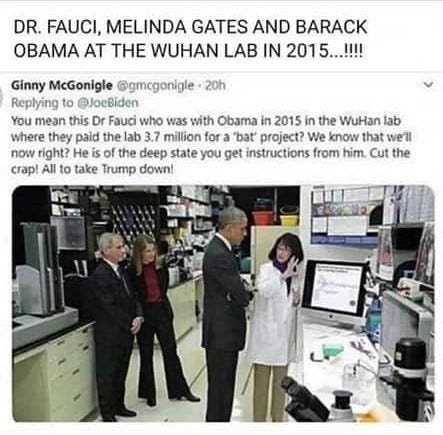
Dr. Fauci, Barack Obama, and Melinda Gates traveled to a lab in Wuhan in 2015
Publisher’s rating: False
“We have just about the lowest mortality rate" for coronavirus.
Publisher’s rating: This lacks evidence.
Ärzte und Krankenschwestern sollen in Frankreich ihre Kittel niedergelegt haben, nachdem der «Corona Schwindel» aufgeflogen sei. Das behaupten zumindest einige User in sozialen Medien. Dazu werden ein Video oder Bilder eines Videos geteilt, die tatsächlich medizinisches Personal beim Protest zeigen. In manchen Fällen ist neben diesem Video auch ein anderes mit demonstrierenden Polizisten zu sehen.
Publisher’s rating: Die Protestaktionen haben nichts mit der Corona-Krise zu tun, sondern entstanden aus anderen Ursachen bereits zuvor.
The claim concerns videos and stills shared online as evidence that French doctors and nurses abandoned their coats after a supposed “Corona hoax” was exposed. The review says the footage did show medical personnel protesting, but identifies the scenes as predating the pandemic’s widespread impact in Europe: it reports that YouTube videos containing the clips were already online in January and that the footage was recorded on 14 January at Saint-Louis Hospital in Paris. [S1: “Youtube-Videos mit den gezeigten Ausschnitten stammen bereits aus dem Monat Januar. Hier sind die Szenen etwa von Minute 0:35 an zu sehen (http://dpaq.de/75fiy). Dem Video des französischen Nachrichtenmagazins «L'Obs» zufolge entstanden die Aufnahmen am 14. Januar im Krankenhaus Saint-Louis in Paris.”] To establish the earlier protest’s purpose, the review describes searching French-language terms for Saint-Louis Hospital and 14 January, which surfaced media reports. It cites CNEWS as reporting that doctors were protesting the government and drawing attention to conditions at their hospital. The review also says lawyers’ protests against pension reform had served as a model. [S1: “Durch eine Google-Suche mit den französischen Begriffen «l’hôpital Saint-Louis 14 janvier» (http://dpaq.de/wxSwp) lassen sich Medienberichte zu dem Vorfall finden. Der Nachrichtensender «CNEWS» berichtete etwa, dass die Ärzte gegen die Regierung protestieren und auf die Situation in ihrem Krankenhaus aufmerksam machen wollten (http://dpaq.de/1QGCW). Vorbild waren demnach Anwälte in Frankreich, die kurz zuvor gegen eine Rentenreform protestiert hatten.”] The police footage sometimes included alongside the medical-worker video depicts a separate demonstration, not a continuation of the hospital protest. The review identifies it as an LCI segment and says the officers symbolically placed their handcuffs on the ground to protest then-interior minister Christophe Castaner’s proposal to ban a controversial arrest technique. [S1: “Ein zweites Video, das im erwähnten Facebook-Post geteilt wird, zeigt Polizisten, die ihre Handschellen auf den Boden werfen. Auch hier geht es nicht um das Coronavirus. Am Logo kann man schnell erkennen, dass es sich um einen Beitrag des französischen Fernsehsenders «LCI» handelt.”; “Demnach legten die Polizisten ihre Handschellen symbolisch auf den Boden, um gegen den damaligen Innenminister Christophe Castaner zu demonstrieren. Dieser wollte nach Demonstrationen gegen Rassismus und Polizeigewalt eine umstrittene Festnahmetechnik verbieten.”]
Op Facebook wordt gesuggereerd dat vliegtuigen van de luchtmacht hebben meegedaan aan een demonstratie voor de versoepeling van de maatregelen tegen de verspreiding van COVID-19. Getoond wordt een foto van twee reclamevliegtuigen die spandoeken slepen met de teksten "BIJNA 100 % OVERLEEFT CORONA" en "STOP 1,5M-VIRUSWAANZIN".
Publisher’s rating: De stelling is fout. Het gaat niet om toestellen van de luchtmacht.
Video yang diklaim sebagai video pembuangan jenazah korban Covid-19 di laut Meksiko
Publisher’s rating: Keliru
The Obama administration "got very poor marks from Gallup on the job they did on swine flu. And they stopped very early on, testing."
Publisher’s rating: False

The World Health Organisation (WHO) has accepted an Indian student’s home remedy for the cure of COVID-19
Publisher’s rating: FALSE
The claim concerned a social-media message saying WHO had accepted a COVID-19 remedy made by a Pondicherry University student. The message specified a mixture of black pepper, honey and ginger juice, taken for five consecutive days. FACTLY reported finding no authentic information that a student from the university had discovered a COVID-19 cure, and no news reports confirming that claim in its search.