PeakMetrics / Fact Checks
Health & medicine fact checks
Explore claims publishers have checked about health & medicine. Read their original ratings and follow the evidence.
Search fact checks
Search by text or image13,676 published reviews in this topic
Thermo gun atau termometer tembak bisa merusak struktur otak manusia
Publisher’s rating: Keliru

Russia developed a COVID-19 vaccine
Publisher’s rating: FALSE
The claim concerned a social-media post saying Russia was the first country to develop a COVID-19 vaccine. FACTLY’s review concluded that a vaccine had not yet been developed and that clinical trials were still underway. Its conclusion addressed the post’s claim as it stood during the reported trial activity, rather than treating the existence of a vaccine candidate as proof that development was complete. To check the claim, the review says it searched the internet for “Russia COVID-19 vaccine” and consulted reporting about the Gamaleya Institute and Sechenov University. It reports that Sechenov University said on 13 July 2020 that Gamaleya still had to decide how to proceed with the next trial stages. It also cites a World Health Organization document released on 15 July 2020, which listed the first stage of Gamaleya’s trials as underway, while third-stage trials by other organizations were mentioned. On this evidence, the review distinguished ongoing clinical testing from a completed vaccine. It concluded that the post’s assertion that Russia had developed a COVID-19 vaccine was false, noting that the trial stages were not finished. The excerpt also says the review consulted clinical-trial information on the US government and WHO websites, but does not provide further details from those records.
Ein angeblicher Mitarbeiter des Westdeutschen Rundfunks (WDR) soll die Manipulation von Berichten über Corona-Neuinfektionen publik gemacht haben. «Hallo. Ich arbeite beim WDR. Am Mittwoch (08.07.) wird verkündet, dass der zweite Lockdown startet. Wir werden dazu gezwungen in den nächsten beiden Tagen exorbitant hohe neue Coronazahen [sic!] zu melden!», heißt es in einem Facebook-Posting, das einen Screenshot des angeblichen Whistleblower-Beitrags teilt (http://dpaq.de/JU9IM). Angehängt ist ein Bild, das zwei Bildschirme in einem Büro zeigt. Auf einem der Bildschirme ist das Logo des deutschen Fernsehnetzwerks WDR zu sehen.
Publisher’s rating: Weder wurde am 8. Juli 2020 der «zweite Lockdown» verkündet, noch hat der WDR zu dieser Zeit Zahlen der Neuinfektionen mit dem Coronavirus vermeldet, die von den offiziellen Zahlen abweichen. «Die Aussagen sind völliger Unsinn», teilt der WDR auf Anfrage mit.

Other countries, including in Europe, are only testing for COVID-19 if someone is “really sick” and the “massive” testing in the U.S. “skews the numbers.”
Publisher’s rating: Distorts the Facts
Das Coronavirus wurde zuerst in der chinesischen Metropole Wuhan nachgewiesen. In sozialen Medien wird nun behauptet, dort würden infizierte Menschen «umgebracht um den Virus nicht weiter zu verbreiten» (sic!). Dazu wird ein Video geteilt, das aus mehreren Teilen zusammengeschnitten ist: Zu sehen sind zuerst Bewaffnete in Schutzkleidung, dann Patienten, die anscheinend auf offener Straße medizinisch betreut werden, schließlich ein leblos am Straßenrand liegender Mensch
Publisher’s rating: Die einzelnen Sequenzen wurden an verschiedenen Orten aufgenommen und manipulativ aneinandergereiht. Sie geben keinerlei Anhaltspunkte für die Tötung coronainfizierter Menschen. Eine der Sequenzen zeigt Medienberichten zufolge einen Polizeieinsatz wegen eines tollwütigen Hundes in der Stadt Yiwu, eine andere einen Motorradunfall im chinesischen Wuzu.
The video was presented as evidence that people infected with coronavirus were being killed in Wuhan. The review examined the footage as three separate sequences, rather than treating them as one event. It identifies the first as a police response to a rabid dog in Yiwu, the second as footage whose location and time could not be firmly established, and the third as a fatal motorcycle crash in Wuzu. The review says the sequences had been joined to create an apparent connection: “Das Video zeigt lose Einzelsequenzen, die dramaturgisch zu einem scheinbaren Zusammenhang aneinandergefügt wurden. Doch haben die Aufnahmen überhaupt nichts miteinander zu tun”. For the first sequence, the review reports that CGTN linked the police vehicle’s identifier, “G1796,” to the Yiwu police department. The local police told CGTN that officers were responding to a rabid dog on February 1, 2020, after it had injured several people. The protective equipment and firearms therefore belonged to that operation, not to an action against infected people: “dass die Beamten am 1. Februar 2020 im Einsatz wegen eines tollwütigen Hundes waren”. The review treats the middle sequence more cautiously. It reports that a post sharing the footage on January 25, 2020, described people in rural areas near Wuhan who were allegedly not receiving hospital care, but says the clip’s location and date could not be established beyond doubt. The final sequence was geolocated to Wuzu using buildings and trees, including the nearby Siyuan School. CGTN reported, based on local police and a hospital doctor, that a 15-year-old and his cousin crashed their motorcycle on January 29, 2020; the young driver was found without breathing or a heartbeat. These different origins do not support the video’s implication that the scenes show coronavirus-related killings.
Ein auf Facebook geteilter Text warnt vor der kommenden Grippe-Impfung für Kinder (http://dpaq.de/qeHJb). Laut den Angaben einer anonymen ehemaligen «Mitarbeiterin eines führenden Pharmakonzerns» sei geplant, ab Herbst alle Kinder mit einem Nasenspray gegen die Grippe zu impfen. Der Beitrag behauptet, dass dieser Spray «gentechnisch veränderte Bestandteile» beinhaltet. «Abgesehen von mehreren toxischen Stoffen» seien «Zellen von Affen und Hunden (Cockerspaniel)» enthalten. Zudem soll es einen Beipackzettel mit abweichenden Informationen über noch mehr Bestandteile geben.
Publisher’s rating: Der Text stellt mehrere falsche Behauptungen auf. Die Impfung ist ein freiwilliges Angebot und limitiert. Der angedachte Nasenspray ist überprüft und laut Experten unbedenklich. Er enthält weder tierische Zellen noch in der vorhergesehenen Dosierung bedenkliche Stoffe. Die enthaltenen und zur Immunisierung erforderlichen Viren sind genetisch modifiziert. Die verlinkte Gebrauchsinformation entspricht der dem Medikament beiliegenden Gebrauchsinformation der Grippesaison 2019/20.
The Facebook post claimed that an anonymous former pharmaceutical employee had revealed plans to vaccinate all children against influenza with a nasal spray from autumn, and alleged that it contained toxic substances, genetically modified ingredients, and cells from monkeys and dogs. It also suggested the leaflet available online concealed additional ingredients. The review examined the specific product identified for the planned programme: Fluenz Tetra, and checked the claims against statements from Austria’s health ministry, the manufacturer and a medical expert. The ministry said the children’s vaccination offer was voluntary and available in limited quantities, not a compulsory vaccination of all children. It also said the vaccine was approved and that its use was restricted to children aged 24 months and older because of possible side effects. The review investigated the leaflet allegation by contacting the company responsible for the online medicine information and AstraZeneca, the nasal spray’s manufacturer. AstraZeneca said the online leaflet matched the leaflet supplied with the vaccine for the 2019/20 flu season, and that the product information listed its active ingredients and components, including the genetically modified organisms. The manufacturer described these as live-attenuated influenza viruses, modified so they do not cause typical flu symptoms and reproduce poorly at body temperature. The review also reported that the spray contained no animal or plant cells and that its ingredients were not toxic at the dosage used. The animal-cell claim appears to conflate how the vaccine viruses are prepared with what is in the administered product. The medical expert said the viruses are reassorted in cell culture, but that the vaccine itself has no contact with that culture; the Vero cells used are from monkeys, not dogs. The review further reported that the vaccine is produced in chicken eggs, so traces of egg protein could be present. These details distinguish the manufacturing process and possible trace material from the post’s allegation that the spray contains monkey or cocker-spaniel cells.
Zal het gebruik van vaccinaties uiteindelijk de huidige, volgende en vorige generaties van onze samenleving transhumaniseren? Volgens verschillende berichten op Facebook – die al sinds lange tijd circuleren – lijkt het daar wel op. Aan deze theorie worden verschillende verklaringen gelinkt. Zo zou er bijvoorbeeld in enkele vaccins "menselijk foetaal DNA" aanwezig zijn. Dat DNA zou zich mengen met het aanwezige DNA van de ontvanger, wat kan leiden tot kanker, auto-immuunziektes, autisme en vooral: genderverwarring. In verschillende posts wordt gewezen naar "de transgender-agenda", die naadloos zou aansluiten op het hele verhaal. Maar zit er een bepaalde waarheid in die theorie?
Publisher’s rating: De berichten zijn niet gebaseerd op wetenschappelijke evidentie en staan doorgaans vol foute claims. Het transhumanisme is een filosofische stroming die je wetenschappelijk niet kan linken aan vaccinaties. Bovendien is het quasi uitgesloten dat het DNA in een vaccin het DNA van de ontvanger zou kunnen wijzigen. Ook de beweringen over genderverwarring, autisme en de inhoud van vaccins zijn fout.
Ahli virus Cina Li Meng Yan menyebut bahwa Covid-19 merupakan hasil persekongkolan jahat
Publisher’s rating: Keliru



The Pirbright Institute owns a patent on the novel coronavirus
Publisher’s rating: This is false. They do own a patent but it's linked to research into a vaccine for a previously known coronavirus that affects chickens.

The Covid-19 nasal swab test is taken at the "blood brain barrier"
Publisher’s rating: This claim is false. "The swab cannot reach the blood brain barrier without significant force that breaks several layers of tissue and bone. We have not seen any complications from Covid swabs in our neurology practice", says Dr Liz Coulthard, a committee member of the British Neuroscience Association (BNA).

Bihar COVID -19 treating hospital ward filled with rainwater and sewage
Publisher’s rating: FALSE
The claim concerns a specific photo shared as showing a COVID-19 hospital ward in Bihar filled with rainwater and sewage. FACTLY’s investigation concludes that the photo instead shows an old ward at Osmania Hospital in Hyderabad, so the image does not establish the claimed Bihar setting. To check the image’s provenance, the review reports conducting a reverse image search. It says that search found a similar photo in an India Today article dated 15 July 2020, which described rainwater and sewage in a ward at Osmania Hospital. The review also found an article from The Hindu Business Line with similar content and the same photo, as well as NDTV video footage showing the same ward. These comparisons are the evidence the review gives for identifying the image as Osmania Hospital in Hyderabad rather than a Bihar COVID-19 hospital. The review notes that Bihar had also experienced incidents in which hospital wards were filled with rainwater and sewage. But it distinguishes those incidents from the image being checked: it says the specific photo in the post is from Hyderabad and is not related to a COVID-19 hospital in Bihar. Thus, the existence of similar problems elsewhere in Bihar does not establish that this particular image depicts one of them.
"If Covid was really carried on your breath, why can't you just breathe on the swab?
Publisher’s rating: This meme is misleading. If you only breathe on a slim swab head, you might not catch the viral particles or the cells that carry the virus. However, if you insert the swab in the nose and throat and rotate it at the site of infection, you are more likely to get infectious material that will yield a result.

Laut Gesundheitsminister Rudi Anschober ist es geplant, ab Herbst alle Kinder in Österreich mit einem Nasenspray gegen Grippe zu impfen. Der Nasenspray enthält toxische Stoffe, „gentechnisch veränderte Bestandteile” sowie Zellen von Affen und Hunden.
Publisher’s rating: Diese Behauptungen sind falsch. Die Impfung wird Teil eines freiwilligen Impfprogrammes für Kinder. Der angedachte Nasenspray ist laut Experten unbedenklich. Er enthält weder tierische Zellen noch in der vorhergesehenen Dosierung bedenkliche Stoffe. Die enthaltenen und zur Immunisierung erforderlichen Viren sind genetisch modifiziert.
The review examined a widely shared message alleging that, starting in autumn, all children in Austria would be required to receive a flu nasal spray containing toxic substances, genetically modified ingredients, and cells from monkeys and dogs. It traced the message to an anonymous former pharmaceutical-company employee and reported finding the claims on Facebook and the BZÖ Kärnten website. The review’s account of the claim distinguishes the planned inclusion of a children’s flu vaccine from compulsory vaccination: the Health Ministry said use of vaccines in the free children’s program was voluntary, and the supply of this flu vaccine was limited. The product under consideration was Fluenz Tetra. The Ministry described it as an assessed vaccine and said only vaccines with a positive benefit-risk profile are approved for use. AstraZeneca said the product information listed all active ingredients and components, including the genetically modified organisms: live-attenuated influenza viruses altered so they do not cause typical flu symptoms and reproduce poorly at body temperature. The review therefore did not treat “genetically modified” as evidence that the spray contained undisclosed or toxic ingredients. On animal cells and toxicity, AstraZeneca said the spray contained no plant or animal cells and no ingredients toxic at the dose used. Pharmacology professor Michael Freissmuth explained that the vaccine viruses are reassorted in cell culture, but the vaccine itself does not contact that culture; he said it is produced in chicken eggs. He also clarified that Vero cells are from monkeys, not dogs, but said they are not present in the vaccine. The review additionally noted that the vaccine’s approval for use was limited to children aged 24 months and older because of possible side effects.
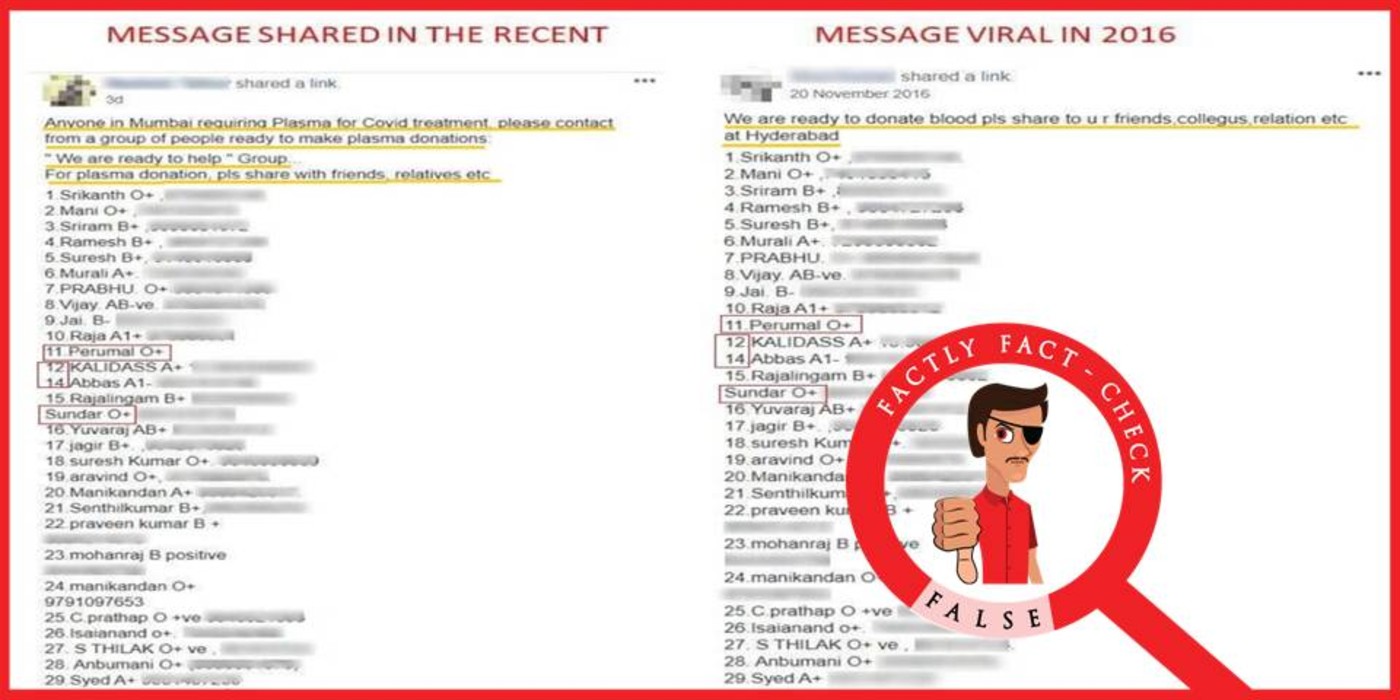
Message with a list of persons ready to donate Plasma in Mumbai for COVID-19 treatment.
Publisher’s rating: FALSE
The claim concerned a circulating list of 64 people, with names, blood groups and contact numbers, said to be ready to donate plasma in Mumbai for COVID-19 treatment. FACTLY reports that it checked whether the list had appeared earlier and found the same names in messages circulated as blood donors in 2016, and again in 2017, 2018 and 2019. Those earlier messages described the people as “Blood donors ready to help,” not as plasma donors.

කන්දකාඩු කොරොනා පොකුර පිළිබඳ අවදානම යන තේමාවෙන් පළවූ සාවද්ය සිතියමක්! | False map indicating the threat posed by the Kandakadu cluster for spread of COVID19
Publisher’s rating: FALSE
The review investigates a Facebook map circulated during concern about COVID-19 infections among residents and staff at the Kandakadu Treatment and Rehabilitation Centre in Polonnaruwa District. The post presented the map as showing places where people connected to the cluster had travelled or lived. The review also notes complaints about missing affected areas and a location error: Uragasmanhandiya, a town in Galle District, was shown as being in Kurunegala District. To check the map’s provenance and contents, the publisher says it contacted the Health Ministry’s media division, which said it had not issued such a map. It then contacted the Health Promotion Bureau, which said the circulating map was not an official map issued by the Ministry, the Bureau, or the Epidemiology Unit, and that its figures were inaccurate. These checks address both whether the map was an official public-health product and whether its numbers represented reliable case information. The review also reports that police officials, speaking at a media briefing on July 15, 2020, described the map circulating on social media as false. According to the review, they said it was a map shared by a private company, and that the figures showed the company’s centres—not people identified in those areas. The publisher concludes that the map misleadingly represented those figures as locations associated with the Kandakadu cluster.
Covid-19 diciptakan untuk menghambat kebangkitan umat Islam
Publisher’s rating: Keliru