PeakMetrics / Fact Checks
Health & medicine fact checks
Explore claims publishers have checked about health & medicine. Read their original ratings and follow the evidence.
Search fact checks
Search by text or image13,675 published reviews in this topic
(VIDEO) VACUNAS CONTRA EL CORONAVIRUS MODIFICAN EL MATERIAL GENÉTICO
Publisher’s rating: Falso
Ein Text und eine Grafik, die zusammen auf Facebook verbreitet werden (hier archiviert), stellen verschiedene Behauptungen über die Ausbreitung und Gefährlichkeit des Coronavirus auf.
Publisher’s rating: Einige der Aussagen im Text sind falsch oder verkürzt. Die Grafik stellt Zahlen zum Coronavirus und zur Grippe gegenüber, die sich aufgrund ihrer Erhebungsmethoden nicht vergleichen lassen.
The review examines a Facebook post that combined a text with a graphic and made claims about coronavirus spread and danger. One assertion was that testing had risen while the positive-test share remained below one percent, implying that rising case numbers resulted only from more testing. The review compared that assertion with Robert Koch Institute (RKI) figures: weekly tests exceeded 1.5 million in the last week of October 2020, while the positive share was 7.26 percent that week, up from 5.51 percent the week before. The review therefore found that increased testing alone did not account for the rise in cases. [S1] The post also gave Covid-19 fatality as about 0.3 percent, apparently referring to infection fatality—the proportion of deaths among all infected people, rather than only confirmed cases. The review notes that studies produced differing estimates: Gangelt’s Heinsberg study reported 0.37 percent, an Ioannidis meta-analysis 0.23 percent, and other cited analyses higher figures. It cautions that estimates depend on factors including population structure and data quality, and reports that experts considered Covid-19 infection fatality higher than influenza’s. [S1] The review identifies the graphic’s comparison of coronavirus and influenza deaths as misleading because the figures were produced differently: influenza deaths in earlier seasons were estimates, while coronavirus deaths were laboratory-confirmed cases. The coronavirus figure was also outdated, roughly corresponding to early July 2020. The comparison omitted measures taken against coronavirus, such as contact restrictions, hygiene measures and face coverings, and the availability of influenza vaccination. [S1]
فایل صوتی «افشاگری» مینو محرز درباره «پشتپرده» واکسن کرونا!
Publisher’s rating: شاخدار
Im Frühjahr machte ein Hamburger Rechtsmediziner Angaben über die von ihm obduzierten Corona-Toten. Seitdem werden diese Aussagen immer wieder ohne Kontext verbreitet - so auch in diesem Sharepic bei Facebook (hier archiviert).
Publisher’s rating: Die Aussagen werden unangemessen verallgemeinert. Zudem sind sie veraltet. Der Rechtsmediziner hat sie inzwischen eingeordnet und sich explizit von darauf basierenden Verschwörungserzählungen abgegrenzt.
The review concerns a Facebook sharepic that reused statements by Klaus Püschel, then recently retired as head of Hamburg’s forensic medicine department. It says Püschel had begun autopsying Covid-19 deaths in spring 2020 and had examined more than 200 pandemic victims. The statements at issue were about his early findings and the risk posed by the virus—not a finding about all Covid-19 deaths everywhere. The review traces one prominent formulation to a Sat.1 interview on 21 April 2020: Püschel said that the more than 100 people his team had autopsied in the Hamburg region had serious pre-existing internal illnesses. The distinction between that regional observation and a universal claim is central. The review says Püschel was speaking about Hamburg, not Germany or the world, and that the wording that “none” had died directly of Covid-19 did not come from that interview. It describes his statements as tending in that direction but being sharpened in retellings. The review also notes that early comments—such as his April statement that fear of the virus was exaggerated—were repeatedly used by coronavirus skeptics as support for their claims. The review describes later interviews in which Püschel qualified his earlier remarks. In May, he said his aim had been to ease ordinary people’s fear, not to downplay the virus, and rejected conspiracy theorists who distorted his statements. In a July interview, he said his early findings had been reinforced over the months, while again describing the people most often dying as older people and those with multiple pre-existing conditions. The review’s account therefore presents the sharepic’s use of his earlier remarks as both overgeneralized and out of date with those subsequent explanations.

Foto yang diklaim sebagai foto bekas luka di punggung warga Zimbabwe akibat vaksin Cina
Publisher’s rating: Keliru

UPDATED: Dettol can kill Novel Coronavirus causing COVID-19
Publisher’s rating: TRUE
Etliche wissenschaftliche Studien haben in jüngster Zeit die Wirksamkeit von Masken zum Schutz gegen das Coronavirus untersucht. Aktuell verweisen Gegner der staatlichen Pandemie-Maßnahmen auf eine Analyse aus Dänemark, nach der angeblich Mund-Nasen-Bedeckungen gegen die Verbreitung des Erregers Sars-CoV-2 «so gut wie gar nichts» nützten (hier archiviert). Auch die AfD-Fraktion im bayerischen Landtag schreibt am 23. November mit Verweis auf jene «bahnbrechende dänische Studie», Masken seien nutzlos (hier archiviert).
Publisher’s rating: Falsch. Die Studie weist auf einen moderaten Schutzgrad für den Maskenträger hin. Außerdem haben die Forscher nicht untersucht, wie sich eine Mund-Nasen-Bedeckung auf andere auswirkt. In vielen Studien ist belegt, dass Masken das Gegenüber vor einer Ansteckung schützen können.
دولت آمریکا در سالهای ۲۰۱۴ و ۲۰۱۵ مبلغ ۱۴ میلیارد دلار بودجه به توسعه طب سنتی اختصاص داده است.
Publisher’s rating: نادرست

COVID-19 కొత్తది కాదు, పాత పాఠ్య పుస్తకంలో దాని చికిత్స గురించి ఉంది.
Publisher’s rating: MISLEADING
The post discussed in the review pointed to a page in a book titled *Animal Science*, attributed to Dr. Ramesh Gupta, and claimed that it described a treatment for coronavirus—evidence, the post said, that COVID-19 was not a new disease. It also urged people to share the purported medicine. The review says it investigated these claims separately and concluded that the post was misleading. For the textbook claim, Vishvas News reports that it contacted Dr. V.K. Dwivedi, identified as a former colleague of Gupta. Dwivedi said Gupta had died and that his textbook discussed the general coronavirus family, not the recent novel coronavirus that causes COVID-19. That distinction is central: a reference to coronaviruses generally does not establish that an older book described COVID-19 or its treatment. The excerpt does not reproduce the textbook page or provide details of a treatment described in it. It therefore supports the review’s distinction between general coronavirus information and information about the novel virus, but does not allow independent examination of the cited page or assessment of any specific treatment claim.
آمریکا [به دلیل وضع تحریمها] مسئول کشته شدن روزانه ۴۰۰ نفر در ایران در اثر کرونا است.
Publisher’s rating: نادرست

నల్ల వెల్లుల్లి 14 రకాల క్యాన్సర్లను నయం చేస్తుంది.
Publisher’s rating: FALSE
«Im Alter von 109 Jahren gehört Dr. Thüm zu den ältesten Deutschen überhaupt», heißt es auf einer Internetseite, auf der ein Produkt zur «Reinigung» von Blutzellen angeboten wird (hier archiviert). Ein Foto soll angeblich «Dr. Thüm an seinem ehemaligen Arbeitsplatz» zeigen. Der Kardiologe sei schon so lange im Ruhestand, dass ihn «die Rentenvereinigung hasst», heißt es weiter.
Publisher’s rating: Das Bild stammt aus einem Artikel über den US-amerikanischen Arzt Walter Watson aus dem Jahr 2010. Er starb zwei Jahre später im Alter von 102.
The claim concerns an advertisement for a blood-cell “cleaning” product that presents a 109-year-old cardiologist named Dr. Thüm and uses a photograph purportedly showing him at his former workplace. The review identifies the pictured man as Walter Watson, a physician from Augusta, Georgia, rather than the advertised Dr. Thüm. It reports that the same photograph has appeared online under several different names, alongside invented accounts about longevity products and the supposed good health of the men shown. (S1) The review traces the photograph to a Telegraph article dated May 25, 2010, about Watson, then 100 and described as the world’s oldest practicing physician. The article said he had assisted at more than 18,000 births. The review also reports that Watson died in October 2012, aged 102. This provenance and chronology contradict the advertisement’s presentation of the image as a 109-year-old Dr. Thüm. (S1)


మెంతి గింజలను టేప్ స్ట్రిప్లో బొటనవేలుపై అతికించి రాత్రిపూట వదిలేస్తే, కరోనావైరస్ సమయంలో గొంతు ఇన్ఫెక్షన్ నయమవుతుంది.'
Publisher’s rating: FALSE
Vishvas News investigated a video shared through its WhatsApp chatbot that claimed sticking fenugreek seeds to the thumb with tape overnight could cure a throat infection during the coronavirus period. The article says the claim had circulated on social media again and notes that the outlet had previously investigated it. Its discussion concerns the specific seed-and-tape remedy, not whether fenugreek can have any health benefits in general. (S1: “విశ్వాస్ న్యూస్ వాట్సాప్ చాట్బాట్లో ఒక వీడియో షేర్ చేయబడింది : ‘మెంతి గింజలను టేప్ స్ట్రిప్లో బొటనవేలుపై అతికించి రాత్రిపూట వదిలేస్తే, కరోనావైరస్ సమయంలో గొంతు ఇన్ఫెక్షన్ నయమవుతుంది.’”) The article describes speaking with Dr. Vimal N., an Ayurvedic physician in the Ministry of AYUSH, who rejected the tape as a coronavirus remedy. He distinguished it from fenugreek tea, saying that tea might temporarily ease a sore throat but could not be described as curing coronavirus. The article also reports consulting an acupuncture specialist at Dr. Lohia Acupuncture Centre. That specialist explained that practitioners apply pressure to throat-related points on the hands, but said taping fenugreek seeds to the thumb does not cure a sore throat. (S1: “ఆయుష్ మంత్రిత్వ శాఖలోని ఆయుర్వేద వైద్యుడు డాక్టర్ విమల్.ఎన్ తో విశ్వాస్ న్యూస్ ప్రతినిధి మాట్లాడటం జరిగింది. ఈ వీడియోలోని వాదన నకిలీదని ఆయన చెప్పారు.”; “మెంతి గింజలతో చేసిన టీ తాత్కాలికంగా గొంతు నొప్పి నుండి ఉపశమనం కలిగిస్తుంది, అయితే, ఇది కరోనావైరస్ను నయం చేస్తుందని చెప్పలేము,”; “కానీ, మెంతి గింజల టేప్ను బొటనవేలుపై అతికించడం వల్ల గొంతు నొప్పి నయమవుతుందన్నది మాత్రం నకిలీ వాదన.”) The review acknowledges that fenugreek is commonly used in Indian cooking and may offer some health benefits, while stating that there is no evidence it can completely cure a coronavirus-related throat infection. Its conclusion follows from the distinction between possible temporary symptom relief from tea and the unsupported claim that the taped seeds cure an infection. The supplied excerpt reports interviews and the article’s assessment; it does not describe a clinical trial of the taped remedy. (S1: “దీనిని తీసుకుంటే కొన్ని ఆరోగ్య ప్రయోజనాలను పొందవచ్చు, అయితే, ఇది కరోనా వైరస్కు సంబంధించిన గొంతు ఇన్ఫెక్షన్ను పూర్తిగా నయం చేయగలదని చెప్పడానికి ఎటువంటి ఆధారాలు లేవు.”; “మెంతి గింజలతో చేసిన టీ తాత్కాలికంగా గొంతు నొప్పి నుండి ఉపశమనం కలిగిస్తుంది, అయితే, ఇది కరోనావైరస్ను నయం చేస్తుందని చెప్పలేము,”)
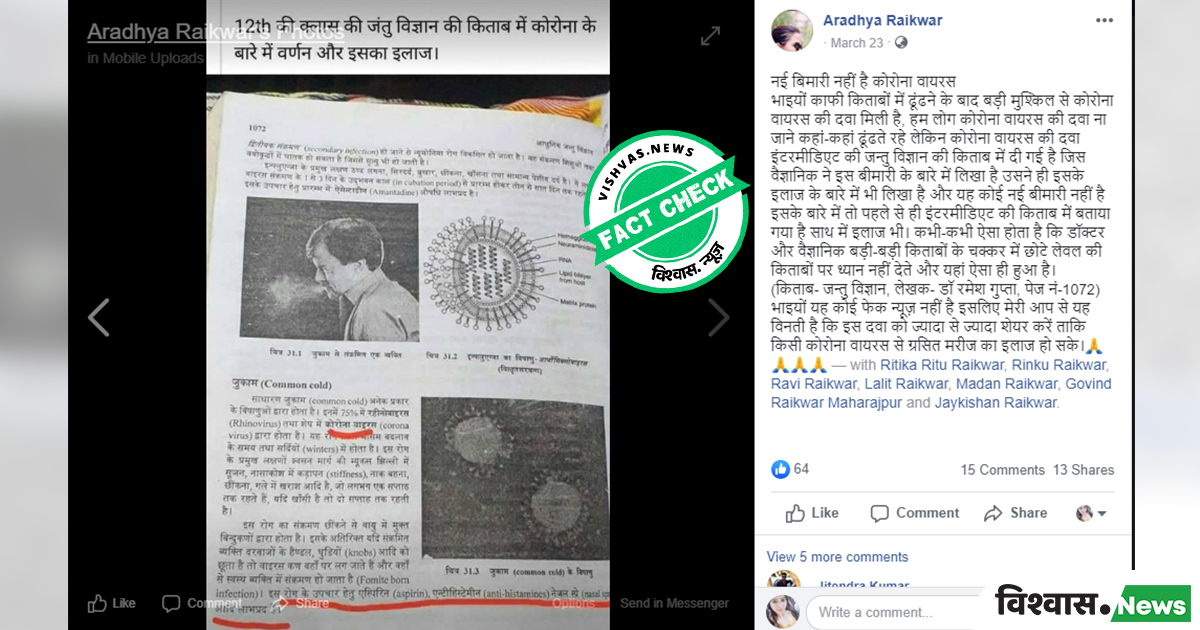
Old Textbook Mentions COVID-19 Cure
Publisher’s rating: Misleading
The post claimed that a Class 12 animal-science textbook by Dr. Ramesh Gupta had already described a medicine and treatment for COVID-19, supposedly showing that the disease was not new. The review says the post showed a textbook page and urged people to share the alleged medicine. Vishvas News concludes that the post was misleading, rather than evidence of a COVID-19 cure.