PeakMetrics / Fact Checks
Health & medicine fact checks
Explore claims publishers have checked about health & medicine. Read their original ratings and follow the evidence.
Search fact checks
Search by text or image13,673 published reviews in this topic

Delta varyantı önceki varyantlara göre daha zararsız ama iki doz aşı olanlar Delta varyantı sebebiyle aşı olmayanlara göre iki kat daha fazla hayatını kaybediyor.
Publisher’s rating: Bağlamdan koparılmış. Gösterilen veriler doğru ama Delta varyantının daha zararsız ve iki doz aşı olanlar için daha ölümcül olduğu sonucu bu verilerden çıkmıyor. Öncelikle pandeminin değişik dönemlerinden alınan rakamlar birbirleriyle karşılaştırılamaz. Ayrıca Corona ölüm vakalarındaki aşısızların oranı sadece görünüşe göre geriliyor.

The Delta variant is more harmless than earlier variants, but double-vaccinated people are more likely to die from the Delta variant than unvaccinated people.
Publisher’s rating: Taken out of context. The data cited are correct, but the claim that the Delta variant is less dangerous but more deadly for vaccinated people cannot be concluded from them. Firstly, figures from different phases of the pandemic cannot be compared with each other, and secondly, the proportion of unvaccinated people among corona deaths only appears to be falling.
المتحولة دلتا هو أخف ضررا من المتغيرات السابقة، ولكن نسبة الموتى بسبب دلتا من الناس الذين تلقوا اللقاح المزدوج أعلى غالبا من غير الملقحين.المتحولة دلتا هو أخف ضررا من المتغيرات السابقة، ولكن نسبة الموتى بسبب دلتا من الناس الذين تلقوا اللقاح المزدوج أعلى غالبا من غير الملقحين.
Publisher’s rating: ادعاءات تم إخراجها من سياقها. والبيانات المقدمة صحيحة، ولكن الادعاء بأن البديل الدلتا أقل خطورة، ولكنه أكثر فتكا بالنسبة للأشخاص الذين تم تلقيحهم، لا يمكن استنتاجه من ذلك. أولا، لا يمكن مقارنة الأرقام المستمدة من مختلف مراحل الوباء، وثانيا، فإن نسبة الوفيات الناجمة عن كورونا لدى غير الملقحين آخذة في التناقص على ما يبدو.

The delta variant of the coronavirus "is not showing more deaths, it is not showing more of a problem."
Publisher’s rating: Distorts the Facts
Die Delta-Variante ist harmloser als frühere Varianten, aber Doppelt-Geimpfte sterben häufiger als Ungeimpfte an der Delta-Variante.
Publisher’s rating: Rating unavailable
Australian police are seperating Covid positive kids from parents
Publisher’s rating: False

لا تؤثر لقاحات كوفيد-19 على الإنجاب
Publisher’s rating: صحيح
The review examines concerns that COVID-19 vaccination could impair the ability to have children. It reports that medical organizations recommend vaccination for people trying to conceive or who may become pregnant, and that professional organizations serving people of reproductive age say there is no evidence that the vaccines cause infertility. It also says male-fertility professional associations support vaccination for men who want children in the future. The review describes two pieces of research. In an in-vitro fertilization study, researchers compared pregnancy success rates among women with antibodies from vaccination, women with antibodies following recent COVID-19 infection, and women without antibodies from either source. The review reports no difference in pregnancy success rates among the groups. Separately, a small study assessed sperm quantity and movement before and after vaccination in 45 healthy men who received an mRNA vaccine, such as Pfizer-BioNTech or Moderna; it found no significant changes after vaccination. On that basis, the review concludes that the physician’s statement that the vaccine does not affect reproductive health is supported by the evidence it describes. Its conclusion is specifically that the cited evidence does not show vaccine-related fertility problems; the excerpt does not provide study names, dates, or detailed methods that would allow further assessment of those studies.

"בנט - אפס בקורונה. הכישלון של בנט עולה בחיי אדם!"
Publisher’s rating: מטעה
The review examines Benjamin Netanyahu’s August 23, 2021 tweet accusing Prime Minister Naftali Bennett of failing on COVID-19 and saying that this failure was costing lives. The tweet paired that accusation with a graph of COVID-19 cases and a headline suggesting public hospitals would stop admitting patients. The review identifies the graph as showing daily confirmed cases per population, averaged over seven days, and says its timeline markers for Bennett taking office were broadly accurate. But it argues that this graph alone did not establish the tweet’s claim about responsibility or deaths: “התמונה נלקחה מהאתר ourworldindata.org, ולפי בדיקת המשרוקית, מייצגת את מספר החולים המאומתים בכל מדינה מדי יום, ביחס לגודל האוכלוסיה ולאחר מיצוע "מתגלגל" של שבעה ימים אחורה.” To assess the timing of the outbreak, the review compared the graph’s case counts with infection-rate data. It reports that Israel’s reproduction rate was already 1.34 on June 14, the first day of Bennett’s tenure, and had risen sharply in the preceding weeks. It also cites the Health Ministry’s calculation, averaged over ten days, which peaked on June 15 at 2.44 after a rise before Bennett took office, then fell to 1.15 by August 13. The review notes that other measures were worsening by August 23: deaths were 2.8 per million per day, compared with 0.2 on the day the government was sworn in, and there were 79 new severe cases weekly, compared with 0.23. It cautions that case counts alone were less central in a vaccinated population: “מקדם ההדבקה הגיע לשיא ב-15 ביוני, יום למחרת כניסתו של בנט לתפקיד, אחרי זינוק חד בשבועות שקדמו לכך. מאז, המקדם, שכזכור מצביע על קצב ההדבקה באוכלוסיה, צנח, וב-13.8 עמד על 1.15.” The hospital headline also lacked the context implied by the tweet’s presentation. The review traced it to a protest by public-hospital managers over the Finance Ministry’s failure to honor agreements; the announced admissions stoppage was a protest measure, not evidence that hospitals were collapsing under patient load. The review’s conclusion is that the tweet’s graph showed a real rise in cases, but omitted the earlier rise in transmission and framed the hospitals’ action misleadingly: “המהלך לא נובע מעומס יתר או אי ספיקה של מערכת הבריאות.”

FACT CHECK : 1981 වසරේ දී කොරෝනාව ගැන ලියැවුණු අභිරහස් පොතක්?
Publisher’s rating: Misleading
The review examines social-media posts claiming that Dean Koontz’s 1981 novel The Eyes of Darkness predicted COVID-19: in particular, that it described a Wuhan-made biological weapon and a pneumonia-like illness spreading worldwide in 2020. The investigation identifies the book’s publication history as a key part of the claim. It reports that the first edition used “Gorki 400,” while a 1989 reprint changed the name to “Wuhan 400” and identified Koontz as the author. Thus, the Wuhan wording does appear in a later version, but not in the 1981 edition described by the posts. (S1) The review also compares the fictional agent’s described effects with COVID-19. In the novel, infection is said to be invariably fatal, with most victims dying within 12 hours and all dying within 24 hours; the review contrasts this with the recovery of many people with COVID-19. It further notes that the novel’s agent is described as having a four-hour incubation period, whereas the review gives COVID-19’s symptom-onset period as typically five to six days, with a range of one to 14 days. These differences undermine the claimed identification of the fictional agent with COVID-19. (S1) Finally, the review distinguishes a separate passage sometimes circulated alongside the novel claim. It says that the wording about a pneumonia-like illness spreading around 2020 comes not from The Eyes of Darkness but from Sylvia Browne’s 2008 book End of Days. The review concludes that the posts are misleading: a later edition of Koontz’s novel contains the Wuhan name, but the novel’s fictional agent and the separate prediction passage do not establish that the 1981 book described COVID-19. (S1)
Het pfizervaccin is helemaal niet goedgekeurd door de FDA, de noodauthorisatie is alleen voor onbepaalde tijd verlengd.
Publisher’s rating: De beweringen zijn gedeeltelijjk fout. De FDA heeft wel degelijk volledige goedkeuring gegeven voor gebruik van het Pfizervaccin met de merknaam Comirnaty. Naast de flesjes met deze merknaam, zijn er ook nog vaccins in gebruik met de naam 'Pfizer-BioNTech COVID-19 vaccine'. Deze vallen nog wél onder de autorisatie voor noodgebruik. Die is daarom verlengd, bovenop de goedkeuring. Ook het gebruik van het vaccin bij bepaalde doelgroepen valt nog onder de noodautorisatie. De vaccins zijn exact hetzelfde, ze dragen alleen een andere naam.
Le coronavirus n'est pas entré en Belgique, mais seulement dans l'imaginaire de la population.
Publisher’s rating: Steven Van Gucht et Maggie De Block n’ont jamais prétendu que le coronavirus n’était pas entré en Belgique, en mars 2020. Le 1er mars 2020, le pays a d’ailleurs activé la « phase 2 » de son programme de gestion des crises, indiquant la présence du virus sur le territoire national. Il y était donc déjà « rentré » officiellement, à ce moment-là, contrairement à ce que prétend l’auteur du message sur Facebook.
The Facebook post took a 2021 interview excerpt from virologist Steven Van Gucht about Covid-19 vaccines and used it to claim that Van Gucht and then-health minister Maggie De Block had said in March 2020 that Belgium was ready and the virus would not enter the country. The review distinguishes the interview from the post’s added interpretation: it says the excerpt was translated from an interview with the Flemish newspaper Het Laatste Nieuws and that the post’s claim about what the two officials had said was a separate assertion. The review’s central evidence is the Belgian government’s response on 1 March 2020. It reports that the country activated phase 2 of its risk-management plan after a second Covid-19 case was detected, and explains that this phase indicated the virus was present in Belgium. Van Gucht said that evening that the risk of importing the virus had increased and described phase 2 as an effort to postpone circulation in the country while detecting asymptomatic cases. The account also reports that De Block said on 2 March that phase 2 meant the virus was already in Belgium and that measures were needed to limit its spread. On 9 March, an enhanced phase 2 was declared amid a sharp increase in cases. These dated statements and actions directly contradict the post’s claim that the virus had not entered the country and existed only in the population’s imagination.
43 Prozent der Neuinfizierten in Niederösterreich sind bereits Geimpfte.
Publisher’s rating: Die Prozentzahl ist verkürzt aus einem Zeitungsbericht wiedergegeben und daher für viele irreführend - denn sie bezieht auch Menschen mit ein, die nur einmal gegen Corona geimpft worden waren und damit keinen vollständigen Impfschutz hatten. Grundsätzlich gilt: Je mehr Menschen geimpft sind, desto mehr Geimpfte können sich auch infizieren. Also ist eine Zunahme ein gutes Zeichen, wenn gleichzeitig die absolute Zahl der Erkrankten sinkt.
The claim circulated in Facebook posts about Lower Austria, where the review says a newspaper report had been condensed into the assertion that 43 percent of new cases were among vaccinated people. The review explains that this figure combined people who were fully vaccinated with those who had received only one dose, so it did not mean that 43 percent had complete vaccine protection. For July 7–26, figures attributed to the Lower Austrian health authorities divided positive tests into 56.7 percent unvaccinated, 21.1 percent partially immunized and 22.2 percent fully immunized. The review also compared these figures with an Austrian Agency for Health and Food Safety (AGES) report: of 1,106 cases in Lower Austria in July, 115 had received a first dose and 137 had received a second or sole dose. On that accounting, about 77 percent were unvaccinated, 10 percent partially immunized and 12 percent fully immunized. The review notes that the two sets of figures used different reporting and that the health authorities did not clarify how their figures were collected. It therefore cautions against treating the 43 percent as evidence that vaccination was ineffective. It also explains that a large vaccinated share among cases can occur when many people are vaccinated, and that the figures do not by themselves establish vaccine effectiveness.
خطر ابتلا به کرونا در افرادی که واکسن زدهاند بیشتر است.
Publisher’s rating: شاخدار


ישראל העניקה בעבר מנות דחף של חיסונים ללא אישור FDA
Publisher’s rating: נכון ברובו
The review assessed Health Minister Nitzan Horowitz’s August 15, 2021 statement that Israel had previously decided to give booster doses before another body had authorized them. Its focus was whether this had happened before—not whether the FDA had approved Israel’s COVID-19 booster campaign. The review reports that Israel’s Health Ministry described several earlier cases in which the state recommended or administered additional doses before international bodies had authorized or registered them as routine repeat doses. The ministry cited the World Health Organization’s recommendation for a second measles-vaccine dose before two doses were registered, repeat pertussis vaccination for pregnant women in several developed countries, including Israel and the United States, and Israel’s second Tdap dose in eighth grade before repeat doses were registered. The review also reports immunologist Aner Otolengi’s examples: Sci-B-Vac hepatitis B vaccine had been given to Israeli children since the early 2000s, while its U.S. FDA approval process began only in recent years; travelers also received repeated MMR doses without the additional doses undergoing an FDA test or controlled clinical trial, according to Otolengi. The review’s qualification is important: Israel’s Health Ministry said such cases were not common, contrary to Horowitz’s description of the practice as fairly common. It also explains that the ministry is not required to follow FDA or European Medicines Agency decisions and can set Israeli vaccine policy itself. Thus, the examples support the narrower claim that Israel had previously given or recommended some additional doses before international authorization or registration; they do not establish that this was frequent or that every vaccine discussed lacked FDA approval in the same sense.

අසාධ්ය තත්ත්වයේ ප්රතිකාර ලබන අජිත් රෝහණ මහතාගේ ඡායාරුපයක්
Publisher’s rating: Misleading
The claim circulated in Sri Lanka in August 2021, after Ajith Rohana, a senior deputy inspector general and former police media spokesperson, was reported to have COVID-19. Posts presented a photograph of a seriously ill patient as showing Rohana in critical condition. The investigation distinguishes the confirmed report that he was receiving treatment from the unsupported claim about the photograph and his condition: it says news reports on August 25 described his condition as not serious. (“අද පෙරවරුවේ වාර්තා වූ එම පුවත් වල ද සඳහන් කර තිබුණේ, ඒ වන විටත් ප්රතිකාර ලබමින් සිටින අතර ඔහුගේ තත්ත්වය බරපතල නොවන බවයි.”) To check who was pictured, the publisher traced the image to a video on the TikTok account tiago.arieiv, posted two days before the review. It reports that the video’s Portuguese caption said the account holder had overcome COVID-19, and that other videos on the account showed him receiving treatment at a hospital in the Unimed network. The review says this pointed to a different person, likely from Brazil, rather than Rohana; it also notes that the pictured hospital was not Lanka Hospitals, where Rohana was receiving treatment. (“තහවුරු වූයේ මෙම ඡායරුපයේ ඇත්ත වශයෙන් ම සිටින්නේ අජිත් රෝහණ මහතා නොවන බවත් එය TikTok සමාජ ජාලයේ tiago.arieiv නම් ගිණුමක ඇති මීට දින දෙකකට ඉහත දී පළකර තිබූ වීඩියෝවකින් ලබාගත් දර්ශනයක් බවයි.”) (“මේ ඔස්සේ මොහු ප්රතිකාර ලබමින් සිටියේ ජාත්යන්තර Unimed රෝහල් ජාලයේ රෝහලක් බව ද අනාවරණය කර ගත්තා.”) The review also reports that a police spokesperson said Rohana was being treated for COVID-19 at a private Colombo hospital and was not in critical condition. Its conclusion is therefore specific: Rohana had COVID-19 and was receiving care, but the viral photograph showed someone else and did not document his condition. (“අජිත් රෝහණ මහතා මේ වන විට කොළඹ පෞද්ගලික රෝහලක කොවිඩ් සඳහා ප්රතිකාර ගන්නා බවත් අසාධ්ය තත්ත්වයෙන් පසු නොවන බවයි.”)
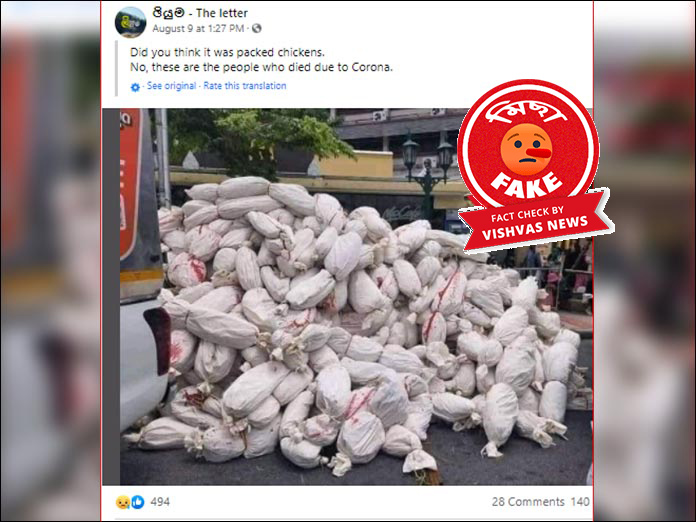
ভাইৰেল পোষ্টটোৰ সৈতে, দাবী কৰা হৈছে যে এইবোৰ শ্ৰীলংকাত ক’ভিডত আক্ৰান্ত হৈ মৃত্যু হোৱা লোকৰ মৃতদেহ।
Publisher’s rating: FALSE