PeakMetrics / Fact Checks
Health & medicine fact checks
Explore claims publishers have checked about health & medicine. Read their original ratings and follow the evidence.
Search fact checks
Search by text or image13,669 published reviews in this topic
Viagra Krem Gerçek mi ?
Publisher’s rating: Evet gerçek üründür ve kullanan müşterilerin hissettiği etkiler kalıcı hale gelmektedir.
Nós abrimos um hospital [Hospital Célio de Castro no Barreiro] de 480 leitos”
Publisher’s rating: Falso
apple cider vinegar can whiten teeth effectively
Publisher’s rating: Mostly False
Research from related reporting directly challenges the claim that apple cider vinegar can whiten teeth effectively. S1 says the mistaken expectation comes from the fact that acid can remove stains, but distinguishes that from whitening: it reports that ACV’s acid erodes enamel, leaving teeth sensitive and translucent rather than whiter. This describes a potential harm, not an effective whitening result. S3 adds a qualification: acidic ingredients may temporarily remove some surface stains, but concentrated use can erode enamel, increase sensitivity and roughen the surface, making teeth more susceptible to later staining. It also says that online home remedies, including apple cider vinegar, may provide surface cleaning but can damage enamel if used improperly. Taken together, the excerpts do not support ACV as an effective way to whiten teeth. They distinguish limited, temporary surface cleaning from whitening and warn that the acid may damage enamel. S3 further reports dental experts’ view that natural remedies cannot effectively whiten teeth and should not replace professional procedures. The excerpts do not provide a study measuring ACV’s whitening effect, so they support a caution against the claim rather than a quantified comparison of treatments.
Cagan Nano is an FDA-approved product that can cure hepatitis and cirrhosis within 36 days
Publisher’s rating: False

Diamond Glucosamine is an FDA-approved supplement for treating joint-related ailments
Publisher’s rating: False
Aumentamos em 20% leitos de UTI, depois da pandemia"
Publisher’s rating: Subestimado


Six fruit combinations that are deadly for humans
Publisher’s rating: FALSE
The review examines a viral social-media warning that named six combinations—orange and carrot, pineapple and milk, papaya and lemon, guava and banana, orange and milk, and banana and lemon—and said they could cause death. It frames its investigation around whether those pairings are deadly, rather than assessing fruit combinations in general. The article notes that fruit and vegetables are generally beneficial, then says it searched for information about the combinations individually. For examples of its checks, the review cites a WebMD recipe combining carrot and orange, and reports Healthline’s explanation that pineapple and milk are not toxic or dangerous, though the milk may curdle. It also points to research reporting antioxidant properties in papaya and lemon juice and to recipes for guava-and-banana smoothies. These examples address some pairings, but the excerpt does not describe separate checks for orange and milk or banana and lemon. The review also reports consulting nutritionist and corporate wellness coach Dr. Umesh Wadhavani. He said the combinations cannot cause death and that there is no scientific evidence that they are deadly; he suggested that some people might experience digestive problems for other reasons. The review concludes that the post’s claim is unsupported and false. Its cited examples and expert’s assessment challenge the death warning, but the excerpt does not provide detailed study methods or evidence addressing each of the six pairings individually.

ලොව වස විස අධිකම ආහාර ගන්න රටවල් අතරින් ලංකාව පළමු තැනට?
Publisher’s rating: Misleading
The claim concerns a social-media image presented as a recent Dinamina newspaper story, alleging both that the World Health Organization had warned Sri Lanka about agrochemical use and that Sri Lanka ranked first among countries eating the most toxic food. The review identifies the image’s source as a Dinamina article published in 2013, rather than a recent report. It also distinguishes the image’s broad claim about food from the agricultural-input measure the underlying figures actually addressed. To check whether Sri Lanka had ranked first for toxic-food consumption, the publisher says it searched major international and local media for a report of such a ranking. It found no report of that kind. It noted that local reporting in 2021 quoted physician Anuruddha Padeniya saying Sri Lankans were becoming a people who consumed the most “poison,” but those reports did not say Sri Lanka had been ranked first. The publisher also checked Dinamina and found no recent article matching the image; its examination of the newspaper logo helped lead it to the 2013 source. The underlying figures were about fertilizer consumption, not a ranking of countries by how poisonous their food was. The review compared World Bank fertilizer-use figures, measured as kilograms of fertilizer per hectare of arable land. In the latest data it examined, for 2020, Bangladesh led South Asia at 320.9 units and Sri Lanka was second at 297.8. The review further says Sri Lanka was outside the world’s top 20 in the World Bank’s global data. Thus, the old report’s regional fertilizer comparison does not establish the social-media image’s claim about toxic-food consumption or a recent WHO warning.
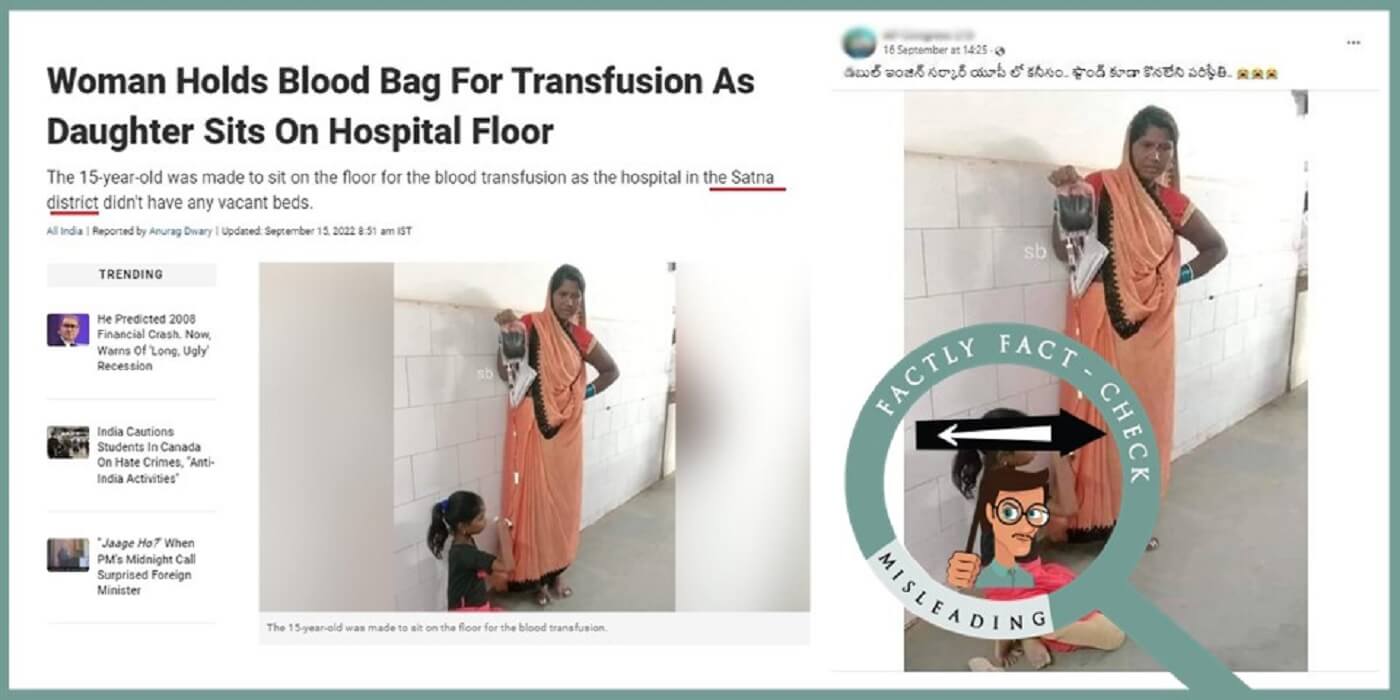
ఉత్తరప్రదేశ్లోని ఆసుపత్రిలో ఒక మహిళ బ్లడ్ బ్యాగ్ పట్టుకొని తన కూతురికి రక్తం ఎక్కిస్తున్న ఫోటో
Publisher’s rating: MISLEADING

மதுரை எய்ம்ஸ் மருத்துவமனை கட்டுமான பணிகள் 95% முடிந்துள்ளன – பாஜக தேசிய தலைவர் நட்டா
Publisher’s rating: Fake
Didier Raoult était présent à la première réunion du conseil scientifique dans laquelle Emmanuel Macron a posé sur la table une montage de boites de Remdesivir.
Publisher’s rating: Essentiellement Faux
Madurai AIIMS Hospital construction is 95% complete – JP Nadda, BJP National President
Publisher’s rating: Fake


De nieuw goedgekeurde coronavaccins zijn getest op slechts acht muizen.
Publisher’s rating: Dat is kort door bocht. De klinische studie van de vernieuwde boosters lopen nog, maar het EMA keek naar verschillende menselijke en dierlijke datasets alvorens het boostervaccin van Pfizer goed te keuren.
The claim concerns the EMA’s approval of Pfizer’s reformulated booster for Omicron BA.4/BA.5: that its approval rested on tests involving only eight mice. The review says the booster was approved in mid-September 2022 and explains that the change was the addition of mRNA for the BA.4/BA.5 spike protein. Because it was a modified version of the earlier vaccine, a complete new clinical study was not required for approval. The review describes the EMA committee’s evidence as broader than a single mouse group. It says the committee considered available data on both the original and reformulated vaccines, clinical data for a recently approved BA.1 booster, and preclinical studies of the BA.4/BA.5 boosters. Clinical studies of the newest boosters were still underway, so the evidence did not include completed new clinical trials for those boosters. The exact total number of animals used in the relevant studies was not publicly known, according to the review. It reports that a June presentation to the US FDA listed a group of eight mice, but says this was the number per study group, not the total number of animals. Different groups received different vaccines to allow antibody comparisons. Thus, the figure of eight did not establish that only eight mice were used overall, and it did not describe all the evidence considered in the approval.