PeakMetrics / Fact Checks
Health & medicine fact checks
Explore claims publishers have checked about health & medicine. Read their original ratings and follow the evidence.
Search fact checks
Search by text or image13,667 published reviews in this topic

حصة الفرد من الإنفاق الصحي في العراق 145 دولار للفرد سنويا، وأفقر البلدان في المنطقة مثل الدول غير النفطية ليس أقل من 256 دولار، والدول الخليجية أكثر من ألفين دولار، وفي أميركا 21 ألف دولار للفرد
Publisher’s rating: التصريح "غير صحيح"، حيث إن نصيب الفرد العراقي من الإنفاق الصحي يبلغ أكثر من 200 دولار خلال 2020، و239 دولارًا في 2019، كما أن بعض البلدان الفقيرة وغير النفطية في المنطقة مثل السودان واليمن وسوريا ومصر تراوحت بين 23 و150 دولارًا للفرد، أما الدول الخليجية ففقط قطر والإمارات تجاوزت حصة الفرد فيها 2000 دولار، كما أن حصة الفرد في الولايات المتحدة تبلغ 12.5 ألف دولارًا

"There is scientific evidence that mammograms are unsafe, unnecessary, and create completely unnecessary risk and anxiety for any woman"
Publisher’s rating: Misleading
5G activate Marburg virus in Covid-19 vaccines
Publisher’s rating: False
durian increases libido
Publisher’s rating: Mostly False
Mathew Perry died of Covid vaccine
Publisher’s rating: Mostly false

carrot and cucumber juice can restore vision in a week
Publisher’s rating: False

Emergency contraceptive pills are not safe
Publisher’s rating: While they can be a powerful tool of women empowerment, there’s an urgent need for public awareness and access, coupled with efforts to promote gender equality in the reproductive sphere.
Research from related reporting describes the belief that emergency contraceptive pills are unsafe as a common concern shaped by stigma and misinformation. It states that the pills are safe when used correctly and work by delaying ovulation, not ending a pregnancy.

Dr. Eckart von Hirschhausen wirbt für «Cardio Balance»,
Publisher’s rating: Die Werbekampagne ist ein Fake. Eckart von Hirschhausen hat mit der Werbung nichts zu tun. Das hat der Arzt nicht nur selbst bereits mehrfach öffentlich geäußert, sondern im aktuellen Fall auch der Verbraucherzentrale bestätigt.
The review examined Facebook advertisements presenting Eckart von Hirschhausen as endorsing Cardio Balance, a supplement promoted as a way to clean blood vessels and address high blood pressure and other illnesses. The ads led to articles featuring supposed patient success stories, and offered the product for purchase. The investigation describes this specific campaign—not merely other uses of the doctor’s image—and reports that he had no connection to its promotion. (The article says the ads promoted the supplement “um dadurch Bluthochdruck und andere Krankheiten loszuwerden” and identifies “Cardio Balance” as the product allegedly recommended.) The review cites von Hirschhausen’s own public statements and confirmation from the consumer advice center. In a June 2023 Instagram post, he said he did not do commercial advertising and specifically disassociated himself from Cardio Balance. The Verbraucherzentrale NRW also warned about the product and said von Hirschhausen had confirmed the alleged endorsement was fraudulent. (The article quotes his post: “Ich mache grundsätzlich keine kommerzielle Werbung” and says he addressed “mit dem in der aktuellen Werbekampagne empfohlenen «Cardio Balance» nichts zu tun.”) The investigation also checked the purported patient evidence. It reports that identical photos appeared with different names; reverse-image searches traced one image to a deceased former wife of a US congressman and another to an Austrian woman pictured in a story about a thwarted bank robbery. Those findings undermine the ads’ presentation of the pictured women as German retirees treated by von Hirschhausen. The review concludes that their stories were not connected to the women shown. (It reports that “Das gleiche Foto einer Frau mit verschiedenen Namen verwendet” and that the stories “also nichts mit den gezeigten Frauen zu tun.”)
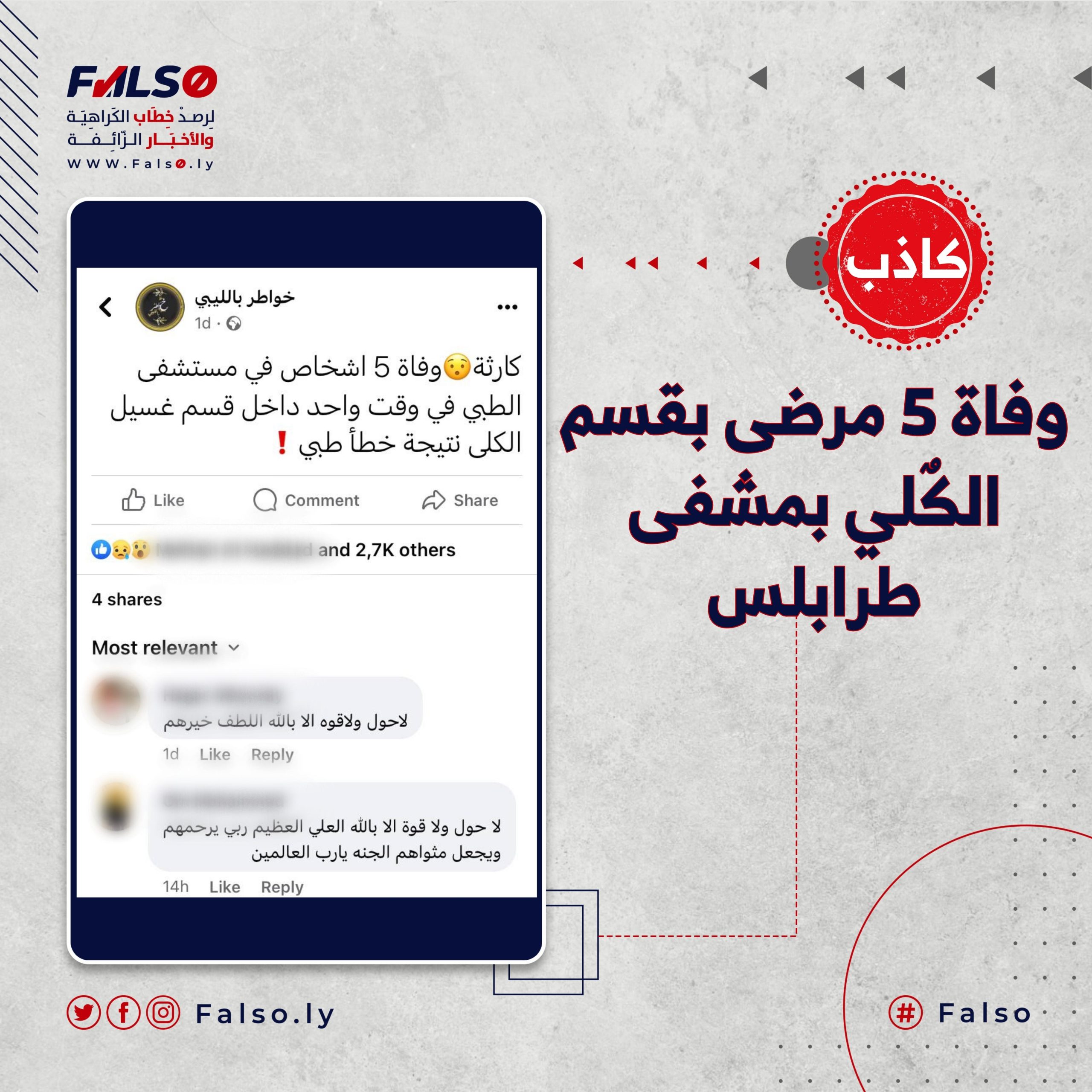
وفاة 5 مرضى بقسم الكلي بمشفى طرابلس
Publisher’s rating: كاذب
The claim examined was that a medical error in the kidney-dialysis department at Tripoli University Hospital had caused five patients to die at the same time. The review says the allegation circulated on Facebook and describes the attributed post as alleging that five people died in the dialysis department. Its account therefore concerns the specific hospital, department and alleged incident in the claim, rather than a general report about kidney care. To check the allegation, the review says its team looked for official announcements and death notices. It reports that it found no official announcement of five deaths, either from the authorities responsible for making such announcements or in death notices. The excerpt does not identify individual records, provide a search log, or specify a timeframe for that check, so those details cannot be independently assessed from the supplied text. The review also cites a statement published on the university hospital’s page by the head of the dialysis department, Dr. Hisham Abu Harba. According to the review, he denied the circulating rumors and said the department was operating smoothly and providing medical services; he also said dialysis supplies were sufficient for the coming months. These are the review’s reported findings and attributed statements; the excerpt does not include the hospital post itself or separate documentation verifying them.

Ausgewählte Zeitungsartikel beweisen: Die Wirksamkeit der Coronavirus-Impfungen hat mit der Zeit abgenommen.
Publisher’s rating: Mehrfach irreführend. Erstens: Es ist keine chronologische Anordnung der Zeitungsartikel, die Daten gehen durcheinander. Zweitens: Es werden Studien angeführt, die nicht sinnvoll miteinander vergleichbar sind, da die Datenlage oftmals völlig verschieden ist.
The claim concerns a video montage of more than 100 English-language newspaper excerpts, shared by Elon Musk, which gives the impression that COVID-19 vaccine effectiveness steadily fell. The review says that the apparent sequence of figures—from 100 percent to lower percentages—does not establish a decline: the articles are not arranged chronologically, and the studies they describe are not directly comparable. It reports that most excerpts date from September 2020 to October 2021, and that some of the reports citing lower effectiveness appeared very early in vaccine development, in some cases before vaccinations began. The excerpts also concern different vaccines, variants, and kinds of evidence. For example, one report concerns the Pfizer/BioNTech vaccine’s results against the original virus, while a later report gives a lower figure for effectiveness against the Delta variant. The review explains that these figures address different variants, so placing them side by side does not demonstrate that the same vaccine’s effectiveness declined over time in comparable circumstances. Study design further limits what the montage can show. The review contrasts an AstraZeneca phase-III clinical trial with a CDC real-world study of Pfizer and Moderna vaccines, noting differences in participants and methods. It also distinguishes protection against infection from protection against severe disease, hospitalization, and death. Taken together, the excerpts do not support the claimed chronological trend: the montage omits essential differences in dates, vaccines, variants, outcomes, and study methods.