PeakMetrics / Fact Checks
Elections & voting fact checks
Explore claims publishers have checked about elections & voting. Read their original ratings and follow the evidence.
Search fact checks
Search by text or image5,414 published reviews in this topic

Erika Kokay do PT denunciou fraude nas urnas eletrônicas
Publisher’s rating: Falso


Campaign by Saliya Pieris to become the next president of Sri Lanka!!
Publisher’s rating: False
The review investigates social-media posters attributed to Saliya Pieris, then president of the Bar Association of Sri Lanka (BASL), that presented him as seeking Sri Lanka’s presidency. The posters used political slogans and purported pledges, including calls to “Stand with me.” The article also identified a Facebook page named “Saliya Peiris – Our Next President” as a source of posters that later circulated on WhatsApp. The claim was therefore about an alleged campaign and statements, not simply about Pieris’s public position on peaceful protest. The publisher reports two checks: it searched mainstream media for reports of Pieris making the statements, finding none, and contacted Pieris directly. According to the article, he denied the posts and said he had made no such statements, had no connection to the Facebook page, and had no hope of contesting the presidential election. He distinguished that denial from his support for people’s right to peaceful protest, which he described as a fundamental right. The review also consulted BASL treasurer Rajind Perera. He clarified that the next BASL presidency elections were scheduled for February 2023 and that Pieris could not contest for a third term under the BASL constitution. That detail concerns the leadership of the lawyers’ association, not Sri Lanka’s national presidency; it does not itself establish whether Pieris could run for national office. The article’s conclusion rests on the attribution and candidacy denials reported from Pieris and BASL, alongside the lack of mainstream-media reports it describes.
Numa única eleição que foi quatro anos atrás, para a Câmara (...), aumentou em 46% o número de deputadas federais
Publisher’s rating: Verdadeiro, mas...
“AUDIO VAZADO DO DIRETOR DO DATAFOLHA MAURO PAULINO CONFESSA PLANO DE FRAUDE NAS URNAS”
Publisher’s rating: Falso

URGENTE ÁUDIO VAZADO DO DIRETOR DA DATAFOLHA MAURO PAULINO PLANO DE FRAUDES NAS URNAS
Publisher’s rating: Falso
Eu mesmo fui o deputado federal mais votado do Brasil
Publisher’s rating: Falso
Das Bundesverfassungsgericht hat geurteilt, dass Wahlen & Gesetze seit 1956 ungültig sind.
Publisher’s rating: Das Urteil des Verfassungsgerichts aus dem Jahr 2012 bezog sich allein auf die damals jüngste und noch nicht angewandte Fassung des Bundeswahlgesetzes. Es hatte keine Auswirkungen auf zurückliegende Wahlen.
The claim invokes a Tagesschau report to suggest that a Constitutional Court ruling invalidated elections and laws dating back to 1956. The review identifies the cited broadcast as a report about the court’s decision on 25 July 2012, and explains that the case concerned a specific amendment to Germany’s federal election law—not the validity of all past elections or laws. The court considered the 2011 version of the law, which had not yet been applied in an election. (S1) The court ruled for a challenge brought by the Social Democrats, the Greens and more than 3,000 citizens, finding that the 2011 amendment conflicted with the Basic Law. A court spokesperson told dpa that “the subject of the proceedings was solely the provisions in the version of 2011.” Former constitutional judge Gertrude Lübbe-Wolff, who had participated in the decision, also said the ruling had no retrospective effect on earlier elections. She noted that the court had expressly said in its 2008 decision that it was not declaring the 2005 election invalid. (S1) The review distinguishes a ruling against a law from a ruling invalidating every decision previously made under that law. It says that even when a statute is declared void, other decisions based on it do not thereby automatically become invalid; the Federal Constitutional Court Act provides that they remain effective. Lübbe-Wolff also explained that election validity is determined through a separate election-review procedure, and that not every error established in such a procedure invalidates an election. The review therefore finds no basis in the 2012 ruling for the broad claim about elections and laws since 1956. (S1)

Felipe Neto diz que vai votar em Bolsonaro em 2022
Publisher’s rating: Falso

Robredo goes to SC to stop Marcos from being proclaimed president
Publisher’s rating: FALSE


GMA anchors show dismay over Marcos win, elation over Robredo NGO
Publisher’s rating: MISLEADING
Video toont verkiezingsfraude in Frankrijk ten nadele van Marine Le Pen.
Publisher’s rating: De video toont een protestactie voor het hoofdkantoor van de partij van Le Pen op 19 april 2022. De papieren moeten neproebels voorstellen en zijn helemaal geen stembiljetten. Buiten de timing van de actie, de week van de tweede stemronde, is er geen enkele link met de uitslag van de verkiezing. Dit is dus helemaal geen bewijs van verkiezingsfraude.
The video was shared with a Spanish caption alleging that the scattered papers were votes for Marine Le Pen and that police were preventing election fraud from being exposed. The investigation identifies what the footage actually depicts: a protest outside the headquarters of Le Pen’s party, Rassemblement National, on 19 April 2022, during the week of the French presidential election’s second round. It found no link between the action and the election result beyond that timing. To assess what the papers were, the investigation examined a higher-quality version of the video posted on Telegram on 4 May in a Spanish-language channel. It reports that the papers show a QR code, a Russian flag, the words “9 millions,” and, on the reverse, a 2017 photograph of Le Pen shaking hands with Vladimir Putin. Those details do not match French ballot papers, which the article describes as bearing a candidate’s name in one ink colour on a white background. The location was also identifiable from the footage: a bus-stop sign reads “Porte de Saint Cloud” and “Michel-Ange,” and the Picard supermarket is visible across the street. The party headquarters is in the same office building as that supermarket. The article connects the scene to a symbolic protest by the Union des étudiants juifs de France and SOS Racisme. It says the papers were intended to represent fake rubles, and that “9 millions” referred to a 2014 loan from a Russian bank to the then-Front National for financing its 2015 election campaign.

London Bridge Tower lit up for Marcos-Duterte victory
Publisher’s rating: FALSE
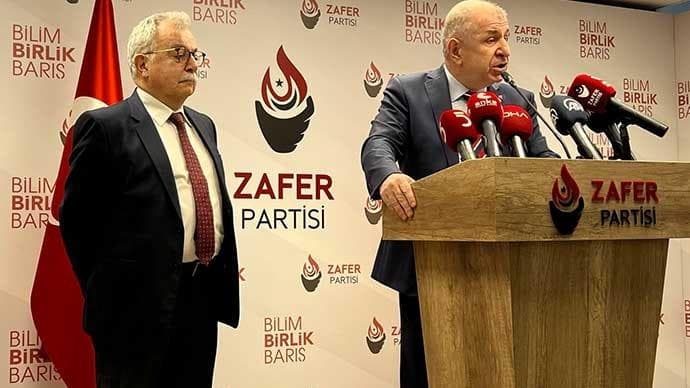
اللجنة العليا للانتخابات في تركيا تستبعد حزب النصر من انتخابات 2023
Publisher’s rating: انحياز