PeakMetrics / Fact Checks
Economy & business fact checks
Explore claims publishers have checked about economy & business. Read their original ratings and follow the evidence.
Search fact checks
Search by text or image7,104 published reviews in this topic

RBI has approved 5-day work week for banks from 1st June.
Publisher’s rating: FALSE
The claim says the Reserve Bank of India approved a five-day bank work week beginning 1 June, which would make banks closed every Saturday. The review checked RBI material on bank holidays and working days, and reports that the last relevant press release it found was dated August 28, 2015. That release set a specific Saturday-holiday arrangement: scheduled and non-scheduled banks across the listed categories would observe public holidays on the second and fourth Saturdays, beginning September 1, 2015. That evidence does not support a new blanket Saturday closure from 1 June. The review says its search of RBI’s website found no subsequent change to the bank timetable as alleged. It also reports that the RBI had clarified that it had issued no instructions for a five-day work week. The review therefore distinguishes the existing second- and fourth-Saturday holidays from the claimed approval to close every Saturday: the former is supported by the cited 2015 release, while the review found no RBI approval for the latter.

Stand up India: This initiative provides loans of up to 1 crore rupees to women/SC/ST/OBC entrepreneurs
Publisher’s rating: TRUE
The claim concerns the Stand Up India scheme, launched by the Government of India in April 2016, and says it provides loans up to ₹1 crore to women and members of SC, ST and OBC communities. The review describes the scheme’s aim as promoting entrepreneurship among women and SC/ST groups, and says it facilitates loans from ₹10 lakh to ₹1 crore for setting up greenfield enterprises in trading, manufacturing and services. Its stated branch-level provision is at least one SC or ST borrower and at least one woman borrower per Scheduled Commercial Bank branch. The review therefore supports the loan ceiling and the women/SC/ST portions of the claim. However, its description and stated conclusion name women and SC/ST borrowers, not OBC borrowers; the supplied text does not establish that OBC entrepreneurs are covered by the cited provision. It also specifies a loan range, eligible enterprise types and a branch-level lending condition, rather than saying that every individual in the named groups automatically receives a loan. The original review nevertheless explicitly labels the claim TRUE.
MUDRA: This scheme provides collateral free loans to entrepreneurs
Publisher’s rating: TRUE
The claim appeared among four statements in a government infographic about the MUDRA and Stand Up India schemes. FACTLY examined the MUDRA claim in the context of the Pradhan Mantri MUDRA Yojana (PMMY), which it describes as launched in April 2015 to provide loans of up to Rs. 10 lakhs to non-corporate, non-farm micro and small enterprises. The review concludes that the claim is true because these loans are provided without collateral or a processing fee. The review distinguishes the scheme’s financing conditions from who actually lends the money. It says applicants must provide documents such as proof of identity and residence, and a machinery quotation where relevant, but banks are not supposed to charge a processing fee or ask for collateral. The scheme’s loans are extended through commercial banks, regional rural banks, small finance banks, cooperative banks, microfinance institutions and non-banking financial companies; MUDRA itself is described as a refinancing institution, not a direct lender to end customers. The finding is therefore about the stated collateral condition for qualifying PMMY loans, not a claim that every entrepreneur or every business can obtain a loan regardless of eligibility. The review specifies the intended recipients as non-corporate, non-farm micro and small enterprises and gives the loan ceiling as Rs. 10 lakhs. Its conclusion supports the claim within that scope.


“Biznes mühiti nöqteyi-nəzərindən 10 ən islahatçı ölkədən biriyik”
Publisher’s rating: faktlarla manipulyasiya

Ognuno di noi lavora circa 1.800 ore all’anno e solo la Grecia riesce a fare peggio. In Francia si lavora circa 240 ore in meno, in Germania 350. [...] In quei Paesi si registra un tasso di disoccupazione più basso del nostro
Publisher’s rating: Nì
On April 11, 2019, Italian undersecretary for labor Claudio Cominardi wrote on Facebook that Italy worked about 1,800 hours per worker annually, that only Greece worked more, and that France and Germany worked fewer hours while having lower unemployment. Pagella Politica checked these comparisons using OECD figures for hours worked and Eurostat unemployment data. The review reports that OECD data for 2017 show 1,723 hours per worker in Italy, compared with 1,514 in France and 1,356 in Germany. The gaps were therefore 209 and 367 hours, respectively—not the stated 240 and 350. The claim that only Greece worked more than Italy was also wrong. Although Greece had the highest figure among the European countries cited, at 1,956 hours, the review lists seven other countries above Italy’s 1,723: Iceland, Poland, Estonia, the Czech Republic, Hungary, Ireland and Portugal. For unemployment, the comparison was accurate: Eurostat’s February 2019 figures were 10.9 percent in Italy, 8.8 percent in France and 3.1 percent in Germany. Those unemployment comparisons do not, however, establish that reducing working hours would cause employment to rise. The review says that Cominardi connected the two and notes that economists’ empirical studies of European experiences did not appear to show that shorter hours increase employment. It also reports that studies found direct benefits for productivity and worker well-being. The review concludes that Cominardi’s statement was imprecise: some comparisons were directionally right, but the hour figures were inaccurate, other European countries worked more than Italy, and the proposed link between shorter hours and greater employment was not established.
Australia has the "highest rate of temporary work in the OECD and the third-highest rate of insecure work".
Publisher’s rating: Not clear cut

Sai Balaji Petroleum in Mumbai has issued their petrol bill receipts to their customers with the text “If you want to reduce petrol price don’t vote Modi again”.
Publisher’s rating: FALSE
The claim concerns an image presented as a Sai Balaji Petroleum receipt from Mumbai, with a message urging customers not to vote for Modi if they wanted lower petrol prices. FACTLY examined whether the receipt was authentic and concluded that the image had been altered, rather than issued with that message by the petrol station. [S1: “Let’s try to verify the authenticity of the receipt put in the post.”; “The sample bill of a company ‘Goldimine Electrosystems Pvt Ltd’ has been photoshopped”] The investigation says it used Google Reverse Image search on the image associated with Sai Balaji Petroleum and found the underlying bill in the sample-bill display section of Goldimine Electrosystems Pvt Ltd’s website. According to the source, the anti-Modi message was added to that sample bill; it also notes visible differences in the font size on the posted image. These findings support the conclusion that the circulating image was edited and do not establish that Sai Balaji Petroleum issued receipts bearing the message. [S1: “When the image is searched using Google Reverse Image search in the name of Sai Balaji Petroleum, there were many results.”; “the original bill was found in the sample bill display section present on the left side of ‘Goldimine Electrosystems Pvt Ltd’ company’s website.”; “The bill is edited and the text ‘If you want to reduce petrol price don’t vote Modi again. Thank you visit again!’ is added to it.”; “they can clearly see the changes in the font size in it.”]
Treasurer Josh Frydenberg claims Australia’s economy is growing faster than any country in the G7, bar the US.
Publisher’s rating: True - The checkable claims are all true.
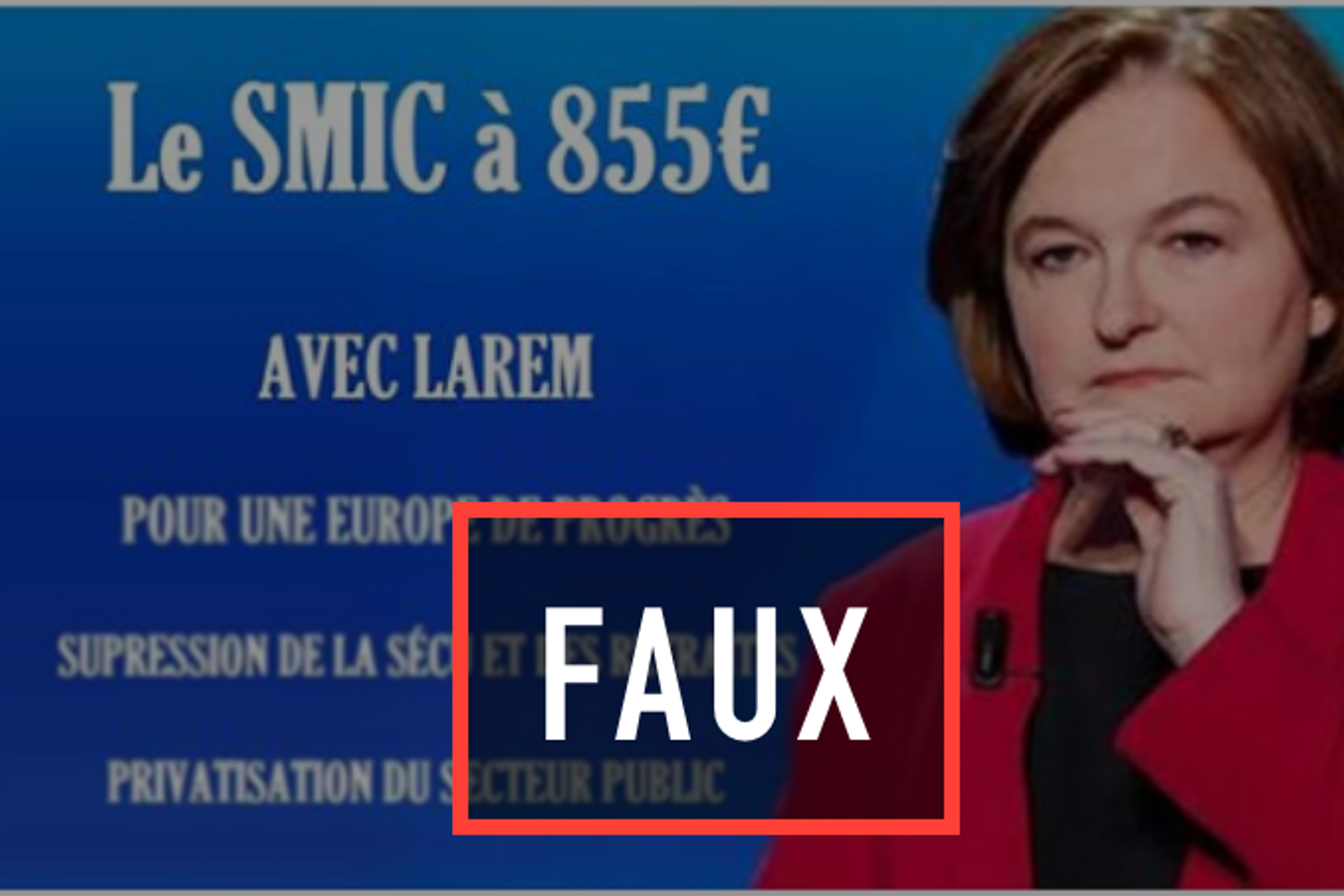
Nathalie Loiseau propose-t-elle de baisser le Smic pour qu'il soit fixé à 855 euros ?
Publisher’s rating: FAUX
The claim arose from a social-media image alleging that Nathalie Loiseau, then the lead candidate for La République en marche in the European elections, supported setting France’s minimum wage at €855 a month. The article traces the controversy to an interview with Le Parisien on 9 April, in which Loiseau advocated a minimum wage in every EU country, set at no less than half that country’s median wage. Her stated proposal concerned a guaranteed floor across the Union, not a replacement for higher national minimum wages. (S1: “Tout est parti d’un entretien de la tête de liste LRM au Parisien le 9 avril.”; “Il faut au minimum un smic dans tous les pays de l’UE. Et, partout, un smic qui permette un revenu décent. C’est-à-dire, par pays, au moins la moitié du salaire médian.”; “Ses propos évoquent bien un « minimum » garanti dans l’ensemble des pays membres de l’Union européenne, pas un seuil qui devrait s’appliquer partout, y compris en France.”) The article distinguishes two figures used in the allegations. Half of France’s median salary, estimated there at about €1,800 a month using 2015 data, would be roughly €900. The €855 figure instead came from halving a different measure: France’s median standard of living, given as €1,710. The article reports the French minimum wage at about €1,200 net per month for a full-time worker. These figures explain how the social-media claim was constructed, but do not establish a proposal to lower the French wage floor. (S1: “Le salaire médian en France était d’environ 1 800 euros par mois en 2015, selon l’Insee.”; “l’idée de Nathalie Loiseau est de fixer le revenu minimum à hauteur de la moitié du salaire médian d’un pays, ce qui correspondrait donc à un seuil de 900 euros en France.”; “Sur Facebook, la rumeur va jusqu’à affirmer que le gouvernement prévoirait de fixer le smic en France à 855 euros par mois, ce qui correspond, cette fois, à la moitié du niveau de vie médian (1 710 euros en France, selon l’Insee).”) The article says Loiseau explicitly rejected lowering France’s minimum wage, quoting her statement: “Nous ne voulons évidemment pas baisser le smic français”. It also notes that the proposed European floor could be criticized as modest: the article says half the median salary would be around the poverty threshold or lower. That qualification concerns the ambition of the European proposal; it does not change the distinction between establishing a minimum in every member state and reducing a higher existing French minimum. (S1: “« Nous ne voulons évidemment pas baisser le smic français », a clarifié Nathalie Loiseau sur Twitter.”; “50 % du salaire médian, cela représente un revenu de l’ordre du seuil de pauvreté, voire moins”)

«A Sánchez no le pasan factura los 20.000 millones de deuda pública»
Publisher’s rating: Falso
Pablo Casado argued that voters were not holding Pedro Sánchez accountable for €20 billion in public debt. The review checks the debt increase during Sánchez’s time as prime minister, rather than treating the entire change across a broader period as attributable to his government. Sánchez took office in June 2018, after a motion of no confidence removed Mariano Rajoy. The review therefore uses the second quarter of 2018 as its starting point and compares it with the latest figures available when Casado made the statement, for the fourth quarter of 2018. Using official Banco de España data, the review reports that public debt rose by €8.22 billion between those quarters—not €20 billion. It also notes that a comparison of the fourth quarters of 2017 and 2018 yields a larger increase, €29.563 billion, but that span includes months when Rajoy was still prime minister. That broader comparison therefore does not establish the increase during Sánchez’s premiership. On the figures and time period it examines, the review concludes that Casado’s claim about €20 billion accruing under Sánchez is false.
“Angka ketimpangan menurun di era Presiden Joko Widodo dan Wakil Presiden Jusuf Kalla”
Publisher’s rating: Benar
“Indonesia masih menjadi pengimpor produk industri halal terbesar nomor 4 di dunia.”
Publisher’s rating: Benar
“Telah terjadi deindustrialisasi, Indonesia tidak memproduksi apa-apa. Kita hanya menerima bahan produksi bangsa lain.”
Publisher’s rating: Sebagian Benar
“Program Mekaar (Membina Ekonomi Keluarga Sejahtera) telah menjangkau 4,2 juta nasabah.”
Publisher’s rating: Benar
“Lebih banyak uang milik warga negara Indonesia di luar daripada di dalam negeri.”
Publisher’s rating: Sebagian Benar
