PeakMetrics / Fact Checks
Economy & business fact checks
Explore claims publishers have checked about economy & business. Read their original ratings and follow the evidence.
Search fact checks
Search by text or image7,104 published reviews in this topic
RBI’s 200 tonnes of gold sent stealthily to a foreign country by the Modi Government
Publisher’s rating: False

Claim: BJP Govt rejecting Tamilians in Railway jobs
Publisher’s rating: MIXTURE
The post under review used a Vikatan report to allege that Tamilians were being excluded from Railway jobs, and said that if the allegation were true, the poster would oppose the BJP. Fact Crescendo checked whether the cited report existed and described it as genuine. The report concerned a protest held in Trichy on May 3 by Tamil nationalist groups and a farmers’ association over appointments at the Ponmalai Railway workshop.
General Motors "got $192 million in tax breaks" and "did nothing" for laid off workers.
Publisher’s rating: False.
The Trump tax cut all "went to the folks at the top and corporations."
Publisher’s rating: False.
وابستگی بودجه کشور به درآمدهای نفتی به ۳۰ درصد کاهش یافته است.
Publisher’s rating: نادرست

In Ungheria le tasse sulle imprese sono al 9 per cento e sulle persone fisiche al 15 per cento, e l’Ungheria cresce del 5 per cento
Publisher’s rating: Vero
The review checks figures cited by Matteo Salvini after he discussed Hungary’s taxation and growth on Rai3’s Mezz’ora in più on 15 May 2019. It says its task is to verify the numbers, not to determine whether low taxes caused Hungary’s economic performance. The investigation reports that Hungary introduced a flat corporate income-tax rate of 9 per cent from 1 January 2017, and a personal income-tax rate of 15 per cent from 1 January 2016. For the growth figure, the review cites Eurostat data: Hungary’s GDP grew by 4.9 per cent in 2018, following growth of 4.1 per cent in 2017 and 2.3 per cent in 2016. It describes the 2018 result as one of the highest among EU member states. Thus, the claim’s 5 per cent figure is an approximation of the reported 4.9 per cent figure, rather than an exact match to it. The review also qualifies the picture of Hungary’s tax system: it reports a 27 per cent VAT rate, which it identifies as the highest among OECD countries, while noting reduced VAT rates for some goods and services. Its evidence supports the cited tax rates and an approximately 5 per cent growth figure, but the review expressly does not assess whether low taxation produced that growth.
Labor treasury spokesman Chris Bowen claims a report from property investment analysts SQM research shows rents will rise under a coalition government as well.
Publisher’s rating: True - The checkable claim is true.
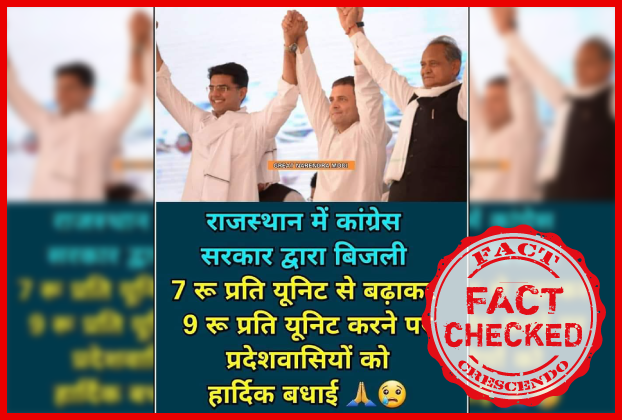
Congress government hiked electricity price by two rupees per unit in Rajasthan
Publisher’s rating: FALSE
The claim concerned a social-media post alleging that Rajasthan’s Congress government, led by Chief Minister Ashok Gehlot, had increased electricity rates from ₹7 to ₹9 per unit after taking office. The review describes the post as showing Gehlot, Deputy Chief Minister Sachin Pilot and Congress president Rahul Gandhi, and says it asserted that the increase had occurred under the Congress government. The review checked whether Rajasthan had made such a decision; its search found no report of a recent rate increase. The review then compared the claimed prices with published tariff information. It reports that the Rajasthan Electricity Regulatory Commission’s tariff section listed 28 May 2018 as the date of the latest tariff order it found. For domestic use above 500 units, that order set the rate at ₹7.15 per unit—not ₹9. The review also says Jaipur Vidyut Vitran Nigam’s website showed the same tariffs and that its notice said those rates would remain in effect until a further order. On that evidence, the review concluded that the claimed increase from ₹7 to ₹9 per unit was not supported: the cited tariff order predated the Congress government’s period in office, and the review found no later increase. It also clarified that the ₹7 figure in the claim was approximate: the stated rate for use above 500 units was ₹7.15 per unit.

Reliance Jio is offering free recharge worth of 399 rupees to lucky 20 thousand users
Publisher’s rating: FALSE
Home Affairs Minister Peter Dutton claims Paul Keating mismanaged the Australian economy around 1988 when he joined the Liberal Party.
Publisher’s rating: False - The checkable claims are all false.
People who worked between 1990 and 2019 “have a right to withdraw R30,000” from South Africa’s government
Publisher’s rating: Fake

A claim that Nigerians import pizza from London to Nigeria using their Cellp hones.
Publisher’s rating: Very likely to be false. And this is because Pizza outlets in London all requested for a London address for the delivery of any ordered Pizza.

Claim: SUEZ company will collect water fee in Coimbatore
Publisher’s rating: MIXTURE

Claim: Wikileaks said BJP has Rs 40 lakh crores black money
Publisher’s rating: FALSE
The claim concerned a viral social-media post attributing a specific allegation to Wikileaks founder Julian Assange: that Rs 40 lakh crore of black money belonged to the BJP and BJP-supported businesspeople. The post paired his image with text also asserting that Rs 72 lakh crore had been hidden abroad. The review notes that the post did not say when the supposed statement was made or whether its amounts were in rupees or dollars. It says the post was shared by Smp Kasaali Mohideen on May 3, in the run-up to an election. To check the attribution, the reviewers searched Google for reports that Assange had published a list concerning Indian black money. They report finding no such report. They then point to a 2011 Times Now interview in which Assange said Wikileaks had lists of people with money in banks around the world, including Indians with Swiss bank accounts, but that he did not remember the Indians’ names and expected the information to be published one day. That account does not substantiate the post’s specific figure or its claim that the money belonged to BJP supporters and associated businesspeople. The review also describes later efforts by Indian authorities to obtain information from foreign banks, reporting that lists were initially kept confidential and that the government later released some names. It says news reports anticipated that Swiss account information would become available from September 2019. The review concludes that it found no evidence supporting the viral post’s specific attribution or Rs 40 lakh crore figure, and says the post was false. Its described evidence supports that conclusion by contrasting the post’s precise claim with the more general statements attributed to Assange; the excerpt does not provide the underlying search results or link contents for independent examination.
"While the Liberals have been in government, there's been a 28 per cent increase in the cost of childcare fees."
Publisher’s rating: In the ballpark

網傳台電回饋金採「登錄制」,還說「6/30前要登入,7/1就截止申請」、「504 元不拿白不拿」的過期訊息
Publisher’s rating: 不實

The EU sends Northern Ireland €500 million a year
Publisher’s rating: ACCURATE WITH CONSIDERATION. The €500 million figure quoted by the SDLP is substantiated by European Commission figures for EU regional funding of Northern Ireland. However, this is not a ‘net’ figure and does not take into account Northern Ireland’s proportion of the UK’s contribution to the EU. A more complete statement would be to say that Northern Ireland receives €55/£45 million more than we pay to the EU.
Labor agriculture spokesman Joel Fitzgibbon claims agricultural productivity has remained flat for almost a decade.
Publisher’s rating: True - The checkable claim is true.
Prime Minister Scott Morrison claims 95 per cent of jobs created in the past year have been full-time positions.
Publisher’s rating: Misleading - The claim is true but somewhat misleading.

சென்னையில் ரூ.7க்கு 20 லிட்டர் வாட்டர் கேன்… 800 இடங்களில் வருகிறது வாட்டர் ஏடிஎம்.
Publisher’s rating: True