PeakMetrics / Fact Checks
Economy & business fact checks
Explore claims publishers have checked about economy & business. Read their original ratings and follow the evidence.
Search fact checks
Search by text or image7,100 published reviews in this topic

తాజాగా పెట్రోల్ పై రూ. 6.40 మరియు డీజిల్ పై రూ. 6.80 తగ్గించిన పెట్రోల్ సంస్థలు
Publisher’s rating: FALSE

Price build-up of Petrol shows that the State Tax on Petrol is more than the Central Tax in Delhi
Publisher’s rating: FALSE
The post claimed that a Delhi petrol-price breakdown showed the State Tax was higher than the Central Tax. FACTLY checked the figures against the Delhi price build-up on the Indian Oil website, noting that the breakdown was also available from Hindustan Petroleum and Bharat Petroleum. It reported that the post’s figures did not match the price build-up: the base price plus freight was Rs 28.28 per litre, not Rs 26, and the average dealer commission was Rs 3.54, not Rs 5. The central-tax comparison is decisive in the review’s account. It explains that central petrol duties included Basic Excise Duty, Special Additional Excise Duty (SAED), and Additional Excise Duty (the Road & Infrastructure Cess). The review says SAED and the Road & Infrastructure Cess accrued entirely to the Union, while states shared 42% of the basic excise duty. For the figures it discusses, the central government’s total was Rs 21.73 per litre, compared with Delhi VAT of Rs 14.79 per litre. That contradicts the post’s assertion that Delhi’s state tax exceeded central taxes. The article contains a small internal inconsistency in its VAT figure: an early passage says Rs 14.49 per litre, while its later breakdown says Rs 14.79 and identifies the rate as 27% as of 18 March 2020. Both figures are below the stated Rs 21.73 central-tax total, so the discrepancy does not reverse the comparison. The review also notes that Delhi received grants in lieu of a share of central taxes; it says those grants were based on cumulative central taxes, not petrol taxes alone.



«Tutti devono sapere: Germania padrona dell’Ue. Aiuti a imprese italiane 25 miliardi. Aiuti a imprese tedesche 550 miliardi»
Publisher’s rating: Pinocchio andante
The review examines a video published by Italian senator Gianluigi Paragone on 14 March 2020. It says he argued that Germany was the EU’s “master” because it could spend €550 billion on the coronavirus crisis while Italy was allowed only €25 billion. The review’s central finding is that the comparison conflates two different kinds of support: German lending capacity and Italian government borrowing for spending.


"I went out and campaigned for (raising the minimum wage) … $15 an hour in New York City. Go talk to the governor."
Publisher’s rating: Event with Andrew Cuomo
"The Fed gave trillions and trillions of dollars in zero-interest loans to every financial institution in this country and central banks all over the world."
Publisher’s rating: Not fully accurate

Las aseguradoras dejan de cubrir accidentes de tráfico por el coronavirus
Publisher’s rating: Falso
The claim concerns a message circulated on social media during Spain’s state of alarm. It warned that insurers would not assist with or cover traffic accidents unless the insured could prove that the journey was permitted under the emergency rules. Newtral identifies the message as false and says car insurance protection continued during the state of alarm, for both third-party and comprehensive policies. The review quotes UNESPA, the Spanish insurance industry association, as saying the emergency did not change the protections offered by motor insurance. The evidence presented is a statement from UNESPA addressing the same claim. According to Newtral, the association had denied the rumor on its social media accounts and shared a communiqué explaining that motor insurance protections remained in place. The communiqué also said the insurance industry was continuing to serve policyholders during the exceptional situation and that the principal insurance lines affected by the disease were operating normally. This directly counters the message’s assertion that accident coverage depended on proving the journey was authorized. The review adds that Royal Decree 463/2020, which declared the state of alarm, did not mention insurance companies or establish a specific rule about their coverage. Thus, the message’s warning was not supported by a change to motor insurance protections described in the article or by a special insurance requirement in the decree. Newtral recommends electronic contact channels for customers, noting that much of the sector’s workforce was working from home; that operational adjustment is distinct from withdrawing coverage.

Claim: PM Modi told India stands first in Beef export
Publisher’s rating: FALSE


Nestle company is selling Maggi with ‘beef’ flavor in India
Publisher’s rating: MISLEADING
The claim concerned whether Nestlé was selling beef-flavoured Maggi in India, prompted by a viral message and an image of the product. The review checked Nestlé India’s listed products and reported that the company’s Indian product range did not include beef-flavoured Maggi. Its description of the non-vegetarian section says that it featured only Maggi products with chicken flavour. The review also reports a direct response from Nestlé India Care to a user who asked about beef-flavoured noodles in India. The company said that MAGGI noodles it manufactured and sold in the country did not contain beef or any form of beef flavour. This statement addresses the claim specifically in the Indian market. The image did show a product that existed, but the review’s investigation found that beef-flavoured Maggi was sold in Australia and New Zealand; it identified a similar product in New Zealand. The distinction is therefore between the product’s availability in those countries and the claim that it was being sold in India. The evidence presented supports the conclusion that the viral image was not from India and that the claim about Indian sales was misleading.
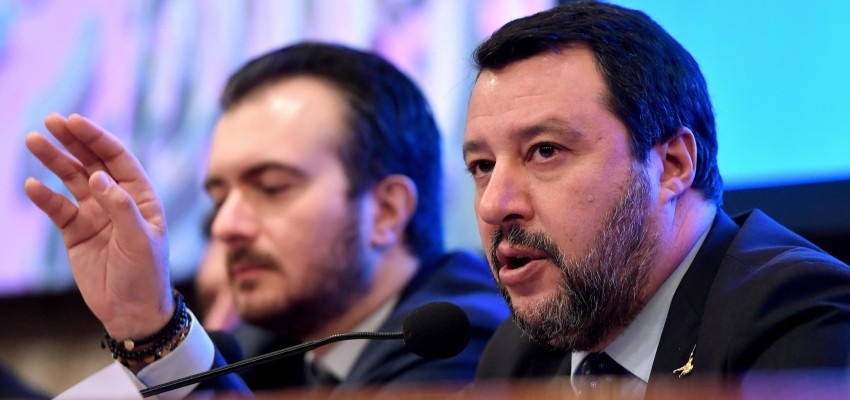
«La Germania diede 300 miliardi per salvare le sue banche»
Publisher’s rating: Nì
The review examines Matteo Salvini’s statement that Germany gave €300 billion to save its banks. It notes that Salvini did not specify the period in his interview with Corriere della Sera, but that on 5 March, on Rai1’s Porta a Porta, he had said Germany spent that amount on its banks in 2008. The review therefore checks both the 2008 figure and the wider crisis-era record. (S1: “Il riferimento dunque è allo scoppio della crisi economica, protrattasi poi per diversi anni successivi.”) For its comparison, the investigation describes using European Commission statistics on aid to banks in EU countries from 2008 to 2017. It distinguishes approved aid—the maximum sums states authorized—from aid actually used, and bases its calculations on the latter. For 2008, the review reports €20 billion in recapitalizations, €9.8 billion in relief measures, €18.7 billion in guarantees and €3.6 billion in other liquidity measures, totaling €52.1 billion. (S1: “la Commissione Ue divide i dati delle sue tabelle tra gli aiuti di Stato «approvati» (approved), ossia le somme massime che ogni singolo Stato aveva stabilito di poter spendere annualmente, e gli aiuti effettivamente «spesi» (used).”) Across 2008–2017, the review gives €64.1 billion in recapitalizations and €80 billion in relief measures, or €144.1 billion combined; adding other liquidity measures takes that total above €150 billion. Guarantees, however, reached €335.4 billion. The review cautions that guarantees are not equivalent to money actually paid: they are state commitments to cover possible interventions. Thus, the €300 billion figure is not supported as money Germany actually gave its banks, although the total for guarantees exceeds that amount. (S1: “Se invece guardiamo alle garanzie, arriviamo a oltre 335 miliardi di euro, andando sopra i 300 miliardi citati da Salvini.”)

డెబిట్ లేదా క్రెడిట్ కార్డులను ఒక్కసారైనా ఆన్లైన్ లావాదేవీల కోసం వాడకపోయినైట్లెతే మార్చి 16 నుండి అవి పనిచేయవు
Publisher’s rating: MISLEADING
“Thousands of companies are leaving China. The supply chain is crumbling because they can’t pay the [Trump] tariffs, and our country has taken over things that you would have never thought.”
Publisher’s rating: Not the whole story
“I want China to do well [in economic growth], and I hope they do well, but they’ve had now the worst year in 57 years.”
Publisher’s rating: Wrong
"Hundreds of billions of dollars have been and are coming into our country in the form of tariffs, and China’s eating the cost."
Publisher’s rating: Not the whole story