PeakMetrics / Fact Checks
Economy & business fact checks
Explore claims publishers have checked about economy & business. Read their original ratings and follow the evidence.
Search fact checks
Search by text or image7,100 published reviews in this topic
سید حسن نصرالله از صندوق بینالمللی پول خواسته زودتر با وام ۵ میلیارد دلاری ایران موافقت کند.
Publisher’s rating: نادرست

«Il debito pubblico italiano, rispetto alla maggior parte degli altri Paesi del mondo, è appena aumentato negli ultimi anni»
Publisher’s rating: Vero

Azim Premji donates 50000 crores amidst coronavirus outbreak
Publisher’s rating: FALSE
No podrá entrar ninguna mercancía de terceros países a España por el estado de alarma
Publisher’s rating: Falso


GOVERNO acaba de liberar o cadastramento do AUXÍLIO EMERGENCIAL no valor de R$600,00 à R$1.200,00 O Agendamento dever ser feito no APP oficial. FAÇA O AGENDAMENTO
Publisher’s rating: Falso: O Projeto de Lei que cria o benefício ainda tramita no Congresso. Se aprovado, precisa ser sancionado pelo presidente da República e ter definido o modo como o valor será distribuído

«La banca mi deve dare con la garanzia dello Stato [...] e deve essere fatto con una procedura automatica come in Svizzera, non con la cultura dei moduli»
Publisher’s rating: Pinocchio andante
The claim concerns Matteo Renzi’s comparison between Italian state-backed support for businesses and Swiss emergency loans during the coronavirus crisis. The review reports that, in a March 28 interview, Renzi said support for companies “deve essere fatto con una procedura automatica come in Svizzera, non con la cultura dei moduli.” The investigation tests that comparison against the Swiss application process described by EasyGov.swiss, the country’s online business-support portal, and reporting by Swiss-based debunker Paolo Attivissimo. The review describes two Swiss credit programmes. For the smaller programme, businesses could seek up to 500,000 Swiss francs, subject to conditions including a Covid-related fall in turnover and a maximum annual turnover threshold. The review says EasyGov characterized the loans as quickly disbursed and fully guaranteed by the Confederation, but also described an application requiring applicants to download, complete, sign, scan and send a credit agreement to a bank. The bank would then check the agreement before paying the funds. The larger “Covid-19 Plus” programme offered up to 20 million francs and involved additional steps, including a more detailed bank review. Its loans were guaranteed 85 per cent by the Confederation, with the remainder guaranteed by the lending bank. The review therefore distinguishes rapid processing and limited bureaucracy from an automatic process: the Swiss measures offered quick access under specified conditions, but still required an application and bank checks. It concludes that the Swiss procedure was not automatic, contrary to the comparison in Renzi’s statement.

Photo shows existing vegetable glut due to COVID-19 lockdown
Publisher’s rating: Misleading

Las aseguradoras dejan de cubrir accidentes automovilísticos por el estado de alarma
Publisher’s rating: Falso



«L’anno scorso il Pil degli italiani sono stati un miliardo e 800 milioni di euro. La spesa pubblica sono 800 milioni di euro»
Publisher’s rating: Nì
The claim concerns remarks by League leader Matteo Salvini on the Rai 3 programme Carta Bianca on March 24, 2020. He put Italy’s GDP at “one billion and 800 million euros” and public spending at “800 million.” The review says both amounts are wrong by a factor of a thousand: they are in the billions, not the millions. It also notes that, after multiplying the figures by a thousand, they are still not exact. To check the amounts, the review cites Eurostat for Italy’s 2019 GDP and Istat for public spending in 2018, the latest year then available in the cited Istat data. GDP was €1,787.7 billion in 2019, approximately €1,800 billion; public spending was €854.6 billion in 2018. Those figures support the review’s conclusion that Salvini’s amounts were far too small, while showing that his approximate relationship between GDP and public spending was substantially right. The review adds that the error was probably a slip, rather than treating the figures as a deliberate or broader claim about the economy. Its closing assessment distinguishes that likely mistake from the incorrect amounts: even after correcting the scale by a thousand, the GDP and spending figures remain somewhat imprecise.

Kerala has asked NABARD for a loan of Rs 20,000 crore to deal with COVID-19
Publisher’s rating: FALSE
The review distinguishes Kerala’s Rs 20,000 crore COVID-19 package from the amount it sought from NABARD. It says the state announced the larger sum as a package to fight the pandemic, but requested a special line of credit of Rs 2,000 crore from NABARD under the Rural Infrastructure Development Fund (RIDF).
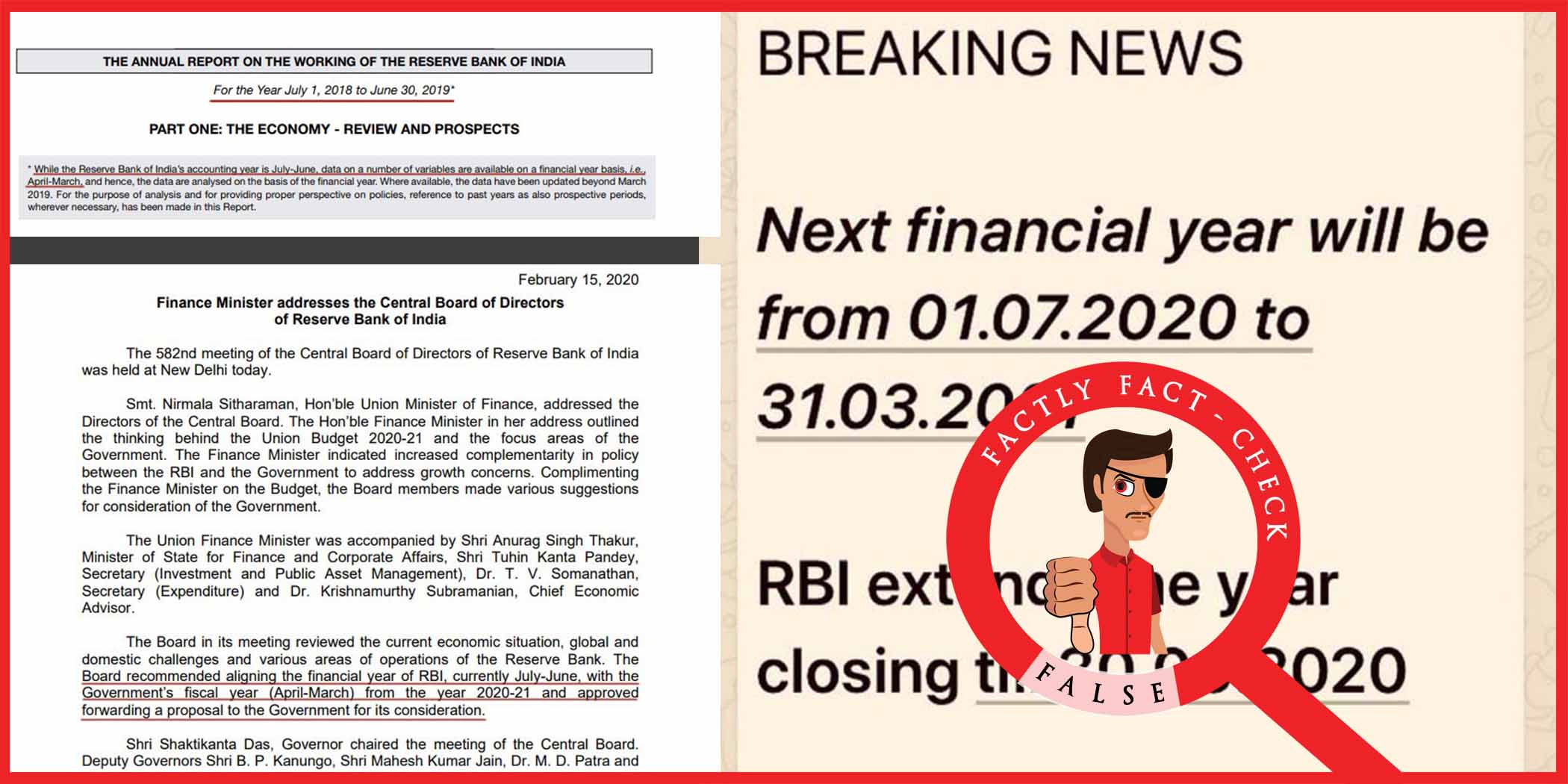
RBI extended the year closing till 30 June 2020
Publisher’s rating: FALSE
The claim concerned a social-media message saying the Reserve Bank of India had extended its financial-year closing to 30 June 2020, with the next year running from 1 July 2020 to 31 March 2021. The review distinguishes the RBI’s accounting year from the financial year used by the Indian government, companies and other organizations. It says the latter normally runs from 1 April to 31 March, while the RBI’s year already ran from 1 July to 30 June. Thus, 30 June 2020 was not a newly extended closing date for the RBI. To assess the viral post, the review says it examined the newspaper article linked in the post and checked information on the RBI website and in its annual report. The linked article described the fiscal-year dates as applying “in the case of RBI”; according to the review, it did not say the RBI had extended its year. The review also cites a meeting of the RBI Central Board of Directors on 15 February 2020, at which the Board recommended aligning the RBI’s July–June financial year with the government’s April–March year from 2020–21 and approved forwarding that proposal to the government for consideration. The distinction is important: a proposed change for a subsequent financial year is not evidence that the existing year was extended. The review says there was no change to the normal April–March financial year followed by the government and other organizations, and that changes were proposed for the RBI’s financial year beginning in 2020–21. The claim therefore conflated the RBI’s already-established July–June accounting cycle with an extension, and treated a proposed future alignment as a current extension.

A CHINA É DONA DE GRANDE PARTE DE AÇÕES DA EMISSORA BANDEIRANTE MAIS CONHECIDA COMO BAND, ISSO EXPLICA MUITA COISA.
Publisher’s rating: Falso

Ifood está dando CUPOM no valor de R$100 para conscientizar as pessoas a não sairem de casa!
Publisher’s rating: Falso
