PeakMetrics / Fact Checks
Economy & business fact checks
Explore claims publishers have checked about economy & business. Read their original ratings and follow the evidence.
Search fact checks
Search by text or image7,096 published reviews in this topic
The Philippines collected P1.5 trillion in taxes in 2015.
Publisher’s rating: Inaccurate

ABS-CBN cheated government in 'billions' in taxes
Publisher’s rating: FALSE

64% of the taxes collected on petrol go to the state governments, whereas the center retains only 36 % – Jyotiraditya Scindia
Publisher’s rating: FALSE
FACTLY examined a video post attributing to BJP MP Jyotiraditya Scindia the claim that states receive 64% of petrol taxes while the central government keeps 36%. The review says Scindia made the statement in the Rajya Sabha on 24 March 2021. Its analysis focuses on central excise duty, rather than treating every tax in a petrol purchase as a single central levy. The review breaks central excise duty into four components: Basic Excise Duty (BED), Special Additional Excise Duty (SAED), Additional Excise Duty (AED), and Agriculture & Infrastructure Development Cess (AIDC). It explains that SAED is a surcharge and that AED and AIDC are cesses, and says those three components are not in the divisible pool shared with states. Of the stated Rs. 32.90 central excise duty per litre, Rs. 31.50 is therefore retained centrally; only Rs. 1.40 in BED enters the divisible pool. Applying the 15th Finance Commission’s 41% state share to that Rs. 1.40 yields Rs. 0.57 for states and Rs. 0.83 retained by the center. On that calculation, the center receives Rs. 32.33 of the Rs. 32.90 central excise duty per litre, or 98.27%; states collectively receive Rs. 0.57, or 1.73%. The review separately illustrates how state-level taxes affect the overall split: in Telangana, it gives a 24 July 2021 Hyderabad pump price of Rs. 105.89 per litre and reports that state VAT plus Telangana’s share of central taxes amounted to Rs. 26.78. That illustration is not a 64% state share of central excise duty; it includes a state tax and uses a specific state and price example.

Fact Check: අර්ථසාධකය ලක්ෂ 7 ට වැඩි නම් 14% ක බද්දක්?
Publisher’s rating: False



"The cost of an automobile is kind of back to what it was before the pandemic."
Publisher’s rating: False
“We’ve created more jobs in the first six months in our administration than any time in American history.”
Publisher’s rating: Misleading

100 trottinettes électriques à donner pour deux euros chacune via bpost.
Publisher’s rating: C’est faux. bpost n’est pas impliquée dans une telle action, a confirmé le groupe à la dpa.

त्यात त्यांनी एलपीजी महागल्यास, राज्य सरकार कारणीभूत असल्याचा दावा केला. त्यांनी आपल्या पोस्ट मध्ये लिहले कि केंद्र सरकार एलपीजी वर पाच टक्के टॅक्स लावते, आणि राज्य सरकार ५५ टक्के टॅक्स घेते.
Publisher’s rating: FALSE
The claim concerned a Facebook post shared by Hemendra Garg of Jaipur. It blamed state governments for rising LPG prices, asserting that the Centre charged 5% tax while states charged 55%. The review reproduces the post’s breakdown of the purported costs and charges, including its tax figures. These details match the claim being checked. [Source: S1]

"Hemos creado más de 3 millones de empleos desde que asumí el cargo, más puestos de trabajo de los que se han creado en los primeros cinco meses de cualquier presidencia en la historia moderna"
Publisher’s rating: Engañoso

SAIU DIÁRIO OFICIAL! PAGAMENTO EM 24 HORAS e 14º SALÁRIO APROVADO APOSENTADOS e PENSIONISTAS INSS!
Publisher’s rating: Falso

Video of Himalaya Company Chairman ranting on Reliance and Patanjali
Publisher’s rating: FALSE
The post identified in the review claimed that the man criticizing Reliance and Ramdev’s products was Himalaya Company chairman. FACTLY’s investigation identifies the speaker as Bhanu Pratap Singh, a lawyer, rather than a company chairman. It also names Meraj Manal as chairman of Himalaya Global Holdings Ltd., distinguishing him from the person shown in the video. To trace the footage, the review says it used reverse image searches of screenshots and found a YouTube video with the same visuals. That video was uploaded on 25 January 2020; its title, translated in the review, refers to Bhanu Pratap Singh and the CAA. The review reports that the post’s clip begins at 4:39 in the longer video and lasts 2 minutes 20 seconds. The review places the speech at a dharna in Mustafabad, Delhi, after a Supreme Court hearing on the Citizenship Amendment Act. It says the YouTube description identifies the speaker as Bhanu Pratap Singh and concludes that the footage is from a lawyer’s speech at an anti-CAA protest, not a Himalaya chairman’s remarks.
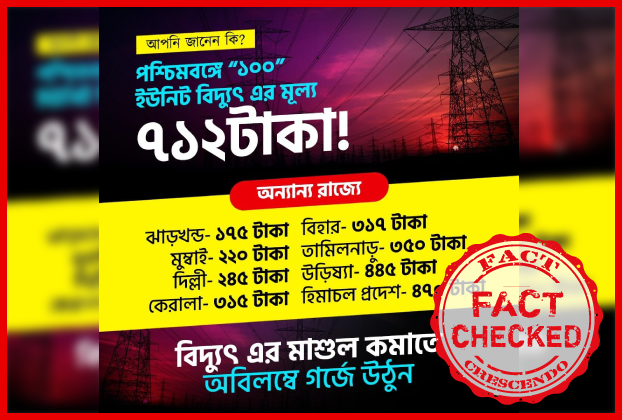
মুম্বাই, দিল্লী এবং আরও বেশ কয়েকটি রাজ্যের তুলনায় পশ্চিমবঙ্গে ১০০ ইউনিট বিদ্যুৎ প্রতি বেশি টাকা নেয় সরকার
Publisher’s rating: FALSE

Vivo informa: Parabens por ganhar esse Super Desconto, pague sua fatura com desconto no valor de R$ 59,90 via Pix CNPJ
Publisher’s rating: Falso


On the domestic LPG cylinders, the State Government levy a tax of 55% whereas the Central Government’s tax is just 5%
Publisher’s rating: FALSE
The claim concerns the tax on domestic LPG cylinders in India, alleging that State governments levy 55% while the Central government charges only 5%. FACTLY’s review says domestic LPG is subject to a combined 5% Goods and Services Tax (GST), split equally between the Central and State components—not a separate 55% State levy. It concludes that the claim has no basis. To check the tax rate, the review reports consulting the Central Board of Indirect Taxes and Customs (CBIC) website and the Petroleum Planning & Analysis Cell’s (PPAC) November 2020 Ready Reckoner. It also describes checking a 14.2 kg domestic-cylinder bill, which showed 2.5% CGST and 2.5% SGST. Those sources and the bill support the review’s explanation that the total GST is 5%, rather than a 55% State tax. The review also distinguishes taxes from other parts of the cylinder’s retail price. It says some market-determined price components vary between States because of factors such as location and uncompensated costs under PAHAL, but not because of taxes. It separately disputes a dealer-commission figure in the post; that is a different component of the price and does not establish the alleged State tax.