PeakMetrics / Fact Checks
Culture & entertainment fact checks
Explore claims publishers have checked about culture & entertainment. Read their original ratings and follow the evidence.
Search fact checks
Search by text or image3,169 published reviews in this topic

कॉमेडियन राजू श्रीवास्तव के निधन के पहले का यह उनका आखिरी वीडियो है।
Publisher’s rating: False

Videonun Malezya’da yayınlanan bir şampuan reklamı olduğu iddiası
Publisher’s rating: Yanlış
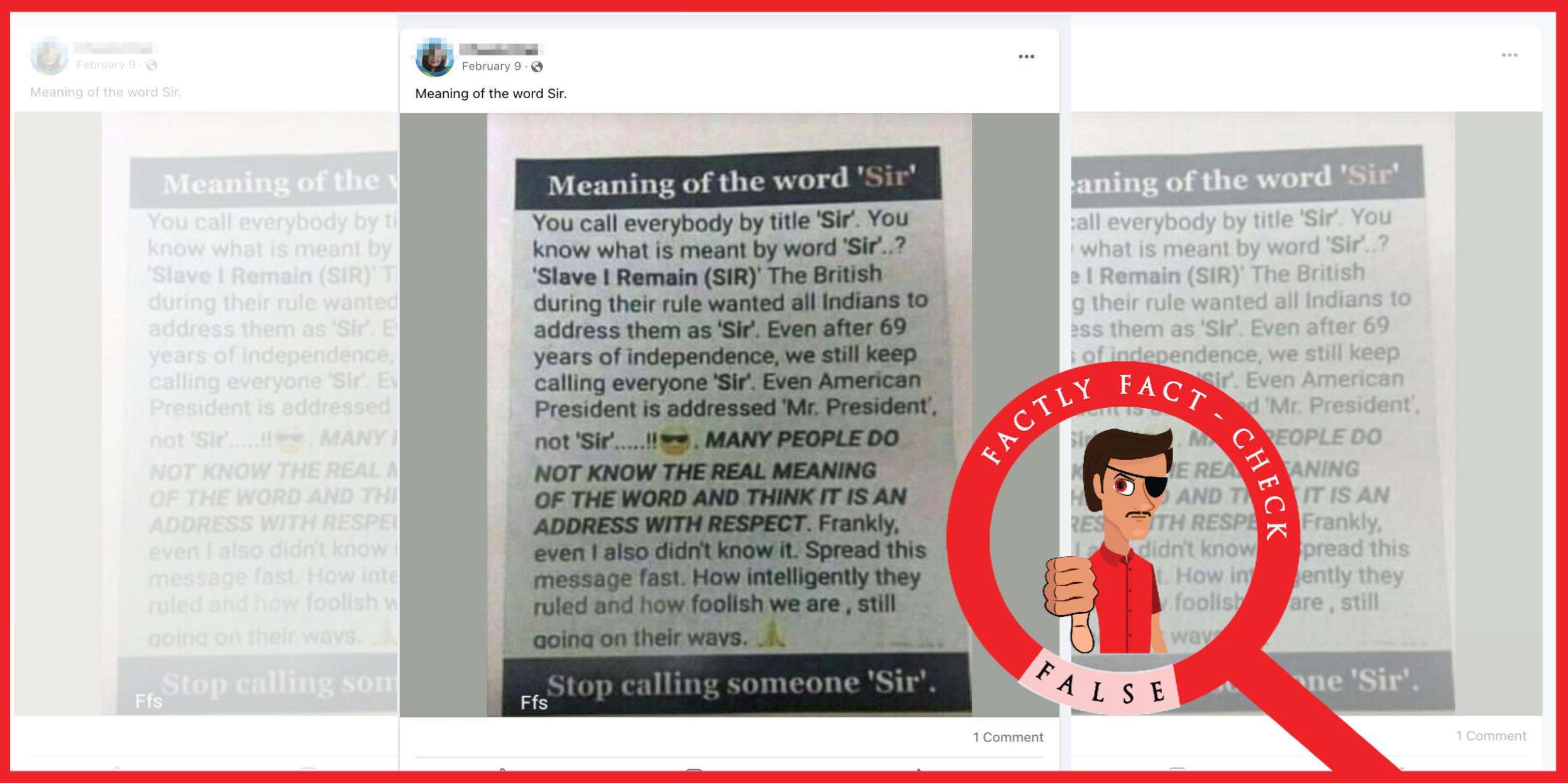
The English word SIR is an acronym for ‘Slave I remain’
Publisher’s rating: FALSE
The review addresses a social-media claim that “SIR” stands for “Slave I Remain,” supposedly because the British wanted Indians to address them that way during British rule. It treats the proposed expansion as an etymological claim and checks whether the word is an acronym, rather than investigating a particular historical document or episode of British rule. The article describes the claim as circulating on social media and gives the alleged colonial explanation as part of that claim.

Een boek van Nijntje met expliciete inhoud is gericht op kinderen.
Publisher’s rating: Het boek bestaat echt maar is voor volwassenen, niet voor kinderen. Het gaat om een Portugese parodie en heeft niets te maken met de echte Nijntje of haar auteur Dick Bruna.

1947க்கு பிறகு காஷ்மீர் திரையரங்குகளில் வெளியான முதல் படம் ஆர்ஆர்ஆர்.
Publisher’s rating: Mix

Pompeii Masturbator !!
Publisher’s rating: Satire
The review examines social media posts claiming that a preserved body found at the site of the Vesuvius eruption shows a man masturbating at the moment he died. It places the claim in the context of the eruption in 79 AD, which destroyed Pompeii and Herculaneum, and says the viral image was first published by the Pompeii Archaeological Park on Instagram in 2017. The park’s post did not identify the figure as masturbating; the interpretation arose from the body’s appearance and became the subject of memes and jokes. [S1]

रवीश कुमार ने यह भाषण एन.डी.टी.वी के अधिग्रहण होने के बाद दिया
Publisher’s rating: False

Un bouc, symbole satanique, était présent dans le cortège funèbre de la reine Elizabeth II.
Publisher’s rating: L’animal sur les photos est un bouc du nom de Shenkin. Il est la mascotte du 3ème bataillon du régiment royal gallois. Mais il ne faisait pas partie de la procession militaire escortant le cercueil d’Elizabeth II jusqu’au château de Windsor.
The claim concerns social-media posts alleging that a goat, presented as a satanic symbol, joined the funeral procession for Elizabeth II in London on 19 September 2022. The review identifies the animal in the circulating photographs as Shenkin IV, the mascot of the Royal Welsh’s 3rd Battalion, but says it did not accompany the procession. The regiment took part; the mascot stayed at home. [S1: “La mascotte du 3ème bataillon du régiment royal du Pays de Galle, le Royal Welsh, est un bouc depuis plusieurs siècles. Ce dernier a porté divers noms au fil du temps. La mascotte actuelle a été baptisée Shenkin IV.”; “Le Royal Welsh a bien participé au cortège funèbre de l’ancienne souveraine, décédée le 8 septembre 2022, mais Shenkin est resté à la maison.”] The review checks the photographs’ dates and settings against the funeral chronology. It identifies the marching-goat image as taken in Cardiff on 11 September, during events around the proclamation of Charles III—not at the funeral. At that point, Elizabeth’s coffin was still in Scotland. The other image, showing Prince Harry petting a goat, dates to 2014 and was taken at a film screening in London. The review notes that a wider version shows the film’s poster. [S1: “La première photo montre Shenkin marchant avec la fanfare du 3ème bataillon du Royal Welsh. Celle-ci a été prise le 11 septembre 2022 à Cardiff, au Pays de Galle. Ce défilé a eu lieu en marge de la proclamation du roi Charles III, pas pendant les funérailles d’Elizabeth II.”; “L’autre photo date de 2014. On y voit le prince Harry caresser le Shenkin de l’époque alors qu’il était venu assister à la projection d’un film à Londres. Sur une version plus large de la photo, l’affiche du film en question est clairement visible.”] The review says no goat appears in the procession: it describes the procession as about two kilometres long, with some 2,000 soldiers, and says horses were the only animals present. It also distinguishes Shenkin from Batisse, the mascot of a Canadian military unit whose members were among those taking part. [S1: “Aucun bouc ne peut être aperçu dans le cortège funèbre, qui mesurait environ deux kilomètres de long et comprenait quelque 2 000 soldats. Les seuls animaux présents dans la procession étaient des chevaux.”; “Mais là non plus, pas de bouc en vue.”]
RRR is the first movie to be played in Cinema theatres in Kashmir after 1947!
Publisher’s rating: Mix

Deze afbeelding laat zien dat The Simpsons de sterfdatum van koningin Elizabeth de II voorspelde.
Publisher’s rating: The Simpsons voorspelde in geen enkele aflevering de precieze datum van de dood van koningin Elizabeth II. De afbeelding die dit zou moeten bewijzen is gemanipuleerd.
ShahRukhKhan says, I am proud to be Muslim & Pakistani !!
Publisher’s rating: Fake
Queen Elizabeth's corgis are being prepared to be buried with her
Publisher’s rating: Satire

Simpsonlar, Kraliçe II. Elizabeth'in Ölümünü Önceden Bildi Mi?
Publisher’s rating: Yanlış
زنان و دختران ایران، به طور خودجوش حجاب را رعایت میکنند.
Publisher’s rating: شاخدار

Les Simpson avaient prédit la mort de la reine Elizabeth II.
Publisher’s rating: Si plusieurs prédictions des Simpson se sont en effet réalisées, celle sur la mort d’Elizabeth II n’en fait pas partie. Cet évènement n’est pas représenté dans la série.
The claim concerned posts saying The Simpsons had predicted Queen Elizabeth II’s death. The review identifies the episode frequently invoked in those posts as the fourth episode of season 15, “Homer rentre dans la reine,” first broadcast in 2003. It reports that Elizabeth II appears in the episode, but does not die there; the review says she also does not die in other episodes in which she appears. (S1: “L’épisode évoqué ces derniers jours sur les réseaux sociaux, dans lequel la série aurait soi-disant prédit la mort de la reine, est le 4ème de la saison 15, baptisé en français « Homer rentre dans la reine » et diffusé pour la première fois en 2003.”; “Contrairement à ce qui est avancé par certains, Elizabeth II ne meurt ni dans cet épisode, ni dans les autres épisodes où son personnage fait une apparition.”) The review distinguishes footage of the Queen appearing in the cartoon from the purported prediction. It says some posts used clips showing her, while another circulated an image purporting to show her Simpsons character in a coffin with 2022 as the death year. The review reports that the image was fabricated, citing the dpa team in the Netherlands. (S1: “Des publications sur Facebook présentent simplement des extraits montrant la reine dans Les Simpson (comme dans « Homer rentre dans la reine » ou « L’œil sur la ville »), tandis que d’autres partagent une capture d’écran censée dépeindre le personnage d’Elizabeth II dans un cercueil, avec l’année 2022 indiquée comme date de sa mort. Cette image a toutefois été fabriquée, comme l’a signalé l'équipe de la dpa aux Pays-Bas.”) The review places the claim against the actual chronology: Elizabeth II died on 8 September 2022, and says that event is not among the events depicted in the series. It contrasts The Simpsons claim with the 2019 BBC miniseries Years and Years, in which the Queen’s death was imagined. (S1: “Mais le décès le 8 septembre 2022 d’Elizabeth II ne figure pas dans cette liste.”; “Le décès d’Elizabeth II en 2022 a bel et bien été imaginé dans une série, mais il ne s'agit pas des Simpson. Cela est arrivé dans l'univers fictif de la mini-série d’anticipation Years and Years, diffusée en 2019 sur la BBC”)
Queen Elizabeth II. füttert in altem Video afrikanische Kinder wie Tiere.
Publisher’s rating: Falsch. Der Clip entstand vor der Geburt von Queen Elizabeth II.

Recent photo of King Charles-III wearing a wrongly buttoned coat after the death of his mother and late Queen Elizabeth-II
Publisher’s rating: MISLEADING
The post claimed that a photo showed King Charles III wearing a wrongly buttoned coat after the death of his mother, Queen Elizabeth II. FACTLY’s review found that the photo does show Charles with his coat buttoned incorrectly, but it was not taken after the Queen’s death. The review identifies it as a photograph from 1 November 2018, when Charles, then Prince of Wales, visited the Commonwealth War Graves Cemetery in Fajara, Gambia. To check the photo’s history, the review says it used reverse image search and found the same image on Getty Images, published on 1 November 2018. Getty’s caption described Charles and Camilla visiting the cemetery on that date. The review also reports finding the same image on Alamy and other news websites with similar descriptions, and says the photograph was credited to Reuters photojournalist Luc Gnago and AFP. The key distinction is therefore between what the image depicts and when it was taken: the coat was buttoned incorrectly, but the image dates to 2018, not to the period after Elizabeth II’s death. FACTLY also points to other Reuters images from the same ceremony in which Charles’s coat was correctly buttoned. Its conclusion is that presenting the old image as a recent post-bereavement photograph is misleading.

यह बुजुर्ग फिल्म ब्रम्हास्त्र के बारें में बात कर रहा है।
Publisher’s rating: False

ఆస్ట్రేలియా అసలు పేరు అస్త్రాలయ, రామాయణ మహాభారత కాలాల్లో అక్కడ అస్త్రాలు దాచేవారు కనుక ఆ పేరొచ్చింది
Publisher’s rating: FALSE

The Simpsons dizisinin Kraliçe II. Elizabeth’in ölüm tarihini önceden bildiği iddiası
Publisher’s rating: Yanlış