PeakMetrics / Fact Checks
Culture & entertainment fact checks
Explore claims publishers have checked about culture & entertainment. Read their original ratings and follow the evidence.
Search fact checks
Search by text or image3,169 published reviews in this topic

Claim: Gujarat picture being shared as Ancient war tool statues in Ayodhya road
Publisher’s rating: False
The claim concerned a photograph of large weapon-like statues at a road junction, shared as a new installation in Ayodhya. The review says a Facebook post by Vijaya Durai, published on December 2, 2020, described the scene as an Ayodhya landmark; it notes that others were also circulating the image as showing ancient war tools in Ayodhya. The investigation focused on whether the photograph was actually taken there. (“இந்த புகைப்படம் அயோத்தியில் எடுக்கப்பட்டதா என்று ஆய்வு செய்தோம்”; “இந்த பதிவை ஆன்மீக களஞ்சியம் என்ற ஃபேஸ்புக் பக்கத்தில் Vijaya Durai என்பவர் 2020 டிசம்பர் 2ம் தேதி பதிவிட்டுள்ளார்.”) Fact Crescendo reports using reverse-image search, then following a correction by a Twitter user who had initially attributed the image to Ayodhya. The correction said the image was from Gada Chowk in Vadodara. The review then searched for Vadodara and Gada Chowk/Circle and says it located the statues through Google Maps imagery, including a full-road view identified as Timber Market. (“படத்தை ரிவர்ஸ் இமேஜ் தேடலில் பதிவேற்றித் தேடினோம்”; “இந்த புகைப்படம் குஜராத் மாநிலம் வடோதராவில் எடுக்கப்பட்டது என்று கூறினாராம்”; “அந்த இடம் பற்றிய குறிப்பில் மிகப்பெரிய கதாயுதம் மற்றும் வில் அம்பு படத்தை சிலர் கூகுள் மேப்பில் பதிவேற்றம் செய்திருந்தனர்.”) The review also cites a photo-listing site that identified the image as taken in Vadodara, and says the statues were already there in 2016, rather than newly installed in Ayodhya. Taken together, its location checks and the image listing contradict the Ayodhya attribution: the photograph shows a Vadodara road junction, not an Ayodhya one. (“இந்த சிலை தற்போது அமைக்கப்பட்டது இல்லை என்பதும் 2016ம் ஆண்டில் இருந்தே இருப்பதும் தெரிகிறது”; “இந்த புகைப்படம் குஜராத் மாநிலம் வதோதராவில் எடுக்கப்பட்டது என்று குறிப்பிட்டிருந்தனர்.”)

Claim: Altered poster being shared on Rajinikanth
Publisher’s rating: False
The claim concerned an image presented as a poster put up by Rajinikanth’s fans in the Thiruvottiyur area. The image appeared to contain a phrase the review describes as “Pundapre Pundare,” which was used to mock Rajinikanth and his fans. The investigation says it examined whether that was the genuine poster, rather than merely whether the image was circulating. The review identifies the disputed wording as having been shared on social media and says fans also shared information about the poster there. The review’s central finding is that the circulated image had been altered. It distinguishes the genuine poster’s wording, “Sandapra Sandare,” from the altered version, “Pundapre Pundare,” and says the latter was deliberately substituted before the image was shared. Thus, the claim that the mocking phrase appeared on the fans’ actual poster is not supported by the review’s account: it attributes that phrase to an edited image, not to the original poster. The review also gives context for the wording on the genuine poster. It says the phrase is also used in devotional literature as “Sandap Prasandan,” and describes its sense as that of a fearsome person who cannot be challenged. It adds that the phrase is used by people who worship Shiva, and says that was the meaning intended by the fans. The excerpt does not describe a technical image-analysis method or provide further documentation of how the original poster was authenticated, so the finding here is limited to the explanation and evidence stated in the review.

ರಾಜಸ್ಥಾನದ ಜೋಧ್ಪುರದಲ್ಲಿ ಬೆಳಕಿನ ಕಾರಂಜಿ ಪ್ರದರ್ಶನದ ವಿಡಿಯೋ
Publisher’s rating: FALSE


ड्वेन जॉनसन फाउंडेशन की ओर से 17400 डॉलर की लॉटरी
Publisher’s rating: FALSE

neta de Agnaldo Rayol cantando, veja que coisa linda….
Publisher’s rating: Falso
Fernando Pérez y Jorge Perugorría fueron convocados por el MINCULT al diálogo con jóvenes y artistas
Publisher’s rating: Falsa
El ministro de cultura Alpidio Alonso participó en el encuentro con los artistas
Publisher’s rating: Falsa

Rajasthan people celebrating Diwali festival by firing guns and cannon
Publisher’s rating: FALSE
The post presented footage of people firing guns and cannons as Diwali celebrations in Rajasthan, supposedly in response to the state government’s ban on firecrackers. FACTLY’s investigation identifies the footage as showing Jabri Gair, a tradition celebrated in Menar village, rather than Diwali festivities. The review explains that Jabri Gair takes place on the day after Holi. It describes the event as a 400-year-old tradition in which people fire guns and cannons to commemorate Menar Brahmins’ heroism and valour in defeating the Mughals during the period of Rana Udai Singh. The review says the event is unrelated to the government’s Diwali firecracker ban. To identify the footage, FACTLY reports conducting reverse image searches on screenshots from the video. It found similar visuals in a Facebook video posted on 12 March 2020, whose user identified them as Menar’s Jabri Gair celebrations, and in a video from the Udaipur beats YouTube channel. FACTLY also cites Times of India reporting about the event at Menar. These clues connect the footage to an established, non-Diwali event and contradict the post’s description of it as a response to the Diwali ban.


Light show at Jodhpur city in Rajasthan
Publisher’s rating: FALSE
The claim concerned a social-media video presented as a light-show exhibition in Jodhpur, Rajasthan. FACTLY concluded that the video did not show a Jodhpur event: it was a collage of special-effects videos created by Chinese special-effects designer Long Yichen. The review describes identifying a logo that repeatedly appears in the video and translating its words as “special effects Long Yichen.” It then says reverse-image searches using those words found similar visuals on Long Yichen’s official channel on the Chinese video site ixigua, including the same visuals on collection thumbnails. FACTLY’s account therefore ties the circulating video to Long Yichen’s effects collection rather than to a light show in Jodhpur.

రాజస్తాన్ లోని జోధ్పూర్ లో నిర్వహించిన లైట్ షో కి సంబంధించిన వీడియో
Publisher’s rating: FALSE
Video of a light show in Jodhpur (Rajasthan)
Publisher’s rating: FALSE
The claim concerns a video presented as showing a light show in Jodhpur, Rajasthan. FACTLY’s review says the video was not filmed in India and identifies it instead with a show at Shuangqing Bay Park in Fuyang, Anhui, China. That directly contradicts the claimed location; the review concludes the Jodhpur attribution is false.

IMAGEN DE ANTONIA BARRA EN PUBLICIDAD DE FALABELLA
Publisher’s rating: Falso
In seinem berühmten Buch «1984» beschreibt der britische Schriftsteller George Orwell eine imaginäre totalitäre Gesellschaft. Regelmäßig werden dem Buch Formulierungen zugeschrieben, mit denen Vergleiche zur Situation während der Coronapandemie konstruiert werden. Derzeit kursiert etwa auf Facebook (hier archiviert): «Alles außer Arbeit ist verboten: Spazierengehen auf den Straßen und Plätzen ist verboten. Spaß haben, singen und tanzen ist verboten. Menschen treffen und zusammenkommen ist verboten.»
Publisher’s rating: Diese Formulierung kommt nicht in «1984» vor.
The claim concerns a Facebook post that attributes to George Orwell’s novel *1984* a passage saying that activities such as walking, singing, dancing and meeting people are forbidden. The Deutsche Presse-Agentur (dpa) checked whether that wording appears in the book. Its review reports that searches of the online English original did not find the alleged passage, and that the words “fun,” “dancing” and “getting together” were also absent. The word “forbidden” appeared five times, but in different contexts. The review also describes searches of German online versions using “Spaß,” “Tanzen” and “ist verboten”; those searches produced no evidence of the alleged quotation. This directly tests the attribution across English and German text, rather than treating the novel’s general portrayal of restrictions on citizens’ freedoms as proof that the circulating wording is authentic. As additional context, the review cites Orwell biographer Bernard Crick, who characterized the book as satire rather than a prediction. That comment concerns how to understand the novel; the review’s textual searches are the evidence it gives for assessing whether this particular passage is in the book.
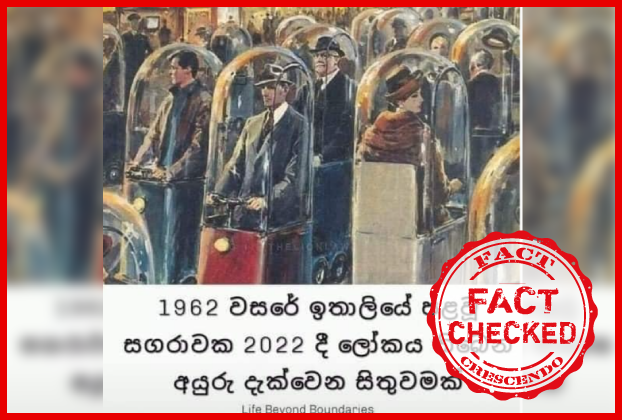
1962 වසරේ ඉතාලියේ පළවු සඟරාවක 2022 දී ලෝකය තිබෙන අයුරු දක්වා තිබු සිතුවමක් ද?
Publisher’s rating: Partly False
The image was presented on social media as a 1962 Italian magazine’s depiction of the world in 2022. The review says it traced the image to Walter Molino, an Italian cartoonist, and to the back cover of the weekly paper *Domenica del Corriere*, published on 16 December 1962. Its subject was not a forecast of how the world would look in 2022: it illustrated “La Singoletta,” a proposed form of individual transport intended to address future urban traffic problems. The review reports that it used a reverse-image search to investigate the image’s provenance. It describes the original illustration’s caption as asking, in Italian, “Will we have to go around the cities like this?” The accompanying proposal was for small, single-seat vehicles as an alternative to large cars, rather than a prediction about the appearance of the world in a particular year. The misleading interpretation also connected the enclosed vehicles to COVID-19 social distancing. The review says the illustration had circulated with that implication, but its account of the original publication places it in the context of transport and city traffic. It concludes that the image itself did not state that the world would look this way in 2022.