PeakMetrics / Fact Checks
War & conflict fact checks
Explore claims publishers have checked about war & conflict. Read their original ratings and follow the evidence.
Search fact checks
Search by text or image5,848 published reviews in this topic

Defective M4 rifles Aquino III bought for the armed forces when he was prexy discovered
Publisher’s rating: False: The rifles were repaired by supplier Remington Arms and distributed
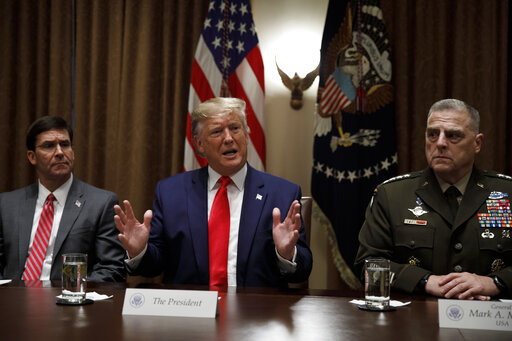
"The United States was supposed to be in Syria for 30 days, that was many years ago."
Publisher’s rating: No early timeline
Says "thousands" of captured ISIS fighters are "mostly from Europe."
Publisher’s rating: Mostly from Syria, Iraq
"When I took over our military, we didn't have ammunition. I was told by a top general — maybe the top of them all — ‘Sir, I'm sorry. Sir, we don't have ammunition.’ "
Publisher’s rating: Unproven anecdote
"When I arrived in Washington, ISIS was running rampant in the area. We quickly defeated 100% of the ISIS Caliphate."
Publisher’s rating: Misleads


Arderéis como en el 36
Publisher’s rating: Falso
The review addresses the allegation that Rita Maestre and other participants shouted “Arderéis como en el 36” during a disturbance at a chapel on the Complutense University’s Somosaguas campus in January 2011. The phrase resurfaced in social-media posts, including a 2016 publication that named Maestre among those who allegedly said it. The review explains that the claim also became a subject of public debate after Isabel Díaz de Ayuso referred to the phrase during an Assembly of Madrid plenary session on October 3; Pablo Casado and José Luis Martínez-Almeida said Ayuso was referring to Maestre. The review says the courts did not establish that the phrase was spoken by any participant, or by Maestre specifically. (S1: “Vuelve a compartirse una publicación del año 2016 titulada”; “ni el Juzgado Penal número 6 de Madrid ni la Audiencia Provincial de la Comunidad”; “durante la primera sesión plenaria en la Asamblea de Madrid el pasado 3 de octubre”) For its account of the evidence, the review describes the 2016 trial and the judgment’s treatment of witness testimony. Of five witnesses who were in or entered the chapel during the disturbance, only one spontaneously said they had heard the disputed phrase. The judge held that only expressions supported consistently and uniformly by witnesses could be treated as proven; because accounts of this phrase were not uniform, it was not established. The review distinguishes that conclusion from other expressions it says were proven through video and witness statements. Maestre was initially convicted, then acquitted on appeal; the review says the appeal court found that the required act of profanation had not occurred. (S1: “De ellos, la sentencia recoge que solo uno dice «de forma espontánea» haber oído «arderéis como en el 36»”; “no consideró acreditada esta expresión”; “un vídeo del asalto y las declaraciones testificales permitieron probar estas otras”)

जिसके सिर पर बुलेट लगी है वह भारतीय आर्मी का जवान है
Publisher’s rating: FALSE

Indian forces killed 95,238 Kashmiris since 1989.
Publisher’s rating: FALSE
The review examined a social-media post asserting that Indian forces had killed 95,238 Kashmiris since January 1989. To assess the figure, it compared two published sets of fatality counts: figures in the Indian Ministry of Home Affairs’ 2018–19 annual report and year-wise figures on the South Asia Terrorism Portal (SATP). The review reports that the Ministry’s figures cover civilian and security-force deaths since militancy began in 1990, while SATP’s total covers people killed in terrorism-related activity in Jammu and Kashmir from 1988 to 2018. The Ministry report, as quoted in the review, records 14,024 civilian deaths and 5,273 security-force personnel deaths up to 31 March 2019. SATP’s reported total is 45,298 deaths: 14,125 civilians, 5,236 security-force personnel, and 25,715 people classified as terrorists. Both sets of figures are far below 95,238, but they are not equivalent measures: SATP’s total includes multiple categories of people killed in terrorism-related activity, rather than counting only Kashmiris killed by Indian forces. The review therefore uses the figures to challenge the claimed scale, not to establish that all deaths in those broader totals were caused by Indian forces. The review also traced the 95,238 figure in the linked article to Kashmir Media Service. It says it contacted that website to ask for the figure’s source and collection methodology, and stated that it would update its article if it received a response. The excerpt does not report receiving one, so it does not establish how the original figure was compiled.
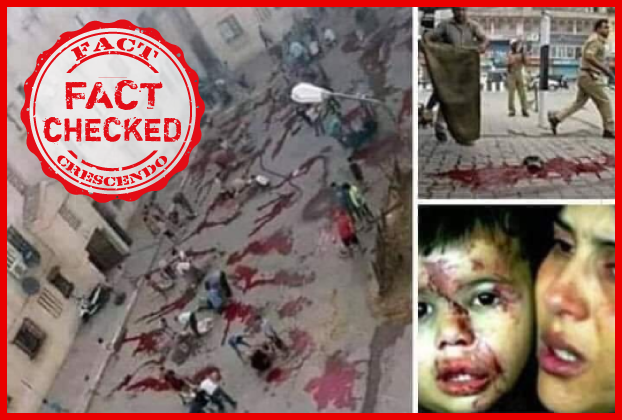
Claim: Bloody pictures of Kashmir violence
Publisher’s rating: FALSE
The review investigated a four-photo collage shared with a message asking that Kashmiris be left alone. The post’s wording implied that the images showed recent events in Kashmir after the region’s special status was removed, although the review notes that neither the images nor the accompanying caption explicitly said they were taken there. It traced the collage to a Facebook post published on 22 September 2019 and checked the four images individually. For the first image, which appeared to show a street covered in blood and bodies, the review enlarged the picture and concluded that it showed livestock being killed, not people. It says the earliest matching post it found was in Arabic and dated 14 August 2019; the translated text did not mention Kashmir. For the second image, showing a uniformed officer approaching blood on a road, the review used reverse-image search and connected it to a 2016 attack in Kashmir—not to a recent event. The review reports that two security personnel were killed in that attack. The other two images also came from different events and places: the injured child was identified as being from Gaza after a 2008 Israeli attack, while the image of a boy wiping a crying woman’s tears appeared in a Telegraph report dated 13 July 2018. That report described a woman grieving Khalid, who had been shot dead, and the boy wiping her tears at his funeral. Taken together, the review’s image searches and identified earlier uses show that the collage combined images from unrelated contexts and presented them as evidence of recent violence in Kashmir.
مجروحان داعش در بیمارستانهای اسرائیل درمان میشدند.
Publisher’s rating: نیمهدرست
اسرائیل از تروریستهای داعش حمایت میکرد و به آنها سلاح میداد.
Publisher’s rating: نادرست

face-off between Indian and Chinese soldiers on September 11, 2019.
Publisher’s rating: FALSE
The claim concerns a video shared as showing a face-off between Indian and Chinese soldiers on September 11, 2019. FACTLY’s review says it examined whether the video was connected to that 2019 encounter and concluded that it was instead footage of a clash on August 15, 2017, near Pangong Lake in Ladakh. The review therefore distinguishes the date and event depicted in the video from the more recent face-off in whose context it was shared. To trace the footage, the review reports searching YouTube for “India and China scuffle.” It found a video published by The Times of India on August 19, 2017, showing a fight between Indian and Chinese soldiers across Pangong Lake. FACTLY says that, on close observation, visuals from the social-media post matched a portion of that video: specifically, the segment from 45 to 48 seconds in its bottom half. This visual match is the review’s stated basis for identifying the circulated clip as selected footage from the 2017 video, rather than footage of the September 2019 face-off. The review also reports finding a Hindustan Times article that described a scuffle on August 15, 2017, near Pangong Lake and shared the same video. Taken together, the reported comparison with the 2017 Times of India video and the cited 2017 coverage support the conclusion that the post misrepresented older footage as showing the 2019 event.
"I’ll withhold again and I’ll continue to withhold until such time as Europe and other nations contribute to Ukraine because they’re not doing it. Just the United States. We’re putting up the bulk of the money."
Publisher’s rating: This is exaggerated.
Claim video claiming army beating Kashmiri Muslim women in India
Publisher’s rating: FALSE
La Policía está en alerta máxima por riesgo de atentado terrorista en Sevilla
Publisher’s rating: Falso
The claim concerned voice messages circulating in Sevilla that said police had been privately warned of an imminent attack. Newtral reports that a purported police officer’s recording claimed an attack was “posible e inminente” in the city, but says emergency services had denied the alleged threat. Sevilla’s Local Police also denied a risk of attack in a social-media post, according to the review. The review identifies a key source of confusion: Spain’s existing national antiterrorism posture was Level IV Reinforced, but it was not a new Sevilla-specific warning. Emergency services said that level had been maintained without changes since 2 August 2018. The recording and other messages therefore did not establish that police were on heightened alert because of a newly identified imminent attack. Newtral also notes that some messages circulated alongside a genuine National Police press release about the arrest in Algeciras of a person who had stored manuals for carrying out attacks. The review distinguishes that real arrest from the unsubstantiated warning about Sevilla; it places Algeciras about 180 kilometres from the Andalusian capital. It advises relying on official sources and not forwarding the messages.

Indian security forces beating and torturing Muslims in Kashmir
Publisher’s rating: FALSE
The claim concerns a video said to show Indian security forces beating and torturing Muslims in Kashmir. FACTLY reports that the footage instead came from Pakistan. Its review says the Sindh Province Police described the video as fake and said it had been designed to damage the police’s reputation; the review therefore rejects the identification of the footage as an incident in Kashmir. The review describes how it traced the clip: it used InVid to extract keyframes, then searched those frames with Yandex. A search result led to a YouTube upload dated May 6, 2019, titled “Sindh Police attack on innocent Women at Sindh | Pakistan.” The review also says it found a Sindh Police tweet addressing the same clip, which characterized the video as fake and intended to malign Sindh and Jamshoro Police. These details support the review’s conclusion that the video was misrepresented as showing Indian forces in Kashmir.

Claim: Picture of Indian Army torturing Kashmir people
Publisher’s rating: Fact Crescendo Rating: False
Vídeo de una batería antiaérea derribando misiles en Israel
Publisher’s rating: Falso
The claim concerned a video shared on Facebook as showing an antiaircraft battery shooting down missiles in Israel. The review describes the footage as showing what appear to be two antiaircraft guns firing at objects in the night sky, and says the accompanying post presented it as “Batería antiaérea derribando misiles en Israel.” The review’s investigation found that the recording was not footage of a real interception: it came from the video game Arma 3. To trace the footage, the review says it used reverse-image searches on several frames and found a YouTube video uploaded by a Japanese user. Its description identified the scene as an Arma 3 scenario involving a Phalanx system and a Tomahawk missile. The review also reports that Bohemia Interactive, which markets Arma 3, confirmed that the images were recorded by one of its players. The company qualified that the scene appeared to use a modified version of the game and a player-created scenario, rather than the standard game experience. The review notes an additional on-screen indication that the clip was fictional: at the end, Japanese text says the video is fiction and that its characters, names and events have no connection to reality. Together, the traced game-video provenance, the company’s confirmation, and the disclaimer directly contradict the post’s presentation of the clip as real events in Israel.