PeakMetrics / Fact Checks
War & conflict fact checks
Explore claims publishers have checked about war & conflict. Read their original ratings and follow the evidence.
Search fact checks
Search by text or image5,848 published reviews in this topic

Ein Video zeigt Szenen am Schwedenplatz zur Zeit des Anschlags.
Publisher’s rating: Das ist richtig.
The claim concerns a video said to show Schwedenplatz during the Vienna attack. The review treats this as one of several viral videos to check, separately from other footage in the article—including videos from Barcelona and older footage of a car fire in Vienna. Its finding for this specific clip is that it shows the claimed place and time.

Photo of an injured Indian army soldier
Publisher’s rating: FALSE
The claim concerns a photo shared as showing an injured Indian Army soldier. FACTLY’s review identifies the pictured man as Russian special forces officer Maxim Razumovsky, not an Indian soldier. It says he died in 2004 while rescuing schoolchildren from the terrorist-seized school in Beslan, and that the photo was taken during that rescue operation. To investigate the image, the review says it conducted a reverse image search and found the same or a similar photo in Russian news coverage of the Beslan attack’s 12th anniversary. That coverage described the image as taken during the rescue mission; another Russian news site identified the injured soldier as Razumovsky. The review also reports finding social-media posts naming him and an article that identified the injured man as Maxim. Taken together, the image’s reported provenance and the identification in the Russian coverage contradict the claim that the man shown was an Indian soldier. The review concludes that the photo depicts a Russian soldier and that its portrayal as an injured Indian Army soldier is false.
Nach dem Terroranschlag in Wien vom 2. November haben viele Länder ihre Anteilnahme bekundet. Am Tag nach dem Angriff kursierte im Internet auch ein Foto vom Eiffelturm, der in den Farben Rot-Weiß-Rot leuchtete. War das ein französisches Zeichen der Solidarität mit den Opfern in Österreich?
Publisher’s rating: Das Foto ist nicht aktuell. Es zeigt nicht den Eiffelturm nach dem Terrorangriff in Wien.
The claim concerns a photo of the Eiffel Tower glowing red, white and red that circulated online the day after the November 2, 2020 attack in Vienna. The review traced the image’s circulation: journalist Isabella Klausnitzer posted it on November 3, and the page “Paris France Official” had also shared it on Instagram and Facebook as a gesture of solidarity with the victims. Those posts, however, did not say that the image was old. The review reports that a spokesperson for Austrian Chancellor Sebastian Kurz confirmed the photo was fake. The review checked a visible feature of the tower against the timing of the claimed display. Webcam images showed that parts of the Eiffel Tower’s upper section were covered at the relevant time, but that covering was absent from the circulating photo. This mismatch indicates that the image did not show the tower as it appeared after the Vienna attack. The review also gives the image a likely earlier context. After the Kleine Zeitung initially picked up the photo in a live blog, it added a correction saying the image was probably from the 2016 European Football Championship in France. The review notes that fans could vote on which participating teams’ national colors would illuminate the tower, and cites a 2016 report about the tower being lit in Turkish colors as an example. Thus, the fact that the old image showed red, white and red did not establish that France had lit the tower in response to the Vienna attack.

Video of Vienna police chasing down the terrorist who carried out the recent Vienna terror attack
Publisher’s rating: FALSE
The claim concerned a video of police chasing a man, shared as footage of Vienna police apprehending the perpetrator of the recent terror attack. FACTLY’s review identifies the video as showing a different event: clashes between police and demonstrators in Barcelona, Spain, over newly imposed COVID-19 lockdown restrictions. It says the footage has no connection to the Vienna attack. The review describes how it traced the clip. A reverse-image search of screenshots from the post led to a news agency’s tweet attributing the same video to clashes in Barcelona. Using that lead, the reviewers searched for relevant reporting and found an article dated November 2, 2020, carrying similar footage and describing the Barcelona clashes. The review also points to additional videos and news articles about that incident. This evidence addresses the video’s provenance, rather than identifying the man in the footage as the Vienna attacker: the matching clip was attributed to police-demonstrator clashes in Barcelona over COVID-19 restrictions. The review concludes that the video does not show Vienna police apprehending the attacker and that the claim misrepresents footage from a separate event.
Cette image présente les camarades des enfants tués à Kumba qui portent le cercueil de l'une des victimes
Publisher’s rating: False

IAF ने बालाकोट एयरस्ट्राइक को लेकर पाकिस्तान का मजाक उड़ाया
Publisher’s rating: FALSE

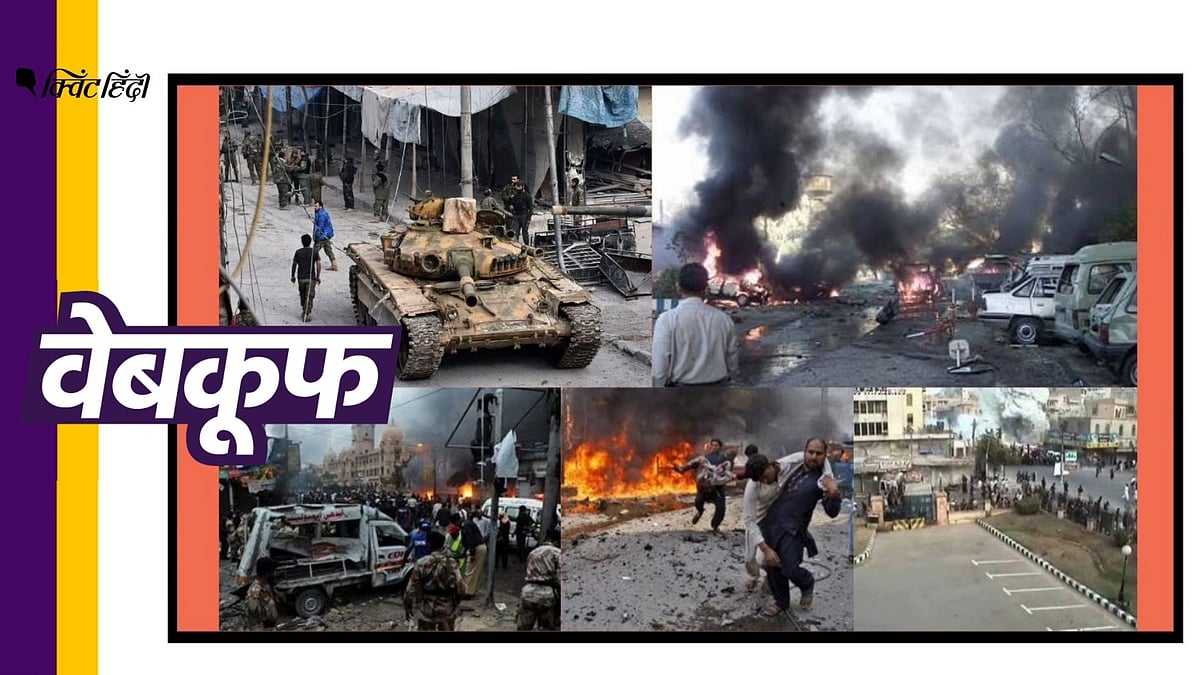
Civil war broke out in Pakistan. Heavy clash between army and police.
Publisher’s rating: Fake
Video yang diklaim sebagai video warga Iran yang sedang menonton perang Armenia dan Azerbaijan
Publisher’s rating: Keliru

Photos show army tanks deployed on Karachi streets
Publisher’s rating: FALSE
The claim concerns two photos presented as evidence that army tanks had been deployed on Karachi streets amid political and police-versus-army tensions in Pakistan. FACTLY’s review traced each image to a different location: it found that the first photo showed tanks in Taiwan and the second was from Aleppo, Syria. Neither image therefore showed tanks on Karachi streets. For the first photo, the review reports that a Google reverse-image search found the same image in a Taiwan News article about tanks in northeastern Taiwan. It also located an uncropped version in The Economist, whose description placed the photo in Yuanshan Township, Taiwan; Google Street View of the same location provided another point of comparison. For the second photo, FACTLY found the image in a 2016 CNN article about Aleppo and says the caption identified eastern Aleppo, Syria. It also found a similar image from the same location on AP Images. The review separately addressed a claim in the Facebook post that Sindh policemen had killed five army personnel. It reports that ANI covered deaths among personnel in clashes between Karachi Police and the Pakistan Army, but notes that the specific reports of killings and casualty figures circulating online were not officially confirmed at the time. This separate, qualified account does not change the photo evidence: the two images were identified as showing places outside Pakistan.

"They have more people there now, by the way, than when we left in Afghanistan."
Publisher’s rating: False. There are fewer US personnel in Afghanistan now than when Mr Obama left office.

A "whistleblower" claims to have information to prove that a "body double" of Osama Bin Laden was killed by American troops in Pakistan, rather than the real Al Qaeda leader.
Publisher’s rating: The claim is false. The accusations prompted fury from a member of the elite Navy Seal unit who took part in the mission. He totally rejected the theory, telling CNN it was "trampling on the graves of some of the best heroes I have ever personally worked with".

Explosion video of Indian test missile that failed
Publisher’s rating: FALSE
The claim concerns a video of a rocket exploding shortly after launch, shared as footage of an Indian test missile failure. FACTLY’s review concludes that the video instead shows a Russian Proto-M rocket explosion in Kazakhstan in 2013, and says the footage is not related to India. To investigate, the review describes reverse image searches of screenshots from the video. It reports finding similar visuals in YouTube videos posted on 7 July 2013, whose descriptions identified a Russian Proto-M launch failure. FACTLY also found matching images in an Electronic Products article, which described the event as a Proto-M rocket explosion at a spaceport in Kazakhstan. The review says the rocket, carrying three navigation satellites, broke apart and fell back to Earth at Baikonur Cosmodrome; it attributes the explosion to a human error involving sensors installed upside down. The review distinguishes this old footage from a separate Indian missile-related event: on 5 October 2020, DRDO successfully tested SMART, described as a supersonic missile-assisted release of a torpedo. That test does not establish that the circulating explosion video is Indian footage; the review’s image matches and earlier video descriptions connect it to the Russian Proto-M incident.
Pesan telak Kopassus untuk PKI, bahwa mereka siap menghancurkan PKI meski berada di balik partai politik
Publisher’s rating: Keliru
ایران در زمان جنگ در یک عملیات ۷۰ و در کل جنگ ۶۵۲ فروند جنگنده عراقی را منهدم کرد.
Publisher’s rating: نادرست

Il faut définir comme arme par destination les feux d’artifices et mortiers
Publisher’s rating: Les mortiers d’artifice sont déjà considérés comme des « armes par destination » au sens du code pénal
The review examines a proposal made by Interior Minister Gérald Darmanin after an attack on the police station in Champigny-sur-Marne. It says the attack took place on Saturday, 10 October, and involved fireworks mortars. Darmanin called for the National Assembly to define fireworks and mortars as weapons by destination, arguing that they could injure or kill and should be penalized. The review’s central point is that, as used in this attack, the mortars already fell within that legal category; it argues that a new law was unnecessary. [S1: “Samedi 10 octobre, le ministre de l’Intérieur Gérald Darmanin s’est exprimé à la suite de l’attaque du commissariat de Champigny-sur-Marne. Cette attaque a été réalisée au moyen, notamment, de mortiers d’artifice.”; “Le ministre a alors exprimé son souhait de voir l’Assemblée nationale définir comme « arme par destination » les feux d’artifices et mortiers”] To explain that conclusion, the article distinguishes an object designed to kill or injure from another object that can be treated as a weapon because of how it is used or intended to be used. It points to Article 132-75 of the Penal Code: the second category covers another dangerous object when used, or intended by its carrier to be used, to kill, injure, or threaten. The review says the mortars used at the station met that test because they were used with the purpose of killing, injuring, or threatening the officers inside. [S1: “D’une part, l’arme par nature, définie par l’article 132-75 alinéa 1 du code pénal comme « tout objet conçu pour tuer ou blesser ».”; “Ce second texte prévoit que « tout autre objet susceptible de présenter un danger pour les personnes est assimilé à une arme dès lors qu’il est utilisé pour tuer, blesser ou menacer ou qu’il est destiné, par celui qui en est porteur, à tuer, blesser ou menacer ».”; “ils ont manifestement été utilisés dans le but de « tuer, blesser ou menacer » les forces de l’ordre repliées dans le commissariat.”] The article further argues that the law’s broad wording avoids needing a legislated list of objects that could be repurposed as weapons. It concludes that those responsible could already face prosecution under existing provisions on violence, with weapon use treated as an aggravating circumstance. [S1: “La formule « tout autre objet » évite donc au législateur d’avoir à dresser une liste aussi fastidieuse qu’inutile des différents objets qui, détournés de leur destination normale, pourraient être « utilisés pour tuer, blesser ou menacer ».”; “les auteurs de ces agressions violentes peuvent déjà être poursuivis, a minima, sur le fondement de textes qui répriment les actes de violence, et érigent en circonstance aggravantes l’usage d’une arme.”]
பிரியங்கா கட்டி ஆறுதல் சொன்னது பாதிக்கப்பட்ட பெண்ணின் வீட்டில் சட்ட விரோதமாக தங்கி இருந்த நக்சல் என அம்பலம்
Publisher’s rating: Fake