
Yandex Strikes: No Notable Drop in Social Bot Activity
PeakMetrics finds no notable drop in social bot activity after the Yandex strikes, highlighting the gap between network traffic and social media behavior.
Published
PeakMetrics examined bot activity, Russia-aligned narratives, and the German AfD conversation after strikes on Yandex data centers. The analysis found no evidence of the collapse of social media bots suggested by viral claims.
After Ukrainian strikes disrupted Russian technology company Yandex’s data centers in October, conversation pointed to a supposed sharp decline in automated traffic from Yandex’s network. Some coverage and social posts interpreted that decline as evidence that Russian propaganda bots had gone offline. Notably, Ukrainian President Volodymyr Zelensky claimed there was "less hate, less division and fewer provocations" online due to the strike’s effects on Russian social media bot operations.
PeakMetrics tested whether that apparent disruption showed up in the social conversations it monitors.
PeakMetrics found no notable decline in bot posting, account presence or reach in the monitored sample. Activity across most monitored topics stayed within its usual Sunday range. Replies to accounts in the PeakMetrics’s monitored Russian state and amplifier network were higher than on any of the nine previous Sundays measured. While social media claimed right-wing bots had disappeared from the German AfD conversation, PeakMetrics found these bots continued to operate at typical levels.
Cloudflare data shows a drop in automated activity from Yandex networks, which one article described as a drop in bots. However, automated web traffic and social media bot activity are different measurements. A sharp decline in one does not establish a decline in the other.
Most monitored conversations stayed within their normal range
To account for quieter weekend automated activity, PeakMetrics compared Sunday, October 11, with previous Sundays. The broader analysis covered 20 monitored topic sets across four accounts, including healthcare, voting rights, Democratic politicians and geopolitical issues.
Eighteen of the 20 topic sets stayed within their normal Sunday range.
The two exceptions, Voting Rights and Healthcare, had lower overall bot presence. But within politically divisive discussions in those same topic sets, which Russian bots often propagate, bot presence increased. That pattern does not support a broad disappearance of bots from the arguments they were participating in.
PeakMetrics also examined a monitored Russian state and amplifier network. Flagged-account activity on October 11 reached 95% of the median of three prior Sundays. Those earlier Sundays ranged from 95% to 110% of that median, putting October 11 within the observed spread.
Replies to accounts PeakMetrics has identified as Russian-aligned reached 184% of the prior-Sunday median, the highest level across all ten Sundays measured and 18% above the busiest earlier Sunday. Those replies are a measure of engagement around the accounts, not proof that every reply came from a bot. They do show that the surrounding conversation had not gone quiet.
Pro-Russia content lost share without falling outside its usual volume range
In the Russia-Ukraine topic set, content favorable to Russia reached 73% of the prior-Sunday median on October 11. Though lower than the median, another recent Sunday also reached the same level.
Bot-flagged content favorable to Russia, meanwhile, reached 124% of its median.
Looking only at share would tell a different story. Favorable content fell to 1.3% of the on-topic conversation, below the previous Sunday low of 2.6%. But the total on-topic conversation more than doubled relative to its median, while neutral war coverage nearly tripled.
Pro-Russia content therefore occupied a smaller portion of a much larger conversation. Its volume remained within the observed Sunday range.
For analysts and communications teams, this is a useful distinction. A narrative can lose share because other coverage expands. That does not necessarily mean the accounts promoting it have stopped posting.
Across five U.S. political topic sets, content attacking institutions or inflaming group conflict also stayed within its usual ranges for both volume and share.
The AfD conversation did not disappear
Claims about Germany’s far-right Alternative für Deutschland party, or AfD, offered another test. Online posts suggested that its supporters had vanished from X after the strikes.
PeakMetrics’ German-language analysis did not support that claim.
- Conversation volume reached 104% of the prior-Sunday median. Discussion was slightly above typical levels.
- Accounts flagged using posting frequency represented 11.1% of posters. That compared with a prior median of 11.9% and an observed range of 10.7% to 13.7%.
- Estimated pro-AfD content volume stayed within its ordinary Sunday range.
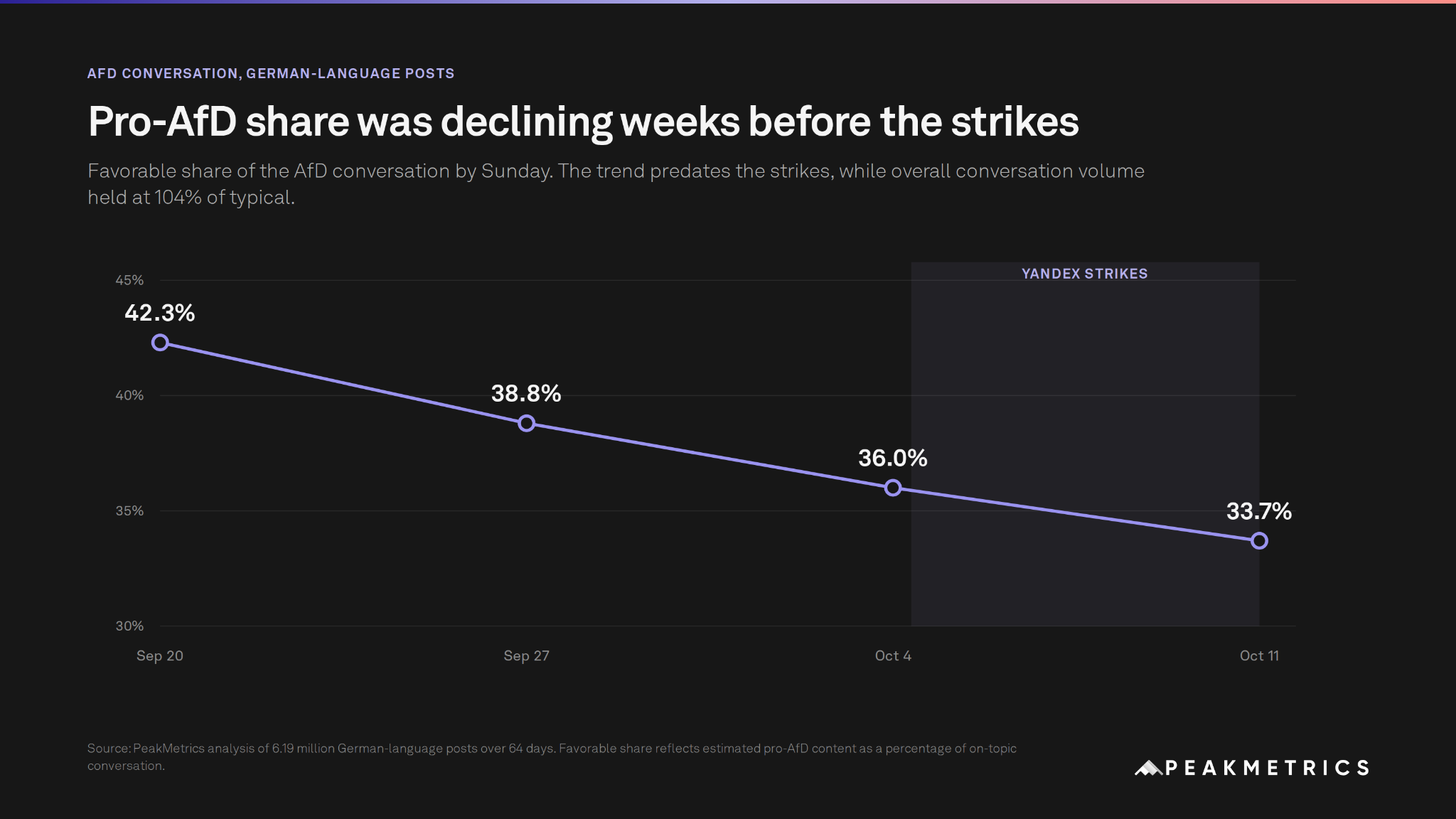
Favorable share did decline, reaching 33.7%. But that decline had begun weeks earlier: across Sundays from September 20 through October 11, favorable share moved from 42.3% to 38.8%, then 36.0% and 33.7%. The trend predated the strikes.
Flagged accounts were also more favorable toward AfD than other accounts on October 11: 38.1% versus 33.1%. The flagged sample was small, so that difference is suggestive rather than conclusive. It does not provide strong evidence that pro-AfD automation disappeared.
Posting frequency is an automation indicator, not a determination of who operates an account. These findings test the claim of a sudden disappearance within the AfD conversation; they do not establish Russian attribution for individual accounts.
Reach showed no corresponding collapse
PeakMetrics also compared ten accounts that tend to attract Russian amplification with five large news accounts used as a reference group.
That comparison helps account for a basic challenge with views: older posts have had more time to accumulate them. Comparing both groups over the same periods helps reduce that distortion, although it does not eliminate every difference between the groups.
The monitored accounts typically attracted about four times the views of the news reference group. On October 11, that ratio was about five times.
RT’s X account also recorded average impressions per post within its prior range. These checks provided no evidence of a corresponding collapse in reach.
What the Yandex traffic drop actually shows
Cloudflare’s automated-traffic measurements concern web requests. Bots in that context can include search crawlers and other software performing routine tasks. They are not interchangeable with social accounts posting or amplifying political narratives.
The traffic decline showed disruption to Yandex’s automated web activity. On its own, it could not establish that Russian influence operations had stopped.
The analysis cannot rule out disruption to individual operations or infrastructure outside the sample. It does show that the social activity PeakMetrics examined did not reflect the broad collapse described online.
For communications teams, the practical lesson is to check what a dramatic metric actually measures. Before treating a traffic drop as evidence that a narrative threat has receded, examine the relevant accounts, their output, the content they amplify and the reach they retain. Compare equivalent days, and consider volume alongside share.
In the conversations PeakMetrics monitored, the claimed shutdown of social bot activity did not materialize.
PeakMetrics helps communications teams examine who is driving a conversation and whether changes in activity support the story being told about it. Explore PeakMetrics.
Sign up for our newsletter
Get the latest updates and publishings from the PeakMetrics investigations team.
Loading the newsletter sign-up form…