
How Election Fraud Narratives Nearly Doubled After the Los Angeles Mayoral Race
PeakMetrics analysis reveals how election fraud narratives surged after the Los Angeles mayoral election and what organizations should monitor after Election Day.
Published
Election fraud narratives don't always peak before ballots are cast.
In the Los Angeles mayoral race, PeakMetrics found that the largest surge in unsubstantiated election fraud claims occurred after election results began to emerge, not during the campaign itself. Rather than attempting to persuade voters ahead of Election Day, the online conversation rapidly shifted toward questioning the legitimacy of the outcome once vote counts were underway.
Using PeakMetrics Narrative Intelligence, we analyzed online conversations before and after the election results to understand how narratives evolved, who amplified them, and what lessons organizations can take into future elections.
The findings reveal a familiar pattern across today's information environment: major events increasingly trigger waves of reactive narratives that gain momentum after uncertainty enters the conversation. As election results unfolded, a relatively small number of election fraud narratives rapidly expanded, increasing both the share of conversation centered on unsubstantiated claims and overall discussion volume.
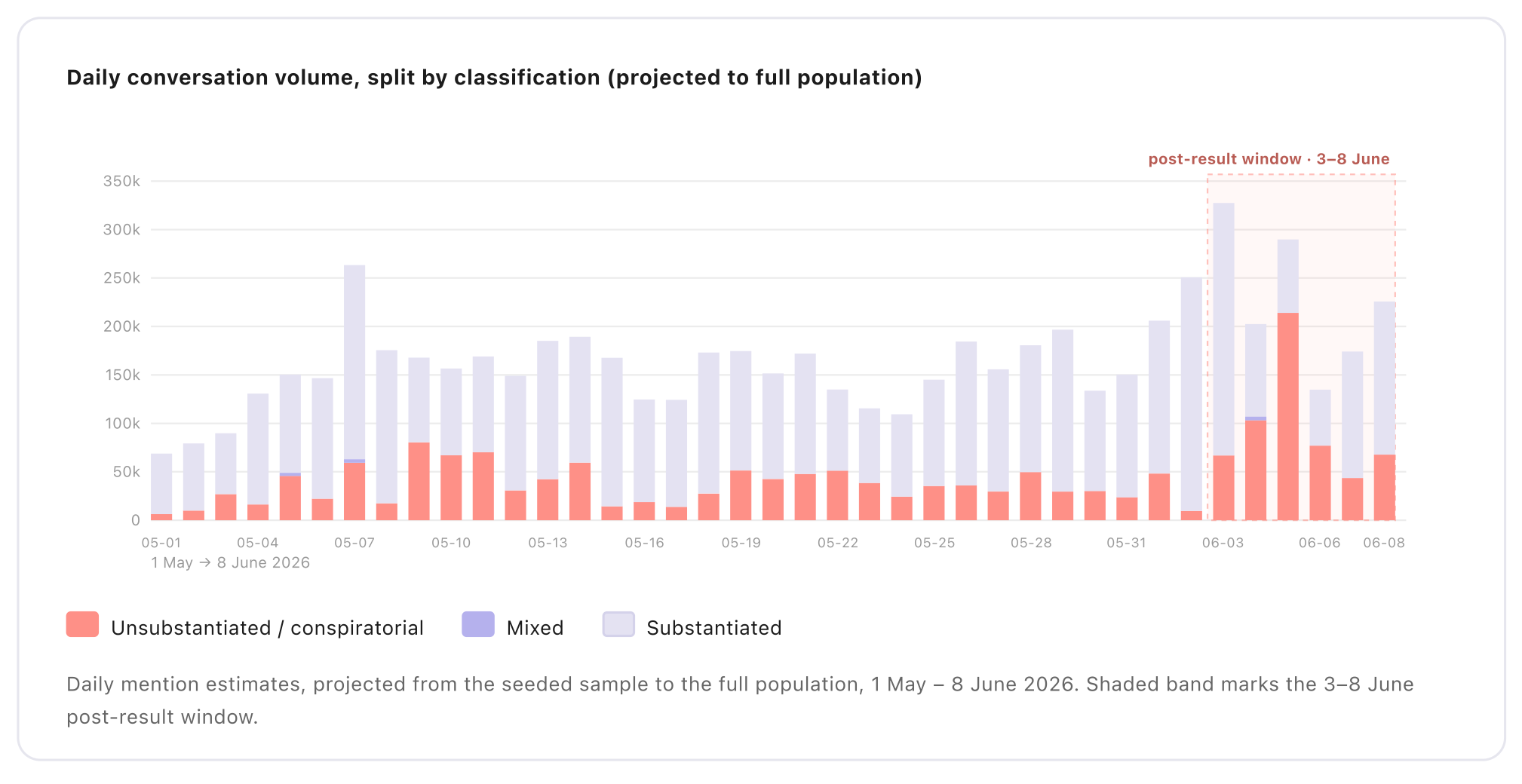
Election Fraud Narratives Nearly Doubled
Prior to the election, 23.3% of the classified conversation consisted of unsubstantiated election claims.
After results began to land, that figure increased to 44.9%, meaning nearly half of the classified discussion centered on claims that could not be corroborated through credible independent sources. The increase was driven almost entirely by election fraud narratives rather than a broader rise in mixed or uncertain content.
PeakMetrics estimates this represented approximately 507,000 projected mentions discussing unsubstantiated election allegations during the post-result period.
Importantly, this was not simply a redistribution of attention. Overall conversation volume also increased, rising from approximately 15.7 thousand mentions per day before the election to 18.8 thousand afterward, indicating that election fraud narratives expanded the conversation rather than replacing existing discussion.
A Handful of Narratives Dominated the Conversation
Although hundreds of thousands of posts contributed to the discussion, the narrative landscape was highly concentrated.
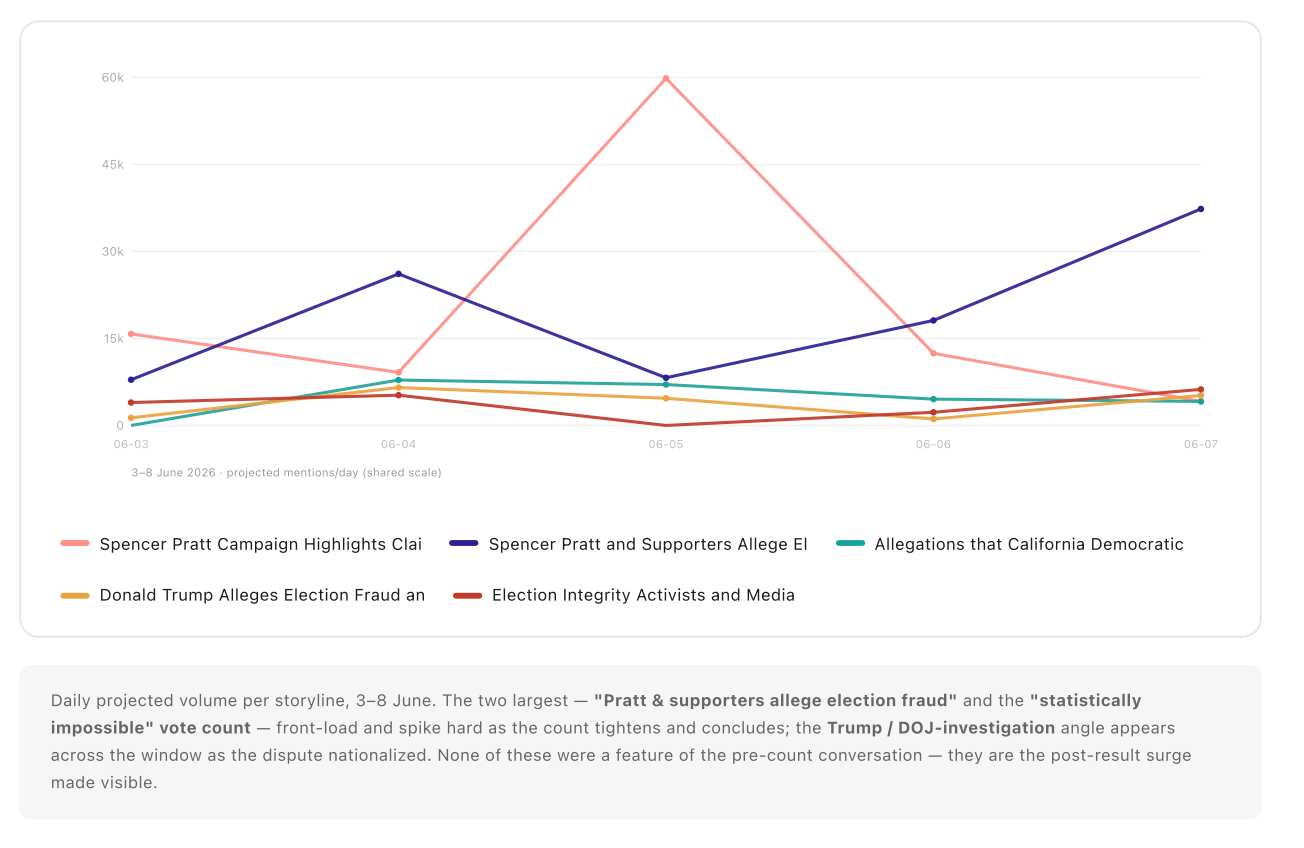
More than half of all unsubstantiated claims centered on just three recurring storylines:
- Spencer Pratt and supporters alleging election fraud
- Claims that vote results were statistically impossible
- Allegations surrounding late ballot counts
Rather than dozens of competing narratives emerging simultaneously, a small number of repeatable claims drove most of the conversation.
This concentration is a pattern PeakMetrics frequently observes during high profile events. Once a narrative begins gaining traction, repeated variations often become the dominant driver of conversation across platforms.
The Conversation Quickly Became National
The discussion also evolved well beyond Los Angeles.
Following the release of election results, a new storyline emerged involving calls for a Department of Justice investigation into California vote counting. While largely absent before results were announced, this narrative quickly became part of the broader conversation, helping transform a local election into a national political discussion.
This illustrates how information environments evolve in real time. Local events can rapidly become national conversations once prominent political figures, creators, or media personalities begin engaging with them.
The Surge Was Primarily Driven by Domestic Political Communities
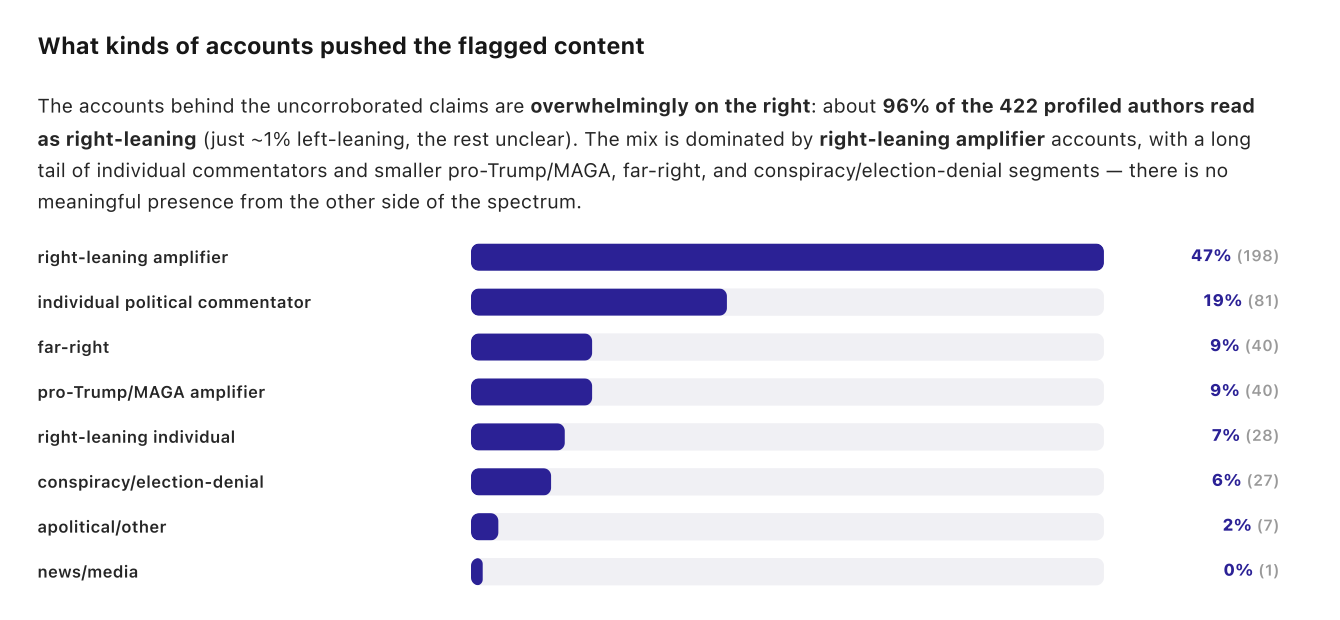
PeakMetrics also analyzed the accounts amplifying the flagged conversation.
Among sampled accounts, approximately 96% appeared to align with right leaning political communities based on publicly available profile information and posting behavior.
Only about 1% of sampled accounts showed apparent alignment with Russian, Chinese, or Iranian state narratives, and those accounts generally had relatively small audiences. The findings suggest the surge was driven primarily by domestic political communities rather than foreign influence.
As with all PeakMetrics account profiling, these findings describe observed public behavior and self presentation rather than confirmed identity, affiliation, or intent.
Automation Contributed, But Was Not the Primary Driver
Major election events often raise questions about coordinated amplification and automated activity.
PeakMetrics' behavioral analysis found that:
- 25% of flagged posts showed likely automation signals.
- 27% showed possible automation signals.
- 48% appeared unlikely to be automated.
While automation contributed to the spread of the conversation, most amplification occurred at a pace consistent with human activity.
The Bigger Story Is When the Narrative Emerged
Perhaps the most important finding is not simply that election fraud narratives spread, but when they spread.
Traditional campaign messaging is designed to influence opinions before an election. In contrast, the most significant increase in unsubstantiated election fraud claims occurred only after results were announced, suggesting the dominant narrative emerged as a reaction to the outcome rather than as an effort to influence voting beforehand.
That timing matters.
Across elections, corporate crises, breaking news, and other major events, organizations often focus on the event itself. Increasingly, however, the narratives that shape public perception emerge in the hours and days that follow. Understanding how those narratives evolve—and identifying which ones are gaining momentum before they become entrenched—is becoming just as important as monitoring the event itself.
Looking Ahead to November
The June election provides more than a retrospective analysis. It offers a preview of how election narratives are likely to emerge in future contests.
While the specific candidates and storylines will change, the underlying pattern is likely to remain consistent. Periods of uncertainty create opportunities for narratives questioning the legitimacy of outcomes to spread rapidly online. The challenge for organizations is no longer simply monitoring election conversations. It is recognizing when those conversations begin shifting, understanding which narratives are gaining traction, and responding before they become the dominant frame.
That is where Narrative Intelligence becomes essential. Rather than simply measuring conversation after it has happened, it helps organizations detect emerging narratives, understand who is amplifying them, identify meaningful shifts in the information environment, and prepare for the next wave before it arrives. The Los Angeles mayoral race demonstrates that the most consequential narrative may not emerge before the election. It may emerge after the first results are reported.
Sign up for our newsletter
Get the latest updates and publishings from the PeakMetrics investigations team.
Loading the newsletter sign-up form…