PeakMetrics / Fact Checks
Has this been
fact-checked?
Paste a claim or upload an image to find existing fact checks. See what fact-checkers found and read the evidence before you share.
Search fact checks ↓API & integrations ↗Browse by topic
Explore fact checks by subject.
Search fact checks
Search by text or imageLatest fact checks
98,314 published reviewsThe University of the Philippines system is being shut down
Publisher’s rating: False

Das Verkehrsministerium bewirbt ein Null-Euro-Ticket.
Publisher’s rating: Es gibt kein Null-Euro-Ticket. Das Plakat ist eine Fälschung.
The claim concerned a poster found in Hildesheim that appeared to advertise a free ticket under the logo of Germany’s transport ministry. The poster said a “0€” ticket was coming “permanently” and “immediately.” The review reports that the €9 ticket had expired at the end of August 2022 and that politicians had not agreed on a successor; the poster did not announce a genuine policy change. The investigation examined the website promoted by the poster. Although it initially looked like an official ministry site, its name referred to a “Ministry for Digitalisation and Transport Transition,” rather than the actual ministry’s name, “Ministry for Digital and Transport.” The site’s imprint link redirected to the real ministry, creating a misleading appearance of official status. The purported ticket generator led to a fake online ticket bearing Deutsche Bahn’s logo and a QR code. The review also checked the poster’s claim that Transport Minister Volker Wissing had announced free public transport from 1 September. It reports that Wissing had recently told Deutschlandfunk he considered a successor to the €9 ticket unable to be free. The embedded video purporting to show him announcing the free ticket was also manipulated: a passage in which he spoke in the Bundesrat about the €9 ticket had been altered. Police warned that no such ticket existed and were investigating suspected attempted fraud.
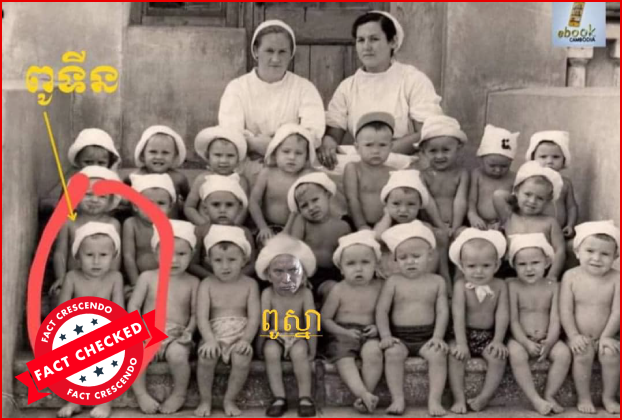
ទំព័រហ្វេសប៊ុកមួយ បានបង្ហោះរូបថតមួយសន្លឹក ដែលបង្ហាញកុមារជាច្រើននាក់ ក្នុងនោះមានកុមារម្នាក់ដែលអង្គុយនៅកណ្ដាលគេ ត្រូវបានគេអះអាងថាជា លោក ខឹម វាសនា កាលនៅកុមារភាព។
Publisher’s rating: Altered
The claim concerned a photo posted by the Facebook page ROEUN MARIN on August 30, 2022. It showed a group of children, with the child sitting in the middle identified as Khem Veasna. The review notes that the image circulated with a caption describing two children as powerful, one through weapons and the other through rotating the earth. The investigation found that the image had been digitally altered, rather than being a childhood photograph of Veasna. [S1: “On August 30, 2022, a Facebook page called ROEUN MARIN posted a photo showing children, one of whom was sitting in the middle, who was identified as ‘Khem Veasna’.”; “Below is a screenshot picture captured from the Facebook page above, describing in Khmer or translated in English as ‘These two children are very strong. One is strong with weapons, the other one is strong by rotating the earth’.”; “Fact Crescendo Cambodia found that the photo posted above is digitally altered.”] To investigate, Fact Crescendo Cambodia says it used Google Reverse Image Search. The search led to a matching group photo on iNEWS, which described it as a photograph of kindergarten children in St. Petersburg. The review also located an earlier post of the original image on the Ebook Cambodia Facebook page. [S1: “Fact Crescendo Cambodia began to investigate the stated claim using Google Reverse Image Search”; “Photos of the same format and shape were found on the iNEWS website published on December 14, 2021.”; “This is a group photo shoot of a kindergarten kid in St. Petersburg”; “Fact Crescendo Cambodia also found the original photo posted by Ebook Cambodia Facebook page on March 15, 2022.”] The review’s comparison identifies the child in the original image as young Vladimir Putin, not Khem Veasna. Thus, the reverse-image results and the earlier version of the photo directly address the pictured child’s identity and show why the social-media version was misleading. [S1: “Below is a screenshot captured from the above Facebook page showing Putin as a child.”; “The following image is the comparison between the original photo and edited photo found on social media.”; “This photo actually shows a young Putin which was taken at one of the kindergarten schools in St. Petersburg. It does not depict Khem Veasna when he was young at all.”]
The P2.5 billion reduction in the budget of the University of the Philippines system for 2023 has been approved
Publisher’s rating: False
In einer Hamburger Bibliothek werden Bücher zum Verheizen gesammelt.
Publisher’s rating: Die Bücherhallen Hamburg teilen mit, dass es sich um eine Fake handelt.
The claim concerned a supposed notice saying that Hamburg libraries would accept “unnecessary” books for future heating. The review identifies the alleged proof as a sign attributed to the library administration, but says the sign was not genuine. The Bücherhallen Hamburg spokesperson, Markus Franke, told dpa: “Dieses Schild ist natürlich ein übler Fake!”
മധ്യപ്രദേശിലെ ഹുക്ക എന്ന ബാറിൽ മുസ്ലീം ആൺകുട്ടികൾ ഹിന്ദു പെൺകുട്ടികളെ ലവ് ജിഹാദിലൂടെ വലയിക്കാൻ ശ്രമിക്കുന്നതിനിടെ പോലീസ് പിടിയിലായി
Publisher’s rating: FALSE

Bill Gates’in fonladığı Dünya Sivrisinek Programı’yla ilgili ‘salgın’ iddiaları
Publisher’s rating: Yanlış

අපේක්ෂා පිළිකා රෝහලේ ක්ෂණික නූඩ්ල්ස් වාට්ටුවක් තියෙනවද?
Publisher’s rating: Misleading
The claim concerned a supposed instant-noodles ward at Apeksha Cancer Hospital in Maharagama, allegedly occupied by patients whose cancers resulted from eating instant noodles. Fact Crescendo says it investigated whether the hospital had a ward specifically for such patients, rather than treating the social-media post as evidence that one existed. The post it examined described a separate ward that was supposedly always full of people who had eaten only instant noodles and developed cancer.
In einem ihrer Artikel fordert die «Frankfurter Allgemeine Zeitung» ein Ende der Sanktionen gegen Russland.
Publisher’s rating: Der Artikel ist gefälscht und stammt nicht von der «FAZ». Die Aufmachung der Original-Website wurde kopiert.
The claim concerns an article presented as coming from the Frankfurter Allgemeine Zeitung (FAZ) that supposedly called for abolishing Western sanctions against Russia. The review says the article was not published on FAZ’s official website or in its print archive: it appeared on a lookalike site with the address “faz.ltd,” whose copied design and links to genuine FAZ sections and an imprint could make it appear authentic. The review concludes that the article was fabricated and that the original website’s appearance had been copied. [S1: “Der Artikel ist weder auf der offiziellen Seite «faz.net» zu finden noch im gedruckten Archiv der «FAZ».”; “Dieser steht nicht auf der offiziellen Webpräsenz «faz.net», sondern auf einer nachgemachten Seite mit einer anderen Endung: «faz.ltd».”; “Durch das kopierte Layout wird der Eindruck erweckt, es handle sich um die echte «FAZ»-Website.”] The review also traces the alleged article’s content to a Tagesspiegel article. It reports that a link presented as leading to a Spiegel comparison table instead led to the Tagesspiegel, and that the fake FAZ page used a rewritten version of the Tagesspiegel article and copied its table. Crucially, the review says the Tagesspiegel text itself did not call for ending sanctions. It also reports that cited expert Timo Wollmershäuser told dpa in writing that he had made the quoted statements only to the Tagesspiegel. [S1: “Bei einem genaueren Blick wird deutlich, dass der gefälschte Artikel auf «faz.ltd» eine umgeschriebene Version des «Tagesspiegel»-Artikels ist.”; “Im Text des «Tagesspiegel» selbst ist allerdings genauso wenig die Forderung zu finden, dass die Sanktionen gegen Russland eingestellt werden sollten.”; “Timo Wollmershäuser vom Institut für Wirtschaftsforschung (Ifo) bestätigte der Deutschen Presse-Agentur (dpa) schriftlich, dass er diese Sätze nur dem «Tagesspiegel» gesagt habe.”] The review further notes that the fake article attributed its information to AFP, although the review says it did not come from that agency. Together, the false web address, copied presentation and material, and unsupported attribution underpin the finding that the article was not a genuine FAZ article. [S1: “Auch die Quellenangabe des gefälschten «FAZ»-Artikels ist nicht korrekt. Die Informationen stammen nicht von der französischen Nachrichtenagentur AFP.”]

Styvenson posta fake news contra jornalista da Jovem Pan News Natal
Publisher’s rating: Enganoso
Die Fotos belegen, dass es in mehreren europäischen Ländern eine Putin-Steuer gibt.
Publisher’s rating: Es gibt keine Belege für eine Putin-Steuer in Europa. Das Foto mit dem Preisschild ist manipuliert, die Nebenkostenabrechnung hätte in der Form keine rechtliche Grundlage.
The review examines three images shared as evidence that a new “Putin tax” had been introduced in European countries: a supermarket price tag, a sign at a public toilet in Italy, and a Swiss utility bill. Its investigation found that the Finnish price-tag image was manipulated and that the Swiss bill could not establish a legally chargeable tax. The evidence therefore does not substantiate the claim that the photos prove such a tax exists in several European countries. For the price-tag image, the review identified the pictured product as Finnish Lidl’s four-grain flakes and says it sent the circulating image to Lidl Finland. The company replied that the product was from Lidl but the rest of the image was not authentic. The review points to differences in the tag’s design, a misspelling of the product name, and a price format inconsistent with Lidl’s actual tags. These details undermine the image as evidence of a genuine charge. For the Swiss bill, the Bern Tenants’ Association said it had no knowledge of a Putin tax in Bern and that there was no legal basis for one. It also explained that landlords may charge tenants additional costs only when they are explicitly agreed as such in the lease and itemized accordingly. For the Italian toilet sign, the operator did not respond to the inquiry, but the review reports that the portion reading “La tassa di Putin” had visibly been added later and that searches found no indication of such a levy. That last finding is not equivalent to confirmation from the operator, but the image itself does not provide reliable proof of a tax.

Covid-19 vaccine changes the blood rhesus of the receiver.
Publisher’s rating: Les vaccins contre le COVID-19 n'ont aucune influence sur le rhésus du groupe sanguin.
Le vaccin anti-Covid est finalement déconseillé aux femmes enceintes au Royaume-Uni
Publisher’s rating: Faux
Where the data comes from
Fact checks come from Data Commons and link to the organizations that published them.
What you’ll find
Each result links to the original fact check. Open it to read the publisher’s findings, with summaries and supporting sources where available.
Report an error
To report an error, send the page URL and supporting evidence.