PeakMetrics / Fact Checks
Has this been
fact-checked?
Paste a claim or upload an image to find existing fact checks. See what fact-checkers found and read the evidence before you share.
Search fact checks ↓API & integrations ↗Browse by topic
Explore fact checks by subject.
Search fact checks
Search by text or imageLatest fact checks
98,307 published reviews
According to Supreme Court’s order, if a stray dog bites a human, the person who feeds that dog should bear the treatment and compensation costs
Publisher’s rating: MISLEADING
The claim concerns whether the Supreme Court had ordered people who feed stray dogs to pay treatment costs and compensation if those dogs bite someone. FACTLY’s review says no such judgment had been passed and that the compensation case was still being heard. It reports that the Court’s order of 9 September 2022, in *Animal Welfare Board of India vs. People for Elimination of Stray Troubles*, asked the Siri Jagan Committee to submit a status report on the stray-dog-bite compensation issue before the next hearing, scheduled for 29 September—not that feeders were liable for victims’ costs. [S1] FACTLY says it searched online using relevant keywords and found no such Supreme Court order. It also describes the compensation arrangement it found in Kerala: a committee considered claims, while local governments paid compensation according to the severity of the wounds and the gravity of the incident. That account distinguishes an existing state-level compensation process from the alleged nationwide Supreme Court rule assigning costs to dog feeders. [S1] On the evidence in the review, the post attributes a liability rule to the Court that the cited proceedings did not establish. The Court was seeking information about the compensation issue; the review reports no order making dog feeders responsible for treatment or compensation. The evidence therefore addresses the precise claim, rather than a separate question about stray-dog policy or dog removal. [S1]

PM Modi said singing bhajans remove malnutrition
Publisher’s rating: False
Vladimir Putin has been ambushed and is in serious danger.
Publisher’s rating: False

Deze afbeelding laat zien dat The Simpsons de sterfdatum van koningin Elizabeth de II voorspelde.
Publisher’s rating: The Simpsons voorspelde in geen enkele aflevering de precieze datum van de dood van koningin Elizabeth II. De afbeelding die dit zou moeten bewijzen is gemanipuleerd.

Die Ema-Zulassung der neuen Omikron-Booster beruht auf den Daten von acht Mäusen.
Publisher’s rating: Die Darstellung ist verzerrt. Zwar lagen für die Zulassungsempfehlung des Omikron-BA.4/5-Boosters nur Daten aus Tierstudien vor, zur Beurteilung wurden aber auch klinische, also an Menschen erhobene Daten des Omikron-BA.1-Boosters herangezogen - denn die Impfstoffe sind sich sehr ähnlich und ihre grundsätzliche Sicherheit und Wirksamkeit sind bekannt. Auch wurden sowohl bei Biontech, als auch bei Moderna jeweils mehr als acht Mäuse in den Tierstudien untersucht.

"Niña ucraniana contra soldado ruso"
Publisher’s rating: Falso
The claim attached to the viral video was that it showed a Ukrainian girl confronting a Russian soldier during the war in Ukraine. The review identifies the clip’s subjects instead as Palestinian activist Ahed Tamimi and an Israeli soldier, and places the confrontation in the West Bank in November 2012—not in the Ukraine conflict. To check the video’s provenance, the review says it found a YouTube upload from December 2012 through a Google search. That upload showed more of the episode and identified the girl as Tamimi. The review also cites an AFP photograph as confirming that the event took place in the West Bank on November 2, 2012. These details tie the circulated footage to a specific earlier event, rather than merely showing that similar footage existed elsewhere. The review adds that the same video had circulated shortly after Russia’s invasion of Ukraine began on February 24, 2022, and says fact-checking teams at Newtral, AFP Factual, and FullFact had already rejected the Ukrainian-girl and Russian-soldier identification. The supplied text does not provide those organizations’ underlying evidence, so the review’s described video provenance and AFP photograph are the evidence detailed here.
Beneficiamos mais de 68 milhões de pessoas [com o auxílio emergencial]
Publisher’s rating: Verdadeiro
Nosso esforço em sancionar mais de 70 normas legais sobre o tema desde o início do meu governo, em 2019
Publisher’s rating: Exagerado
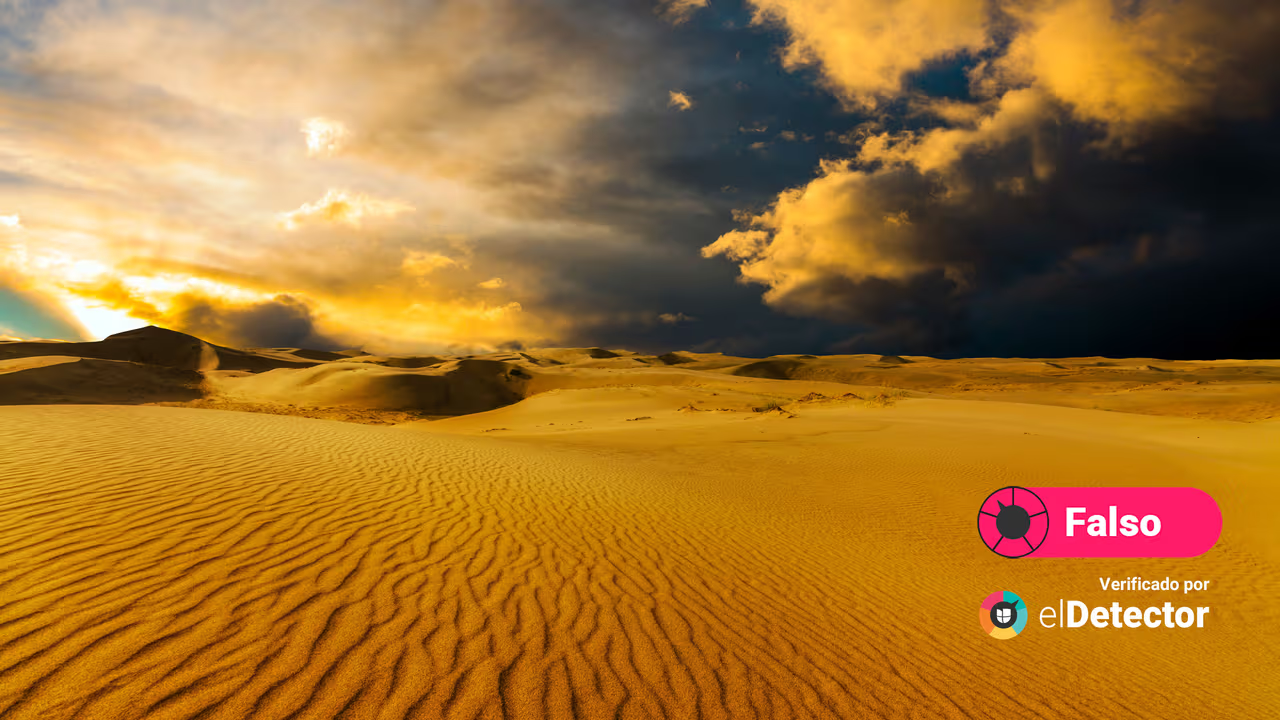
El polvo del Sahara es provocado por el ser humano.
Publisher’s rating: Falso
ElDetector examined the specific claim that Saharan dust is caused by humans, submitted by users through its WhatsApp chatbot. The review describes Saharan dust as a natural phenomenon: winds pick up sand and dust from dry soils in the Sahara, carry the particles into the atmosphere, and can transport them thousands of kilometers. It reports that the World Meteorological Organization (WMO) explained that wind—not humans—spreads the dust over long distances, including across the Atlantic. The review also cites the European Environment Agency’s account of how hot, dry conditions can create daytime turbulence that lifts dust several kilometers into the air. To support its explanation of how the dust forms and moves, the review cites the WMO, the European Environment Agency, NASA’s Earth Observatory, and NOAA. It reports that NASA’s Earth Observatory estimates winds collect about 100 million tons of Saharan dust each year, and that dust movement can occur at any time of year. The review also describes NOAA researcher Jason Dunion’s explanation that Saharan air-layer outbreaks form when tropical waves pass along the southern edge of the Sahara and raise large quantities of dust into the atmosphere. The review distinguishes the natural origin of the dust from human influence on conditions in the region. It notes evidence that global warming may worsen Saharan dust storms, while stressing that the evidence is not conclusive. It also reports the WMO spokesperson’s qualification that human activities, poor land and soil management, and drought have worsened desertification in some areas of the Sahara—but that this does not mean humans cause the Saharan dust phenomenon. Taken together, the cited evidence supports the review’s conclusion that the claim is false: the dust is generated by natural wind and dry-soil processes, though climate change and human land use may affect related conditions.


"In de politiek gebeurt niets per toeval. En als het gebeurt, reken maar dat het gepland was." is een citaat van president Roosevelt.
Publisher’s rating: Er is geen bewijs dat Franklin D. Roosevelt deze uitspraak ooit deed.
ShahRukhKhan says, I am proud to be Muslim & Pakistani !!
Publisher’s rating: Fake
Queen Elizabeth's corgis are being prepared to be buried with her
Publisher’s rating: Satire

Simpsonlar, Kraliçe II. Elizabeth'in Ölümünü Önceden Bildi Mi?
Publisher’s rating: Yanlış
वह शख्स मंदिर में नमाज़ पढ़ रहा है। यह प्रयागराज के सिविल लाइन्स क्षेत्र के हनुमान मंदिर का वीडियो है।
Publisher’s rating: False
زنان و دختران ایران، به طور خودجوش حجاب را رعایت میکنند.
Publisher’s rating: شاخدار
No meu governo, extirpamos a corrupção sistêmica que existia no país
Publisher’s rating: Falso
O Brasil foi o quarto maior destino de investimentos estrangeiros direto no mundo
Publisher’s rating: Verdadeiro
Where the data comes from
Fact checks come from Data Commons and link to the organizations that published them.
What you’ll find
Each result links to the original fact check. Open it to read the publisher’s findings, with summaries and supporting sources where available.
Report an error
To report an error, send the page URL and supporting evidence.