PeakMetrics / Fact Checks
Has this been
fact-checked?
Paste a claim or upload an image to find existing fact checks. See what fact-checkers found and read the evidence before you share.
Search fact checks ↓API & integrations ↗Browse by topic
Explore fact checks by subject.
Search fact checks
Search by text or imageLatest fact checks
98,284 published reviews
The Philippines is Asia's fast-growing economy
Publisher’s rating: Misleading

The Price Of A Standard Eraser Used By Schoolchildren Risen To Rs.250!!
Publisher’s rating: Misleading
Factcrescendo examined a viral Sri Lankan social-media post that showed an eraser priced at Rs.250 and implied that this was the current price of an average schoolchildren’s eraser. The review places the post against rising stationery costs, but distinguishes the broad price increases from the specific claim about a standard eraser: it says the post’s implication was exaggerated because standard erasers remained available for much less. To check prices, the team says it looked at eraser listings from the M.D. Gunasena and Sarasavi bookstores, contacted bookstores directly, and spoke to the Sri Lankan representative for Staedler, the German brand depicted in the viral posts. The review reports that most standard erasers were priced below Rs.50. It also notes that some decorative or custom erasers cost more, so the low prices did not apply to every kind of eraser. The brand detail helps explain why the image did not establish the price of an ordinary school eraser. According to the review, Staedler is used by some schoolchildren but is more popular with professional artists and architects; its representative gave a starting price of Rs.73 for the cheapest German-made eraser and said the model shown could be bought locally for around Rs.207 upwards. Thus, a price near Rs.250 could describe a particular branded product, but the price checks reported do not support treating it as the average price of a standard schoolchildren’s eraser.
Leni Robredo said Bongbong Marcos won the presidency because of the massive disinformation campaign against her
Publisher’s rating: Fake
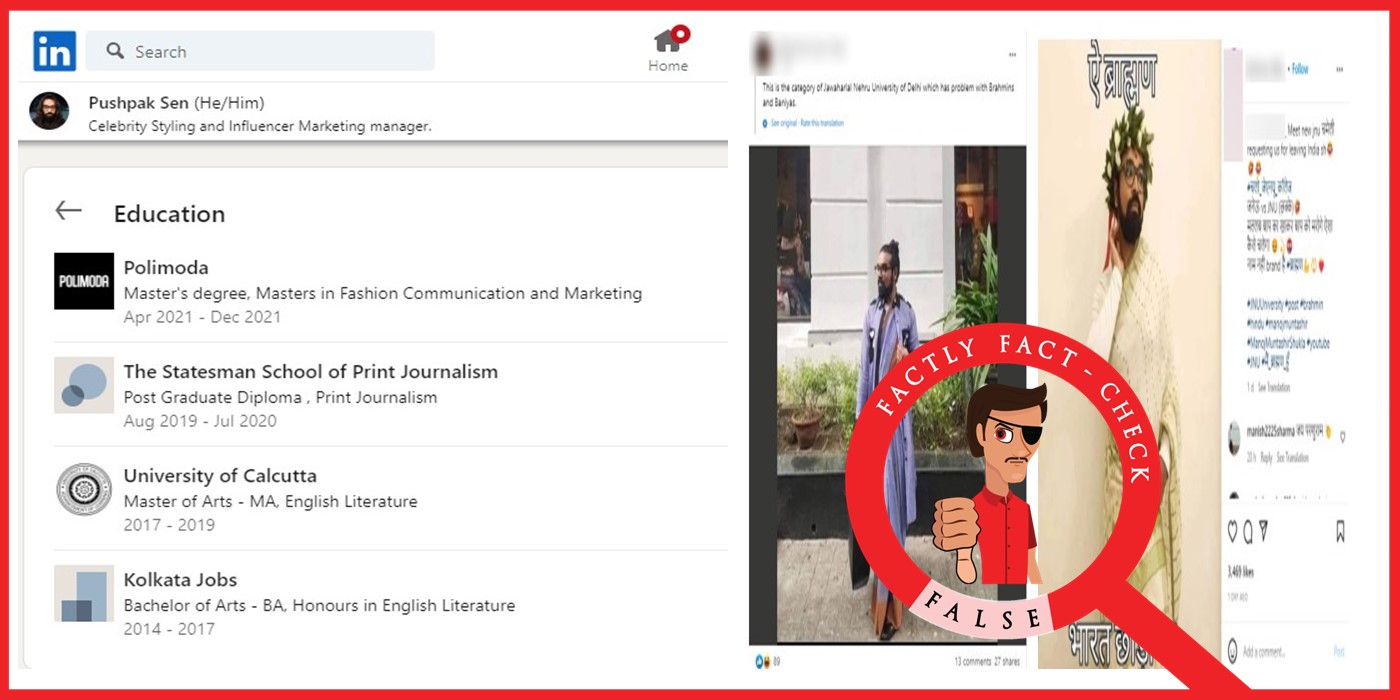
Images of the students in JNU who support the anti-Brahmin slogans in JNU
Publisher’s rating: FALSE
The claim concerns two images circulated as showing JNU students who supported the anti-Brahmin slogans at the university. FACTLY’s review identifies the person in both images as Pushpak Sen, a Kolkata-based activist who identifies as non-binary and promotes gender-neutral fashion. It reports that Sen is not a JNU student, so the images do not establish that JNU students are pictured.


Vídeo que mostra paraquedistas saltando de um avião militar no Rio de Janeiro. Na gravação, uma mulher diz que a imagem foi registrada do bairro de Unamar, onde ela vive. A comunidade fica na cidade de Cabo Frio, no Rio de Janeiro, na Região dos Lagos. No Twitter, o vídeo é acompanhado pelo seguinte texto: “Aviões, comboios das FA chegando a Cabo Frio. A cidade está cheia de soldados. Lembrando, Cabo Frio é porta de entrada no país pelo mar. Eles estão fechando as entradas do país. PRA VC QUE ESTÁ PERDENDO AS ESPERANÇAS ACREDITE E CONTINUE EM FRENTE AOS QUARTÉIS ”.
Publisher’s rating: Falso
The claim interprets footage of parachutists over the Cabo Frio area as evidence that the Brazilian armed forces were gathering there to close the country’s maritime entrance. The review identifies the footage as a video made by a woman who says she lives in Unamar, a neighborhood in Cabo Frio. It notes that the video itself shows parachutists jumping from a military aircraft, while the accompanying social-media message asserted that Cabo Frio was full of soldiers and that they were there to close the sea entrance. The review reports that the woman’s recorded words differ from the claim’s description of what she said: she says, “God would not let his people be put to shame.” The decisive evidence came from the Army’s response to the investigation. The Army said the video was genuine but had no connection to closing borders. Instead, it showed Operation Saci, a joint exercise involving the Army, Navy and Air Force. The review says the exercise has been held annually since 1976 and that the 2022 operation took place from November 28 through December 2 in municipalities in the Região dos Lagos. The stated purpose was to keep the Army’s strategic employment force ready for deployment and to simulate operational scenarios—not to shut the country’s maritime entrance. The review describes checking the allegation by contacting the Army’s communications center for an explanation of Operation Saci, contacting the post’s author to ask about the video’s origin and claims, and searching online for records of the operation in 2022 and earlier years. It reports finding records from the Army and a defense news site, as well as a G1 report about an accident involving parachutists in one of the operations. The author had not responded by the review’s closing. The available account therefore supports the conclusion that authentic military-exercise footage was presented with a false explanation of its purpose.

Los vacunados contra el covid-19 se convierten en personas “transgénicas”.
Publisher’s rating: Falso
The claim concerns a statement by Argentine doctor Chinda Brandolino that COVID-19 vaccination makes people “transgenic.” The review says she made the statement in June 2021 during a conference held by Médicos por la Verdad, and that a video of her presentation was circulating again on Instagram in December 2022. The article explains that “transgenic” here means artificially altering an organism by incorporating DNA sequences from another species; it reports that Brandolino did not present scientific evidence for her assertion. To assess the claim, the article distinguishes the way transgenic organisms are produced from how COVID-19 vaccines work. It cites the U.S. National Human Genome Research Institute’s description of introducing foreign DNA into a fertilized egg, and notes that none of the COVID-19 vaccines intervenes in or modifies DNA, citing CDC guidance. The article also reports that a CDC document from September 2022 says the vaccines neither affect nor interact with DNA because they do not enter the cell nucleus where DNA is located. The review addresses both vaccine types referenced in the claim. It says mRNA vaccines from Pfizer and Moderna provide instructions for producing a coronavirus-like protein, and that the mRNA does not enter the cell nucleus. For adenovirus-vector vaccines, such as Johnson & Johnson’s, it says the vector delivers instructions but lacks the machinery to integrate its genetic material into human DNA. The article also cites CDC guidance that the body discards vaccine ingredients after an immune response develops. These explanations directly address the proposed mechanism behind the claim; the review reports no evidence that vaccination turns people into transgenic organisms.


Bolsonaro já assinou GLO que garante intervenção militar no Brasil
Publisher’s rating: Falso

Brasil fecha fronteiras terrestres com países da América do Sul em 2022
Publisher’s rating: Falso

PRIMEIRO MINISTRO DE ISRAEL CHEGA EM BRASÍLIA PARA DAR APOIO A BOLSONARO!
Publisher’s rating: Falso

ජනපති රනිල් වික්රමසිංහගේ නිවසේ ඡායාරූපයක් ද?
Publisher’s rating: False
The claim concerned a social-media photograph presented as showing Sri Lankan President Ranil Wickremesinghe’s residence enclosed by tall coils of wire. The investigation says the image circulated with that implication on Facebook and Twitter. Its reverse-image search found that the photograph had already been circulating on social media among people in Myanmar from the preceding April, before Sri Lanka’s public protests and while Gotabaya Rajapaksa was president. The review says it had not established the original details of the photograph, so it did not claim to identify the place shown in it. The review also reports that Sri Lanka’s Presidential Media Division said the pictured property was neither the president’s official residence nor his private home, and that neither residence had coils of wire like those in the image. This directly addresses the identification at the heart of the claim, while the image’s earlier circulation in Myanmar provides separate evidence against its being a new photograph of Wickremesinghe’s home. The article distinguishes this photograph from a real attack on Wickremesinghe’s private residence: it says his Colombo Fifth Lane home was set on fire in July, when he was prime minister. It also notes that footage of a protest outside his home on May 7 did not show the tall wire coils depicted in the circulated image. Those events provide context, but the review does not present them as the source of the photograph.


Plantão da Globo: TRISTEZA: Aos 81 anos, foi confirmado agora há pouco, sobre PELÉ, querido amigo: "Descanse em paz
Publisher’s rating: Falso

මකනයක මිල රු.250 දක්වා ඉහළ ගිය සිදුවීමේ ඇත්ත කතාව!
Publisher’s rating: Explainer
The review examined a social-media image that led people to believe an ordinary school eraser had risen in price to Rs. 250. It says the image showed a Staedtler eraser, rather than establishing that this was the price of a typical school eraser. The investigation focused on checking prices and identifying the product in the image. To compare ordinary erasers with the item shown, the reviewers checked prices at two major Sri Lankan bookshops, M.D. Gunasena and Sarasavi, and said they also confirmed prices with some bookshops. Their reported finding was that ordinary erasers cost less than Rs. 50. The article separately notes that decorative erasers, including designs appealing to young children, can cost more. The review identified the pictured item as a German-made Staedtler eraser and says the Sri Lankan distributor described the brand’s products as available in different types for different purposes, including use by professional artists and architects. According to the article, the pictured eraser was priced from Rs. 207, while the least expensive German-made Staedtler eraser sold in Sri Lanka was Rs. 73. Thus, the post’s Rs. 250 implication did not represent the ordinary erasers the reviewers checked; the account also cautions that school-supply prices had generally risen amid inflation.

China Has Created An Artificial Woman, As This Video Claims !!
Publisher’s rating: False
The claim attached to the viral video was that China had created an artificial woman who could speak fluently in many languages and do household chores. Factcrescendo Sri Lanka says the video circulated on social media and WhatsApp, and reports that its investigation found the claim misleading: the woman shown was not a real robot created by China but a fictional character in a computer game. To trace the footage, the fact-check says it used InVID-WeVerify technology to locate an earlier version of the clip. It identifies that version as a video uploaded by the official PlayStation YouTube channel in May 2018, titled “Detroit: Become Human – Shorts: Chloe I PS4.” The review says the clip was taken from *Detroit: Become Human*, a game made by Quantic Dream, and identifies Chloe as a character in that game. This evidence addresses the video’s provenance rather than showing a Chinese-built robot performing the abilities described in the claim. The review concludes that the viral clip was misleadingly presented: it showed a game character, not a real artificial woman created by China. It also says the game was released in 2018.

न्यूज एंकर रूबिका लियाकत ने दिल्ली MCD चुनाव में किया वोट
Publisher’s rating: FALSE

পোল্যান্ডের বিপক্ষে নিজের ম্যাচ সেরার পুরস্কার ম্যাক অ্যালিস্টারকে দিয়ে দিলেন মেসি
Publisher’s rating: False

Saudi Arabia banned the installation of loudspeakers in mosques – and said those who believe in religion, why do they need the Imam to call from the mosque… They should be present in the mosque beforehand, without being invited, at the time of prayer.
Publisher’s rating: Misleading
Where the data comes from
Fact checks come from Data Commons and link to the organizations that published them.
What you’ll find
Each result links to the original fact check. Open it to read the publisher’s findings, with summaries and supporting sources where available.
Report an error
To report an error, send the page URL and supporting evidence.