PeakMetrics / Fact Checks
Has this been
fact-checked?
Paste a claim or upload an image to find existing fact checks. See what fact-checkers found and read the evidence before you share.
Search fact checks ↓API & integrations ↗Browse by topic
Explore fact checks by subject.
Search fact checks
Search by text or imageLatest fact checks
98,284 published reviews
இஸ்லாமிய நாடுகளில் பெண்களை சங்கிலியால் பூட்டி சந்தையில் விற்பனைச் செய்ய இழுத்து வரும் காட்சி.
Publisher’s rating: Fake

Video of Paresh Rawal apologising over his comments on Bengalis
Publisher’s rating: MISLEADING
The claim concerns a video circulated as Paresh Rawal apologising for remarks about Bengalis. FACTLY’s review says the video does show Rawal apologising, but finds that the apology was for different remarks, made five years earlier. Its conclusion therefore turns on the video’s context, not on whether Rawal ever apologised about Bengalis. To check the video’s provenance, the review says it used reverse image search on keyframes from the viral clip and found the full version on YouTube, uploaded on 30 November 2017. In that full video, Rawal apologises for comments on Rajputs made in November 2017. This evidence links the circulated footage to an earlier incident rather than to the later controversy over Bengalis. The review distinguishes that footage from the 2022 events: it says Rawal made the remarks about Bengalis on 29 November 2022 and tweeted an apology on 02 December 2022. Thus, the fact that he later apologised for the Bengalis remarks does not establish that the circulated video shows that apology; the review identifies the video as five years old and about his remarks on Rajputs.

චරිත හේරත් සහ සෝරත හිමි ලෙස හුවමාරු වූ සටහන් පිලිබඳ කරුණු විමසා බැලීමක්…
Publisher’s rating: Explainer
The posts under review presented an image as a photograph of Charitha Herath during a period when he was a Buddhist monk, and claimed he had been known as Kamburugamuwa Soratha and later disrobed after going to the United States for postgraduate study. The review’s image check addressed a central piece of that presentation: it says a reverse-image search showed that the circulated picture had been made by editing Herath’s face onto a photograph of the late Kotugoda Dhammawasa Thera. Thus, the image was not an authentic photograph of Herath as a monk, even though the review separately discusses claims about his past monastic life.
Eles [generais das Forças Armadas] diplomaram Bolsonaro como novo presidente”
Publisher’s rating: Falso
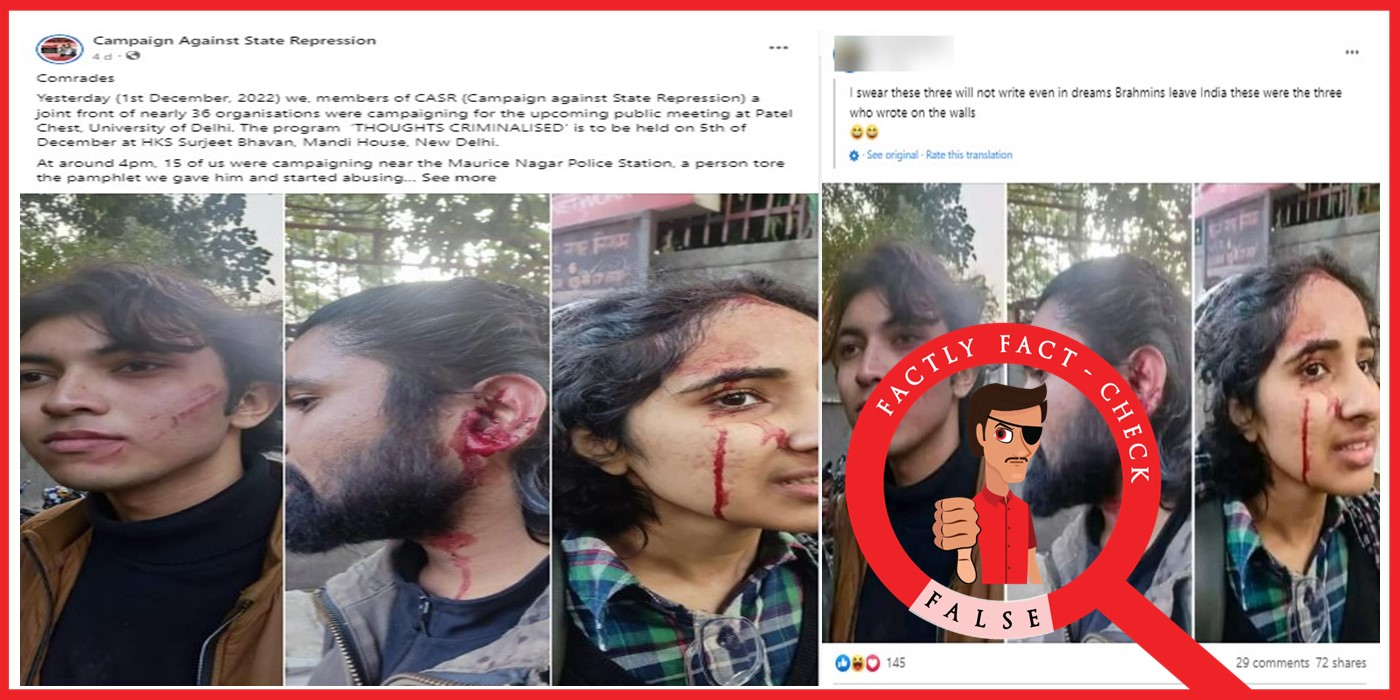
Images of people who made the anti-brahmin slogans on JNU walls recently
Publisher’s rating: FALSE
The viral collage showed three injured people, but the investigation found no evidence that they were responsible for the anti-Brahmin slogans at Jawaharlal Nehru University (JNU). Instead, the review traced the images to a scuffle at Delhi University (DU), a separate event. It reports that those responsible for the JNU slogans had not been identified and that the university administration had ordered a probe. To check the images’ provenance, the review says it conducted a reverse image search and found the same images on the Facebook page of Campaign Against State Repression (CASR), posted on 2 December 2022. According to the post description quoted in the review, CASR members were campaigning at DU on the evening of 1 December for a program demanding the release of Professor Saibaba and other political prisoners when a scuffle broke out with ABVP members. The review says several students were injured and admitted to Hindu Rao Hospital. The review identifies two of the injured people as Aksh Negi, a DU bachelor’s student, and Entmam-ul-Haque, a law graduate from Jamia Millia Islamia. It also notes that media reports said both groups complained to Maurice Nagar Police station. This evidence connects the pictured people to the DU incident, not to writing the JNU slogans. The excerpt does not identify the third person in the collage or establish who wrote the slogans.

Claim: Misleading shared as football players worshipping the jesus
Publisher’s rating: FALSE
The review investigated a video shared with the claim that footballers were worshipping Jesus during the World Cup. It describes footage of two players crossing a pitch on their knees, carrying a Bible and praying, and says the accompanying post identified it as a World Cup scene. The review questioned that setting: the stadium did not look like a World Cup venue, and the guards visible there did not appear to be Qatari police. To trace the footage, the reviewers converted video frames into images and searched them with Google reverse image search. They say this led them to Spanish-language coverage identifying the scene as a local football match in Guatemala. According to their account of those reports, Coatepeque had won the Apertura 2022 first-division final, and players Denilson Ochaeta and Alexander Morales crossed the pitch on their knees with a Bible, praying after the win. The review therefore distinguishes what the video showed from the misleading World Cup framing: it attributed the footage to the Guatemalan team’s victory, not to the FIFA World Cup in Qatar. Its conclusion is based on the visual search and the foreign reports and posts it located; the supplied excerpt does not provide independent verification beyond those described checks.


කොළඹ වරාය ජාඇළට ගෙන යන්න ජනපතිගෙන් තීරණයක්?
Publisher’s rating: Misleading
در مدت یک سال و نیم درگیری مستقیم با آمریکاییها توانستیم بیش از ۵۲ نفر تلفات بگیریم و در مقابل ما ۹ شهید دادیم.
Publisher’s rating: شاخدار

Video of people discovering currency coins in plants
Publisher’s rating: FALSE
The video under review shows two men pulling up a plant’s roots and taking currency coins from inside them. FACTLY says it could not establish the exact details or provenance of that particular clip, so it does not identify the people in it or prove precisely how its effects were made. Its conclusion is narrower: the footage is not evidence of a natural plant growing coins in its roots. To assess the clip, the investigation reports using reverse-image searches of screenshots, which did not turn up reliable sources for that exact video. It then searched relevant terms and found similar videos attributed to Pakistani TikTok user Rana G. In those, he described the videos as entertainment and fun; in some, he explained reattaching sliced vegetables or plant branches with thin sticks. These examples support the possibility that coin-extraction videos are staged, but they are similar footage rather than confirmation of the exact clip’s production. The decisive point in the review is the distinction between the specific video’s uncertain provenance and the claim that plants naturally grow coins. FACTLY says there is no evidence of plants capable of growing coins or currency notes inside their branches or roots. It therefore concludes that the clip does not show a natural money-growing plant, while acknowledging that it could not ascertain the exact details of the video shared in the post.

සියදිවි නසාගත් ඉංජිනේරුවාගේ මරණය සම්බන්ධයෙන් පාර්ශවයන් කිහිපයකගේ අදහස් දැක්වීමක්!
Publisher’s rating: Explainer

‘Yakumi Plus Effervescent tablets’ are FDA approved and are effective in treating acid reflux and other gastrointestinal diseases
Publisher’s rating: MISLEADING
The review examined a social-media advertisement claiming that Yakumi Plus Effervescent tablets are FDA-approved and treat acid reflux and other gastrointestinal diseases. It reports that a search of the FDA-approved-drugs database found no medicine by that name. This is the review’s stated basis for concluding the product is not FDA-approved; the excerpt does not describe any broader investigation of FDA records.


Twitter hesabının Selvi Kılıçdaroğlu’na ait olduğu iddiası
Publisher’s rating: Yanlış

कतर में फीफा वर्ल्ड कप के दौरान एक शख्स के अनोखे अंदाज ने ड्रोन के जरिए कलमा तैयबा का झंडा फहराकर पूरी दुनिया को संदेश दिया।
Publisher’s rating: False
Where the data comes from
Fact checks come from Data Commons and link to the organizations that published them.
What you’ll find
Each result links to the original fact check. Open it to read the publisher’s findings, with summaries and supporting sources where available.
Report an error
To report an error, send the page URL and supporting evidence.