PeakMetrics / Fact Checks
Has this been
fact-checked?
Paste a claim or upload an image to find existing fact checks. See what fact-checkers found and read the evidence before you share.
Search fact checks ↓API & integrations ↗Browse by topic
Explore fact checks by subject.
Search fact checks
Search by text or imageLatest fact checks
98,284 published reviewsगुजरात में रिक्शाचालक को डंडा मारते पुलिसकर्मी का वीडियो
Publisher’s rating: FALSE

A Gazeta: Após decreto de Bolsonaro Estado de Sítio começará em 72 horas
Publisher’s rating: Falso
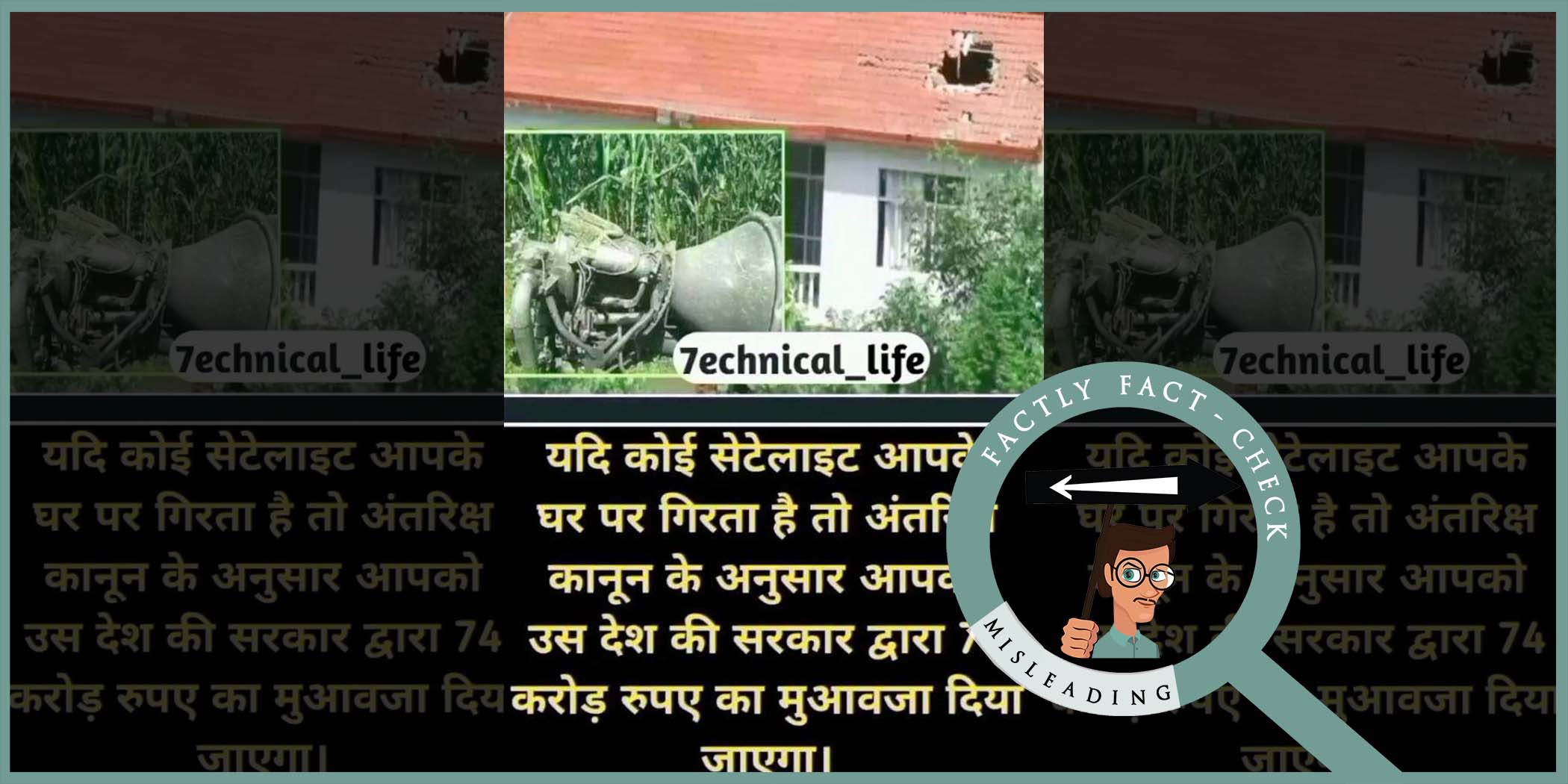
If a satellite falls on a house, the owner of that house will receive a compensation of 74 crore rupees from the country which launched it
Publisher’s rating: MISLEADING
The post’s claim is that a house owner would receive 74 crore rupees from the country that launched a satellite if it fell on their house. FACTLY says the launching state is liable for damage caused by its space object on Earth’s surface, but the compensation is not a preset amount. The review’s conclusion is that the specific 74-crore figure is unsupported as a fixed entitlement. To check the claim, the review reports searching the internet for relevant keywords and examining the Convention on International Liability for Damage Caused by Space Objects. It quotes the convention as making a launching state “absolutely liable” for damage caused by its space object on Earth’s surface or to aircraft in flight. That establishes a liability principle, not a guaranteed payment of 74 crore rupees. The review further quotes the convention’s rule that compensation is to be determined under international law and principles of justice and equity, with the aim of restoring the affected party to the condition it would have been in had the damage not occurred. It also notes that claims are presented to the launching state through diplomatic channels and that a Claims Commission may be established if diplomatic settlement fails. These provisions describe how claims are handled; they do not set the fixed payout asserted in the post.


In Italien haben diverse schwere Erkrankungen seit Jahresbeginn stark zugenommen.
Publisher’s rating: Die Zahlen lassen sich aus keinen offiziellen Daten ableiten und sind offenbar frei erfunden.
The fact-check investigated an Austrian social-media post that attributed dramatic increases in illnesses and deaths to Italy. The post claimed, among other figures, that miscarriages had risen by 279 percent, heart attacks by 269 percent and pulmonary embolisms by 458 percent. It also gave large increases for ovarian dysfunction, breast cancer and multiple sclerosis. The post did not specify the period behind most of these figures, beyond referring to a period in 2022. The review compared the post’s figures with official data from Italy’s national statistics institute, ISTAT. It notes that the post’s claim that 80 percent of the population was vaccinated was approximately consistent with official vaccination figures, but says the other purported statistics had little or no basis. The review also points to ISTAT’s recorded total of 530,145 deaths in the first nine months of 2022—about 4,500 fewer than in the same period of 2021—as evidence inconsistent with the alleged surge in heart attacks. The post further claimed 548,000 “sudden unexpected deaths” in the first three quarters of 2022. The review says that figure exceeded the total number of deaths recorded by the end of September, making it impossible on the cited data. It also notes that the post did not define “sudden and unexpected” or provide evidence connecting the alleged deaths to vaccination.

ההתקשרויות החיצוניות של משרד החינוך מהוות כאלפית האחוז מתקציב החינוך
Publisher’s rating: לא נכון

गुजरात में बीजेपी का प्रचार कर रहे अभिनेता परेश रावल को जनता ने लौटाया! बीजेपी नेताओं के साथ परेश रावल माफ़ी मांगते रहे पर वोटरों ने एक नहीं सुनी
Publisher’s rating: False

Die EU will den Obst- und Gemüseanbau in Gärten verbieten.
Publisher’s rating: Diese Falschbehauptung kursiert schon seit 2013. Obst- und Gemüseanbau in privaten Gärten ist nicht verboten und die EU wollte das auch nicht verbieten.
The claim arose from a sharepic circulating in November 2022 that presented an alleged EU decision to ban fruit and vegetable growing in gardens. The accompanying text also claimed that growing old and rare varieties would become punishable. The review traces the sharepic to an older blog article referring to a 2013 article, rather than to a newly adopted EU measure. (The article describes the sharepic as saying: “Eu will Obst- und Gemüseanbau in Gärten verbieten”; it also says it “bildet einen alten Blogartikel ab, der auf einen Artikel von 2013 verweist.”) The key distinction is between growing and sharing seeds privately, and regulating their sale or other commercial distribution. The review says EU rules regulate the “Inverkehrbringen” of seeds, meaning their distribution and sale, but that growing rare varieties in one’s own garden and giving them to a neighbour is not prohibited in Germany. It reports that the Federal Plant Variety Office confirmed private gardeners may give away rare varieties and exchange amateur varieties, provided this is not done for commercial or other income-generating purposes. The review also addresses the historical proposal behind the recycled claim. The European Commission had sought to harmonize seed rules in 2013, but the review says this was not a plan to prohibit private cultivation. It reports that the EU pointed to exceptions in the draft and that the Federal Plant Variety Office said there was never a plan to ban or criminalize growing amateur or conservation varieties. The review further notes that the European Parliament rejected the proposed new direction in 2014; a later effort to revise seed rules was underway, but a ban on private cultivation was not part of it.
Claim: This gambling topic for tn school students not included by the dmk govt
Publisher’s rating: Missing Context

Tişörtünü kaldıran kadın taraftarı gösteren videonun Katar’da kaydedildiği iddiası
Publisher’s rating: Yanlış

BJP has won the MCD 2022 election by securing 154 seats out of 250, whereas AAP and INC got 87 & 08 seats respectively
Publisher’s rating: MISLEADING
The claim concerns a video shared after the 2022 Municipal Corporation of Delhi (MCD) election that said the BJP had won 154 of 250 seats, with AAP on 87 and INC on 08. FACTLY’s review compares those figures with results it attributes to the Delhi State Election Commission. It reports that the official figures were AAP 134, BJP 104, INC 09 and Others 03—not the totals stated in the claim. The figures add up to all 250 seats, and the BJP total is 50 below the claimed figure. The review distinguishes between the video’s account of initial leads and the definitive result it presented to viewers. It says the video discussed initial leads, but its title, description and thumbnail said that BJP had won 154 seats. That distinction matters: the review does not treat a lead during counting as the final seat tally. On the reported final results, AAP won the most seats, while BJP came second. As a further account of its check, FACTLY says it consulted official data available on the Delhi State Election Commission’s “Nigam Chunav Delhi” app and that media outlets reported the same figures. The supplied excerpt does not name those outlets or reproduce the app’s underlying record, so the specific result figures and the review’s description of its verification are what the evidence supports. The review concludes that presenting 154 as BJP’s winning total was misleading.

Fotoğraf 1900'lü Yıllardan Bir Türk Kadınını mı Gösteriyor?
Publisher’s rating: Yanlış

Hinchas de la selección de Marruecos causasen disturbios en Parla
Publisher’s rating: False

Bir grup esnafın CHP Genel Merkezi önünde ekonomik krizi protesto ettiği iddiası
Publisher’s rating: Yanlış


Video showing visuals of a recent train accident
Publisher’s rating: MISLEADING
The claim concerns a video circulated as showing a recent train accident. FACTLY reports that the footage instead shows a collision at Kacheguda railway station in Hyderabad, Telangana, on 11 November 2019. The review identifies the trains as a Hyderabad MMTS service and the Kurnool–Secunderabad Intercity Express, making the footage about a specific, earlier accident rather than a recent one. The review’s conclusion is that the video was misrepresented as recent footage. To investigate the video’s origin, FACTLY says it performed a reverse image search on screenshots. That search located a video with similar visuals published by The New Indian Express on 12 November 2019, described as CCTV footage of the Hyderabad MMTS collision. The review also says that the accompanying news report placed the head-on crash at Kacheguda station on 11 November 2019. This earlier publication and event date provide the central evidence for identifying the footage as old. The review adds that several news websites reported the accident in 2019. It also cites a South Central Railway press release describing damage to coaches and passengers taken to hospital. These details support the identification of a real 2019 collision, but the supplied excerpt does not independently establish the precise route or date of the video’s original recording beyond the review’s account of its search and cited reporting.

Video of a man urinating into a pot full of sweets
Publisher’s rating: FALSE
FACTLY examined a social-media video presented as showing a man urinating into a pot of sweets. The review says the circulating clip was shortened: in a longer version, the man holds a bottle near his pelvic region and pours liquid from it into the sweets container. The edited version removed portions where the bottle could be seen, making the act appear to be urination. To trace the video, the review describes an internet keyword search that led to a YouTube video by The Shadab Word News. Its host showed the viral clip alongside a longer version and challenged the claim. FACTLY says it then identified the Instagram account ashiq.billota from the original clip shown in that video; the review describes the account as the source of the prank video. The longer footage is the central evidence in the review: the visible bottle and pouring action provide an alternative explanation for what the clipped footage appears to show. The review concludes that the video was a prank clip edited to support a false narrative, rather than evidence that the man urinated into the sweets.
Where the data comes from
Fact checks come from Data Commons and link to the organizations that published them.
What you’ll find
Each result links to the original fact check. Open it to read the publisher’s findings, with summaries and supporting sources where available.
Report an error
To report an error, send the page URL and supporting evidence.